3 Sources
[1]
Socure Secures $156M at $5.2B Valuation, Acquires AI Fraud Investigation Startup Fravity
Identity verification and fraud prevention company Socure announced Thursday that it raised $156 million in a strategic growth investment valuing it at $5.2 billion. The Incline Village, Nevada-based company is also acquiring Austin-based agentic AI startup Fravity as it looks to automate more of the labor-intensive work involved in investigating financial crime. Summit Partners led the investment, which includes both primary capital and a secondary tender offer for employees. Goldman Sachs Alternatives, Wells Fargo, Docusign and others also participated. Socure did not disclose the terms of its acquisition of Fravity. With the latest funding, Socure has raised over $742 million in disclosed funding since its 2012 inception. It was previously valued at $4.5 billion at the time of its Series E round in 2021. The company did not break down how much of its raise was primary and secondary capital. Rapid growth as fraud surges The transactions come as Socure says it is seeing both rapid growth in its own business and a sharp rise in increasingly sophisticated fraud. The company is refreshingly open about its financials, telling Crunchbase News that it ended the second quarter with $364 million in annual recurring revenue, up 63% from a year earlier, and added 95 customers during the quarter, including Circle, Cox Automotive, MoneyLion and Login.gov. It also claims to be growing "profitably." Socure uses AI and machine learning to help banks, fintechs and government agencies verify identities so they can "approve real customers instantly while stopping fraud." It now has more than 3,000 enterprise customers. They include 19 of the 20 largest U.S. banks, more than 600 fintech companies, major sportsbook and prediction-market operators, and 160 public-sector organizations. Specifically, some of those customers include Capital One, Citi, Chime, Robinhood, DraftKings and Revolut. The company's revenue model mixes usage- and transaction-based SaaS. AI creates both an opportunity and a problem Socure co-founder and CEO Johnny Ayers said AI is creating both an opportunity and a problem for the business. For example, Socure saw an 8,000% increase in AI-driven fraud across its network last year, according to the company, as generative AI and other tools make it easier to create convincing fake identities and automate attacks. At the same time, AI could help address one of the more costly parts of fraud prevention: investigating the large number of cases and alerts that automated systems flag for human review. That is where Fravity comes in. Automating fraud investigations Fravity has built an AI-native platform that uses agents to automate fraud, risk and compliance investigations. Its technology will be incorporated into Socure's RiskOS platform as RiskOS_Agents, initially focusing on watchlist screening and monitoring and know-your-business checks. Socure and Fravity already share several enterprise customers that use the two products together, according to Socure. Across its existing deployments, Fravity has reduced cost per case by 80%, sped up case resolution fivefold and cut false positives by as much as 70%, the companies say. The acquisition puts Socure more directly into what identity intelligence company Liminal estimates is a $71.1 billion financial crime investigation market. The problem is particularly acute at banks, where 53% spend at least an hour reviewing each alert, and 37% manually review more than 40% of alerts, according to Liminal. As AI increases the volume and sophistication of fraud, Ayers argues that the identity layer -- determining whether people and increasingly AI agents are who or what they claim to be -- is becoming more critical to doing business online. "I believe there are two types of companies that matter in the AI-driven global economy: those that are AI-native, and those that fight the consequences of AI acceleration," he said in a statement. Expanding beyond financial services The investment follows a period of expansion for Socure beyond its financial services roots. In May, the company won a five-year, $163 million federal contract to provide identity-proofing technology for Login.gov. It is also pushing further internationally. Socure had more than 550 employees as of March 2026, more than 100 more than it had about a year ago, according to Ayers.
[2]
Socure raises $156M at $5.2B valuation and acquires AI startup Fravity
Socure raises $156M at $5.2B valuation and acquires AI startup Fravity Identity verification company Socure Inc. today announced a $156 million strategic growth investment at a valuation of $5.2 billion. Part of that money went to agentic artificial intelligence startup Fravity AI, acquired in a separate transaction announced the same day. Neither company disclosed the price. Socure said the acquisition targets the manual case reviews that eat analyst time. Intelligence platform provider Liminal Strategy Inc. reported this year that 53% of banks spend an hour or more on every alert they open. A separate finding put 37% of banks manually reviewing upward of 40% of everything that lands in the queue. Much of that work is documentation. Fravity AI aims its agents at that queue. The software retrieves the documents an investigator would gather, runs the sanctions and watchlist screening and drafts the case summary, which leaves the analyst reading a finished file rather than building one. Kedar Samant, the chief executive, co-founded the fraud platform Simility, which PayPal Holdings Inc. bought in 2018, and stayed on there as a senior director of fraud and risk. His co-founder Rushik Upadhyay, now chief technology officer, was a chief architect on compliance at the same company. RiskOS_Agents is the name the technology will carry at Socure. It slots into RiskOS, the risk decisioning platform Socure launched in February 2025. Watchlist screening, ongoing monitoring and know-your-business checks are the first use cases, with Socure planning further RiskOS offerings for insurance, gaming, crypto and public sector customers. Socure said its existing deployments have cut cost per case by 80%, resolved cases five times faster and dropped false positives by as much as 70%. Several enterprises were already running both companies' products side by side in production before the deal. "I believe there are two types of companies that matter in the AI-driven global economy: those that are AI-native, and those that fight the consequences of AI acceleration," said Johnny Ayers, co-founder and chief executive of Socure. "That's why Socure is scaling so quickly." The top five U.S. banks are Socure customers. So are 160 public sector organizations, more than 600 fintechs and four of the Magnificent Seven technology companies. Summit Partners led the investment. Goldman Sachs Alternatives, Wells Fargo & Co. and Docusign Inc. also took part, and the round mixes primary capital with a tender offer that lets employees sell existing shares. Andy Collins, a managing director at Summit Partners, said identity has become "a primary control point for trust in an AI-driven economy" and pointed to Socure's data advantage and its record with large enterprise and government buyers. Socure is based in Incline Village, Nevada. Accel and T. Rowe Price led a $450 million Series E round for the company in November 2021 at a $4.5 billion valuation. Fravity is the third company Socure has bought, after Berbix in 2023 and Effectiv a year later.
[3]
Socure Acquires Fraud Fighter Fravity as Valuation Hits $5.2 Billion | PYMNTS.com
The firm reached that valuation Thursday (Aug. 27) following a new $156 million round of funding led by Summit Partners, which allowed Socure to acquire Fravity, an agentic platform aimed at automating fraud, risk and compliance operations. "Identity has become a primary control point for trust in an AI-driven economy, and we believe the platforms that can verify identity accurately at global scale will define the next decade of risk infrastructure," said Andy Collins, a managing director at Summit Partners. "Socure has built that capability with rigor -- an AI-native architecture, a deep data advantage and documented outcomes for large enterprise and government customers." With Fravity, Socure can add an agentic operations layer to its trust infrastructure, which is used by more than 3,000 enterprise customers and government agencies. Socure and Fravity already share multiple enterprise customers, the company added. Now, Fravity's capabilities will be delivered via Socure's RiskOS platform as RiskOS_Agents to further automate the investigation work that takes up analysts' time in reviewing manual cases. "Today, many analysts are paid to do paperwork, and a growing amount of it as fraud volume rapidly grows and AI enables sophisticated attacks at scale," the release added. "As alert volumes rise, an increasing share of financial crime teams' time is consumed by manual investigation and documentation." According to the release, Fravity has reduced cost per case by 80% across its customer deployments, made case resolution give times faster and reduced false positives by up to 70%. Working with Socure, the companies focus on watchlist screening and monitoring along with know your business use cases. Additional offerings available within RiskOS are planned for businesses across industries including financial services, workforce and payroll, public sector, big tech and AI, insurance, gaming, prediction markets, crypto, ticketing and global eCommerce. The new funding and acquisition comes as businesses are dealing with increasing levels of fraud. Research by PYMNTS Intelligence shows that 57% of businesses report seeing more fraud attempts than a year ago. Close to half of these companies (47%) pointed to incoming customer payments (including bill pay, recurring charges and repayments) as the kind of transaction where fraud presents the greatest risk. "In practice, this shows up as failed or returned payments, unauthorized or reversed transactions and abuse of refunds or reimbursements," the report said. "These patterns sharpen as payments accelerate, since refunds can go out before an original payment fully fails and real-time transactions cannot be clawed back once fraud is discovered."
Share
Copy Link
Socure secured $156 million at a $5.2 billion valuation and acquired AI startup Fravity to automate fraud investigations. The identity verification company reported $364 million in annual recurring revenue, up 63% year-over-year, as it battles an 8,000% surge in AI-driven fraud attacks across its network.
Identity verification company Socure announced it raised $156 million in strategic growth funding at a $5.2 billion valuation, led by Summit Partners
1
2
. The investment includes both primary capital and a secondary tender offer for employees, with participation from Goldman Sachs Alternatives, Wells Fargo, and Docusign1
. This marks a significant jump from Socure's previous $4.5 billion valuation during its Series E round in November 20212
. With this latest funding, Socure has raised over $742 million in disclosed funding since its 2012 inception1
.
Source: Crunchbase
Simultaneously, Socure acquired Austin-based agentic AI platform Fravity, though neither company disclosed the acquisition price
1
2
. The Fravity acquisition directly addresses the labor-intensive burden of manual case reviews that consume analyst time. According to intelligence platform provider Liminal Strategy, 53% of banks spend an hour or more on every alert they open, while 37% of banks manually review upward of 40% of everything in their queue2
. Fravity's technology will be incorporated into Socure's RiskOS platform as RiskOS_Agents, initially focusing on watchlist screening, ongoing monitoring, and know-your-business checks1
3
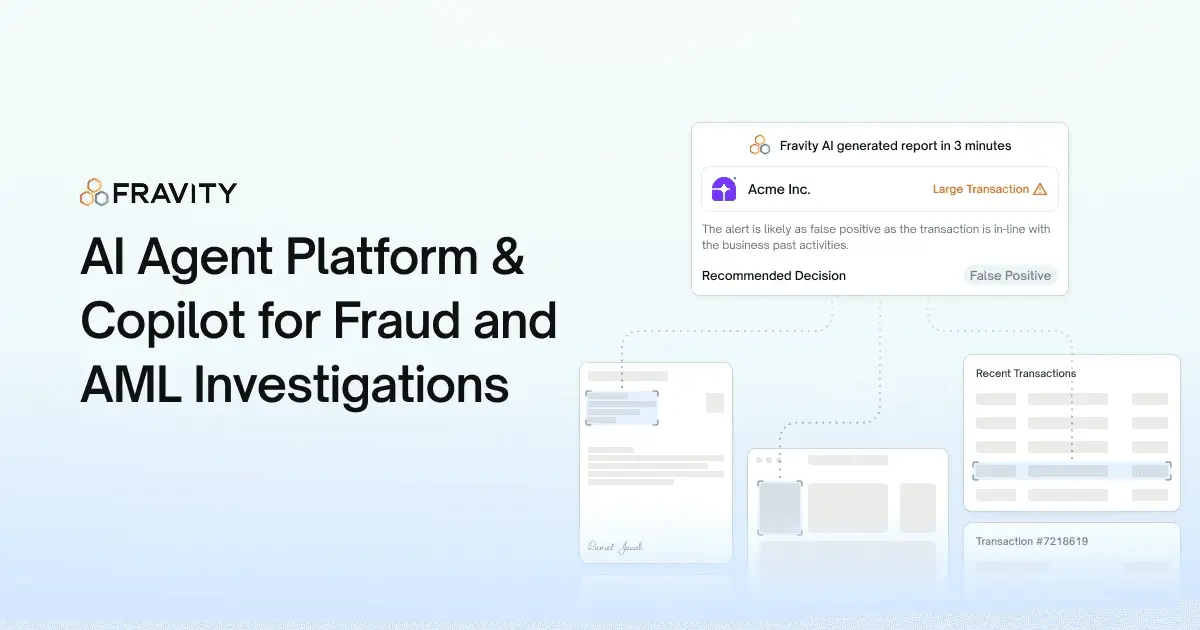
.Fravity has built an AI-native platform that uses agents to automate fraud and compliance operations. The software retrieves documents an investigator would gather, runs sanctions screening, and drafts case summaries, allowing analysts to read finished files rather than building them from scratch
2
. Across existing deployments, Fravity has reduced cost per case by 80%, sped up case resolution fivefold, and cut false positives by as much as 70%1
3
. Several enterprises were already running both companies' products side by side in production before the deal2
.
Source: SiliconANGLE
Socure ended the second quarter with $364 million in annual recurring revenue, up 63% from a year earlier, and added 95 customers during the quarter, including Circle, Cox Automotive, MoneyLion, and Login.gov
1
. The company now serves more than 3,000 enterprise customers across fintech, public sector, and traditional banking, including 19 of the 20 largest U.S. banks and more than 600 fintech companies1
3
. Socure co-founder and CEO Johnny Ayers revealed the company saw an 8,000% increase in AI-driven fraud across its network last year, as generative AI and other tools make it easier to create convincing fake identities and automate attacks1
.

Source: PYMNTS
Related Stories
Andy Collins, a managing director at Summit Partners, stated that "identity has become a primary control point for trust in an AI-driven economy"
3
. The acquisition positions Socure more directly into what Liminal estimates is a $71.1 billion financial crime investigation market1
. Ayers emphasized this shift: "I believe there are two types of companies that matter in the AI-driven global economy: those that are AI-native, and those that fight the consequences of AI acceleration"1
2
.The investment follows Socure's expansion beyond its financial services roots. In May, the company won a five-year, $163 million federal contract to provide identity-proofing technology for Login.gov
1
. Socure is also pushing further internationally and planning additional RiskOS offerings for insurance, gaming, crypto, eCommerce, and public sector customers2
3
. The company had more than 550 employees as of March 2026, representing an increase of over 100 from the previous year1
. This marks Socure's third acquisition, following Berbix in 2023 and Effectiv a year later2
.Summarized by
Navi
[1]
25 Oct 2024•Business and Economy

04 Sept 2025•Technology

01 May 2025•Business and Economy

1
Technology

2
Policy and Regulation

3
Policy and Regulation