Intel partners with SoftBank to develop Z-Angle Memory that promises triple HBM capacity


8 Sources
[1]
Intel is co-developing new Z-Angle Memory to compete with HBM used in AI data centers -- vertically-stacked memory touts 2 to 3x more capacity, greater bandwidth, and half the power consumption
Intel and a SoftBank subsidiary, Saimemory, have signed a new collaborative agreement to advance the development and manufacture of a new type of vertical-stacked memory known as Z-Angle Memory, or ZAM. This next-generation memory is designed to compete against High Bandwidth Memory (HBM) used in
[2]
SoftBank subsidiary to work with Intel on next-gen memory for AI
Saimemory, a subsidiary of multinational investment giant SoftBank, has signed a collaboration agreement with American chipmaker Intel Corp. to advance the commercialization of next-generation memory technology, the companies announced Tuesday. The partnership focuses on next-generation memory
[3]
Intel is helping develop a new type of DRAM aimed at AI
This innovation builds on Intel's existing Foveros chip stacking technology and aims to reduce power consumption while meeting growing AI memory demands. Intel began as a memory supplier. The PC industry faces its most dire memory crunch in years, if not decades. So it makes sense for Intel to
[4]
Intel teams with SoftBank on next-gen ZAM memory, prototypes to compete against HBM in 2028
TL;DR: Intel partners with SoftBank's SAIMEMORY to advance next-generation DRAM bonding technology using Z-Angle Memory (ZAM), enabling higher capacity, lower power consumption, and improved performance for AI data centers. This innovation aims to revolutionize memory architecture, surpassing
[5]

Intel and SoftBank to develop next-gen ZAM memory chips
SoftBank Corp, through its subsidiary Saimemory, and Intel Corporation announced a strategic partnership to develop Z-Angle operation memory technology for AI data centers. The technology provides higher capacity, greater bandwidth, and significantly lower power consumption than conventional memory
[6]

Intel Stock Rallies As SoftBank Partnership Unlocks Breakthrough AI Memory Tech - Intel (NASDAQ:INTC)
Intel Corp (NASDAQ:INTC) stock was trending on Tuesday following the announcement of a collaboration with SoftBank Group Corp's (OTC:SFTBY) subsidiary, Saimemory. The partnership aims to advance next-generation memory technology, addressing the growing demands of artificial intelligence and
[7]

Intel Plans to Re-Enter the Memory Business as the Firm Pairs With SoftBank to Introduce a New Solution, Capitalizing on Ongoing Shortages
Intel is now looking to capitalize on the ongoing DRAM demand by partnering with a SoftBank subsidiary to launch a new "ZAM" memory technology. Well, with the AI infrastructure buildout being at its peak this year, there has been a gigantic rise in DRAM demand, driven by the adoption of
[8]

SoftBank Corp. Unit Teams Up With Intel to Work on Next-Generation Memory Tech -- Update
A unit of SoftBank. Corp is teaming up with Intel to develop cutting-edge memory technology that can better support artificial intelligence. The Japanese telecom company said Tuesday that subsidiary Saimemory will work on the technology with chip maker Intel, aiming to bring it to market in around
Share
Copy Link
Intel and SoftBank subsidiary Saimemory signed a collaborative agreement to develop Z-Angle Memory (ZAM), a vertically-stacked memory technology designed to compete with High Bandwidth Memory in AI data centers. The next-generation memory promises 2 to 3 times more capacity, greater bandwidth, and half the power consumption of HBM, with prototypes expected in 2027 and mass production targeted for 2029.
Intel Returns to Memory Business with Z-Angle Memory Development
Intel has signed a collaborative agreement with Saimemory, a SoftBank subsidiary, to advance the development of Z-Angle Memory (ZAM), marking the chipmaker's return to the memory market for the first time since the 1980s
1
. This next-generation memory technology is designed to compete directly with High Bandwidth Memory (HBM) used in AI data centers, but with significantly enhanced specifications. The vertically-stacked memory architecture promises to deliver 2 to 3 times the capacity of HBM while operating at half the power consumption and offering greater bandwidth1
. The partnership addresses a critical bottleneck in AI computing, as larger and more complex generative AI models demand advanced memory systems capable of handling massive data throughput while controlling energy costs5
.
Source: Benzinga
Advanced DRAM Bonding Technology Powers ZAM Innovation
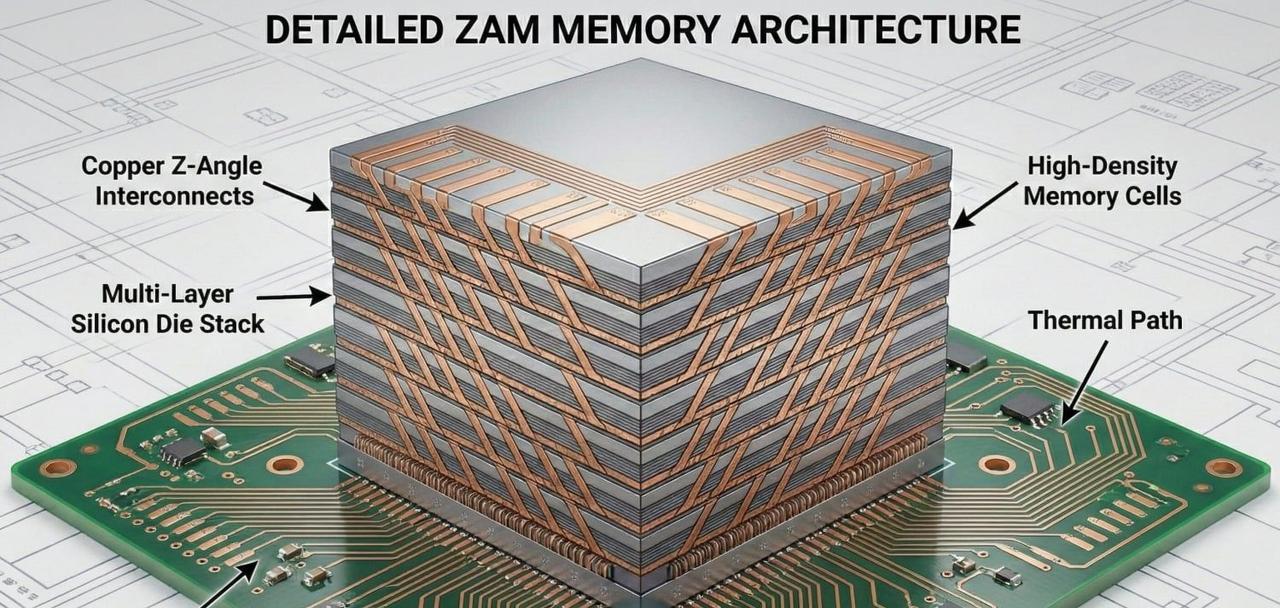
The Z-Angle Memory program builds on Intel's Next Generation DRAM Bonding (NGDB) initiative, which was completed under the Advanced Memory Technology R&D program managed by the U.S. Department of Energy and National Nuclear Security Administration through Sandia National Laboratory, Lawrence Livermore National Laboratory, and Los Alamos National Laboratory
3
. Saimemory will attempt to achieve these ambitious goals by vertically stacking more DRAM and using Intel's Embedded Multi-Die Interconnect Bridge (EMIB) to reduce latency between individual chips1
. The innovation builds on Intel's existing Foveros chip stacking technology, which first emerged in 2018 by extending Intel's EMIB technology vertically to allow stacking logic chips on top of one another3
. Dr. Joshua Fryman, Intel Fellow and CTO of Intel Government Technologies, explained that "Standard memory architectures aren't meeting AI needs, so NGDB defined a whole new approach to accelerate us through the next decade"1
.
Source: TweakTown
Production Timeline and Cost Advantages Target 2029 Commercialization
Saimemory is slated to produce its first ZAM prototypes sometime in 2027, with plans to develop a mass production line for the new memory by 2029
1
. According to reports from Nikkei, the DRAM bonding technology is designed to be up to 60% cheaper to produce than current HBM solutions1
. The partnership announced prototypes expected by the fiscal year ending March 31, 2028, with commercialization targeted for fiscal 20292
. Intel and Sandia had to design a new stacking approach and a different way of organizing the DRAM chips, with early prototypes confirming it was possible to increase capacity through new stacking techniques while recent developments have demonstrated the necessary high performance1
.
Source: PCWorld
Related Stories
Strategic Implications for AI Infrastructure and Japan's Semiconductor Revival
The collaboration extends the relationship between SoftBank Group and Intel, following SoftBank Group's mid-2025 agreement to invest $2 billion in the U.S. chipmaker
5
. This marks the first time a Japanese company has attempted to produce cutting-edge memory in decades, as Japan was a major memory manufacturing region in the 1980s before Korean and Taiwanese manufacturing dominated the market1
. Other firms backing the project include Japanese IT hardware and services firm Fujitsu, the recent Micron acquisition PowerChip Semiconductor Manufacturing, Shinko Electric Industries, and the University of Tokyo1
. Gwen Voskuilen, principal member of technical staff at Sandia, noted that "This is an exciting technology that we anticipate will lead to a wider adoption of higher bandwidth memories in systems that are currently unable to take advantage of high bandwidth memory due to its limited capacity and power constraints"1
. The venture positions memory density and power efficiency as critical factors for AI data centers processing large-scale AI models, while SoftBank views the development as a key initiative to support next-generation social infrastructure and strengthen Japan's global competitiveness in semiconductor technologies1
. Shares of SoftBank rose 3.13%, while Intel stock rose 5% in overnight trading following the announcement2
.References
Summarized by

Navi
[4]
[5]
Related Stories
Intel and SoftBank's ZAM Memory Project Secures Japanese Government Subsidies for AI Development
24 Apr 2026•Technology
Intel explores stacking memory directly above CPUs to tackle AI performance bottlenecks
13 Aug 2026•Technology

Samsung debuts zHBM, zNAND-O and 400-layer BV-NAND for AI infrastructure at FMS 2026
05 Aug 2026•Technology
Recent Highlights



Recent Highlights
Today's Top Stories



Don’t drown in AI news. We cut through the noise - filtering, ranking and summarizing the most important AI news, breakthroughs and research daily. Follow topics that matter to you and stay ahead.


