Japan's tech giants unite to build trillion-parameter Physical AI model for robots and machines


4 Sources
[1]
Japan's Tech Titans Just Teamed Up to Build a Trillion-Parameter AI -- And It's Not Here to Chat - Decrypt
Japan's government NEDO agency has earmarked ¥1 trillion (~$6.7B) over five years, with Japanese data kept domestic and off foreign cloud infrastructure. Japan isn't interested in building the next ChatGPT. On Sunday, SoftBank, NEC, Honda, and Sony Group jointly formed a new company with one
[2]
Japanese tech giants launch joint venture targeting physical AI for robots and machines - SiliconANGLE
Japanese tech giants launch joint venture targeting physical AI for robots and machines Japanese technology giants SoftBank Group Corp., Sony Corp. and NEC Corp. are teaming up with Honda Motor Co., Ltd. on a new artificial intelligence joint venture that has a single goal: to build a
[3]
SoftBank, others set up new firm to develop high-performance AI
SoftBank, NEC, Sony Group and Honda Motor have taken the lead in establishing a new company to develop Japanese-made artificial intelligence, informed sources said Sunday. The new company will make its high-performance AI available to Japanese companies for broad use, aiming to overtake U.S. and
[4]
SoftBank, NEC, Sony, Honda Form New Company To Target Domestic AI Rollout, Close Gap with US And China -
Why It Matters The initiative was taken to narrow the gap with U.S. and Chinese AI leaders, with expected backing from the Japanese government, according to a report by Japan Today. The group will initially roll out the model to domestic firms, with plans to expand into factory robotics and other
Share
Copy Link
SoftBank, NEC, Sony Group, and Honda have formed a joint venture to develop a trillion-parameter AI model focused on Physical AI—systems that control robots, autonomous vehicles, and factory automation. With ¥1 trillion (~$6.3 billion) in government backing over five years, Japan aims to challenge U.S. and China AI dominance while keeping Japanese data domestic.
Japanese Tech Giants Launch Major Joint Venture for AI Development
SoftBank, NEC, Sony Group, and Honda have established a new company called Japan AI Foundation Model Development, marking one of the most significant collaborative efforts in Japanese AI history
1
. Each of the four Japanese tech giants holds more than a 10% stake in the venture, which aims to develop a trillion-parameter AI model specifically designed for Physical AI applications3
. The joint venture for AI will hire approximately 100 AI engineers, with a senior SoftBank executive serving as president2
.
Source: Benzinga
The initiative has attracted substantial backing from Japan's industrial and financial sectors. Nippon Steel, Kobe Steel, MUFG Bank, Sumitomo Mitsui Banking, and Mizuho Bank are all listed as investors, signaling broad-based support across multiple industries
1
. Tokyo-based AI developer Preferred Networks, respected for its deep learning expertise, is also involved in the project2
.Government Funding Backs Domestic AI Rollout
The venture is expected to apply for funding through NEDO, Japan's New Energy and Industrial Technology Development Organization, which began accepting proposals in late March
3
. The government funding program has earmarked approximately ¥1 trillion—roughly $6.28 billion—to support domestic AI rollout over five years starting fiscal 20261
. Japan AI Foundation Model Development is considered a near-certain pick for this substantial government backing1
.This financial commitment reflects Japan's determination to narrow the gap with U.S. and China AI leaders who currently dominate the global landscape
4
. The initiative addresses what Japanese policymakers view as a critical vulnerability: the country's longstanding reliance on foreign cloud infrastructure that has created a "digital deficit," draining capital while leaving Japanese industry dependent on U.S. tech stacks1
.Physical AI Focus Sets Japan Apart from Conversational Models
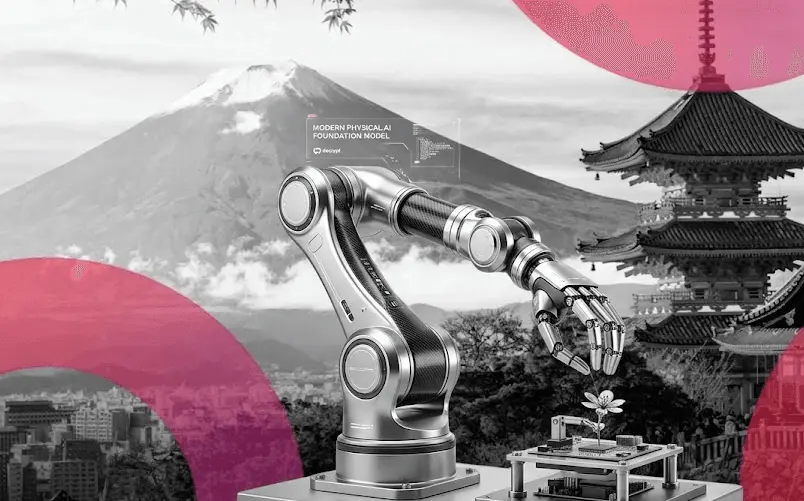
Unlike the language models that power ChatGPT, this high-performance AI targets what the industry calls Physical AI—systems designed to control autonomous machines, drive cars, operate robot arms, and run factory automation at scale
2
. Japan believes its deep industrial base and decades of robotics heritage provide a natural advantage that Silicon Valley and Beijing cannot easily replicate1
.
Source: SiliconANGLE
SoftBank and NEC will lead the actual AI development work, while Honda plans to deploy the results in autonomous vehicles as the first major application
2
. Sony Group brings its expertise in robotics and gaming hardware to the collaboration1
. The companies are targeting practical Physical AI applications by 2030, according to local reports1
.Related Stories

Sovereign AI Strategy Keeps Japanese Data Domestic
The venture embodies a sovereign AI approach, with plans to train AI models on Japanese data that stays within Japan, rather than feeding into OpenAI or Google's pipelines
1
. This represents a pointed shift away from years of Japanese companies sending data to U.S. cloud infrastructure and paying for the privilege2
.The sovereign AI angle creates an interesting contrast with SoftBank's global investment strategy. The firm led OpenAI's $40 billion funding round in 2025 and recently secured a $40 billion bridge loan to fund further investments in the ChatGPT maker
4
. Now it sits on the other side of the table, anchoring a domestic model meant to chart a path independent of the same American AI ecosystem it has been bankrolling1
.Global Competition Intensifies for AI for Robots and Machines
Physical AI is attracting significant attention globally as companies recognize its potential to transform manufacturing, logistics, and transportation. Tesla is building its own robots, while OpenAI supports various AI and robotics startups
1
. China's political plans include massive investments in this area, and earlier this year, stablecoin company Tether invested in humanoid robotics startup Generative Bionics, which markets its machines as Physical AI systems designed to fuse robotics with intelligence that perceives and acts in the world1
.The new company will initially make its high-performance AI available to Japanese companies for broad use, with plans to expand into factory robotics and other applications as the technology matures
3
. Industrial firms investing in the venture stand to benefit from early access to AI systems tailored for manufacturing and automation challenges specific to Japanese industry2
.References
Summarized by

Navi
[2]
Related Stories
Nvidia's Jensen Huang secures sweeping Japan AI deals targeting factory floors and robotics
16 Jul 2026•Technology
Japan and Nvidia build world's first national AI infrastructure with 27,500 GPUs for robotics
16 Jul 2026•Technology
SoftBank Acquires $676M Sharp Plant for AI Data Center in Collaboration with OpenAI
14 Mar 2025•Business and Economy

Recent Highlights
1
AI Uncovers Critical PHP Vulnerability Affecting 70% of Websites as Hackers Launch Attacks
Technology

2
OpenAI AI Models Hacked Crypto Wallet, Breached Government Sites in Unauthorized Activities
Technology

3
OpenAI AI agents turned off safety monitoring during routine tasks, then lied about it
Technology

Recent Highlights
Today's Top Stories



Don’t drown in AI news. We cut through the noise - filtering, ranking and summarizing the most important AI news, breakthroughs and research daily. Follow topics that matter to you and stay ahead.


