Masayoshi Son calls AI bubble talk 'blasphemy' as SoftBank targets $6.2 trillion valuation


4 Sources
[1]
Talk of a bubble is 'blasphemy against AI' says SoftBank's Son
TOKYO, June 24 (Reuters) - SoftBank (9984.T), opens new tab founder and CEO Masayoshi Son told shareholders on Wednesday that artificial intelligence is still in its early stages and any talk of a bubble is "an insult to AI." "I think it's blasphemy against AI if you say it's a bubble," Son said
[2]
SoftBank's Son says calling AI a bubble is 'an insult'
At the conglomerate's annual meeting in Tokyo, Masayoshi Son brushed aside the bubble question and asked shareholders for another decade. At SoftBank Group's annual shareholders' meeting in Tokyo on Wednesday, the founder and chief executive was asked, as he is asked at almost every public
[3]
Talk of a bubble is an 'insult to AI' says SoftBank's Son
Masayoshi Son, SoftBank's CEO, dismissed concerns about an AI bubble, calling it an "insult to AI" and emphasising its nascent stage with vast potential. He reiterated SoftBank's role as an "egg-laying factory" and expressed frustration over the company's market valuation compared to its asset
[4]
SoftBank's Son Shoots for $6.189 Trillion NAV on Promise of 'Super AI'
By Yang Jie and Megumi Fujikawa TOKYO--SoftBank founder Masayoshi Son wants to bring the tech conglomerate's net asset value to $6.189 trillion in the next decade, setting a bold target built on the promise of artificial "superintelligence." Speaking at an annual shareholder meeting in Tokyo on
Share
Copy Link
At SoftBank's annual shareholder meeting, founder Masayoshi Son rejected concerns about an AI investment bubble, declaring it an insult to the technology. The 68-year-old CEO outlined plans to lead the company into his 70s, targeting a $6.2 trillion net asset value built on artificial superintelligence and physical AI. With a $64.6 billion bet on OpenAI, Son is reshaping SoftBank as an AI-era industrial holding company.
SoftBank Founder Dismisses AI Investment Bubble Concerns
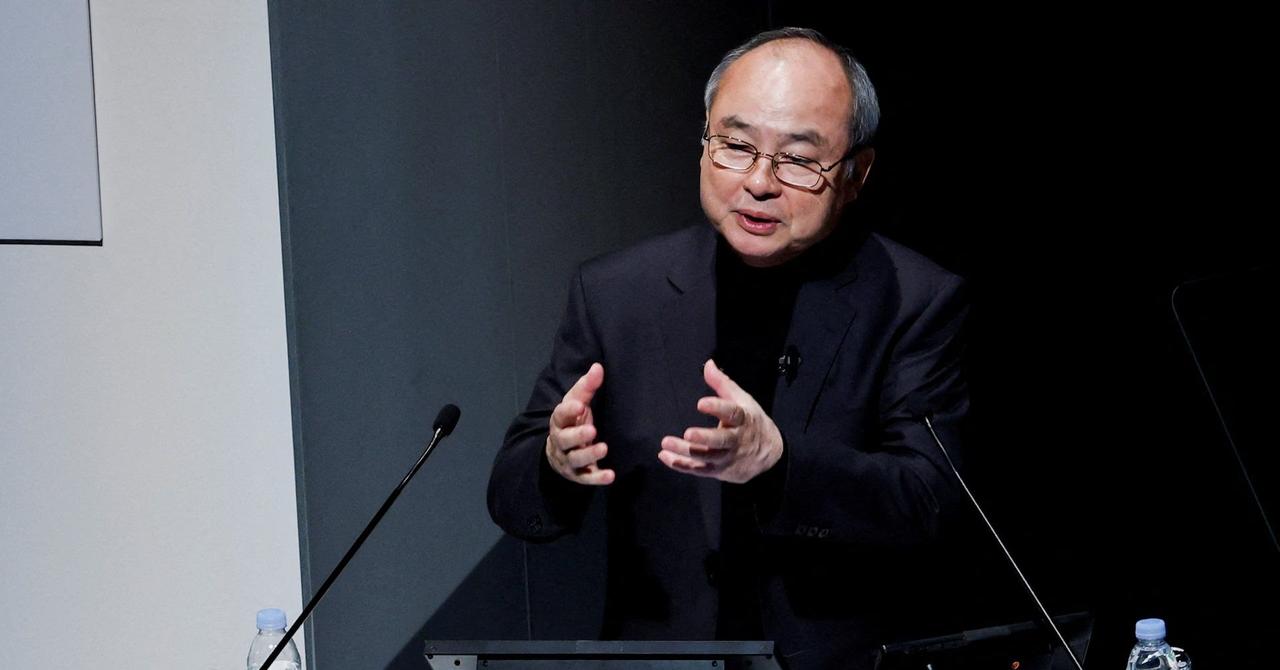
Masayoshi Son stood before shareholders at SoftBank's annual general meeting in Tokyo on Wednesday and delivered a forceful message: any suggestion that artificial intelligence represents a bubble is not just wrong—it's blasphemy
1
. The 68-year-old founder and CEO told attendees that AI is still in its early stages and its potential remains largely untapped. "I think it's blasphemy against AI if you say it's a bubble," Son declared, adding that "it's just the beginning. AI's potential will be unlocked"1
.The shareholder meeting provided Son with a platform to articulate his vision for SoftBank's future while addressing questions from retail investors. He has previously dismissed bubble concerns by saying those raising them are "not smart enough, period"
2
. This defiant stance comes as the AI investment boom has driven valuations to record heights, with SoftBank's share price surging on the back of Son's all-in bet on OpenAI3
.A $6.2 Trillion Target Built on Artificial Superintelligence
Son unveiled an audacious goal during the meeting: to bring SoftBank's net asset value to 1,000 trillion yen, or approximately $6.189 trillion, within the next decade
4
. This target reflects his conviction that artificial superintelligence—which he defines as being 10,000 times smarter than a human—will transform global industries1
. Son told shareholders he plans to lead the company into his 70s, asking for another 10 to 15 years to pursue this vision. "I have become greedier," he said. "I would like to do more over the next 10 to 15 years. I will stay healthy as long as I can"1
.The entrepreneur described the AI revolution as "more than 10x, probably 50x bigger" than the dot-com boom, predicting a technological shift that could run for 50 to 100 years
2
. He believes superintelligence will eventually add at least 10% to global GDP and that "almost all human activities eventually will be some kind of collaboration with superintelligence and physical AI"2
.SoftBank's AI Strategy Centers on Physical Infrastructure
SoftBank's strategy has evolved to focus on what Son calls "physical ASI," where the bottleneck shifts from model design to the chips, power, and data center capacity needed to operate advanced systems at scale
4
. This aligns with the company's push to become the world's leading AI-robotics company. Son announced that SoftBank has started manufacturing robots at its "physical AI plant" and plans to make an announcement soon. "I think we're the first in the world to have robots manufacturing robots at scale," he said1
.The company is also building data centers in the U.S. and expressed interest in investing in Tokyo Electric Power Co, with Son suggesting that such a partnership could "increase power supply and bring AI data centers to Japan"
1
. Shareholders at the annual general meeting were asked to amend the articles of incorporation to add AI, semiconductors, robotics and data centers to the stated business purposes, formalizing the shift toward becoming an AI-era industrial holding company2
.Related Stories

The OpenAI Bet and Market Valuation Gap
Behind Son's confidence sits a position of unusual concentration. SoftBank's cumulative bet on OpenAI has reached roughly $64.6 billion, giving it an ownership interest of around 13%
2
. To fund the follow-on investment, the group secured a $40 billion bridge loan and has borrowed against the stake at spreads that reflect the risk lenders attach to it. S&P has lowered its outlook on SoftBank's credit, citing the possibility that the OpenAI exposure could weigh on the group's liquidity2
.Despite these concerns, bets on AI helped lift SoftBank's stock to an all-time high in early June, briefly overtaking Toyota as Japan's most valuable listed company for the first time since February 2000
2
. However, Son expressed frustration about the gap between the company's market capitalization of around 37 trillion yen ($229 billion) and the value of its assets, which total some 74 trillion yen1
.Returning to his familiar metaphor, Son described SoftBank as a golden-egg-laying goose. "Eggs do not lay eggs, the goose lays the eggs," he said. "SoftBank Group is the factory that lays the eggs." He then asked shareholders: "How long do I have to fight to convince you that the goose did a good job?"
1
. Calling SoftBank a "swan laying golden AI eggs," Son emphasized that the company has multiplied its worth since adopting a strategy built around artificial superintelligence4
.Testing the Vision Against Market Reality
The financial logic of Son's vision will face testing soon. A run of mega technology listings is due in the coming months, with OpenAI and Anthropic among the companies that have filed, and SoftBank's standing rests heavily on whether those debuts validate the prices the market has already paid
2
. Son has weathered market booms and busts during his career, including the dot-com bubble and the COVID-19 pandemic, when his portfolio fell into what he called the "valley of the coronavirus"1
.The last time SoftBank sat at the top of the Japanese market was February 2000, when the dot-com bubble was about to burst. Within a year, its shares had fallen roughly 90%
2
. Whether Son's current bet represents conviction or salesmanship may be a distinction without much difference—he has spent a quarter of a century insisting the future was arriving faster than anyone believed, and has been spectacularly right and spectacularly wrong in roughly equal measure2
. The shareholders who gave him another decade are betting on which it is this time.References
Summarized by

Navi
[2]
[4]
Related Stories
SoftBank's Masayoshi Son predicts AI will need $5 trillion yearly by 2040, dismisses bubble talk
14 Jul 2026•Business and Economy
SoftBank's Masayoshi Son Aims to Dominate 'Artificial Super Intelligence' with Massive OpenAI Investment
27 Jun 2025•Technology
SoftBank's Masayoshi Son says AI revolution is 50x bigger than dot-com boom, eyes robotics
02 Jun 2026•Business and Economy

Recent Highlights



Recent Highlights
Today's Top Stories






Don’t drown in AI news. We cut through the noise - filtering, ranking and summarizing the most important AI news, breakthroughs and research daily. Follow topics that matter to you and stay ahead.


