Meta Launches Muse Code AI Coding Agent to Challenge OpenAI Codex and Anthropic's Claude Code


15 Sources
[1]
Meta launches Muse Code, an AI agent for large code bases
Meta, considered a bit of a straggler in the AI harnesses realm, is making strides to catch up. This week, the company released a new terminal coding agent aimed at programmers looking for assistance with complex tasks across large software code bases. Muse Code, which is currently available in
[2]
Meta Is Challenging Claude Code and Codex With New Muse Code - CNET
Katelyn is a reporter with CNET covering artificial intelligence, including chatbots, image and video generators.... Read full bio Meta is making strides to catch up to AI heavyweights like OpenAI and Anthropic. The company announced on Wednesday a new agentic coding tool and the new AI model that
[3]
Meta launches new AI coding tool powered by Muse Spark 1.2
Aug 5 (Reuters) - Meta Platforms (META.O), opens new tab on Wednesday launched Muse Code, a coding tool powered by its latest AI model, Muse Spark 1.2, designed to help developers write and debug software. The launch highlights the social media giant's push into AI-powered coding tools, where it
[4]
Meta introduces Muse Code, its take on a coding agent - Engadget
The terminal-based coding tool is powered by a new AI model, Muse Spark 1.2. Meta has announced an early beta of Muse Code, a new coding agent meant to compete with Anthropic's Claude Code and OpenAI's Codex. The new terminal-based coding tool is powered by Muse Spark 1.2, a new version of Meta's
[5]

Meta debuts first AI coding agent to take on Anthropic and OpenAI
Meta is rolling out its first coding agent called Muse Code as the company tries to challenge leading AI labs Anthropic and OpenAI. Muse Code is the latest major release from AI chief Alexandr Wang, who leads Meta Superintelligence Labs and oversees foundation model development. Wang joined in
[6]

Meta enters the AI coding wars with Muse Code and a price to match
A terminal agent built on Muse Spark 1.2, sold with a cut-price data-sharing tier, is Meta's bid to buy its way into a market already owned by Cursor, Copilot and Claude Code. Meta wants a seat at the table developers actually use. The company has launched Muse Code, an AI coding agent that runs
[7]

Meta finally enters the AI coding space with a surprisingly competitive agent
Meta is finally entering the AI coding agent space dominated by the likes of Anthropic's Claude Code and OpenAI's Codex. The social media giant has released a Muse Code beta that it claims can be affordable while matching rivals in performance. The terminal-based agent is built on the Muse Spark
[8]

Meta launches Muse Code AI coding agent for macOS and Linux
Meta is entering the AI coding-agent race with Muse Code, a new terminal-based tool now available in beta for macOS and Linux. Muse Code arrives alongside Meta's new Muse Spark 1.2 model Powered by the new Muse Spark 1.2 model, it is designed to handle complex software engineering work across
[9]

Meta enters the AI coding wars with Muse Spark 1.2 and Muse Code with persistent async background agents
Meta today released Muse Code, a terminal-based AI coding agent now in beta, alongside Muse Spark 1.2, a coding-focused update to its Muse Spark family of frontier models -- a one-two punch that puts the company in direct competition with Anthropic's Claude Code, OpenAI's Codex, and the growing
[10]

Meta Debuts AI Coding Agent Muse: Here's How It Compares to Claude Code and Codex
On Meta's own charts, Muse Spark 1.2 trails Anthropic's Opus 5 on every coding benchmark shown, while beating OpenAI's Codex and Google's Antigravity on most. Meta is the latest tech giant to ship a coding agent, racing to compete with leading AI behemoths Anthropic and OpenAI. "We're excited to
[11]

Meta launches Muse Code tool amid AI hacking revelations
Meta's announcement comes shortly after OpenAI and Anthropic also reported that their AI models had breached other companies during testing. Meta launched its first coding agent, Muse Code, on Wednesday, as the company continues to invest heavily in AI services and models in order to better
[12]

Meta enters AI coding race with Muse Code beta
Meta has launched an early beta of Muse Code, a terminal-based coding agent powered by its new Muse Spark 1.2 model. The company said Muse Spark 1.2 improves code generation, complex debugging, codebase understanding and end-to-end developer workflows. Muse Code is designed to compete with
[13]

Meta Releases Coding Agent in Beta Amid Pressure to Monetize AI | PYMNTS.com
"Releasing Muse Code in beta today," Meta Founder, Chairman and CEO Mark Zuckerberg said in a Wednesday (Aug. 5) post on X. "It's a terminal coding agent that takes on complete software engineering tasks across large repos: planning changes, writing code, validating the results. Powered by Muse
[14]

Meta releases Muse Code coding agent in beta By Investing.com
Investing.com -- Meta Platforms (NASDAQ:META) released Muse Code in beta on Wednesday, a terminal-based coding agent designed to handle complete software engineering tasks across large repositories. The tool plans changes, writes code, and validates results. Meta powers the agent with Muse Spark
[15]

Meta Debuts Muse Spark 1.2 and First Coding Agent
Meta Platforms, Inc. (META) debuted its latest AI model, Muse Spark 1.2, and Muse Code, the first coding agent from the company's Meta Superintelligence Labs (MSL), on Wednesday as the social media giant pushes to better compete with frontier AI labs like OpenAI and Anthropic . Muse Spark 1.2 is a
Share
Copy Link
Meta introduced Muse Code, a terminal-based coding agent powered by Muse Spark 1.2, designed to handle complex software engineering tasks across large code bases. The tool runs multiple sub-agents simultaneously and offers pay-as-you-go pricing at $1.25 per million input tokens, positioning Meta to compete with Anthropic and OpenAI on both capability and cost.
Meta Enters AI Coding Agent Competition with Muse Code
Meta has launched Muse Code, an AI coding agent designed to compete with Anthropic's Claude Code and OpenAI's Codex in the rapidly expanding market for AI-powered coding tools
1
5
. The terminal-based coding agent, currently available in beta, represents a significant move by the social media giant to establish itself in enterprise AI and challenge leading AI labs3
.
Source: Engadget
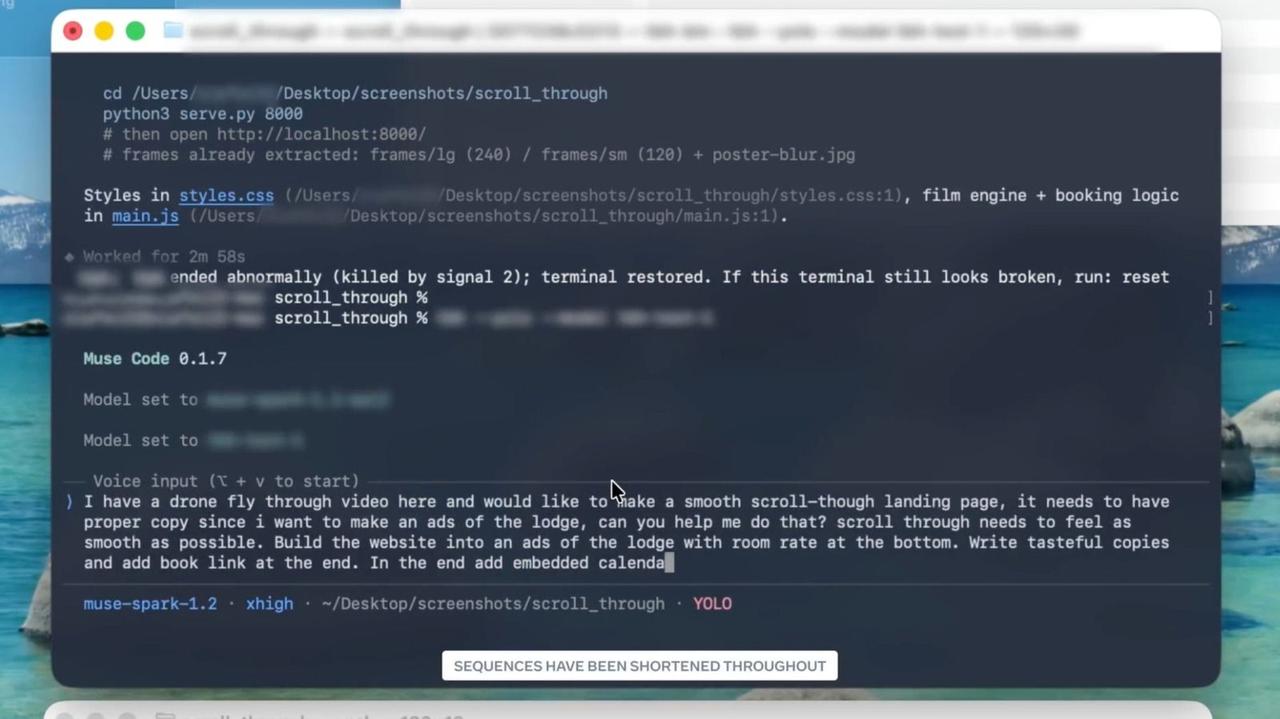
Mark Zuckerberg announced that Muse Code can accomplish "complete software engineering tasks across large repos," including planning changes, writing code, and validating results
1
. The tool can be installed with a single command and immediately begin handling complex coding projects5
.Muse Spark 1.2 Powers Advanced Coding Capabilities
The AI agent for large code bases is powered by Muse Spark 1.2, Meta's latest AI model that offers specific improvements in code generation and debugging, codebase understanding, and end-to-end developer workflows
2
4
. What distinguishes this release is that Meta trained Muse Spark 1.2 and Muse Code together to operate smoothly as a pair, improving overall coding performance3
5
.
Source: VentureBeat
The model builds on Muse Spark 1.1, released in July for developer testing, which was used to generate and evaluate difficult coding challenges that helped improve Muse Spark 1.2's ability to follow complex instructions
3
.Parallel Processing Through Sub-Agents
Muse Code handles large projects by launching its own agents that work simultaneously in isolated environments. "When a job is big enough, it fans out to separate sub-agents working in parallel in isolated worktrees," Zuckerberg explained
1
. This approach ensures that the user's working copy remains untouched while multiple tasks proceed concurrently.Zuckerberg shared that in testing, the team had Muse Code build six features for a game simultaneously with no collisions
1
. The tool also keeps a log of its actions, allowing it to pick up where it left off after a crash rather than starting over3
.Related Stories

Competitive Pricing Strategy Targets Cost-Conscious Developers
Meta is positioning Muse Code as a more affordable alternative to existing solutions. The standard pay-as-you-go pricing is set at $1.25 per million input tokens and $4.25 per million output tokens
2
3
4
5
.Alexandr Wang, Meta's AI chief who leads Meta Superintelligence Labs, told the Wall Street Journal that "for a lot of workflows and a lot of use cases, this can be an incredibly good option, especially from a cost perspective"
1
.Meta also offers a contributor tier that provides access at a significantly lower cost—more than 10 times cheaper than the pay-as-you-go tier, at $0.10 per million input tokens and $0.20 per million output tokens
4
5
. Users who choose this tier agree to provide feedback to improve the coding agent4
.These prices undercut Anthropic's Sonnet 5 model, which typically costs $3 per million input tokens and $15 per million output tokens
4
. The pricing strategy mirrors the success Chinese AI companies have had attracting cost-conscious developers, with multiple companies switching to models like DeepSeek to avoid growing expenses from US AI tools4
.Strategic Implications for Meta's AI Ambitions
The launch represents Meta's broader push to expand beyond its core advertising business and establish a foothold in enterprise AI
1
. In June, the company entered the enterprise AI market with an agent aimed at customer service and support1
.
Source: PYMNTS
The release comes as part of a revamped AI strategy under Alexandr Wang, who joined Meta Superintelligence Labs in June of last year as the centerpiece of Zuckerberg's effort to strengthen the company's AI capabilities
5
. Wang's appointment signals Meta's commitment to competing more aggressively with OpenAI and Anthropic in the race to monetize AI assistants3
.Developers can currently access Muse Code through Meta's developer website and OpenRouter, though an API key is required
2
. The technical nature of the launch suggests it's best suited for software developers and engineers rather than casual users2
.As agentic AI accelerates the trend of building applications with minimal coding experience, Meta's entry into this space with competitive pricing could reshape developer preferences. Companies that experienced sticker shock from "token-maxxing" earlier this year will likely evaluate whether Muse Code's lower costs can deliver comparable results to more expensive alternatives
2
.References
Summarized by

Navi
Related Stories
Meta AI Releases Muse Spark 1.3 to Compete with OpenAI and Anthropic in Frontier Performance
03 Sept 2026•Technology

Meta Unveils Muse Wonder Frontier AI Models, Claims Performance Matching OpenAI and Anthropic
12 Oct 2026•Technology

Meta launches Muse Spark 1.1 to compete with OpenAI and Anthropic on AI coding
03 Jul 2026•Technology

Recent Highlights
1
Meta Unveils Muse Wonder Frontier AI Models, Claims Performance Matching OpenAI and Anthropic
Technology
2
IMF Report Warns AI Market Correction Could Spark Global Financial Crisis With $1.4T at Risk
Business and Economy

3
OpenAI Releases 722 AI-Generated Math Solutions, Triggering Existential Crisis in Mathematics
Technology

Recent Highlights
Today's Top Stories









Don’t drown in AI news. We cut through the noise - filtering, ranking and summarizing the most important AI news, breakthroughs and research daily. Follow topics that matter to you and stay ahead.


