Elon Musk Announces ASML Will Expedite Shipments to Terafab, Targets 2028 Volume Chip Production


4 Sources
[1]
Elon Musk says ASML and other critical semiconductor equipment suppliers will expedite shipments to Terafab -- facility targets volume chip production by Q3-Q4, 2028, in 'highly aspirational' timeline
Musk's AI companies aim to achieve 13 GW of AI compute by the end of 2027, using massive 440,000-GPU Nvidia "Vera Rubin" training cluster Elon Musk says ASML and other critical semiconductor equipment suppliers have expedited shipments for the ambitious Terafab semiconductor manufacturing
[2]
SpaceX and Tesla's Terafab targets 2028 for volume chip production, Musk says
SAN FRANCISCO, Oct 20 (Reuters) - The chip manufacturing joint venture between SpaceX (SPCX.O), opens new tab and Tesla (TSLA.O), opens new tab called Terafab aims to reach volume production by the third quarter of 2028, Elon Musk said on a SpaceX conference call on Tuesday. "I put big error bars
[3]
Elon Musk Breaks Silence On Plans For A School For 10,000 Robots & Says Terafab Would Probably Rank Among The Top 20 Countries By Economic Value
Tesla CEO Elon Musk has outlined plans to build a school for his Optimus robots in order to ensure smooth AI training. Musk discussed the plans during Tesla's third-quarter earnings call and added that it could take Tesla longer than a year to hit the million-unit-per-year production target. He
[4]
SpaceX and Tesla's Terafab targets 2028 for volume chip production, Musk says
SAN FRANCISCO, Oct 20 (Reuters) - The chip manufacturing joint venture between SpaceX and Tesla called Terafab aims to reach volume production by the third quarter of 2028, Elon Musk said on a SpaceX conference call on Tuesday. "I put big error bars on this because we don't know if we will
Share
Copy Link
Elon Musk revealed that ASML and other semiconductor equipment suppliers are expediting deliveries to the ambitious Terafab facility in Texas. The joint SpaceX and Tesla venture targets volume chip production by Q3-Q4 2028, aiming to produce 1 terawatt of AI computing power annually—though Musk cautioned the timeline carries "big error bars."
ASML Accelerates Equipment Deliveries for Terafab
Elon Musk announced during SpaceX's Q3 2026 earnings call on October 20 that ASML and other critical semiconductor equipment suppliers are expediting shipments to Terafab, the ambitious semiconductor manufacturing facility jointly developed by SpaceX and Tesla
1
2
. "These are very aggressive dates, and we're very appreciative of ASML and all of our other suppliers in accelerating equipment deliveries in order to achieve this outcome," Musk stated1
. The facility in Gibbons Creek, Texas, targets volume chip production by the third or fourth quarter of 2028, though Musk emphasized this ambitious timeline carries "big error bars"2
4
.
Source: Market Screener
Terafab's Unprecedented Scale and Timeline
The Terafab project aims to produce 1 terawatt of computing power annually for AI and robotics—a staggering figure when compared to current global capacity
2
4
. Research firm Gartner estimates total global AI-optimized data center capacity at roughly 44 GW as of late 2026, making Terafab's planned output 4.4% of current worldwide capacity from a single facility1
. Musk claimed that once fully operational, the economic value of Terafab's advanced chip output would place it among the top 20 global country GDPs—comparable to Switzerland's $1.14 trillion GDP1
3
. The timeline is exceptionally aggressive—cutting-edge logic factories in the United States typically take three or more years to build2
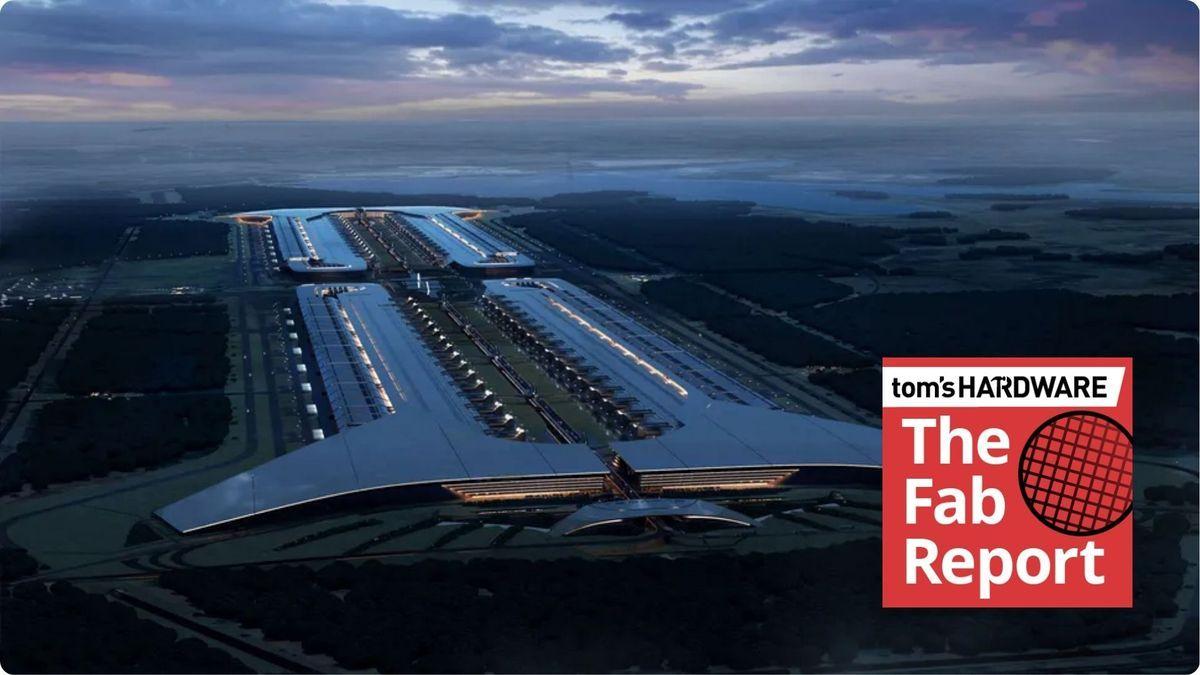
.
Source: Tom's Hardware
First Test Chip Expected by Mid-2027
SpaceX plans to manufacture its first experimental test chip at its research fabrication facility in Austin, Texas, around May or June 2027
1
2
. The facility will begin commissioning machinery in the first half of 2027, with the initial test chip using static random-access memory (SRAM) circuits—a common method chip manufacturers use for refining manufacturing process development2
3
. Musk described the goal as making "some kind of useful chip at volume around Q3 of 2028," acknowledging that "these are obviously like insanely fast time frames for chip production"2
3
.Critical Equipment Partnerships and Supply Chain
ASML, the world's sole commercial supplier of $400 million EUV lithography systems required for cutting-edge chip production, represents perhaps Terafab's most critical partnership
1
. When asked directly whether SpaceX had placed orders for EUV lithography machines necessary to produce cutting-edge chips, Musk did not answer directly but expressed appreciation for accelerated equipment deliveries2
4
. Acquiring sufficient complex, expensive semiconductor manufacturing equipment from ASML or American suppliers such as Applied Materials and KLA represents one of Terafab's primary challenges2
. Other major suppliers include Lam Research, KLA Corporation, and Tokyo Electron for front-end processing, metrology, and process control machinery1
. Tesla and SpaceX are also in discussions with approximately 10 South Korean equipment makers, including Hanmi Semiconductor and HPSP1
.Intel Partnership and Manufacturing Technology
Intel officially joined the Terafab venture in April 2026 to help co-develop and refactor silicon fabrication technology, providing access to its state-of-the-art 14A manufacturing process
1
2
. Intel CEO Lip-Bu Tan and Musk shook hands during a campus visit in April, though the companies have not revealed how the collaboration would function in practice2
4
. Intel has confirmed that 14A volume production will start in Q1 20283
. Earlier this month, Musk mentioned discussions about potential cooperation with TSMC, the world's largest advanced chip manufacturer, but later stated Terafab is committed to running the facility itself2
4
.Related Stories
AI Computing Ambitions and GPU Deployment
Musk outlined aggressive near-term ambitions for his AI companies during the broadcast, expecting 2.5 to 3 gigawatts of computing capacity active by the end of 2026
1
. He expressed high confidence about bringing an incremental 10 GW online in 2027, saying he "would be surprised" if they do not hit a total of 13 GW of AI compute by the end of 20271
. To achieve this milestone, SpaceX and xAI are aggressively procuring next-generation NVIDIA architecture, with plans to bring a massive 440,000-GPU Nvidia "Vera Rubin" training cluster online by the end of Q2 20271
. For context, the now-restructured 10 GW Project Stargate was expected to reach full capacity in the 2030s, while Meta's 5 GW Hyperion follows a similar timeline1
.Applications for Optimus and Beyond
The facility aims to mitigate future shortfalls of cutting-edge AI processors from external foundries, supplying AI chips for Musk's xAI clusters, self-driving vehicles, Optimus humanoid robots, and SpaceX's orbital AI data center, as well as the broader AI industry
1
. Terafab is a key component of Tesla's plans to build AI5 chips that will power the Optimus humanoid robot3
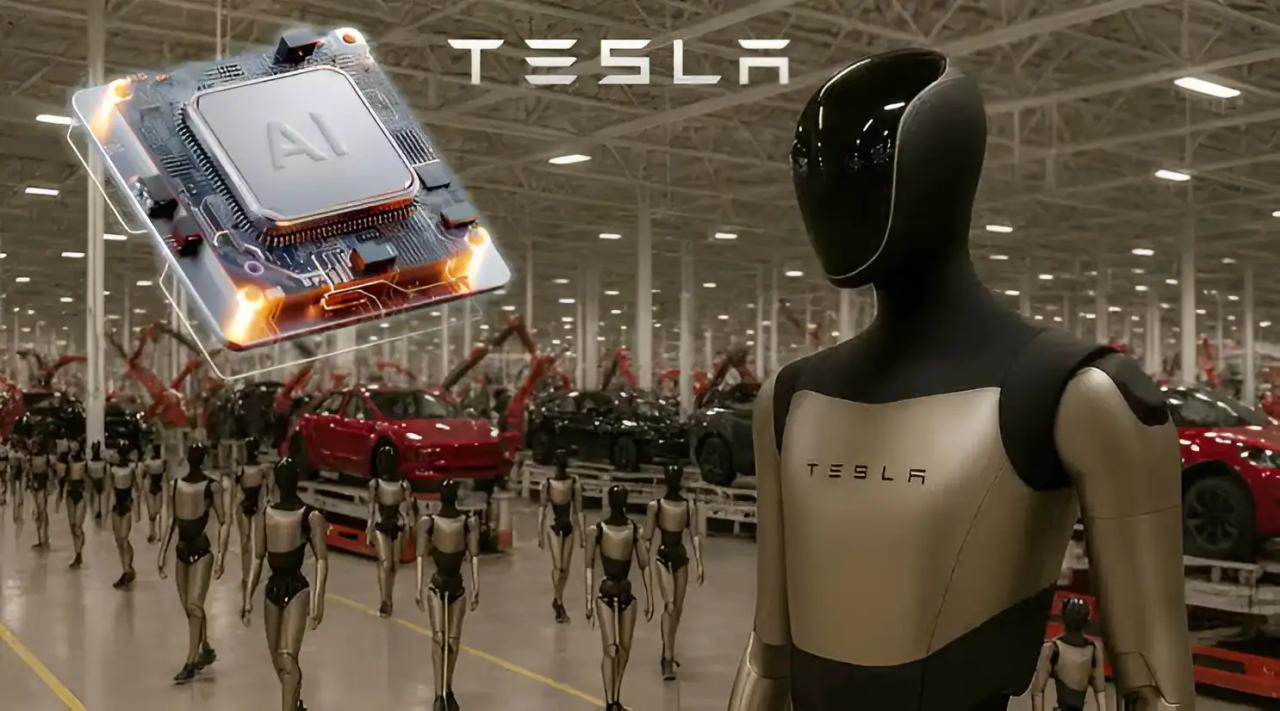
. During Tesla's Q3 earnings call, Musk discussed plans to build a "robot school" or "Optimus academy" where 10,000 to 20,000 robots would practice a wide range of tasks through self-play to generate training data3
. Musk expressed confidence in producing a million Optimus robots annually, though he estimated it would take "at least a year, maybe a little longer" to reach that annualized rate of 20,000 units per week3
.
Source: Wccftech
Expert Skepticism and Industry Context
Many experts have questioned the validity of Musk's 1 TW Terafab ambition, particularly given the aggressive timeline
1
. Musk himself has a history of setting timelines that his companies have missed2
. The SpaceX CEO described the Terafab timeline as the company's aspiration, acknowledging that "the outcome of achieving volume production is at least in the set of possible outcomes for Q3 or Q4 of '28"2
. Global AI computing capacity has grown by roughly 3.3x to 3.4x per year since 2022, according to EpochAI, suggesting rapid expansion remains possible1
. The vertically integrated facility will fabricate logic, memory, and advanced packaging internal architectures in one place using traditional EUV lithography systems1
.References
Summarized by

Navi
Related Stories
Tesla stakes AI future on Intel's unfinished chip tech as Musk reveals Terafab plans
23 Apr 2026•Technology

Elon Musk launches Terafab chip plant in Austin to fuel AI ambitions across Tesla and SpaceX
15 Mar 2026•Technology
Elon Musk's $5 Trillion Terafab Chip Plan Faces Skepticism Over Feasibility and Scale
22 Mar 2026•Technology
Recent Highlights
1
Jensen Huang's Affair with Suspected Chinese Spy Exposes $7 Billion AI Chip Smuggling Network
Policy and Regulation

2
Anthropic Launches Claude Meetings and AI-Powered Office Tools to Challenge Microsoft and Google
Technology

3
Anthropic launches Fable 5.2 and Mythos 5.2 with 20% price cut and 30% faster output
Technology

Recent Highlights
Today's Top Stories







Don’t drown in AI news. We cut through the noise - filtering, ranking and summarizing the most important AI news, breakthroughs and research daily. Follow topics that matter to you and stay ahead.


