34 Sources
[1]
Spotify will label 'AI Persona' profiles and exclude their music from recommendations
Spotify will begin labeling AI-generated artists with "AI Persona" profile tags and ban their music from its editorial and algorithmic recommendations, the company announced on Tuesday. In mid-September, Spotify users will see "AI Persona" badges appear on some artists' profiles that signal the artist's identity is AI-generated, instead of representing a real person. While Spotify will allow artists to identify themselves as AI Personas, the company says it won't rely on self-disclosure alone. It will also review artist profiles and identify those where the artist's name and imagery appear to represent photorealistic AI-generated identities. Spotify said it will begin its review with profiles that have met pre-defined audience thresholds to ensure the more listened-to artists are covered first. Once labeled, the AI Persona badges will appear on the artist's profile in the banner and the About section, in Search, and on track rows across playlists. By default, Spotify won't include AI Personas in its editorial or algorithmic recommendations, nor will it add AI Personas' music to users' personalized recommendations -- unless they happen to follow an AI Persona. Only users can choose to follow an artist, so it's an explicit signal that the user wants to hear more music from that person or group. The move is the latest expansion of Spotify's AI policies, which detail guidelines for how AI-generated music appears on its service. First announced in September 2025, Spotify's current policy identifies and labels AI music using industry-standard techniques, and bans unauthorized AI voice clones and deepfakes from its platform. Like others in the music industry, Spotify is attempting to balance innovations driven by AI, like its own AI-powered Prompted Playlists, AI DJ and chat, and forthcoming AI remixes, while still managing to thwart the deluge of AI-generated slop -- low-quality content that AI has made it easier to mass produce. Allowing slop to proliferate could lead to a poor user experience and subscription cancellations. Spotify also notes that artists will be able to appeal their AI Persona label if they think it's been incorrectly applied. Signaling its understanding of a growing consumer backlash against AI-generated art, Spotify wrote in its announcement that, "while we believe all artists have creative choice in determining how they present themselves, Spotify's programming is focused on elevating music from authentic artists building careers in music." However, the company clarified that an AI Persona is a judgment on the artist's profile, not the music. "Although there's a broad spectrum in how artists use AI as a creative tool, the question of whether a profile represents an actual human is one where Spotify can help make a clear determination. This badge is about the artist's public identity, not about how the music was made," the company said. Information about how the music itself was made will continue to be available through Spotify's other features, like AI Credits and SongDNA. In the months ahead, Spotify will also roll out a tool that allows users to report artist profiles that appear to be AI Personas that haven't yet been labeled. The addition of the labels will also help Spotify users to differentiate between AI Personas and the forthcoming AI-generated remixes and covers, soon to be permitted by Spotify's recent licensing deals with labels UMG and Merlin. The latter will allow for fan-made remixes and covers, while still funneling money back to the participating artists. As for the AI Personas, Spotify says artists will be able to self-disclose starting on August 11, 2026, through Spotify for Artists. The labels themselves will appear starting next month.
[2]
Spotify's AI Persona Label to Pluck AI Artists From Your Algorithm - CNET
Kourtnee covers streaming services and entertainment.... Read full bio Music fans who are seeking to pin down AI artists versus human creatives on Spotify will soon have a new tool at their disposal. On Tuesday, the music streamer shared that it's adding an "AI Persona" label to the platform as another way to help fans -- and artists -- identify AI creators. The badge will start appearing in profiles, songs, search results and in an artist's About section in mid-September. If you're worried about those tracks popping up in your finely tuned algorithm, don't. Spotify explained that AI Personas will automatically be excluded from your personalized recommendations by default, unless you choose to follow the AI Personas account or a specific AI music profile. How will the streamer pinpoint which accounts are AI? Starting Aug. 11, accounts can self-report via Spotify for Artists, but Spotify will also conduct its own reviews and tag profiles with the AI Persona label. According to the streamer, it will check "artist profiles and identify those whose public identity -- the identity an artist presents on their profile, including name and imagery -- appears to represent photorealistic AI-generated identities." To take it a step further, when you, as a listener, click the badge, you'll be able to see whether the artist disclosed their AI identity themselves or if Spotify classified them as an AI artist. During the coming months, the streamer will enable listeners to flag suspected AI profiles. Artists can appeal if they think they've been incorrectly designated as AI. The company clarified that the move is about verifying an artist's authentic identity, not about how the music was made. It's one of the latest ways Spotify is aiming to help listeners distinguish between AI and human artists. While the streaming service has a range of AI tools that let subscribers curate their listening experience, it's also launched artist profile protection, verification badges and policies to crack down on deepfakes.
[3]
Spotify says it won't recommend music from 'AI Personas'
Spotify will soon label AI artists and remove their music from your recommendations. The change, which will start rolling out in mid-September, means you'll see an "AI Persona" badge on an artist's profile across the app if they do "not represent a real person." The music streaming platform will allow artists to disclose that they're an AI persona starting today, but it won't rely solely on self-identification. Spotify says it will use human review and AI tools to determine whether someone's profile, including their name and image, "appears to represent photorealistic AI-generated identities." If Spotify determines that an artist's identity may be AI-generated, it will apply a "Likely AI Persona" badge. Spotify will review artists who meet "defined audience thresholds" first to cover the profiles people listen to the most. Music from AI personas won't appear in editorial suggestions or personal recommendations by default. "Listeners have been clear in telling us that they don't like seeing an artist profile that seems human, only to find out that the persona is AI-generated," Spotify says. "We tune our algorithms to highlight authentic human artists and, based on available signals, strive to not include spam, slop, or low-effort content in our recommendations." The move comes as AI music continues to flood streaming platforms, with the music streaming service Deezer recently revealing that AI-generated tracks now make up half of its daily song uploads. Spotify says its new labels only pertain to an artist's identity, rather than how they created their music. While Spotify currently doesn't have a system to identify AI-generated music like Deezer, it allows artists to disclose AI use and launched a "Verified by Spotify" badge to indicate that they're a real person. The platform will notify artists if it puts a "Likely AI Persona" badge on their profile, and will also give them the ability to appeal. Spotify plans on adding a feature that will let listeners flag artists with potential AI-generated identities as well.
[4]
Spotify Will Now Flag 'AI Personas' and Stop Recommending Their Music
Is that a human artist or an AI persona? Spotify will soon make that distinction clearer with new "AI Persona" labels. The streamer introduced the label today and said that it will apply to artists' profiles whose public identity, name, and imagery "represent photorealistic AI-generated identities." You will begin seeing the label in search, artist profiles, and playlists starting in mid-September. Once an artist has been marked as an "AI Persona," Spotify won't include their songs in any editorial or algorithmic recommendations unless you follow the AI Persona. "Listeners have been clear in telling us that they don't like seeing an artist profile that seems human, only to find out that the persona is AI-generated," Spotify says. "The badge signals to listeners that an artist's identity may be AI-generated and does not represent a real person." Artists can declare themselves as an AI Persona through the Spotify for Artists platform starting today. Spotify will also begin identifying and marking "Likely AI Personas" soon. If Spotify applies the label, the account holder will be notified and allowed to make a self-disclosure. They will also be allowed to appeal the label if it was applied in error. Spotify already has a Verified by Spotify badge for real, human artists, and an AI credits badge to indicate when part of a track is generated by AI. The new AI Persona label is meant to ensure that artists whose public image doesn't suggest they are human are marked as such. "This badge is about the artist's public identity, not about how the music was made," Spotify said. The streamer also noted that while "all artists have creative choice in determining how they present themselves, Spotify's programming is focused on elevating music from authentic artists building careers in music."
[5]
Spotify to slap 'AI Persona' badges on AI-generated artist profiles
Aug 11 (Reuters) - Spotify (SPOT.N), opens new tab said on Tuesday it would begin adding "AI Persona" badges to some profiles from mid-September to give listeners more transparency about whether the artist behind the music was a real person. Listeners have expressed concerns about artist profiles that appear human but instead represent AI-generated personas, the media streaming platform said. Reporting by Anzar Mehraj in Bengaluru; Editing by Jonathan Ananda Our Standards: The Thomson Reuters Trust Principles., opens new tab
[6]
Spotify AI Persona labels will alert listeners if an artist isn't real - Engadget
The streaming service has faced an onslaught of AI-generated music. Spotify announced that it will begin labeling certain artist accounts that aren't real people. The new AI Persona badge will add a level of transparency to music profiles that present themselves as human despite being generative AI creations. Accounts can declare themselves to be AI Personas beginning August 11 via the Spotify for Artists portal. Spotify will also use a mix of human checks and AI-powered reviews to apply a Likely AI Persona badge to artists it believes aren't real. The account is will be alerted if the tag is applied, and artists will have an appeal process if they receive the badge erroneously. The AI Persona label will begin appearing in mid-September, initially on mobile on an artist's profile, in search and on playlists' track rows. By default, content from AI Personas will not be included in Spotify's personalized recommendation tools. As with so many companies, Spotify is playing both sides of the artificial intelligence coin. It has been building up a bigger arsenal of tools for both artists and listeners to identify gen-AI creations. But it has also been putting all sorts of generative and agentic AI tools into its service.
[7]
Spotify to introduce AI badge after fans make feelings 'clear'
Spotify is introducing a new feature that will highlight if an artist has been generated by artifical intelligence (AI). The streaming service says the AI Persona badge, that will start appearing on some profiles from mid-September, will flag to listeners if an "artist's identity may be AI-generated and does not represent a real person". The changes are being introduced to give listeners "more transparency" about what they're hearing, Spotify says. It comes after some music fans made it "clear" to the streamer they don't like seeing a profile that seems to be a human, to then realise it's AI-generated. AI-generated music has long been a concern for users of the platform. The BBC previously heard from one frustrated listener, who, after finding his playlists increasingly sprinkled with tracks he suspected were AI-generated, built a tool to automatically label and block them. Announcing the change, Spotify says "true artist-fan connection can only be built on a foundation of trust and authenticity". "In music, that means listeners need to be able to trust that the artist behind the music is who they say they are," it adds. "That's more essential than ever in the age of generative AI." The badge will appear on the banner and about section of artist profiles, as well as a note when they come up in searches and on tracks in playlists. Artists with the badge will not appear in users' personalised recommendations unless they already follow them, Spotify says. The streamer also says the badge will relate to the "artist's public identity" and not about "how the music was made", acknowledging that AI tools are being used in some human music creation now. Musicians can currently be transparent about the AI tools they've used when making their tracks through the AI Credits feature, with Spotify saying they get tens of thousands of submissions for this daily. Spotify hopes AI profiles will self-disclose in the same way, but it will also be reviewing accounts which appear to meet the criteria. Those which are then labelled with the AI Persona badge by the streamer will be given the chance to self-disclose or appeal the decision. It will be noted on the badge if an artist was transparent about being AI-generated, or if Spotify had to review the account. Listen to Newsbeat live at 12:45 and 17:45 weekdays - or listen back here.
[8]
Spotify Will Label A.I. Artists and Avoid Recommending Them
The new label, which will begin to be applied next month, is an effort by the streaming service to be more transparent about A.I.-generated music on its app. As A.I.-generated songs top charts and flood social media, Spotify wants its users to know when they're listening to real people. Starting in September, Spotify will affix labels to the profiles of artists whose identities it believes were most likely generated by artificial intelligence, the streaming service announced on Tuesday. Users behind A.I.-generated artists will also be able to identify those artists as such. Once labeled, the profiles will be excluded from the company's editorial and algorithmic recommendations, Spotify said. "While we believe all artists have creative choice in determining how they present themselves," the company said in a news release, "Spotify's programming is focused on elevating music from authentic artists building careers in music." The announcement comes a month after a consortium of music industry groups, including the Recording Academy and the Recording Industry Association of America, called for labels on songs that had been made with some degree of A.I. The groups cited fans' desire for transparency when A.I. has been involved in making music. Songs by A.I.-generated acts with names like the Velvet Sundown and Breaking Rust have amassed millions of streams on Spotify, with many listeners seemingly unaware of the music's origins. (Some listeners have said they are unbothered by A.I.'s role in music creation.) Spotify's new label will read "AI Persona" and be placed near an artist's name. Laura Batey, a spokeswoman for Spotify, said the company's review process would be twofold: an automated screening followed by a check from the company's human moderators. The review will look primarily at users' names and their profile pictures, Batey said, adding that the feature is intended to focus on artists' identities rather than their songs. Spotify allows A.I.-generated music to be uploaded to its platform, provided it does not violate the company's rules governing spam or fraud. In its news release, Spotify said the "AI Persona" label would also appear in its app's search function and on playlists that include those songs. Listeners will be able to tell if artists had disclosed the information themselves or if the label had originated from Spotify. Profiles that Spotify flags will have a chance to appeal the designation. The streaming platform also said that in the coming months, it will allow users to report artist profiles that they believe were generated by A.I. The details of that process were not disclosed. While Spotify listeners have expressed frustration about being recommended A.I.-generated music in the app, the company said in its news release: "We tune our algorithms to highlight authentic human artists and, based on available signals, strive to not include spam, slop or low-effort content in our recommendations." This year, Spotify rolled out its A.I. Credits feature, allowing artists to disclose how they had used A.I. in making their songs. The company has also incorporated A.I. technology into its app through a personalized D.J. feature and remix tool.
[9]
Spotify will start labeling AI-generated artist profiles and stop recommending their music
Artists can self-disclose as an AI Persona, but Spotify will also apply the label to other artist profiles that it suspects are AI-generated. Spotify has been hard at work helping listeners identify AI-created content. The streaming platform rolled out verification for music creators with its "Verified by Spotify" badges, and now it is planning to help users identify artists who have created their public identities using AI tools. The company today announced a new "AI Persona" label that it will display on artist profiles that may be AI-generated and do not represent a real person. This, Spotify hopes, will help users feel more confident trusting the artists behind the music they listen to. Artists can self-disclose as an "AI Persona" through Spotify for Artists, and Spotify will display the "AI Persona" badge on their profiles. However, it will also display a "Likely AI Persona" label on profiles that it suspects are AI-generated, even if the artist doesn't self-disclose as such. It's worth noting that the "AI Persona" label isn't meant to identify whether an artist's music is AI-generated. It is solely focused on their public identity. The platform already offers features such as AI Credits and SongDNA to help users identify music created using generative AI tools. The platform has also said that it will not include music from profiles with the AI Persona badge in any editorial or algorithmic recommendations. The only way music from these profiles will be recommended to a listener is if the listener has followed an AI Persona-labeled artist. Spotify will display the new label starting in mid-September. It will appear on artist profiles in the banner and about sections. It will also be displayed in search results and on track rows in playlists. Users will also be able to tap the badge to see whether an artist self-disclosed as an AI Persona or if the platform marked them as one based on its judgment.
[10]
Spotify will badge AI artist profiles, and keep them out of your recommendations
Spotify will begin attaching an "AI Persona" badge to artist profiles whose public identity is generated rather than human, the company announced. Profiles carrying the badge will be excluded by default from editorial and algorithmic recommendations, which is the part of the policy that actually bites. There are two versions of the label. Artists can apply "AI Persona" to themselves from Tuesday through Spotify for Artists, under a new setting in the profile and identity menu. Spotify will apply "Likely AI Persona" itself to profiles it judges to be photorealistic AI-generated identities, working through a review queue that prioritises accounts by audience size. The company has said it will not rely on self-disclosure alone, and that human reviewers work alongside its detection tooling. Badges start appearing to listeners in mid-September, on mobile first, in the profile banner, the About section, search results, and the track rows inside playlists. A reporting tool that lets listeners flag suspected unlabelled AI personas is promised for some point in the following months. The distinction Spotify is drawing is narrower than the headlines suggest, and the company has been careful about it. "This badge is about the artist's public identity, not about how the music was made," Spotify said in the announcement. A human songwriter who used generative tools in the studio is not the target. An invented performer with a synthetic face and a plausible backstory is. Spotify has framed the question of whether a profile represents an actual person as one it can make a clear determination on, which is a lower bar than adjudicating the provenance of every track, and a considerably more enforceable one. Recommendation exclusion carries a carve-out. If a listener has actively engaged with an AI persona, following the artist being the obvious case, the music can still surface. What disappears is the passive discovery layer, the editorial playlists and the algorithmic feeds that account for a great deal of how anything gets heard on Spotify at all. Artists notified of a pending label can self-disclose or appeal, and a Spotify-applied badge can only be lifted by Spotify after review. No penalty beyond the badge and the exclusion has been described. The policy lands after a year in which the volume problem stopped being theoretical. Deezer, which has been publishing upload statistics that Spotify has not, said in July that more than half of the tracks reaching its platform each day are AI-generated, around 90,000 of them, up from 44% in April. Spotify removed over 75 million spam tracks in the twelve months to September 2025, when it introduced an impersonation policy and backed a DDEX standard for disclosing AI use in credits. Sixteen distributors and labels signed up to that standard at launch; Universal and Warner indicated support without joining the launch group. What forced the question into public view was The Velvet Sundown, a band that accumulated a large audience last year before anyone could establish that its members existed. Spotify's response then was a verified badge in April that AI-persona accounts simply could not qualify for. The announcement inverts that logic: rather than marking the humans, Spotify will now mark the machines. Spotify has not said how large the review team is, how many profiles it expects to badge, or when the listener-reporting tool arrives. The first badges appear next month.
[11]
Spotify Will Start Labeling AI Artists on Its Platform Next Month
A lack of regulation in the U.S. surrounding the use of deepfakes has led to a wave of AI artists washing over streaming platforms, but on Tuesday, Spotify announced it was taking a new step to give users some clarity around whether an artist is an actual human being, or a human-like character created by an algorithm. Starting in mid-September, the company will begin applying an "AI Persona" label to the latter category. "Listeners have been clear in telling us that they don't like seeing an artist profile that seems human, only to find out that the persona is AI-generated," the company wrote in its announcement. The new label "signals to listeners that an artist's identity may be AI-generated and does not represent a real person." Spotify added in its announcement that the human creators behind AI personas on the platform will have an opportunity to self-disclose through Spotify for Artists. A similar voluntary labeling system was proposed last month by a group of organizations representing musicians and record labels. But the company will also run a review process for suspicious-looking profiles that haven't self-disclosed, beginning "with artists who have met defined audience thresholds, so the labels cover the vast majority of artist profiles that users visit," Spotify wrote, without specifying exactly what that threshold would be. 'AI Personas' won't be recommended by default Artists that have been labeled as AI Personas will also no longer appear in Spotify's algorithmic recommendations, unless a user already follows an AI-generated artist. The labels will appear in artist banners and "About" sections, in Spotify's search feature, and next to tracks from AI-generated artists in playlists. Presumably as an incentive not to try to evade the new system, users will be able to click on the label and see if the creator behind the AI persona self-disclosed or had to be discovered by Spotify. The streaming platform also introduced "AI credits" earlier this year, through which artists can disclose if the technology was used in various parts of a song's production, such as writing lyrics. "With AI credits, we have seen that people are eager to take the opportunity to be transparent and share how they used AI as part of their song's creative process," Spotify wrote in its announcement on Tuesday. "We're hoping for a similar level of self disclosure for AI Personas." AI's place in the music industry AI is a touchy subject among musicians. Many will tell you it's a scourge for their industry, a technology built using copyrighted material without compensation for the artists who created it, and a source of soulless musical slop. Others might be open to experimenting with AI without handing their entire creative process over to a machine. And for the small minority of people making huge profits streaming AI-generated tracks fronted by completely fictitious artists, it's obviously been an enormous blessing. The "artist" Enlly Blue, for example, currently has just shy of 168,700 followers on Spotify, and a profile picture that looks like a heavily airbrushed photo of Marilyn Monroe. Blue's most popular song, "Through My Soul," debuted at #44 on Billboard's "Emerging Artists" chart in October. Blue is an AI-generated persona, though, a project launched by a songwriter named Thong Viet, according to Billboard: a very profitable one at that. "Through My Soul," has been streamed well over 29 million times (and counting), meaning that track alone has earned more than $145,000.
[12]
Spotify will now label AI creators posing as human artists
The "AI Persona" badges which will start rolling out mid-September on Spotify. stockcam/Getty Images/iStock Unreleased hide caption Spotify, one of the largest streaming companies in the world, says it will soon start labeling AI profiles posing as human artists. The "AI Persona" badges, which will start rolling out mid-September, will appear on the artist's profile page, in search results related to the profile and in playlist track listings. "Although there's a broad spectrum in how artists use AI as a creative tool, the question of whether a profile represents an actual human is one where Spotify can help make a clear determination," reads the announcement on Spotify's website. "This badge is about the artist's public identity, not about how the music was made." Starting this week, creators uploading music to Spotify will be able to self-disclose if they are using AI for their public persona, not for actual music creation. (Spotify recently launched a different tool called AI credits, where artists can share how generative AI was used in their creative process, if at all.) Spotify will also independently review artist profiles and enforce the new policy, analyzing whether artists' names, identities or images appear to be the product of generative AI. Any user who Spotify believes to be an AI Persona will be notified and given the option to appeal the label. Once an AI badge appears on a profile, listeners will be able to learn if an artist opted in or if Spotify applied the label. AI Personas -- and any music they upload -- will be excluded from all of Spotify's recommendation features, meaning they will not appear in algorithmic or editorial playlists. The only way for an AI Persona's content to appear on a listener's feed is if the listener chooses to follow or intentionally searches for it. In the future, listeners will also be able to report profiles that they suspect are AI-generated. In the new feature announcement, Spotify wrote: "While we believe all artists have creative choice in determining how they present themselves, Spotify's programming is focused on elevating music from authentic artists building careers in music." Last summer, controversy broke out after a generative AI project posing as a human band called The Velvet Sundown racked up millions of streams in a matter of weeks (their songs also popped up on users' Discover Weekly feeds and third-party playlists, which featured hundreds of thousands of followers). Since then, Spotify has started taking measures to accurately label and detect generative AI usage, including cracking down on AI impersonations of real artists and limiting AI spam uploads to the platform. In April, the service also introduced verification badges, which indicate that an artist's identity and authenticity have been confirmed by the platform. Spotify's emphasis on transparency follows reports that audiences are increasingly uncomfortable with AI-generated music. Earlier this year, the entertainment and insights company Luminate published a study that found listeners' interest in AI music is decreasing, particularly among Gen Z and Gen Alpha. As AI usage has ramped up, musicians have spoken up, too. In 2024, hundreds of artists -- including Billie Eilish, J Balvin and Stevie Wonder -- signed an open letter cautioning against AI usage that could infringe and devalue the work of human artists. Most recently, SZA and Lorde have been two of the most outspoken critics of artificial intelligence. In March, SZA told the digital magazine i-d that she feels "at war" with AI. Last month, Lorde took to social media to criticize a Spotify feature that creates AI summaries and descriptions of songs, asking for artists to be given the chance to opt out.
[13]
Spotify AI Persona badge will label AI artists
That new singer in your Spotify playlist may have a name, a face, and a carefully written bio. Soon, Spotify may also tell you the person they describe doesn't exist. Beginning in mid-September, the streaming platform will place an "AI Persona" badge on profiles built around AI-generated identities. Music from those profiles will also be excluded from Spotify's editorial playlists and algorithmic recommendations by default, the company announced Aug. 11. Spotify will stop introducing listeners to AI Personas by default. Their songs should no longer pop up in Discover Weekly, Release Radar, or another personalized playlist unless you have already shown interest in the artist. You can still search for, play, and follow them, and following one may tell Spotify that you're open to hearing more. Put simply, the company doesn't want an AI Persona to be something you discover by accident. That is also the frustration Spotify says it has heard from listeners, who "don't like seeing an artist profile that seems human, only to find out that the persona is AI-generated," according to the announcement. The data suggest plenty of listeners share that concern. As Mashable reported in 2025, 97 percent of respondents could not distinguish a fully AI-generated song from one made by humans. Still, 80 percent wanted AI music clearly labeled, and 72 percent wanted to know if a streaming service was recommending it. How Spotify's AI Persona badge works As of Aug. 11, artists can disclose through Spotify for Artists that their profiles represent AI Personas. Those who do will receive an "AI Persona" badge when the labels begin appearing in mid-September. Spotify is not relying entirely on the honor system. The company will also review profiles that appear to represent photorealistic AI-generated people. If Spotify reaches that conclusion, it will apply a separate "Likely AI Persona" badge. Reviews will begin with artists who meet certain audience thresholds, although Spotify has not said what those are. The badges will appear on artist profiles, in mobile search results, and beside artist names within playlists. Tapping one will show whether the artist self-disclosed or Spotify applied the label after a review. Artists can appeal Spotify's decision, and listeners will eventually be able to report suspected AI Personas. The policy does not cover every fictional or virtual musician. It specifically targets photorealistic AI identities that could reasonably be mistaken for real people. One important caveat: The badge identifies the artist, not how the music was made. Spotify handles that separately through AI Credits, which identify specific parts of a track that were generated with AI. An artist could disclose AI-generated lyrics, vocals, instrumental performances, or production without labeling the entire song as AI-made. AI music has been flooding streaming platforms The need for clearer labels became harder to ignore as AI-generated musicians began attracting real audiences. The Velvet Sundown, for example, initially presented itself as a four-person rock band and drew more than 1 million monthly listeners before acknowledging in July 2025 that it was a "synthetic music project." The same confusion has reached Spotify's recommendation tools. In January, Mashable's Features Editor Rachel Thompson reported that Smart Shuffle placed an AI-generated funk song in her queue, even though she had not been looking for AI music. The track fit naturally alongside songs from the 1970s and '80s, and she only learned how it was made after investigating the artist. Meanwhile, the number of AI songs entering streaming services continues to climb. Deezer said it received about 90,000 fully AI-generated tracks per day in June 2026, accounting for more than half of new uploads on peak days. Those tracks still represented only 1 to 3 percent of listening after Deezer removed them from recommendations. Other streaming services are trying to make AI use more apparent, too. Apple Music added Transparency Tags back in March, allowing labels and distributors to disclose whether AI was used in a track, composition, music video, or artwork. The AI Persona badge is also only one part of Spotify's larger effort to sort out who listeners are and what they are hearing. Artist Profile Protection, which entered limited beta in March, is an optional feature that lets artists review eligible releases before they appear under their names. Artists can approve or decline each release, and anything they reject or fail to review will not appear on their profiles or contribute to their statistics and recommendations. Spotify has also introduced a green "Verified by Spotify" badge for profiles it has reviewed and determined represent real artists. The company looks for sustained listener engagement, compliance with its policies, and evidence of an identifiable artist outside Spotify; for example, live concerts, merchandise, or linked social accounts. Profiles primarily representing AI-generated artists are not eligible. The company says hundreds of thousands of artists have now been verified, accounting for more than 99 percent of the artists listeners actively search for. Taken together, Spotify's new features are trying to answer a question listeners rarely, if ever, had to ask before: Is the artist behind this song an actual person? Spotify may not catch every AI act or get every label right, but starting next month, listeners should no longer have to leave the app and start Googling to find out.
[14]
Spotify is introducing AI Persona tags to differentiate real artists from fake ones, vowing to become 'the most transparent and trustworthy place to listen to music' -- but the tool isn't targeting the music itself
* Spotify is introducing AI Persona tags in mid-September * The platform aims to improve user transparency by differentiating real artists from AI-generated ones * Spotify only reviews an artist's profile and images, and not the music itself Spotify has fallen short on the AI transparency front compared to some of the other best music streaming services, with users pining for a fix -- and now the platform is taking its biggest step yet towards combatting AI slop. The streaming giant announced today (August 11) the arrival of new AI Persona tags, which are designed to differentiate human artists from ones that are AI-generated. Spotify says these tags will roll out to mobile in mid-September, and will appear in an artist's profile banner, 'About' section, in Search, and in song rows in playlists. Once they become available, users can be safe in the knowledge that the artists they're listening to haven't been generated by AI. Spotify added that artists with AI Persona tags will be excluded from all personalized recommendations by default, ensuring that your music-discovery regime remains uninfected by slop. Though AI Persona tags won't roll out for another month or so, Spotify says artists can already disclose if their profile is AI-generated. If an artist declares this, a tag reading 'AI Persona' will appear next to their name. 'We hope artists will be transparent, so we are giving them the opportunity to disclose,' the service shared in its announcement -- but it's not putting all its trust into self-disclosure. Instead, Spotify says it will take matters into its own hands if need be, and will conduct reviews of profiles where it thinks an artist's images have been created using generative AI to imitate a lifelike persona. If Spotify detects that an artist profile might be AI-generated, it will display a tag that reads 'Likely AI Persona', and the artist will be notified and given the option to self-disclose or appeal. It's taken Spotify a long time to catch up to the likes of Deezer when it comes to improving its transparency on AI-generated music. Deezer was the first major audio streaming service to roll out tags that explicitly say if a track has been AI-generated, and recently its Head of Research told us why we need AI filters more than ever. Spotify's own AI Persona tags mark a big shift for the platform, and will certainly improve the user experience by giving listeners more peace of mind. However, Spotify's feature comes with an important caveat. It reviews the profile only, not the music AI Persona tags are just one of the ways Spotify has been working towards improving transparency for users. Verified by Spotify was launched a few months back -- this is a certification feature that shows if an artist is legitimate, but it's not as watertight as we'd hoped it would be. Additionally, Spotify's SongDNA gives listeners a comprehensive overview of the creatives behind their favorite songs, while AI Credits give artists the opportunity to share where and how they've used AI in their music production. It's not as upfront as Deezer's methods, but the measures are in place nonetheless, and AI Persona tags are the cherry on top. That said, AI Persona tags target an artist's public image, not how the music was made, which could present some issues, as it still leaves room for AI-generated music to slip its way onto the platform. If Spotify detects that an artist is human-presenting, how are we to know that artist won't upload AI-generated music to their profile? There's nothing stopping that artist from publishing slop, because Spotify reviews their name, imagery, and public identity, not the music they upload. It's a tricky one, because while Spotify has measures in place that evaluate music and artist image respectively, it doesn't have a comprehensive tool that reviews both components simultaneously, which again isn't as upfront as Deezer. As far as AI-generated content in Spotify goes, I've been one of the lucky ones who hasn't encountered this issue. Because my love for physical media and radio impacts what I listen to on Spotify, I suspect that my algorithm has been trained enough to push AI slop out of my recommendations. I do think that on top of my streaming habits, Spotify's anti-AI music measures have helped to keep the fence up and block out unwanted songs to a certain extent -- I just wish its approach to tagging was a bit more robust. Follow TechRadar on Google News and add us as a preferred source to get our expert news, reviews, and opinion in your feeds.
[15]
Spotify to distinguish AI artists from real people and block them from some playlists
Music streaming platform creates 'AI persona' label that will appear on profiles and track listings in crackdown on fake performers Spotify is to label AI artists and exclude them from algorithm recommendations as part of a crackdown on fake performers. The world's largest music streaming platform is creating a label for AI-generated artist identities called "AI personas" that will appear on the artist profile and on track listings on playlists. It means that from next month AI-generated artists such as the Velvet Sundown will carry the persona label and will be blocked from personalised recommendations by default. The aim is to differentiate these deepfake artists from real performers who might lose out on streams to artificial rivals. Spotify said: "True artist-fan connection can only be built on a foundation of trust and authenticity. In music, that means listeners need to be able to trust that the artist behind the music is who they say they are. That's more essential than ever in the age of generative AI." Last year Spotify revealed it had removed 75m spam tracks from its platform over a 12-month period as AI tools created a flood of fake music. Spotify's legitimate catalogue stands at 100m tracks. Spotify will allow music creators to reveal if their identities are AI-created - and will then label them as an AI persona - but it will not rely on self-disclosure alone. The company said it would use human review and AI investigative tools to determine if artists are fake. Although the new rule technically applies to AI "identities", Spotify says AI-generated profiles are invariably a front for AI-made tracks as well. The company said: "Listeners have been clear in telling us that they don't like seeing an artist profile that seems human, only to find out that the persona is AI-generated." Last year there was debate about the origins of the Velvet Sundown - a 70s-style US rock band - before the band's social media channels confirmed the subterfuge. A statement described the group as an AI creation that was "somewhere in between" human and machine. The Velvet Sundown has 117,000 monthly listeners on Spotify but its page has no clear AI labelling, although the artist profile describes the four-piece as a "synthetic music project". In January there was further discussion about Sienna Rose, a soul singer who entered Spotify's viral top 50 but did not appear to be real, having never played a gig or released any videos despite releasing a prolific burst of material over a 10-week period. The Spotify profile for Rose, who has more than half a million monthly listeners, does not clarify whether she is AI or not.
[16]
Spotify adding AI Persona badges to flag AI-generated artists
The badges will appear on artist profiles, in search results, and on track rows starting in mid-September, and labeled artists will be excluded from recommendations Spotify $SPOT announced Tuesday that it will begin labeling AI-generated artist profiles with "AI Persona" badges starting in mid-September, and will exclude those artists from editorial and algorithmic recommendations by default. Across the platform, the badges will surface on artist profile pages -- including banners and About sections -- as well as in Search and alongside track rows within playlists. When listeners tap a badge, they will be able to see whether the artist voluntarily disclosed their AI Persona status or whether Spotify's review team made that determination independently, the company said. Starting Tuesday, artists can identify their own profiles as AI Personas through Spotify for Artists. Spotify said it will not rely on self-disclosure alone, however. The company will also review profiles whose public identity -- including name and imagery -- appears to represent a photorealistic AI-generated person. Spotify said it will begin that review with artists who have met defined audience thresholds, to ensure the labels cover the profiles that listeners visit most. If Spotify's review team flags a profile, the artist behind it will receive a notification and have the chance to either claim the designation themselves or contest it. In the coming months, Spotify will also give listeners the ability to report artist profiles they believe represent AI Personas. Unless a user takes action, AI Persona artists will be kept out of Spotify's recommendation systems -- whether personalized, editorial, or algorithmically driven. The one carve-out applies to users who have actively chosen to follow an AI Persona artist -- that deliberate act is treated as a signal of interest, and the artist's music can still surface in their recommendations, the company said. According to Spotify, the badge is a judgment about who or what the artist presents themselves as being, and carries no implication about the nature of the music they release. Separate features -- AI Credits and SongDNA -- provide information about how music was made. The announcement is part of a broader set of transparency initiatives Spotify has rolled out in 2026, including Verified by Spotify, which signals that an artist is a real human; Artist Profile Protection, which lets artists review and approve releases delivered to the platform; and Artist Details, which surfaces career milestones and release history drawn from Spotify's own platform data. Spotify reported record Q1 operating income of €715 million earlier this year, with monthly active users climbing 12% year over year to 761 million and premium subscribers growing 9% to 293 million. The company has flagged slowing growth in core markets heading into the second quarter.
[17]
Spotify is finally calling out AI artists, and you'll see it right away
Spotify's new AI Persona badge flags artist profiles with AI-generated identities starting in mid-September. I've caught myself scrolling past an artist photo on Spotify assuming there was an actual human behind it, only to later find out I was wrong. That has been happening a lot lately. That guessing game is about to end. Spotify is rolling out a new "AI Persona" badge, which is designed to flag artist profiles built around AI-generated identities (anything from the name, face, bio, and visual image) rather than real people. The label will go live across the app starting in mid-September. So how exactly will this badge work? Starting today, artists can voluntarily flag their profile with the "AI Persona" badge through Spotify for Artists. That's the part where the streaming service is going easy on creators. However, it's not like Spotify is leaning entirely on creators' honesty. Recommended Videos The platform also has its own review process. It combines human moderators and AI detection tools to catch photorealistic AI-generated identities that haven't been disclosed voluntarily. Reviews are beginning with artists who've already crossed certain listener thresholds. Spotify plans to complete the process by mid-September. Post that, the AI Persona badge will start showing up directly on the artist's profile banner, the About section, inside Search results, and even on track listings within playlists. Basically, it will show up everywhere where listeners come across a creator's profile. If Spotify's own review team applies the label rather than the artist disclosing it, that artist gets notified. Then, they can either confirm it or file an appeal with the platform. What happens to their music once they're labeled? Here's the part with real teeth. Spotify isn't just trying to flag identities that are created using AI. In the process, it's also trying to bump up the reach and discoverability of organic content. Once a profile carries the AI Persona badge, its music is excluded from personalized recommendations, unless a listener specifically chooses to follow that artist. That said, I also want you to know that the badge only addresses whether the artist's public identity is genuinely human, not whether AI played a role in actually producing the song. That bit is already covered separately through Spotify's existing AI Credits and SongDNA features. This fits into a broader trust push Spotify's run all year, including its Verified by Spotify badge.
[18]
Spotify asks creators to label songs when they're AI-generated | Fortune
Spotify Technologies SA will begin identifying songs created by artificial intelligence with a new "AI Personas" label. The world's largest music streaming service said it wants customers to know which songs were created by real artists and which ones artificially. The company won't recommend songs labeled as AI Personas in suggested playlists unless the subscriber specifically chooses to receive them. The company will allow artists to identify their creations as AI-generated starting on Aug. 11, with the labels appearing on songs starting in mid-September. Users can flag songs they think were AI-generated. Artists who believe their songs are mislabeled as AI will have a chance to appeal. "Listeners have been clear in telling us that they don't like seeing an artist profile that seems human, only to find out that the persona is AI-generated," the company said in announcing the initiative on Tuesday. The music industry has been wrestling with the new technology, which allows musical novices to create professional-sounding songs in seconds. Last year, a fake band called the Velvet Sundown sparked a debate about transparency, when streams of the group's music took off and the creators even distributed AI-generated photos of the imaginary musicians. Spotify has been rolling out a suite of AI-related products, including AI Credits, which allows artists to identify how they used AI in their work.
[19]
Spotify moves to expose the AI-generated artists flooding its platform
Spotify's move comes as AI-generated music floods streaming platforms, with Deezer recently reporting that AI tracks accounted for more than half of all new daily uploads in June. Music streaming giant Spotify has announced that from September it will begin adding an "AI Persona" badge to some artist profiles, helping listeners identify when an artist's music may have been generated using artificial intelligence. AI Personas will also be excluded from Spotify's editorial and algorithmic recommendations, in an effort to give greater visibility to music made by genuine human musicians and artists. Spotify will give artists the option to disclose whether they consider themselves an AI Persona. The platform will also conduct its own reviews to identify profiles that appear to be AI-generated identities. Listeners will also be able to report artists they believe should be reviewed by Spotify's team. "Although there's a broad spectrum in how artists use AI as a creative tool, the question of whether a profile represents an actual human is one where Spotify can help make a clear determination," reads a press release from Spotify. It adds: "This badge is about the artist's public identity, not about how the music was made." Growing concerns over AI music The move comes at a time of growing concern across the music industry over the volume of AI-generated musical slop flooding streaming platforms. In June, French music streaming service Deezer reported that uploads of AI-generated tracks had, for the first time, exceeded half of all daily new music deliveries. Following the milestone, the platform said it would remove generative-AI tracks being used to generate fraudulent streams, as well as tracks that had not been streamed for six months or more. Spotify has faced a similar problem. Last year, the platform revealed that it had removed 75 million spam tracks over a 12-month period, as AI tools contributed to a flood of low-quality and fraudulent music. The alarming success of AI-generated music The Velvet Sundown provided an early glimpse of how easily AI-generated artists can break through into the mainstream. The psychedelic rock project appeared on Spotify in 2025 and quickly amassed more than a million monthly listeners, releasing two albums in June. Its supposed four members - complete with names (led by vocalist and "mellotron sorcerer" Gabe Farrow), photographs and elaborate biographies - appeared to present the band as a genuine four-piece from the US. But doubts soon emerged. Reddit users started questioning the band's authenticity after their music began appearing in listeners' Spotify Discover Weekly playlists, while the group's imagery and promotional material appeared clearly artificial. The band's own social media accounts initially denied the allegations, insisting that the music had been created by "real" people using "real instruments, real minds, and real soul". Eventually, The Velvet Sundown's Spotify profile was updated to acknowledge the truth. The band described itself as a "synthetic music project guided by human creative direction", with its music, voices, lyrics and imagery created with the assistance of AI. The group still has more than 100,000 monthly listeners and several of their tracks have over one millions streams. The phenomenon has also begun to spill into more traditional measures of musical success with the AI-generated country project Breaking Rust reaching No 1 on Billboard's Country Digital Song Sales chart with "Walk My Walk". The viral track now has close to 30 million streams on Spotify.
[20]
Spotify to slap 'AI Persona' badges on AI-generated artist profiles
Spotify said on Tuesday it would begin adding "AI Persona" badges to some profiles from mid-September to give listeners more transparency about whether the artist behind the music was a real person. Listeners have expressed concerns about artist profiles that appear human but instead represent AI-generated personas, the media streaming platform said. Spotify will display the badge on banners and About sections in artist profiles, as well as in Search and on track rows across playlists. Starting Tuesday, artists can disclose that their profile represents an AI Persona through Spotify for Artists. Spotify will also review profiles whose public identity appears to represent photorealistic AI-generated imagery. Spotify said it will exclude AI Personas from editorial and algorithmic recommendations by default unless users follow those artists. Artists whose profiles are flagged by Spotify's review team will be notified and given an opportunity to self-disclose or appeal, it said. Listeners will also be able to see whether an artist transparently shared that they were an AI Persona or whether Spotify identified the profile through its own review. Spotify added that the badge will be based on an artist's public identity and not how the music was made.
[21]
Spotify to launch badge identifying AI music
Stockholm (AFP) - Streaming giant Spotify said Tuesday it would launch a new "AI Persona" badge in mid-September clearly identifying content producers that are AI-generated and not real people. "Listeners have been clear in telling us that they don't like seeing an artist profile that seems human, only to find out that the persona is AI-generated," Spotify said in a statement. The move is the Swedish company's latest effort to be transparent about how the music on its platform was made, amid growing concern across the music industry over AI-generated content overwhelming streaming catalogues. In April, the company launched its "Verified by Spotify" badge, signalling that a profile has been reviewed and meets its authenticity standard. "Alongside artist profiles that self-disclose as AI Personas, we will also start applying badges to relevant profiles," the company said. Spotify will not include AI Personas in editorial or personalised recommendations, unless a user follows an AI Persona, it said.
[22]
Spotify will label fake artists with an AI Persona badge
Spotify said it will begin labeling artist accounts that are not real people with an AI Persona badge. The company said the label is intended to add transparency to profiles that present themselves as human but are actually generative AI creations. Artist accounts can declare themselves as AI Personas starting Aug. 11 through the Spotify for Artists portal. Spotify said it will also use a mix of human checks and AI-powered reviews to assign a Likely AI Persona badge to artists it believes are not real. Spotify said account holders will be notified if the tag is applied. Artists will also be able to appeal if they believe the badge was assigned in error. The AI Persona label will begin appearing in mid-September. Spotify said it will initially appear on mobile, including on artist profiles, in search results and on playlist track rows. By default, content from AI Personas will not be included in Spotify's personalized recommendation tools, the company said. Spotify has faced a rise in AI-generated music on its platform. The company is also developing tools for artists and listeners to identify generative AI creations while adding generative and agentic AI tools to its service.
[23]
Spotify's New Update Will Now Label AI Artists: Are You Listening to AI?
Spotify announced today that it will now label AI-generated artist identities with a new "AI Persona" badge, a change which takes place in mid-September. The new indicator will be displayed on artist profiles, search results, and even playlist track rows to clarify when an artist's persona does not represent a real human being. With the new policy, music from flagged AI Personas will be excluded from Spotify's editorial and algorithmic recommendations by default. Listeners will only encounter AI-generated identities in personalized feeds if they actively seek out those profiles. The platform is allowing artists to self-disclose AI-generated identities through Spotify for Artists effective immediately. In addition to voluntary disclosures, Spotify's internal review team will evaluate high-traffic profiles whose public names or visual imagery appear to depict photorealistic AI human personas. READ: Spotify Just Launched a Game-Changing Feature for Walkers and Runners Artists who receive a badge through Spotify's automated or internal review process will be notified and given the option to appeal. Spotify is also working on a reporting tool for listeners, which allows them to flag suspected AI personas. With that said however, creators who use AI during the production process can still disclose tools via Spotify's existing AI Credits feature, while the platform's "Verified by Spotify" badge will continue to authenticate verified human artists.
[24]
Spotify Will Label AI-Generated Artist Profiles With New AI Persona Badge
Artists can disclose their AI identities through Spotify for Artists Spotify will start labelling artist profiles that appear to represent AI-generated identities and will keep their music out of most recommendations by default. The company is introducing an AI Persona badge to help users identify profiles that do not represent real people. Artists can disclose their AI identities through Spotify for Artists, but Spotify will also review profiles itself. The labels will begin appearing from mid-September across artist pages, Search and playlist track listings, according to the company. Spotify AI Persona Badge Will Identify AI-Generated Artist Identities Spotify said artists can start disclosing AI Persona profiles through Spotify for Artists from August 11. The company will also independently assess profiles where names, images and other public-facing elements appear to depict photorealistic AI-generated identities. It will begin with artists who meet specific audience thresholds, with the aim of covering profiles that attract the most listener attention. The AI Persona label will be visible in an artist profile's banner and About section, as well as in Search and on track rows in playlists. Tapping the badge will show whether the artist disclosed the identity or whether Spotify applied the label following its own review. Artists who receive a label from Spotify will be notified and can either confirm their AI Persona status or appeal the decision. Spotify also plans to let listeners report profiles they believe are AI-generated but have not been labelled. That reporting feature is expected to arrive in the coming months. Spotify claimed it will exclude AI Personas from editorial and algorithmic recommendations by default. Their music will also stay out of personalised recommendations unless a user follows the relevant profile. This means that following an AI Persona will act as an explicit indication that the listener wants to hear its music. The new label concerns the identity presented by an artist, rather than the use of AI in music production. A real artist who uses AI as part of the creative process will not automatically receive an AI Persona label. Spotify will instead use AI Credits and SongDNA to provide information about AI involvement and the people who contributed to a track. The move is part of Spotify's wider push to provide more information about artists and music on its platform. Verified by Spotify identifies artist profiles that have been confirmed as authentic human identities. Spotify says hundreds of thousands of profiles are verified, most of them belonging to independent artists, and that more than 99 per cent of artists that users actively search for are represented by verified profiles. Spotify's AI Credits feature allows artists to disclose how they used AI while making music, with tens of thousands of credits submitted each day, according to the company. SongDNA provides information about artists and contributors behind individual tracks. Artist Details adds information from Spotify's platform data, including release history, career milestones and touring activity. Artist Profile Protection gives artists greater control over releases delivered to their profiles. The feature allows them to review and approve releases, helping prevent music from being assigned to the wrong artist. Spotify also says it adjusts its recommendation systems to favour authentic human artists and reduce the presence of spam, low-effort material and other content that can be mass-produced with AI. The company has been developing its approach to AI-generated music as the technology becomes more widely used across the industry. The music streaming app also offers AI features such as Prompted Playlists, AI DJ and AI chat. It is also working with Universal Music Group and Merlin on licensed AI-generated remixes and covers, with participating artists set to receive royalties. Notably, Spotify introduced its current AI music policy in September 2025, with measures to identify and label AI-generated music while banning unauthorised AI voice clones and deepfakes.
[25]
Spotify to slap 'AI Persona' badges on AI-generated artist profiles
Listeners have expressed concerns about artist profiles that appear human but instead represent AI-generated personas, the media streaming platform said. Spotify said on Tuesday it would begin adding "AI Persona" badges to some profiles from mid-September to give listeners more transparency about whether the artist behind the music was a real person. Listeners have expressed concerns about artist profiles that appear human but instead represent AI-generated personas, the media streaming platform said. Spotify will display the badge on banners and About sections in artist profiles, as well as in Search and on track rows across playlists. Starting Tuesday, artists can disclose that their profile represents an AI Persona through Spotify for Artists. Spotify will also review profiles whose public identity appears to represent photorealistic AI-generated imagery. Spotify said it will exclude AI Personas from editorial and algorithmic recommendations by default unless users follow those artists. Artists whose profiles are flagged by Spotify's review team will be notified and given an opportunity to self-disclose or appeal, it said. Listeners will also be able to see whether an artist transparently shared that they were an AI Persona or whether Spotify identified the profile through its own review. Spotify added that the badge will be based on an artist's public identity and not how the music was made.
[26]
Spotify Details Plan to Label AI Artists
Spotify will start handing out "AI Persona" badges to artist profiles featuring music generated with artificial intelligence. The new policy will officially go into effect in mid-September, though people behind AI artists will have the option to self-disclose starting today (Aug. 11). Otherwise, Spotify will start reviewing, identifying, and labeling the badge to relevant profiles. Music from artist profiles embossed with the AI Persona badge also won't appear in any of Spotify's editorial or algorithmic recommendations (though they can appear in personalized recommendations if a user follows such an artist). In a statement, Spotify said it will be looking for artists profiles that appear to use "photorealistic AI-generated identities." It'll also focus primarily on artists "who have met defined audience thresholds, so the labels cover the vast majority of artist profiles that users visit." The AI Persona badge will appear on artist profiles, as well as in search results and on track rows on playlists. Furthermore, users will be able to see whether the person behind the AI artist chose to self-disclose, or if Spotify stepped in "to review and make an informed determination." Artists given the AI Persona badge by Spotify will have the chance to self-disclose, or they'll be able to appeal the decision if it was a mistake. Streaming services have seen a drastic rise of AI music over the past few years, with several AI personas, like Sienna Rose and the Velvet Sundown, generating millions of streams. Spotify has already rolled out tools like AI Credits and SongDNA to help identify music made with AI tools, while the company said the new AI Persona badge was about addressing the question of "whether a profile represents an actual human." Spotify said that listeners have overwhelmingly made it clear that "they don't like seeing an artist profile that seems human, only to find out the persona is AI-generated." But the company has also generated some heat for some of its other AI-focused initiatives. In July, Lorde called out Spotify's "About the Song" feature after it appeared to use AI to generate phony information about her Virgin track, "Current Affairs." A Spotify spokesperson acknowledged the mistake and noted the "About the Song" tool was still in beta.
[27]
Spotify to launch badge identifying AI music
Streaming giant Spotify said Tuesday it would launch a new "AI Persona" badge in mid-September clearly identifying content producers that are AI-generated and not real people. The move is the Swedish company's latest effort to be transparent about how the music on its platform was made, amid growing concern across the music industry over AI-generated content overwhelming streaming catalogues. Streaming giant Spotify said Tuesday it would launch a new "AI Persona" badge in mid-September clearly identifying content producers that are AI-generated and not real people. "Listeners have been clear in telling us that they don't like seeing an artist profile that seems human, only to find out that the persona is AI-generated," Spotify said in a statement. The move is the Swedish company's latest effort to be transparent about how the music on its platform was made, amid growing concern across the music industry over AI-generated content overwhelming streaming catalogues. In April, the company launched its "Verified by Spotify" badge, signalling that a profile has been reviewed and meets its authenticity standard. "Alongside artist profiles that self-disclose as AI Personas, we will also start applying badges to relevant profiles," the company said. Spotify will not include AI Personas in editorial or personalised recommendations, unless a user follows an AI Persona, it said.
[28]
Spotify to Start Labeling AI Artists
Spotify has announced a new feature intended to label AI artist profiles on the platform, one of the company's most significant moves to date as the streamer looks to offer users more transparency about AI content on the service. "AI Personas," as Spotify is calling the tool, will begin to roll out in mid-September, Spotify said on Tuesday, working as a badge that will appear on the mobile app on artist profiles, as well as in search and on track rows on playlists. "Listeners have been clear in telling us that they don't like seeing an artist profile that seems human, only to find out that the persona is AI-generated," the company said on Tuesday. "That's why, starting mid-September, you'll begin to see an AI Persona badge on some artist profiles. The badge signals to listeners that an artist's identity may be AI-generated and does not represent a real person. Alongside artist profiles that self-disclose as AI Personas, we will also start applying badges to relevant profiles." While the feature will roll out in September, starting today, artists have the option to disclose if their profile is an AI persona. Notably though, Spotify isn't stopping at voluntary labeling, saying that "we hope artists will be transparent, so we are giving them the opportunity to disclose, but we won't rely on self-disclosure alone." The company said it would review and label artist profiles that meet a certain number of listeners and "whose public identity" on their profile "appears to represent photorealistic AI-generated identities." Spotify's AI personas badge will specify whether the artist self-identified as AI or if Spotify had to review itself. Artists who Spotify labels as AI will be given an opportunity to either self-disclose or appeal the determination. Spotify also said that users on the platform will be able to report artist profiles they believe may be AI as well, though the company didn't give specifics on when that feature would roll out. The badge is specific to the artist profiles themselves, Spotify said, "not about how the music was made." This seems to mean that if a recording artist's profile reflects who they actually are, they won't face any required labeling on their content, even if it's an AI-generated song. Some of the AI acts who've generated headlines in the past several years though, like Xania Monet or Breaking Rust, may have their profiles labeled with the AI Persona badge. Spotify said that by default, it won't include any artists labeled as AI Personas in its editorial or algorithmic recommendations. "While we believe all artists have creative choice in determining how they present themselves, Spotify's programming is focused on elevating music from authentic artists building careers in music," Spotify said. This isn't Spotify's first initiative with labeling AI content on the platform. Earlier this year, Spotify rolled out a beta on AI credits on songs, though the disclosures are dependent on if the artist chose to include the information. Spotify's announcement comes as the music industry overall continues to explore how to handle AI music. Some services such as Bandcamp decided to outright ban AI music on the platform. Last month, a coalition led by the RIAA and IFPI had pushed streaming services to adopt labels for songs similar to how explicit music is currently labeled. The major record labels also called on the chart organizers around the globe to disqualify AI slop tracks from being included.
[29]
Spotify to label AI-generated artist profiles with AI Persona badge
Spotify has announced an AI Persona badge for artist profiles to indicate when an artist's public identity may be AI-generated. The badge is part of its Artist Identity & Trust efforts and will complement existing features that provide information about artists and AI use in music. Spotify AI Persona badge The AI Persona badge indicates that an artist's identity may be AI-generated and does not represent a real person. Spotify said it is introducing the label after listener feedback about profiles that appear to represent humans but use AI-generated personas. Artists can disclose their status through Spotify for Artists, but Spotify will also review profiles whose public identity, including their name and imagery, appears to represent a photorealistic AI-generated identity. The initial reviews will focus on artists meeting defined audience thresholds so the labels cover the vast majority of artist profiles users visit. The badge will appear on: * Artist profile banner and About section * Search * Track rows across playlists Tapping the badge will show whether the artist self-disclosed the AI Persona status or Spotify reviewed the profile and made an informed determination. Artists whose profiles are labeled by Spotify will be notified and can self-disclose or appeal. Spotify also plans to let listeners report suspected AI Persona profiles to its review team. AI Personas and recommendations Spotify will exclude AI Personas from editorial and algorithmic recommendations by default. Their music will not appear in personalized recommendations unless a listener follows the AI Persona, for example. The badge concerns the artist's public identity, not how the music was made. Artists can use AI as a creative tool in different ways, so the badge does not indicate that a song itself was generated using AI. Spotify uses AI Credits to let artists disclose how they used AI during a song's creative process, while SongDNA provides information about the artists and contributors behind a track. Other Spotify artist features Spotify introduced several artist identity and transparency features in 2026: * Verified by Spotify: Indicates that an artist is a real human presenting themselves authentically. Hundreds of thousands of profiles are verified, with the majority being independent artists, representing more than 99% of the artists Spotify listeners actively search for. * AI Credits: Tens of thousands are submitted daily, allowing artists to disclose AI use in music creation. * SongDNA: Provides information about artists and contributors behind a track. * Artist Details: Uses Spotify platform data to show career milestones, release history and touring activity. * Artist Profile Protection: Lets artists review and approve releases delivered to Spotify to protect their identity and prevent confusion from misattributed music. Spotify also said it tunes its algorithms to highlight authentic human artists and, based on available signals, works to exclude spam and low-effort content from recommendations. Availability * Artist self-disclosure: Available through Spotify for Artists starting today. * AI Persona badge: Begins appearing in mid-September 2026 on relevant profiles, including the banner and About section, Search and track rows across playlists. * Appeals: Artists whose profiles are labeled by Spotify can self-disclose or appeal after notification. * Listener reports: Reporting of suspected AI Persona profiles will be available in the coming months. Spotify said it will continue adapting its approach as the music ecosystem changes and as it receives feedback from artists, listeners and industry partners.
[30]
Spotify's AI debacle is a mess of its own making
There's something grimly satisfying about the news that Spotify has deemed it necessary to relegate AI generated music to its own corner of the platform. From September, the streaming service has announced it will start labelling some profiles as 'AI Personas' and keeping them out of users' recommendation feeds. It's good news that Spotify wants to tackle the epidemic of AI content on its platform. But it also looks like a crystal clear admission by a big tech brand that something has gone wrong, and we're surrounded by slop. Spotify recently announced that it has removed 75 million spammy tracks. Deezer has shared the alarming statistic that more than half of the tracks uploaded to its service every day are AI generated. The proliferation of AI slop isn't some distant problem; it's happening now, and you might be listening to it without even realising it. Those lo-fi beats you're working to? Who knows who made them, and whether it was a person at all. Nobody asked for this. Users didn't wake up one morning demanding an endless supply of synthetic artists with suspiciously polished album covers and just as suspiciously polished beats. And real artists certainly didn't ask to be buried beneath a bunch of algorithmically produced background noise. We've gone so far as to say AI is killing music, with fake bands like The Velvet Sundown drowning the platform with crisp yet somehow dead-behind-the-eyes soundscapes. It's the platforms that allowed it to happen. Today's media platforms and social media reward quantity and novelty. They embraced the shiny new thing, AI, and now they're having to clean up the mess. Spotify isn't alone. YouTube has recently tightened its approach to low quality AI content by demonetising accounts. LinkedIn is letting users report posts they think are AI. It's encouraging that the tide seems to be turning, with badges and filters naming, shaming and, most importantly, hiding artificially generated content. But this feels very much like a problem of big tech's own making. Both AI and streaming promise infinite content. Combining the two is a recipe for infinite slop.
[31]
AI Slop Discovery: Spotify Will Identify and Inform When the Artist Isn't Real
Barely days after Anthropic announced that it would watermark AI-generated text, Spotify has now done its bit to curtail the growing menace of AI slop on the internet by placing an "AI Persona" badge on profiles built artificially. The music streaming company said starting mid-September, users would build-in this persona around AI-generated identities and music emanating from those profiles would be excluded from Spotify's editorially curated playlists and algorithmic recommendations by default. In an announcement made earlier this week, the company said, "True artist-fan connection can only be built on a foundation of trust and authenticity. In music, that means listeners need to be able to trust that the artist behind the music is who they say they are. That's more essential than ever in the age of generative AI." As part of this crackdown on AI generated music, Spotify also would stop introducing listeners to AI personas by default and their renditions would no longer pop-up in the Discover Weekly, Release Radar and other personalised playlists provided by the streaming platform. Of course, if a user wants to listen to the AI slop by showing interest in an artist, their latest songs would be shown. The idea behind the move is to provide listeners with the option of not having to deal with pop-ups of fake artists that appear human and later turn out to be AI-generated personal. The AI Persona badge would appear on such profiles starting mid-September, the blog post said. "The badge signals to listeners that an artist's identity may be AI-generated and does not represent a real person. Alongside artist profiles that self-disclose as AI Personas, we will also start applying badges to relevant profiles," the company said. However, it also clarified that the latest step would in no way remove the choice of listeners who actually want to continue listening to AI-generated music. One can still search for, play, and follow them on Spotify, which would then adhere to this option and deliver discovery options accordingly. The company also shared the process by which it kickstarts segregating real artists from AI-generated ones. Starting right away, artists can share that their profile represents an AI Persona through Spotify for Artists. "We hope artists will be transparent, so we are giving them the opportunity to disclose, but we won't rely on self-disclosure alone," the blog said. Spotify will also review artist profiles and identify those whose public identity -- the identity an artist presents on their profile, including name and imagery -- appears to represent photorealistic AI-generated identities. We'll start with artists who have met defined audience thresholds, so the labels cover the vast majority of artist profiles that users visit. AI Persona badges are part of our broader efforts to make Spotify the most transparent and trustworthy place to listen to music, the company said, noting that In addition to these features, we tune our algorithms to highlight authentic human artists and, based on available signals, strive to not include spam, slop, or low-effort content in our recommendations.
[32]
Spotify Adds AI Persona Badge for AI-Generated Artists
Spotify is set to introduce an AI Persona Badge in mid-September for artist profiles representing AI-generated identities. The music streaming platform announced the change on August 11, targeting profiles across artist pages, Search, and playlists. Spotify aims to help listeners recognize fictional artists and understand who stands behind the music. The platform will identify these profiles through artist disclosures and its own reviews. , "True artist-fan connection can only be built on a foundation of trust and authenticity." The company will display the badge on artist banners, About sections, Search results, and playlist track rows. Spotify will initially review profiles that meet audience thresholds and attract significant listener attention. Artists can disclose an AI identity through Spotify for Artists from August 11. Spotify can also review names, images, and other profile details that show photorealistic AI identities. The platform will use two labels based on how it identifies the profile. The 'AI Persona' label applies when an artist discloses an AI identity. The 'Likely AI Persona' label applies when Spotify identifies the profile after its review. Artists can appeal when Spotify applies a label incorrectly. Spotify will also keep AI Personas outside editorial and algorithmic recommendations by default. Their music can still reach listeners through searches, playlists, or direct profile visits. Following an AI Persona will also signal clear interest in hearing its music. The badge focuses on artist identity rather than production. Human artists using AI tools for production, artwork, or mastering will not automatically receive it. Spotify will instead use AI Credits and SongDNA to explain AI involvement within individual tracks. Spotify also plans to let listeners report suspected AI-generated artist profiles. The feature should arrive in the coming months. The company expects the new system to improve transparency as AI-generated artists continue entering streaming platforms.
[33]
Spotify to flag AI slop with special new label in wake of user complaints
Spotify is drawing a line in the sand in the battle against an onslaught of AI "artists." The music streamer said Tuesday it will label accounts that produce AI-generated music starting in mid-September. Spotify will slap an "AI Persona" label on profiles that appear to be AI bots. The badges will appear on "artist" profiles as they appear in search and other areas on the app -- and such profiles will be excluded from the company's prized algorithmic recommendations for users, Spotify said. The Daniel Ek-led company will allow accounts to proactively disclose if a profile is an AI persona. For those that aren't forthcoming, the platform's human moderators will label them after a review using Spotify's own AI tools. "True artist-fan connection can only be built on a foundation of trust and authenticity," Spotify said Tuesday. "In music, that means listeners need to be able to trust that the artist behind the music is who they say they are. That's more essential than ever in the age of generative AI." The change is part of an effort to combat a wave of annoying AI-generated accounts that have overrun the streamer in recent years. In April, Spotify added a badge for human artists to note they've been "Verified by Spotify," which also followed a bevvy of new tools to let listeners see how an artist used AI in their song while also getting some insight at how each credited artist contributed to a track. "Listeners have been clear in telling us that they don't like seeing an artist profile that seems human, only to find out that the persona is AI-generated," the company added. "The badge signals to listeners that an artist's identity may be AI-generated and does not represent a real person." Ironically, while the streamer has also taken steps against AI artists by banning unauthorized vocal impersonations and filtering out mass-uploaded spam, it's also integrated the tech into the platform. Last month, Spotify introduced a ChatGPT-like feature that allows users to engage with a conversational AI assistant to help figure out what they want to listen to. It also launched an "AI DJ" and, through a licensing deal with Universal Music Group, the ability for fans to remix or cover select songs using AI, according to The Verge. The company is also working with UMG and other music companies, including Warner Music Group and Sony, to develop "responsible AI products."
[34]
Spotify unveils AI Persona badge: synthetic artists lose recommendations
From mid-September, labeled profiles stay searchable but off autoplay Spotify is adding a new "AI Persona" badge to artist profiles that aren't connected to a real human identity. Starting in mid-September, fully machine-generated acts will carry a clearer public label, Spotify says. Profiles with the AI Persona badge also won't show up in Spotify's default personalized recommendations. That means they won't get pushed into autoplay, mixes, or discovery features, though listeners can still search for them and play them directly. Spotify says the goal is to make invented names, photos, and branding easier to spot at a glance. Artists will be able to disclose that status through Spotify for Artists. Spotify says it will also rely on human reviewers and investigative detection tools, then notify the artist or rights holder and give them a chance to appeal. The policy is aimed at the public-facing persona, not every use of software during production, and track-level tools such as AI Credits and SongDNA will remain separate. For anyone who cares about recommendation quality and transparency, this matters. Streaming services are dealing with a flood of machine-made uploads, and rival platforms are reportedly seeing tens of thousands of tracks a day. You'll start seeing the AI Persona badge on Spotify artist pages, in search results, and in playlists in mid-September, according to Spotify.
Share
Copy Link
Spotify announced it will start labeling AI-generated artist profiles with "AI Persona" badges beginning mid-September. The streaming platform will exclude music from these AI-generated artists from editorial suggestions and algorithmic recommendations by default, unless users explicitly choose to follow them.
Spotify announced on Tuesday that it will begin labeling AI-generated artist profiles with "AI Persona" badges starting mid-September, marking a significant shift in how the streaming platform handles AI-generated artists
1
. The badges will appear across multiple touchpoints including artist profiles, search results, playlists, and the About section, helping listeners distinguish between human creators and photorealistic AI-generated identities2
. This move addresses growing user feedback expressing frustration when discovering that seemingly human artist profiles actually represent AI-generated personas3
.
Source: Rolling Stone
By default, Spotify will exclude music from AI Persona profiles from both editorial suggestions and personalized algorithmic recommendations
1
. The only exception occurs when users explicitly choose to follow an AI Persona account, sending a clear signal they want to hear more from that creator4
. The platform stated its algorithms are tuned to highlight authentic human artists and actively strive to exclude spam, slop, or low-effort content from recommendations3
. This approach aims to prevent the proliferation of AI-generated content that could degrade user experience and potentially drive subscription cancellations.Starting August 11, artists can self-disclose their AI Persona status through Spotify for Artists
1
. However, Spotify won't rely solely on self-identification. The platform will conduct its own reviews using human moderators and AI tools to identify profiles where the artist's name and imagery appear to represent photorealistic AI-generated identities3
. Spotify will prioritize reviewing artist profiles that have met pre-defined audience thresholds, ensuring the most listened-to artists are covered first1
. When Spotify determines an artist identity may be AI-generated, it will apply a "Likely AI Persona" badge and notify the account holder4
.
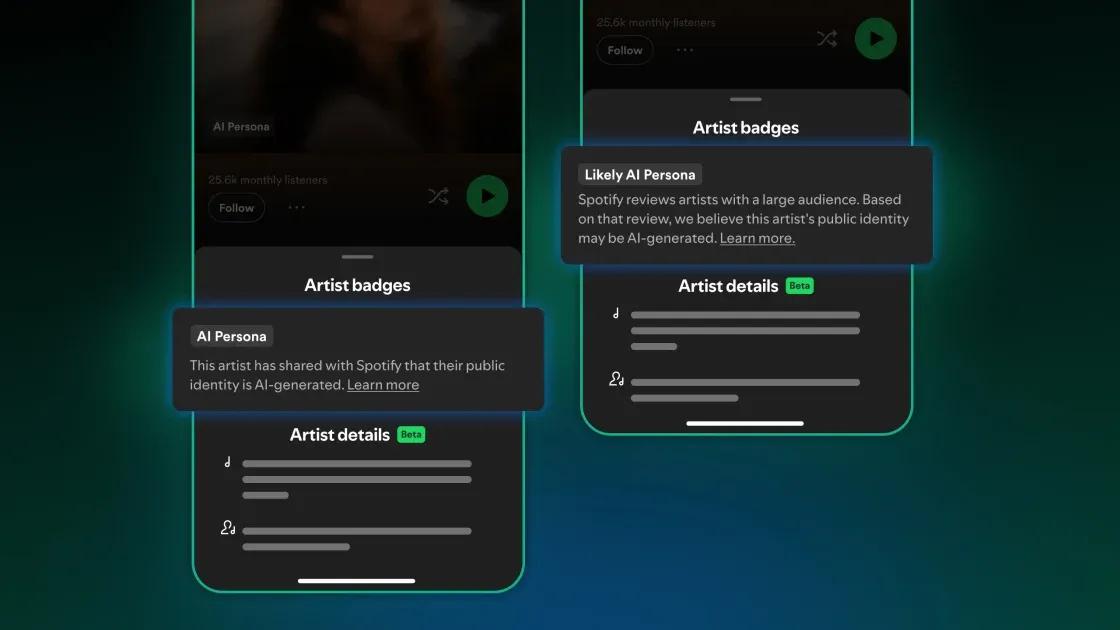
Source: PC Magazine
Spotify clarified that the AI Persona label focuses specifically on artist identity rather than how the music itself was created
1
. The company stated that while there's a broad spectrum in how artists use AI as a creative tool, the question of whether a profile represents an actual human is where Spotify can make a clear determination4
. Information about AI use in music production will continue to be available through existing features like AI credit badges and SongDNA1
. This distinction matters as Spotify balances supporting human artists while allowing creative AI tools.Related Stories
Artists who believe the AI Persona label has been incorrectly applied to their profile will have the ability to appeal the designation
1
. In the coming months, Spotify will roll out a tool enabling listeners to flag artist profiles that appear to be AI Personas but haven't yet been labeled1
. This crowdsourced approach to identifying AI-generated artist profiles leverages user feedback to improve transparency across streaming platforms. The combination of self-disclosure, platform review, and community reporting creates multiple layers of verification for artist authenticity.The timing of Spotify's announcement reflects the growing challenge streaming platforms face with AI-generated content. Deezer recently revealed that AI-generated tracks now constitute half of its daily song uploads
3
, highlighting the scale of AI music proliferation. Spotify's policy expansion builds on guidelines first announced in September 2025 that banned unauthorized AI voice clones and deepfakes1
. The platform continues developing its own AI features including AI DJ, Prompted Playlists, and forthcoming AI remixes through licensing deals with labels like UMG and Merlin1
. Watch for how other streaming platforms respond to this precedent and whether industry-standard verification methods emerge for distinguishing human from AI creators in the content ecosystem.
Source: CNET
Summarized by
Navi
25 Sept 2025•Technology

06 Jan 2026•Technology

29 Jun 2026•Entertainment and Society

1
Technology

2
Policy and Regulation

3
Health