6 Sources
[1]
Spotify's AI bet: more of everything, less of what you want | TechCrunch
Spotify was a music app at one time. Then it added podcasts. Then audiobooks. Now the company is piling AI features into its app at a pace that can feel overwhelming. The latest wave, announced at its investor day, skews heavily toward using AI to generate content rather than using AI to help users find content they actually want. Until now, Spotify has been largely a platform for human-created content -- music, podcasts, and audiobooks. As it adds AI-powered tools to generate all of those formats, the app is poised to look very different. That shift is also creating friction; AI can now produce music faster than Spotify can manage it. Last year, the company was criticized for not properly labeling AI music. Following that backlash, the company changed its policy and adopted the DDEX industry standard -- a widely used labeling system for identifying AI-generated tracks -- for its catalog. Now, Spotify has signed a deal with Universal Music Group (UMG) that allows fans to create AI covers and remixes of existing songs. While this agreement ensures artists are compensated, it will bring more AI music to the platform, and could make it harder for listeners to discover emerging human artists. Spotify is also partnering with the AI voice company ElevenLabs to release a tool that lets authors narrate audiobooks using AI voices. While this speeds up audiobook production, AI narration can still sound unnatural at times. Stranger still is the company's productivity push: the personal podcasts feature lets users generate AI-made podcasts about anything, including summaries of their calendars and emails. Earlier this month, the company introduced a tool for developers using AI coding assistants like Codex and Claude Code, allowing them to create podcasts and save them to their Spotify library. With the latest release, all users will be able to build personal podcasts through prompts directly in the app. The company is also releasing an experimental desktop app that connects to a user's email, notes, and calendar, pulls in relevant information, and generates a personalized audio briefing. It's the kind of feature that could have lived inside the existing Spotify app -- which makes the choice to spin it into a separate product worth watching. "With your permission, it can take action on your behalf: researching topics, using a web browser, organizing information, and helping complete tasks," the app's description reads. The language is a tell: Spotify is gesturing toward agentic AI -- software that doesn't just answer questions but autonomously completes tasks on your behalf. The company didn't elaborate further, but given its ambition to own all things audio, it's not hard to imagine something like AI meeting notes, in the style of Granola, eventually making its way into Spotify. All of this adds up to more content on the platform, and Spotify's answer to helping users navigate it is, again, AI. The company is adding natural-language discovery for audiobooks and podcasts, similar to how Google has been pushing people toward conversational search. The groundwork is already there: Spotify already has an AI DJ that lets you chat while listening to music. Now, users can ask questions to get answers about a particular podcast episode or its themes more broadly. They might already be doing this in chatbots like ChatGPT or Gemini, but Spotify doesn't want them to leave the app. Spotify is trying hard to become an everything-audio app, but in that quest, it is filling itself with features users didn't ask for and making it confusing and harder to navigate. The company is no longer focused solely on consumption -- it's actively nudging users to create content, too, even if it's just for themselves. The risk is that this trades depth for breadth: the more time users spend making sense of a cluttered app, the less time they spend discovering and listening to content by other creators, raising the question: Is Spotify deepening its competitive moat or diluting what made it essential? If users feel that the app has lost focus and isn't surfacing the content they want, more of them may follow my colleague Amanda out the door -- and take their listening time with them.
[2]
Spotify adds AI-powered Q&A and briefing generation features to podcasts
For users, Spotify has been a place to consume podcasts made by other creators. The company wants to change that by introducing a personal podcast feature, which uses AI to generate podcasts for users based on an idea or a custom prompt. Earlier this month, the company released a GitHub-based command-line tool for Claude Code and Codex that allows users to create a podcast and save it to their own Spotify library. The company said that, soon, users would be able to create podcasts directly within the Spotify app. They can also schedule them to create daily or weekly briefs for topics they have a recurring interest in. Plus, they can also create one-off podcasts to understand a topic. Users can make a request like "Share my daily city updates, and tell me about local concerts from artists I love," or "Help me understand economics in five minutes," to create a podcast and have it saved to the library for personal consumption. What's more, users can add links, PDFs, and text, and choose a custom voice to generate podcasts. The company is taking a leaf out of NotebookLM, ElevenLabs reader, and former NotebookLM devs' app Huxe to create personal podcasts on any topic. Spotify also released a dedicated desktop app called Studio by Spotify Labs, which can connection wth users' email and calendar to create personalized briefings. In addition, the company is rolling out an AI-powered Q&A feature for Premium mobile users in the U.S., Sweden, and Ireland today. With this, users can ask questions about the episode they are listening to or a concept mentioned in the podcast to get answers. They can also ask for podcast recommendations on specific topics. The new addition comes after the company released a prompt-based feature to create podcast playlists in April. Until now, Spotify has been pushing people to consume more video podcasts. The company said that users who streamed a video podcast were up 50% year-on-year. With this release, Spotify wants users to engage more with the app by asking questions about a podcast, which is akin to Ask YouTube, released by Google earlier in the week, and creating their own interest-based podcasts. For podcast makers, Spotify is making its creator sponsorship tool available to manage brand partnerships. Plus, it is also adding a way for creators to charge a subscription to unlock exclusive content and experiences. Social platforms like Instagram, Facebook, and Snap already offer a similar product to content creators.
[3]
Spotify is adding more AI gunk for podcasts and audiobooks - Engadget
Premium users in the US will soon be able to generate personal podcasts that explain certain topics and provide daily briefings. Spotify held its latest investor day event on Thursday. Among other things, it had some updates to share regarding podcasts and audiobooks. Of course, many of these concerned generative AI features. For one thing, Spotify says you'll be able to ask a chatbot questions about a podcast episode you're listening to in order to get clarification, more context or recommendations related to a host or guest. Premium users in the US, Sweden and Ireland are the first to get access to this feature starting today. The company is fairly transparent about why it's adding this feature. It says you'll be able to "delve deeper without leaving Spotify." That fits in with other tech companies trying to construct walled gardens around their ecosystems to discourage you from going anywhere else on the internet to get information, as Google is blatantly attempting with its AI-powered Search. Spotify is also expanding a feature that enables users to generate "personal podcasts." It announced this tool last month with the option to use AI agents like OpenClaw and Claude Code to whip up such synthetic audio. The company says it's adding a way for users to generate personal podcasts directly within Spotify. It notes that, after you enter a prompt, it will generate audio that draws from factors like your Spotify taste profile and world knowledge. You can also feed in text, PDFs and links to give the tool more context for what you'd like to hear about. (A new desktop app called Studio by Spotify Labs ties into that). These podcasts can focus on things like explainers on a certain topic, daily briefings or updates on local concerts featuring artists you're into. These audio episodes are saved in your library privately, and you can set up the app to generate episodes daily or weekly. Spotify says eligible Premium users in the US will get access to personal podcasts next month. The company added that users will receive a set number of credits each month as part of their subscription, so there's a limit on how many personal podcasts you'll be able to generate without paying extra. Inevitably, you can buy more credits if you desire.
[4]
Spotify's huge new podcast makeover means you can now ask in-depth questions about the episodes you're listening to, which sounds great -- but the new 'generated' Personal Podcast feature will be more controversial...
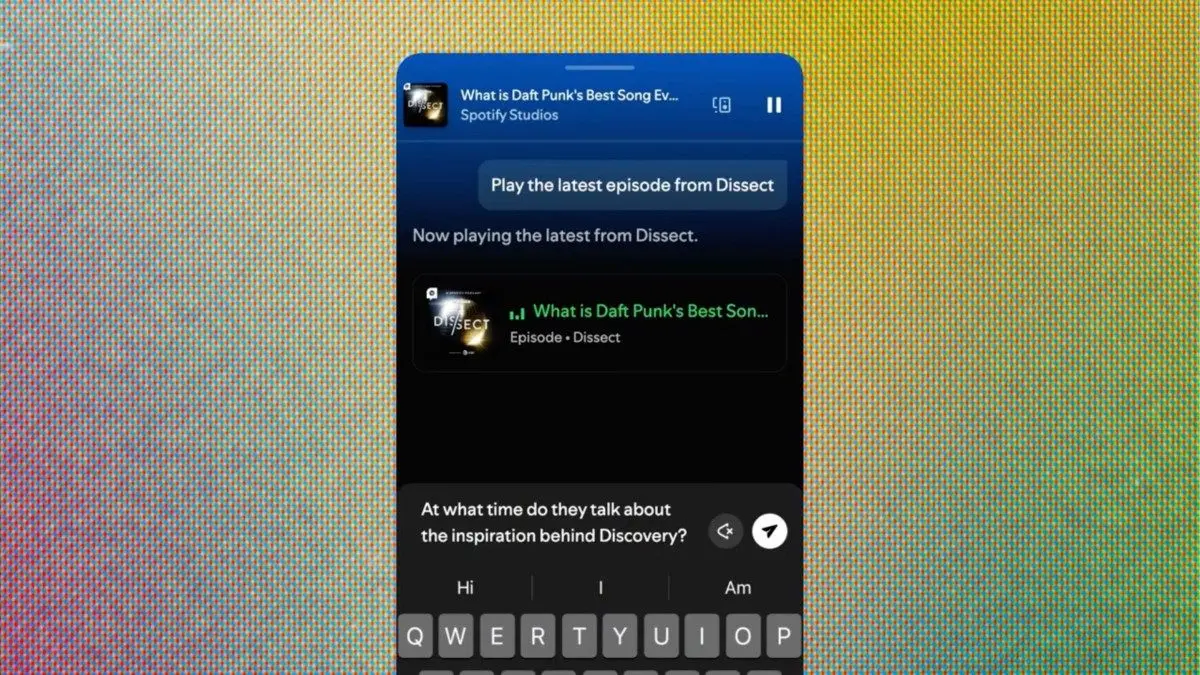
* Spotify is upgrading podcasts with two AI-powered features * One is a new search function that allows you to ask questions about episodes * There's also the new Personal Podcasts tool, which generates a short audio briefing based on your prompts Spotify has used its Investor Day event to announce some new features for podcast listeners -- and they're quite big. The first of the new podcast features enables you to ask Spotify about the episode you're currently listening to or watching, and it will give you answers in real-time. For example, you could get more information about something mentioned in the episode that you may want to know more about, or ask to find more podcasts that cover the same topic. From the demonstration images, it shows the user tapping on the AI DJ search bar in the Spotify home page to launch the podcast episode, and then from there the user proceeds with questions. You can also ask generic questions such as 'play the latest episode from Dissect'. Rolling out to Premium mobile subscribers in the US, Sweden, and Ireland first, this new tool is part of Spotify's larger plan to expand its podcast interface. The company said: "This new capability makes the experience more dynamic, helping fans learn more and connect deeply with the topics, perspectives, and creators they care about." Now the controversial part... Additionally, Spotify wants you to start generating your own personal podcast episodes using AI, which builds on the platform's recent expansion of Prompted Playlists into podcasts. Rolling out to Premium subscribers in the US first, Personal Podcasts is another new tool that can be found among the roster of other playlist-making buttons when you tap the Create button in Spotify. Previously, you could create your own podcasts using platforms such as OpenClaw and Claude Code which you could then save to your Spotify library, so this new tool offers a more on-demand option directly within the platform. As you'd expect by its name, Personal Podcasts allow you to generate short audio episodes which Spotify says are "tailored to your interests and listening habits", and it works on a prompt basis. You can ask it to create a daily briefing to include local weather, any live music happening in your area, and daily news headlines across different topics which you can schedule to update every day or weekly. But Spotify doesn't draw the line there -- Personal Podcasts can also generate episodes that dive deeper into topics, connecting you with related podcast episodes for you to explore your curiosity further. As well as text prompts, you can add more context to your requests by attaching PDFs and website links, and the information should be pulled into the episode. There's a slight catch however. Just like Spotify's monthly audiobook listening hours allowance, the same applies to Personal Podcasts ,which come with a fixed allocation of credits to generate podcasts included with their subscription each month. If you find that you can't get enough of them, there's an option to purchase additional credits. The interesting thing about Spotify's new podcast upgrades is that nowhere in the company's announcement doesn't explicitly state how these features are powered, though it's quite clear that AI is the mastermind behind these generative tools. We think the streamer is onto something with tools to let you dive further into the shows you love the most and pull information from them, and allowing you to ask for more insights on topics that presenters maybe don't go into detail with. It's kind of amusing that Spotify recently added features in support of the anti-AI brigade by not only rolling out 'Verified by Spotify' badges for music artists to certify that they're real, it then did the same thing for podcasts only a few days ago -- and now it's offering AI-generated podcasts right from its own menus. Follow TechRadar on Google News and add us as a preferred source to get our expert news, reviews, and opinion in your feeds.
[5]
Spotify wants to turn audio into an AI experience and India may be central to it
Spotify is embracing artificial intelligence to become a personalised audio platform. The company is developing AI playlists, conversational listening, and interactive audio experiences. This move aims to differentiate Spotify in a competitive streaming market. India is highlighted as a key growth market for Spotify's AI ambitions and subscriber base expansion. Spotify is going all in on artificial intelligence (AI). Not just to recommend songs, but to turn itself into a fully personalised, generative audio platform. At its 2026 Investor Day in New York on Thursday, Spotify outlined a future built around AI playlists, conversational listening, remix tools, personalised podcasts and interactive audio experiences. The company repeatedly used the word "generation" to describe where the platform is headed next. Also Read: Spotify says it made record payout of more than $11 billion to music industry in 2025 "Spotify's evolution has followed a clear path: first access, then personalisation, now generation," Spotify co-CEO Gustav Söderström said during the event. The broader pitch was simply that streaming apps may no longer just compete on music catalogues, because everyone already has largely the same songs. Instead, the next battleground is AI-driven personalisation -- how well platforms understand users and generate experiences around their tastes. Spotify said it is building what it calls a "Large Taste Model", trained on 3.4 trillion daily signals from users across music, podcasts and audiobooks. Rather than competing directly with frontier AI companies like OpenAI or Google, Spotify is betting that its biggest advantage is two decades of listener behaviour and cultural data. That data moat could become increasingly important as music streaming itself becomes commoditised. "Experts say these tech investments may be critical to Spotify's ability to build a moat around its business as the core input, music, becomes commoditised across the streaming apps," CNBC reported earlier this year. Spotify executives have also increasingly framed AI as key to subscriber growth and retention. "Our investments into personalisation and AI are paying off," co-CEO Alex Norström said during a recent earnings call, according to CNBC. "It means people are spending more days in a month with us and across more moments." Spotify's AI push goes beyond recommendations Spotify already has AI-powered features like Prompted Playlists, where users can type prompts based on moods, memories or situations to generate playlists. It also recently integrated with ChatGPT, allowing users to ask for songs, podcasts or playlists conversationally inside the chatbot. Now the company wants to go further. At Investor Day, Spotify announced "Studio by Spotify Labs", a desktop app that can generate personalised private audio experiences, including custom briefings and podcasts based on users' listening habits and interests. The company also unveiled AI remix and cover-generation tools built in partnership with Universal Music Group and Universal Music Publishing Group. In many ways, Spotify is positioning itself less like a streaming app and more like a generative AI platform for audio. Also Read: Spotify strikes deal with Universal Music to let premium users create AI covers, remixes India is becoming central to Spotify's growth story Spotify said that India is now one of its biggest markets by monthly active users (MAUs) alongside the US. Spotify's subscriber base in India has grown sevenfold since 2022, according to the company. Speaking at the event, Gustav Gyllenhammar, Senior Vice President of Markets and Subscriptions, said Spotify sees massive long-term potential in the country. "With 1.4 billion people and rising consumer spending, we can imagine a future with more than 150 million subscribers in India," he said. Industry estimates cited by Moneycontrol peg Spotify's India monthly active users at around 80-90 million. Gyllenhammar added that less than 10% of Indian users currently pay for Premium subscriptions, but Spotify framed that low penetration as future growth runway rather than a problem. India's role may also go beyond subscriptions. Spotify's AI ambitions rely heavily on understanding user behaviour -- what people listen to, skip, save, search for and describe in prompts. India's huge and highly diverse listener base across languages and genres could become important to training those systems. Söderström hinted at this while discussing Spotify's "language-to-song" dataset. "You actually need to have many, many hundreds of millions of listeners across the world's markets constantly telling you what it means for that specific person," he said during the recent earnings call, arguing that music preferences differ heavily across countries and cultures. Spotify's India business is also starting to monetise better. According to Storyboard18, Spotify India LLP turned profitable in FY25 after posting losses a year earlier, driven by strong growth in subscriptions and advertising revenue. Rivals are also racing into AI music Spotify is not the only streaming company trying to turn AI into a core product feature. Apple recently launched Playlist Playground for Apple Music, allowing users to create playlists through text prompts. It also introduced AutoMix, an AI feature that blends songs together like a DJ. Amazon has been testing Maestro, a prompt-based playlist generator inside Amazon Music. Meanwhile, Google has added AI-generated playlists to YouTube Music and recently announced music generation tools inside Gemini. According to CNBC, analysts say Spotify's challenge now is to make users feel locked into its ecosystem through personalisation and integrations. Similar to what Google has been able to achieve with Search and its browser Chrome. "Users build libraries, curate playlists and train algorithms over years. Each additional integration, whether with a car dashboard, a voice assistant or now an AI chatbot -- Spotify says it now connects to over 2,000 device types -- can further entrench the ecosystem," the report added. Also Read: Spotify has cut 15 jobs in podcast unit to reduce management layers: Report AI features are winning but users are not fully sold on AI-generated music While streaming companies are rapidly adding AI features, fully AI-generated songs themselves still appear to face resistance from listeners and the music industry. According to a memo obtained by Billboard this week, Apple Music said AI-generated content makes up less than 1% of weekly plays on the platform, while 65% of AI-generated tracks have never received a single play. "While AI is an incredibly exciting opportunity, we believe that technology should amplify artists, not replace them," Apple Music said in the memo. The industry's copyright battle around AI-generated music is also intensifying. In 2024, Universal Music Group, Warner Music Group and Sony Music Entertainment sued AI music startups Suno and Udio over copyright infringement claims. Spotify appears aware of that tension. Its new AI remix tools are being launched with licensing agreements, artist consent and compensation mechanisms built in. For now, the company seems to be betting that users may not necessarily want AI to replace artists, but they do want AI to make discovering and interacting with audio feel more personal.
[6]
Spotify Introduces AI-Generated Personal Podcasts
'Beaches' Musical to Close After Being Shut Out of Tony Nominations As Spotify brings more AI capabilities to its platform, the company will soon let users generate their own podcasts. At the company's investor day Thursday, Spotify announced the addition of personal podcasts, which allow users to generate podcasts directly within Spotify based on their interests and listening habits. The creation follows a similar mechanism to the existing Prompted Playlists segment, in which users write a prompt into Spotify, which then generates audio based on the input. Spotify gives the example: "You can create a daily briefing, a deep dive on a topic you're curious about, or a weekly roundup of whatever's on your mind. Ask 'Share my daily city updates, and tell me about local concerts from artists I love' or 'Help me understand economics in five minutes,' and Spotify will create a tailored audio overview while linking you to relevant episodes, shows, and creators where you can explore more." Users can then schedule those podcasts to recur daily or weekly, with the option to choose a voice and add more context through additional text, PDFs or links. The episodes are only available to each individual through their library. Personal podcasts will roll out to eligible premium users in the U.S. starting next month, with a set number of monthly credits included, and the option to buy more. "We're entering the era of Generation, where the experience isn't just selected from a catalog. It's shaped by each of our users, in real time, around their taste, context, and intent ... Today, there is no media player for both public and private content - or put differently - there is no media player for the generative era. We believe Spotify will become that," Gustav Söderström, co-CEO of Spotify, said as part of the investor presentation. Additionally, Spotify unveiled creator sponsorships, as a way for podcast creators to earn recurring revenue directly from their most engaged fans on Spotify. In addition to these features, Spotify announced that it will reserve two concert tickets for dedicated fans who have Spotify Premium, before tickets go on sale, and will allow premium subscribers to make AI-generated covers and remixes of songs.
Share
Copy Link
Spotify announced a wave of AI features at its investor day, including AI-powered Q&A for podcast episodes and tools to generate personalized podcasts from prompts. Premium subscribers in the US can now create daily briefings and topic explainers, while the company also released Studio by Spotify Labs for desktop. The moves signal Spotify's shift from a consumption platform to a generative audio experience, though critics warn the expanding feature set may dilute what made the app essential.
Spotify unveiled a suite of AI features at its 2026 investor day, marking a decisive shift toward becoming a generative audio experience rather than just a consumption platform. The company is rolling out AI-powered Q&A functionality for Premium subscribers in the US, Sweden, and Ireland, allowing users to ask questions about podcast episodes they're listening to in real-time
2
3
. Users can request clarification on topics mentioned in episodes, seek recommendations for similar podcasts, or explore concepts more deeply without leaving the app4
. The chatbot integration aims to keep user engagement within Spotify's ecosystem, mirroring strategies from Google and other tech companies building walled gardens around their platforms3
.
Source: TechCrunch
Spotify is fundamentally changing its relationship with users by introducing tools to generate personalized podcasts directly within the app. Premium subscribers in the US will gain access next month to create custom audio episodes using text prompts, with the ability to attach PDFs, links, and choose custom voices
2
4
. Users can request daily briefings that include local weather, concert updates from favorite artists, or five-minute explainers on complex topics like economics2
. These AI-powered features for podcasts draw inspiration from tools like NotebookLM and ElevenLabs reader, allowing users to schedule recurring episodes or create one-off content2
. However, content generation comes with limits: Premium subscribers receive a monthly allocation of credits, with the option to purchase additional credits if needed3
4
.
Source: Engadget
Spotify also released Studio by Spotify Labs, a dedicated desktop app that connects to users' email, notes, and calendar to generate personalized daily briefings
1
2
. The app's description reveals broader ambitions: it can "take action on your behalf: researching topics, using a web browser, organizing information, and helping complete tasks"1
. This language points toward agentic AI—software that autonomously completes tasks rather than simply responding to queries. The decision to launch this as a separate product rather than integrating it into the main app suggests Spotify is testing the waters for more autonomous AI capabilities, potentially including features like AI meeting notes similar to Granola1
.The AI push extends across Spotify's entire audio catalog. The company partnered with Universal Music Group to allow fans to create AI covers and remixes of existing songs, ensuring artists receive compensation while adding more AI-created music to the platform
1
5
. Spotify is also partnering with ElevenLabs to offer AI narrated audiobooks, allowing authors to produce audiobooks faster using AI voices, though the narration can still sound unnatural at times1
. Last year, the company faced criticism for not properly labeling AI music and subsequently adopted the DDEX industry standard for identifying AI-generated tracks1
.India has become critical to Spotify's growth ambitions, with the country now ranking among its biggest markets by monthly active users alongside the US
5
. Spotify's subscriber base in India has grown sevenfold since 2022, and the company envisions a future with more than 150 million subscribers in the country5
. Currently, less than 10% of Indian users pay for Premium subscriptions, representing significant growth potential5
. Beyond subscriber numbers, India's diverse listener base across languages and genres could prove valuable for training Spotify's "Large Taste Model," which processes 3.4 trillion daily signals from users across music, podcasts and audiobooks5
.

Source: ET
Related Stories
As Spotify adds more content through AI generation, the company is deploying natural language processing to help users navigate the expanding catalog. The approach mirrors Google's push toward conversational search, building on Spotify's existing AI DJ feature that allows users to chat while listening to music
1
. Users can now ask questions to receive answers about podcast episodes or explore themes more broadly, keeping them within the app rather than turning to external chatbots like ChatGPT or Gemini1
. Co-CEO Gustav Söderström framed the evolution clearly: "Spotify's evolution has followed a clear path: first access, then personalisation, now generation"5
.The rapid expansion into AI-generated content has sparked concerns about whether Spotify is diluting its core value proposition. The company is positioning itself as an everything-audio app, but critics argue it's filling the platform with features users didn't request, making content discovery harder rather than easier
1
. The shift from consumption to creation could impact emerging human artists, as AI-generated music floods the platform faster than Spotify can manage it1
. The company is betting that its two decades of listener behavior and cultural data provide a competitive moat as music catalogs become commoditized across streaming apps5
. Co-CEO Alex Norström noted that "investments into personalisation and AI are paying off," with users spending more days per month on the platform5
. Whether this strategy strengthens user engagement or drives listeners away remains to be seen.Summarized by
Navi
23 Mar 2026•Technology

21 May 2026•Technology

30 Jul 2025•Technology

1
Technology

2
Business and Economy

3
Health