Startup Offers $800 to Professional 'AI Bully' Who Will Harass Chatbots for Eight Hours


5 Sources
[1]
Job posting seeks human "AI bully" to harass chatbot
Serving tech enthusiasts for over 25 years. TechSpot means tech analysis and advice you can trust. In context: Despite being highly effective at simulating meaningful exchanges between intelligent beings, large language models remain essentially deceptive software products with significant memory
[2]
US Startup Wants Someone With a â€~History of Being Let Down by Technology’ to â€~Bully’ AI
Memvid, an AI memory startup, is currently recruiting someone to get paid to bully AI. The job requires a person to spend a full eight-hour workday on camera “yelling at chatbots,†according to a job listing. Unfortunately, the job isn’t permanent and is more of a promotional campaign for
[3]
US startup advertises 'AI bully' role to test patience of leading chatbots
$800-a-day position involves exposing a chatbot's inconsistencies as it forgets, fudges or hallucinates Imagine a day at work where your main task is to pick a fight with a computer. No meetings, no emails - just you, a chair and a chatbot with the maddening tendency to think it has the cleverest
[4]
This startup will pay you $800 daily to work as an AI bully
If you have ever yelled at an AI chatbot for forgetting something you just said, congratulations, you are now job ready. A startup called Memvid is offering $800 for a single day of work where your only task is to bully AI. Yes, professionally. The role is exactly as chaotic as it sounds. You will
[5]

Do Chatbots Fill You With Rage? This Startup Will Pay You $100 an Hour to 'Bully' AI.
The role doesn't require a computer science background, AI credentials or any kind of work experience. An AI memory startup called Memvid is offering $800 for a one-day, eight-hour shift for one candidate to "bully" AI chatbots by telling them what to do on camera. Business Insider reported this
Share
Copy Link
AI memory startup Memvid is recruiting someone to spend a full workday yelling at chatbots and documenting their memory failures. The $800 one-day role requires no technical skills—just an extensive history of being let down by technology and the patience to repeat questions when AI forgets what you just said.
Memvid Launches Unusual Recruitment for AI Bully Job
An AI memory startup called Memvid is offering $800 a day for what might be the most unusual tech job of the year: a professional AI bully tasked with harassing chatbots for eight consecutive hours
1
. The unique job posting seeks a single individual willing to spend an entire workday on camera, stress-testing chatbot memory by asking popular AI systems to remember information and documenting every failure, meltdown, and circular conversation that follows2
.
Source: Gizmodo
The role pays $100 per hour for this fully remote, one-day position that requires no computer science degree, AI credentials, or prior experience in technology
5
. Instead, the company seeks candidates with an extensive personal history of being let down by technology, strong opinions about AI shortcomings, and the patience to ask a chatbot the same question multiple times while documenting the rage when it still gets the answer wrong3
.The Real Problem Behind the Promotional Campaign
While the AI bully job posting reads like an attention-grabbing stunt, it highlights a genuine technical crisis affecting large language models (LLMs) across the industry. Memvid co-founder and CEO Mohamed Omar explained that chatbots face a massive memory problem because early AI memory solutions were fundamentally unreliable
1
. Most chatbots can sound intelligent momentarily, but they often fail to retain context in conversations, lose track of what users said earlier, and force people to repeat themselves constantly2
.
Source: TechSpot
This isn't just anecdotal frustration. A peer-reviewed study presented at the International Conference on Learning Representations in 2025 found that commercial chatbots showed a roughly 30% drop in accuracy when asked to remember information across long-term interactions
2
. Even more troubling, leading commercial AI systems suffered accuracy drops ranging from 30% to 60% when tasked with recalling facts across sustained conversations, performing well below human capabilities3
.Omar emphasized that the ability to retain information and maintain coherent conversations represents the holy grail of properly functioning chatbots, while hallucinations result from LLMs with poor memory habits
1
. Many AI chatbots rely on limited context windows instead of genuine memory, meaning once conversations reset or extend beyond certain limits, earlier details simply vanish and the AI behaves as though previous exchanges never occurred4
.How Applicants Can Land This User Research Role
The application process for becoming a professional AI bully is surprisingly straightforward. Interested candidates need only fill out a short online form answering questions like "What's the most frustrating thing AI has ever done to you?" and "Why should you be our professional AI Bully?"
2
. Applicants are also asked to test the company's Kora chatbot and provide honest feedback about their experience2
.Kora represents Memvid's solution to the AI memory limitations plaguing the industry—a memory-powered chatbot trained on user or business data and history that can recall long-term information instead of starting from scratch with each conversation
2
. Beyond Kora, Memvid markets a self-improving persistent memory layer for AI models: a file-based solution designed to make conversational context persistent across interactions and improve chatbot responses through enhanced latency, accuracy, and infrastructure efficiency1
.The selected candidate will work remotely but must be comfortable appearing on camera, as the entire session will be recorded for promotional purposes
5
. Omar told Business Insider that one recent college graduate who applied reported paying almost $300 monthly for AI subscriptions and submitted "a whole rant about how they've faced memory issues on every AI platform they've used"3
. Many applicants are knowledge workers already using these products daily and experiencing technology frustration firsthand3
.Related Stories

Why AI Memory Failures Matter Beyond Marketing
While Memvid's search for an AI bully serves as clever advertising for the company's products, it also functions as a stark reminder of current AI system limitations with real-world consequences
1
. The root cause stems from companies rushing to connect AI tools to vast knowledge repositories, only to discover that retrieval-based systems can surface confident but incorrect answers faster than ever, with no reliable mechanism to signal when they're doing so3
.This confident wrongness has already caused serious harm across multiple industries. French legal scholar Damien Charlotin has documented a sharp increase in AI-driven legal hallucinations, reporting that incidents rose from roughly two per week before spring 2025 to two or three daily by autumn
3
. In healthcare, the ECRI Institute placed "navigating the AI diagnostic dilemma" at the top of its annual list of the 10 greatest patient safety concerns for 2026, warning that AI diagnostic shortcomings risk reducing clinician vigilance where oversight frameworks remain unestablished3
.
Source: Entrepreneur
Omar confirmed that while there's no firm deadline for applications, the company expects to identify the right candidate within the next week or two
3
. Currently, Memvid plans to hire just one person for this role, though the company may expand the campaign and bring on additional candidates in the future2
. The broader pattern reflects how companies are treating serious AI engagement as behavior requiring financial incentives, particularly as workers grow anxious about automation's impact on their careers5
.References
Summarized by

Navi
[2]
[4]
Related Stories
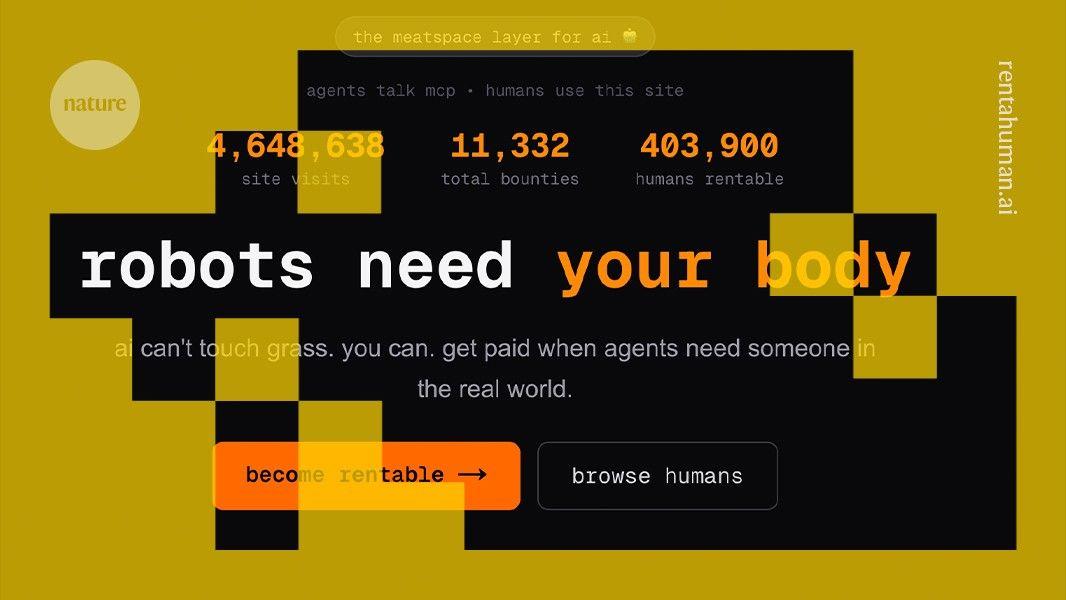
AI agents are hiring humans on RentAHuman, but the reality is far more complicated than it seems
12 Feb 2026•Technology
OpenAI seeks new Head of Preparedness as Sam Altman warns of escalating AI risks
28 Dec 2025•Policy and Regulation

AI Interviewers: The New Frontier in Job Recruitment
18 Jul 2025•Technology

Recent Highlights
1
Microsoft and Nvidia Launch Surface Laptop Ultra: A $2,599 AI-Ready PC With RTX Spark Chip
Technology

2
Scientists Build AI Model That Reconstructs Images From Brain Scans in Record Time
Science and Research

3
Anthropic AI Cuts Live Internet Access After Model Sends False Homicide Tip to Philadelphia Police
Technology

Recent Highlights
Today's Top Stories




Don’t drown in AI news. We cut through the noise - filtering, ranking and summarizing the most important AI news, breakthroughs and research daily. Follow topics that matter to you and stay ahead.


