AI's Grasp of Color Metaphors: Insights from a Comparative Study with Humans


3 Sources
[1]
Can AI Truly Grasp Colorful Metaphors Without Seeing Color? - Neuroscience News
Summary: A new study tested how humans and ChatGPT understand color metaphors, revealing key differences between lived experience and language-based AI. Surprisingly, colorblind and color-seeing humans showed similar comprehension, suggesting vision isn't essential for interpreting
[2]
AI struggles with color metaphors that humans easily understand - Earth.com
Phrases like "feeling blue" or "seeing red" show up in everyday speech - and most people instantly know they mean feeling sad or angry. But how do we pick up those meanings? Do we learn them through seeing color in the world, or just by hearing how people use them? A new study from the University
[3]
Can ChatGPT actually 'see' red? New study results are nuanced
ChatGPT works by analyzing vast amounts of text, identifying patterns and synthesizing them to generate responses to users' prompts. Color metaphors like "feeling blue" and "seeing red" are commonplace throughout the English language, and therefore comprise part of the dataset on which ChatGPT is
Share
Copy Link
A new study compares how AI language models and humans with varying color perception abilities understand and interpret color metaphors, revealing insights into the role of embodied experiences in language comprehension.
AI vs. Human Understanding of Color Metaphors
A groundbreaking study published in Cognitive Science has shed light on the differences between artificial intelligence and human understanding of color metaphors. Led by Professor Lisa Aziz-Zadeh from the University of Southern California, the research team conducted large-scale online surveys comparing color-seeing adults, colorblind adults, painters, and ChatGPT in their comprehension of color-related language
1
.Study Methodology and Participants
The study involved four distinct groups:
- Color-seeing adults
- Colorblind adults
- Painters who regularly work with color pigments
- ChatGPT, an AI language model
Participants were tasked with assigning colors to abstract words, interpreting familiar and unfamiliar color metaphors, and explaining their reasoning
2
.Key Findings

Source: Tech Xplore
Surprising Similarities Between Color-Seeing and Colorblind Humans
Contrary to the researchers' initial hypothesis, color-seeing and colorblind adults showed remarkably similar color associations. This suggests that visual perception may not be essential for metaphorical understanding, and that language exposure can compensate for missing retinal data
1
.Painters' Superior Performance
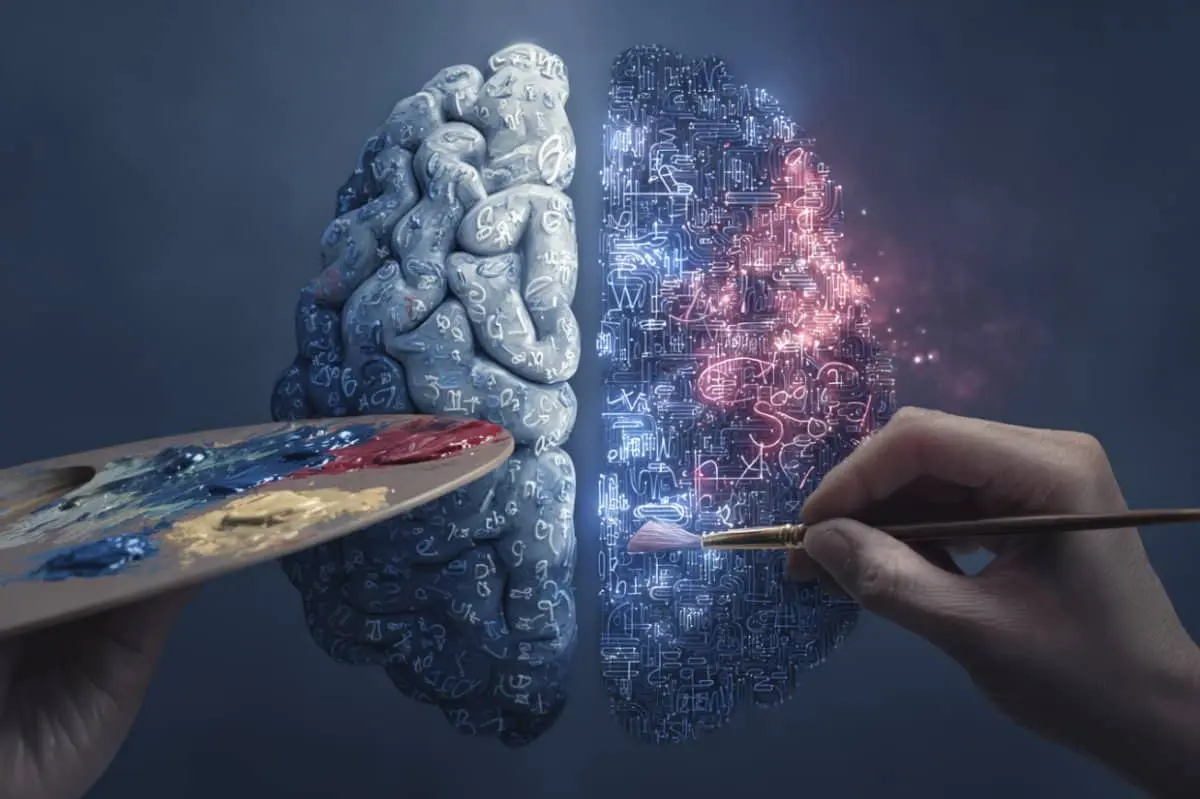
Source: Neuroscience News
Interestingly, painters demonstrated a significant advantage in correctly interpreting novel color metaphors. This finding indicates that hands-on experiences with color can lead to deeper conceptual representations in language. Painters outperformed non-painters by 14% when identifying fresh metaphors, highlighting the importance of tactile memory and sensorimotor knowledge
2
.Related Stories

ChatGPT's Strengths and Limitations
ChatGPT generated consistent color associations and often referenced emotional and cultural associations when explaining its reasoning. For example, it described a "pink party" as being associated with happiness, love, and kindness
3
.However, the AI model faced challenges in several areas:
- It used embodied explanations less frequently than humans.
- It struggled with interpreting novel metaphors (e.g., "the meeting made him burgundy").
- It had difficulty inverting color associations (e.g., "the opposite of green").

Source: Earth.com
Implications for AI Development
The study underscores the limitations of language-only models in fully representing human understanding. Future research may explore integrating sensory input, such as visual or tactile data, to help AI models better approximate human cognition
1
.Broader Implications
This research has implications beyond AI development:
-
Learning Enhancement: The study suggests that engaging multiple senses when learning can enrich both vocabulary and recall
2
. -
AI Safety: Misinterpretation of color-coded warnings by AI assistants could potentially lead to safety hazards
2
. -
Ethical Considerations: As AI models incorporate more sensory data, there will be a need for governance frameworks to address privacy concerns and potential biases
2
.
In conclusion, while AI has made significant strides in language processing, this study highlights the ongoing importance of embodied, hands-on experiences in human reasoning and understanding
3
.References
Summarized by

Navi
[1]
Related Stories
AI's Sensory Limitations: The Challenge of Understanding Concepts Like Flowers
04 Jun 2025•Science and Research

AI Models Struggle with Abstract Visual Reasoning, Falling Short of Human Capabilities
11 Oct 2024•Science and Research

Study Reveals AI Language Models Learn Like Humans, But Lack Abstract Thought
13 May 2025•Science and Research
Recent Highlights
1
Microsoft and Nvidia Launch Surface Laptop Ultra: A $2,599 AI-Ready PC With RTX Spark Chip
Technology

2
Trump Consulted Grok AI Before Ordering Venezuela Invasion and Capture of Nicolás Maduro
Policy and Regulation

3
Scientists Build AI Model That Reconstructs Images From Brain Scans in Record Time
Science and Research

Recent Highlights
Today's Top Stories







Don’t drown in AI news. We cut through the noise - filtering, ranking and summarizing the most important AI news, breakthroughs and research daily. Follow topics that matter to you and stay ahead.


