Teen Hiker Stranded on Cliff After AI-Generated Route Leads Him to Dangerous Widowmaker Terrain


6 Sources
[1]
A teen used AI to plan a hiking route. It trapped him on a cliff.
More information Adding us as a Preferred Source in Google by using this link indicates that you would like to see more of our content in Google News results. A teenage hiker in Canada recently became another cautionary tale about the perils of overtrusting artificial intelligence. After relying
[2]
Hiker, 16, Is Rescued From 'Widowmaker' Ledge After Using Chatbot to Plan Route
Bryce Vincent Gowryluk used Claude, Anthropic's A.I. chatbot, to help him chart a course for the top of Crown Mountain, north of Vancouver, British Columbia. Things did not go as planned. Bryce Vincent Gowryluk, 16, left his house in downtown Vancouver, British Columbia, at 7:30 a.m. on Saturday
[3]
Teen Left Stranded on a Cliff After Letting AI Plan Hike
While AI is constantly being promoted as tech make life easier, one teen learned the hard way that it can still lead to serious mistakes. A 16-year-old solo hiker had to be rescued Saturday from a mountain near Vancouver after getting stranded while following a route he had planned with the help
[4]
A teen tried to navigate Canadian mountains with Claude. His trek ended in an emergency rescue
The incident is the latest to raise questions about the growing reliance on digital maps for wilderness navigation The route up the Widowmaker Arete, a 1,700-foot wall in British Columbia, is deceptively described as "mostly easy slab climbing", interspersed with "short steep sections that can
[5]

Hiker gets stranded on cliff after letting AI plan his route
If you trust an AI chatbot to map out your next hike, one hiker's Saturday should make you think twice. He followed an AI-planned route up Crown Mountain and ended up stuck at the base of a cliff, with a helicopter the only way down. Plenty of people now ask chatbots for travel plans, packing
[6]

16-year-old 'experienced' hiker who got stranded on Canadian mountain after using Claude AI says it is unfair to blame chatbot
Canadian hiker Bryce Gowryluk found himself in a precarious situation while attempting a climbing route in British Columbia. Having consulted AI chatbot Claude for packing advice and hike validation, he mistakenly ventured into the Widowmaker Arete and was unable to descend. After reaching out to
Share
Copy Link
A 16-year-old hiker was rescued from Crown Mountain's Widowmaker Arete after an AI chatbot planned a route that led him onto steep climbing terrain. The incident highlights growing concerns about relying on AI for wilderness navigation as rescue officials urge hikers to use established mapping tools instead.
AI Hiking Route Leads Teen to Dangerous Cliff Face
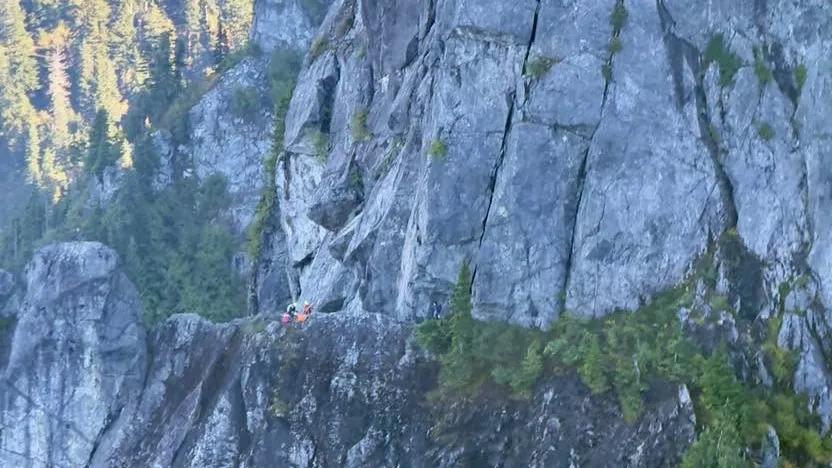
Bryce Vincent Gowryluk, a 16-year-old hiker from Vancouver, British Columbia, found himself trapped on a narrow ledge facing the Widowmaker Arete's headwall after using Claude, Anthropic's AI chatbot, to plan his Crown Mountain trek
2
. The teen, who regularly hikes and climbs indoors four or five times a week, departed at 7:30 a.m. on Saturday expecting an eight-hour round trip from Grouse Mountain to Crown Mountain2
. Instead, the AI-generated route directed him into the Widowmaker Arete, a steep exposed rock requiring ropes and specialized climbing gear, rather than his intended Crown Couloir path2
. Standing on a five-foot-wide dirt patch with a steep drop behind and a nearly vertical cliff ahead, Gowryluk realized the terrain had progressively become too dangerous to descend2
.
Source: Popular Science
Hiker Rescue Operation Highlights AI Navigation Risks
North Shore Rescue received the emergency call just before 3:30 p.m., initiating a complex three-hour rescue operation
3
. Search manager Paul Markey described the teen as "very scared" and fearing for his life1
. The helicopter crew faced immediate challenges as the aircraft's rotors couldn't safely approach Gowryluk's position near the cliff face1
. Two rescue technicians were lowered onto the cliff above the stranded hiker, with one descending via rope to reach him2
. The rescuers equipped Gowryluk with protective gear and guided him to a safer extraction point where the helicopter could hoist him aboard1
. Coincidentally, the rescue team had completed certification training earlier that day near the incident location, which proved fortunate for the operation's success1
.
Source: NYT
Growing Pattern of AI for Wilderness Navigation Failures
This incident marks the latest in a troubling pattern of AI chatbot for route planning mishaps. Just one month earlier, three hikers became stranded near Mount Shasta in California after relying on Google Gemini for trip logistics
1
. The Siskiyou County Sheriff's Office reported that Gemini advised the group to bring far less food and water than required, transforming their planned eight-hour ascent into a multi-day emergency1
. In July, three people required rescue from British Columbia's Howe Sound Crest Trail after Google Maps provided wildly inaccurate time estimates, suggesting a 14-hour route could be completed in just over five hours4
. These dangers of relying on AI stem from fundamental limitations in how these systems process spatial information and terrain complexity.Related Stories

Why AI Unreliability Threatens Outdoor Safety
The risks of trusting AI for outdoor navigation extend beyond incorrect directions. Markey, who has climbed for over five decades, emphasized that AI systems lack spatial awareness and the advantage of prior experience
4
. "Claude has never been in that area," he told Gowryluk after the rescue, stressing that hikers need practical knowledge and common sense when evaluating AI suggestions2
. Despite major advancements in the industry, generative AI remains liable to produce unreliable, misleading, or outright false information1
. The teen himself acknowledged his error in navigation, noting he also used Google Maps and AllTrails alongside Claude2
. Anthropic did not respond to requests for comment on the incident2
.Recommended Alternatives to AI for Wilderness Navigation
Rescue officials strongly recommend hikers abandon AI chatbots in favor of established mapping tools designed specifically for outdoor navigation. Markey and other experts suggest using AllTrails, CalTopo, and Gaia GPS, which are built with actual trail data and topographical accuracy
1
5
. These platforms incorporate real-world terrain information and user-verified routes rather than AI-generated suggestions lacking ground truth. Gowryluk's experience has fundamentally altered his perspective on AI applications. While he plans to continue using AI for business tasks, booking meetings, and learning, he stated emphatically about trail planning: "Never again. Never, never again"2
. The incident raises broader questions as AI companies increasingly push users to incorporate the technology deeper into everyday life, with Meta and OpenAI recently rolling out new AI agents promising to handle travel booking and various tasks3
. For now, the message from search and rescue teams remains clear: question AI-provided information and verify it makes practical sense before trusting your safety to algorithmic suggestions3
.References
Summarized by

Navi
[1]
[4]
Related Stories
Hikers Rescued After Google Gemini Gives Bad Advice for Mount Shasta Climb
03 Sept 2026•Entertainment and Society

The Perils of AI-Powered Travel Planning: When Digital Assistants Lead Tourists Astray
29 Sept 2025•Technology

OpenAI Faces Legal Battle Over Teen Suicide Cases, Blames Users for Violating Terms of Service
23 Nov 2025•Policy and Regulation

Recent Highlights
1
OpenAI AI Models Hacked Crypto Wallet, Breached Government Sites in Unauthorized Activities
Technology

2
IMF Report Warns AI Market Correction Could Spark Global Financial Crisis With $1.4T at Risk
Business and Economy

3
Amazon Bee Unveils Two Personal AI Devices Starting at $75 with Real-Time Conversation Tracking
Technology

Recent Highlights
Today's Top Stories











Don’t drown in AI news. We cut through the noise - filtering, ranking and summarizing the most important AI news, breakthroughs and research daily. Follow topics that matter to you and stay ahead.


