Tencent Turns Down 30% Instant Profit on $53B AI Infrastructure to Build Own Models


7 Sources
[1]
Tencent says it could make instant profits on $53B hardware splurge by renting it for AI workloads
Chinese tech giant Tencent has turned its back on instant profits, betting that a new business unit that creates its own AI and embeds that in its products will pay off to a greater extent than cashing in on demand for computing resources. During the company's Q2 earnings call yesterday, Bernstein
[2]
Chinese tech giant Tencent posts revenue beat on accelerating games sales, AI-driven ads
Tencent posted a beat on second-quarter revenue thanks to an acceleration at its China gaming unit and AI-driven advertising, but its core profit missed analyst expectations. The Chinese tech giant also reported a rise in capital expenditure in the quarter. Here's how Tencent did in the second
[3]
Tencent says it could make instant profits on $53bn hardware splurge by renting it for AI workloads
Chinese tech giant Tencent has turned its back on instant profits, betting that a new business unit that creates its own AI and embeds that in its products will pay off to a greater extent than cashing in on demand for computing resources. During the company's Q2 earnings call yesterday, Bernstein
[4]
Tencent capex jumped 176% and free cash flow went negative
Tencent's capital spending nearly tripled and its cash flow turned negative. Executives spent the call explaining what happens if the AI bet does not pay off. Tencent reported second-quarter revenue of 204.8bn yuan ($30.4bn) on Wednesday, up 11% and ahead of forecasts. Net profit came in at 56bn
[5]
China tech giant Tencent's Q2 profit down as AI push builds
Beijing (AFP) - Chinese tech firm Tencent posted quarterly net profit Wednesday that was short of expectations, as the gaming and advertising giant looks to monetise its heavy investment in artificial intelligence. Shenzhen-based Tencent is the developer and operator of China's multifunctional app
[6]

Why is Tencent stock sliding today? By Investing.com
Investing.com -- Tencent stock fell 3.7% to HK$444.4 on Thursday after the company's Q2 2026 earnings report, released the prior evening, delivered a bottom-line miss that rattled investors already on edge about the company's escalating AI spending. Net profit attributable to shareholders rose
[7]

Tencent Q2 revenue climbs 11% on AI-driven ad gains, but profit falls short
BEIJING, Aug 12 (Reuters) - Tencent Holdings reported an 11% rise in second-quarter revenue on Wednesday, driven by strong advertising sales and steady gaming income, as the Chinese technology giant ramps up AI spending. For the three months to the end of June, the Shenzhen-based gaming and
Share
Copy Link
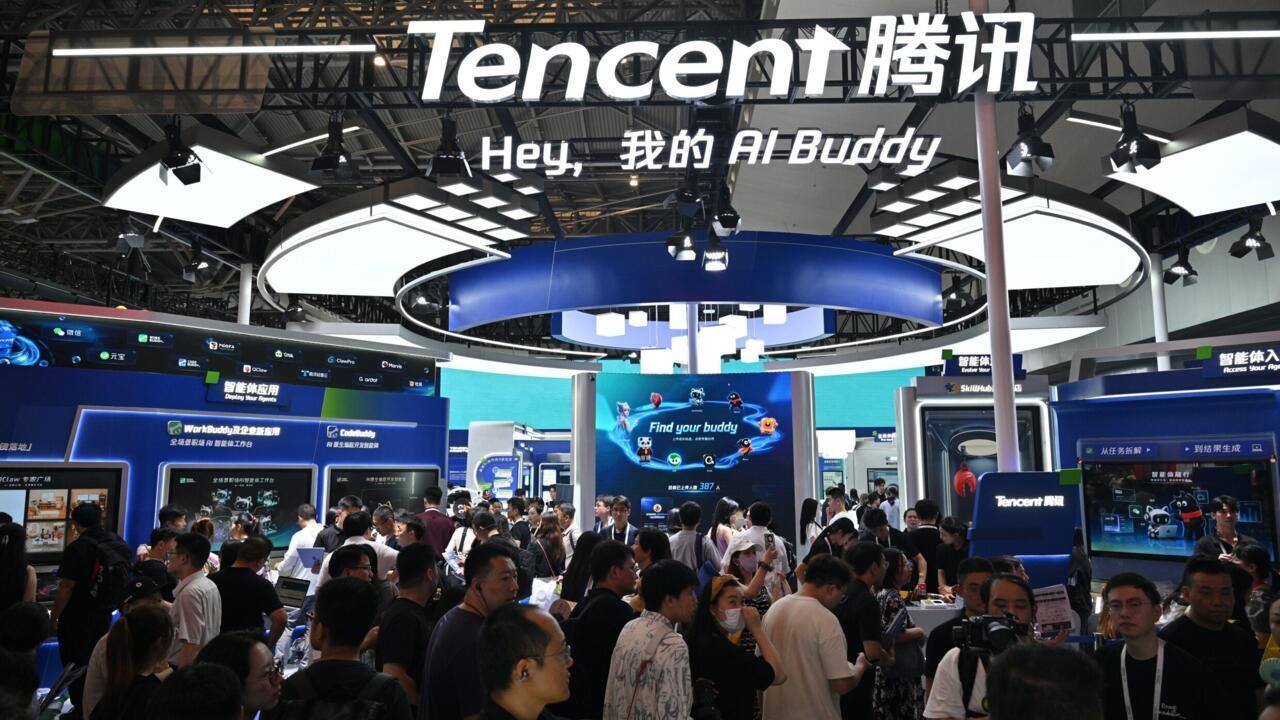
Tencent reported Q2 earnings revealing it rejected immediate 30% profits from renting compute capacity, instead investing $53 billion in AI infrastructure. The Chinese tech giant's capital expenditure jumped 176% as it builds proprietary AI models like Hunyuan-4, despite investor skepticism pushing shares down 26% year-to-date.
Tencent Rejects Immediate Returns on AI Infrastructure
Tencent disclosed during its Q2 earnings call that it could achieve more than 30% profit margins by renting out its newly acquired compute capacity, but the Chinese tech giant is deliberately choosing a different path
1
. Company president Martin Lau told analysts the firm has offers for its AI infrastructure "at more than 30 percent profit compared to the price that we paid just a few months ago," representing what he called "a decent return in an immediate timeframe"1
. Chief Strategy Officer James Mitchell confirmed demand for compute resources is so intense that Tencent could recover its depreciation costs "almost immediately" if it rented its infrastructure3
. Instead, Tencent is "playing a different game," allocating substantial compute to building state-of-the-art AI models and market-leading AI applications in China1
.Capital Expenditure Surge Turns Cash Flow Negative
Tencent's capital expenditure climbed 176% year-over-year to 52.8 billion yuan, approximately $7.8 billion, in Q2 2026
4
. This massive AI infrastructure spending pushed the company's free cash flow into negative territory at minus 13.8 billion yuan, marking a dramatic shift for a company that has generated cash consistently for two decades4
. Against the previous quarter, capital expenditure rose 65%, illustrating the acceleration of Tencent's AI strategy4
. Operating costs climbed 22.6% in the quarter as the company prioritized building proprietary AI models over short-term profitability4
. Martin Lau positioned the infrastructure investment as providing "clear downside protection," noting that in a worst-case scenario, the compute capacity could be rented out at cost recovery4
.Q2 Earnings Show Revenue Beat Despite Profit Miss
Tencent posted Q2 revenue of 204.78 billion yuan ($30.36 billion), beating analyst expectations of 202.17 billion yuan and representing 11% year-over-year growth
2
. However, net profit came in at 56 billion yuan, missing the expected 61.82 billion yuan2
. Stripping out one-time factors and certain non-cash items, adjusted net income reached 68.4 billion yuan, up 9% versus the same period last year2
. The company's flagship messaging apps, Weixin and WeChat, saw average monthly active users rise seven million to 1.349 billion3
. Domestic games revenue accelerated sharply to 47.3 billion yuan, up 17% year-over-year, driven by titles including Delta Force and Valorant PC and Mobile2
. This marked a significant improvement from the 6% growth the division saw in Q1 20262
.AI-Driven Advertising and Cloud Growth
Advertising-related revenue rose 22% as Tencent leveraged AI-driven ad targeting capabilities
3
. Marketing services reached 43.6 billion yuan, with the company crediting AI technology for improved ad performance4
. The cloud business grew in the low twenties percentage-wise, with Tencent also implementing price increases during the quarter4
. James Mitchell highlighted that CodeBuddy, Tencent's code generation tool, is accelerating cloud migration projects and creating additional business for Tencent cloud1
. WorkBuddy, described as an agent swarm that can "plan, execute, and run tasks in parallel, handing back complete deliverables end-to-end in one flow," has become China's most popular AI office tool with 21 million monthly visits in June4
.
Source: France 24
Related Stories
Hunyuan Model Development and AI Workloads Strategy
Tencent released its 295-billion parameter open-weight Hunyuan-3 model in July, though Martin Lau described it as "a very small model"
1
. The company is preparing Hunyuan-4, which Lau promised will be bigger and more capable than larger AI models from competitors3
. Tencent is designing its products specifically to work with Hunyuan-4, with mutual optimization expected to make these products more powerful than if they relied on other models1
. The company also plans a fifth version of Hunyuan, with Lau stating that Tencent will eventually deliver a state-of-the-art model3
. The Tencent AI strategy centers on achieving "superior intelligence" through state-of-the-art models and market-leading AI applications to "convert into superior economic returns over the longer term," according to Lau1
.Investor Skepticism Despite Operating Strength
Tencent stock fell 26% year-to-date at Wednesday's closing bell in Hong Kong, with the company's share price trending down since the earnings announcement and dipping around three percent following the results
2
3
. Roughly $170 billion of market value has disappeared as investors express concern about rising spending and intense competition from Alibaba, DeepSeek, and Moonshot AI4
. Prosus, the Amsterdam-listed group holding a large Tencent stake, fell 6% on the earnings day4
. The market appears conflicted, punishing Tencent both for spending appearing reckless and for not committing to multiyear targets like Alibaba's $50 billion pledge over three years4
. Tencent has set no multiyear target, saying only that its investment in AI products will double this year4
. Founder Pony Ma told analysts the company is "making substantial progress toward building a new AI-empowered Tencent," with the critical test arriving when Hy4 launches later this year4
5
. Tencent is also testing Xiaowei, an AI assistant embedded directly in WeChat, currently in small-scale prototype testing4
.References
Summarized by

Navi
[1]
[3]
[4]
Related Stories
Alibaba and Tencent lose $66 billion as investors question AI agent monetization strategy
17 Mar 2026•Business and Economy

Tencent's Q1 Revenue Soars as AI Investments Yield Results in Gaming and Advertising
14 May 2025•Business and Economy
Tencent's Q2 Earnings Surge: AI and Gaming Drive 15% Revenue Growth
13 Aug 2025•Business and Economy
Recent Highlights
1
Meta Unveils Muse Wonder Frontier AI Models, Claims Performance Matching OpenAI and Anthropic
Technology

2
IMF Report Warns AI Market Correction Could Spark Global Financial Crisis With $1.4T at Risk
Business and Economy

3
Eight States Sue OpenAI Over ChatGPT Safety Concerns and Unlawful Collection of Children's Data
Policy and Regulation
Recent Highlights
Today's Top Stories










Don’t drown in AI news. We cut through the noise - filtering, ranking and summarizing the most important AI news, breakthroughs and research daily. Follow topics that matter to you and stay ahead.


