The Impact of AI on Higher Education: Challenges and Adaptations


2 Sources
[1]
Students must learn to be more than mindless 'machine-minders'
University students have taken to artificial intelligence in the same way that an anxious new driver with a crumpled road map might take to satnav -- that is to say, hungrily and understandably. A survey of UK undergraduates by the Higher Education Policy Institute think-tank shows 92 per cent of
[2]
Humanities teaching will have to adapt to AI | Letter
I agree with Prof Andrew Moran and Dr Ben Wilkinson (Letters, 2 March) that cheap and easy‑to‑use AI tools create problems for universities, but the reactions of many academics to these new developments remind me of the way some people responded to the arrival of cheap pocket calculators in the
Share
Copy Link
As AI tools become increasingly prevalent in universities, educators grapple with maintaining academic integrity and fostering critical thinking skills among students.

AI Usage Surges Among University Students
Recent surveys indicate a significant increase in AI usage among university students. According to the Higher Education Policy Institute, 92% of UK undergraduates are now using generative AI in some form, up from 66% last year. More strikingly, 88% have employed AI in assessments, compared to 53% in the previous year
1
.Challenges in Adapting Teaching Methods
As AI tools become more prevalent, universities face the challenge of adapting their teaching and assessment methods. Initial attempts to incorporate AI into coursework have yielded mixed results. Professor Maria Abreu of Cambridge University reported disappointing outcomes when students were asked to improve AI-generated texts, noting that "improvements were very cosmetic, they didn't change the structure of the arguments"
1
.Concerns Over Critical Thinking Skills
Educators express concern that overreliance on AI tools may hinder the development of crucial critical thinking skills. Michael Veale, an associate professor at University College London, views AI as a "threat to the learning process" due to its allure as a shortcut for time-pressed students
1
.Impact on Various Disciplines
The impact of AI extends beyond essay-based subjects. A study by the ACM Digital Library found that in programming courses, high-performing students used AI tools effectively to accelerate problem-solving, while others developed misconceptions and an "unwarranted illusion of competence"
1
.Workplace Implications
The challenges faced in education mirror potential issues in the workplace. A Microsoft study on knowledge workers' use of generative AI found that these tools "reduce the perceived effort of critical thinking while also encouraging over-reliance on AI"
1
.Related Stories
Adapting to AI: Lessons from History
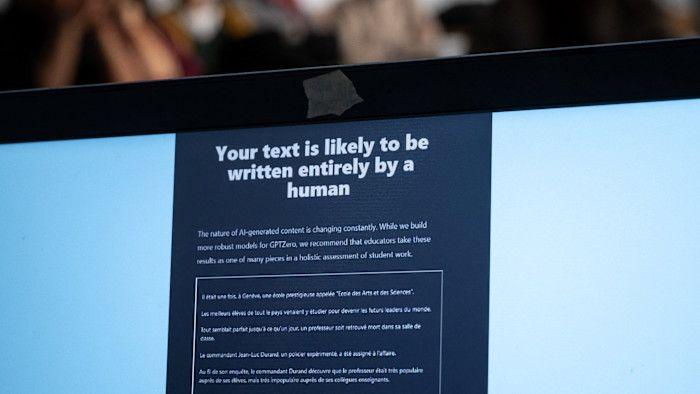
Professor Jim Endersby of the University of Sussex draws parallels between the current AI situation and the introduction of pocket calculators in the 1970s. He argues that, like math teachers then, today's humanities educators must adapt their methods to ensure students can critically evaluate AI-generated content and produce work that stands out
2
.Maintaining Human Skills in an AI-Driven World
Experts emphasize the importance of maintaining foundational skills in information gathering and problem-solving to avoid overreliance on AI. The ability to perform tasks without AI assistance is crucial for effective and critical use of these tools. As Endersby notes, "Genuinely good writing exhibits genuinely human qualities - such as individuality and empathy. True intelligence is still something people do best"
2
.References
Summarized by

Navi
[2]
Related Stories
Universities Adapt to AI: Exeter's Innovative Approach to Academic Assessments
18 Jul 2024

Universities scramble to rethink exams as 92% of UK students now rely on AI for coursework
03 Dec 2025•Entertainment and Society
AI in Education: Reshaping Learning and Challenging Academic Integrity
12 Sept 2025•Technology

Recent Highlights



Recent Highlights
Today's Top Stories



Don’t drown in AI news. We cut through the noise - filtering, ranking and summarizing the most important AI news, breakthroughs and research daily. Follow topics that matter to you and stay ahead.


