2 Sources
[1]
fiduciary grade AI delivers trusted professional insights
Fiduciary grade AI sets the bar as Thomson Reuters and Snowflake bring governed intelligence to the professions Professionals who carry personal liability for their decisions -- lawyers, tax accountants, auditors -- cannot afford AI that gets it wrong. As enterprises accelerate deployment of agentic systems, the firms serving those professionals are discovering that fiduciary grade AI -- intelligence built on governed, authoritative data -- is not a constraint on adoption; it is the very thing that makes high-stakes AI possible. Thomson Reuters Corp., which has built its enterprise AI and data platform on Snowflake to deliver trusted intelligence at scale, is demonstrating what fiduciary grade AI looks like in practice. The company's data estate -- spanning more than 37,000 governed tables and 350 databases -- provides the foundation for AI tools its legal, tax and audit customers can stake their reputations on, according to Bala Kasiviswanathan (pictured, right), vice president of developer and AI experiences at Snowflake Inc. "All these tools for AI are not real until they are on a governed data platform," Kasiviswanathan said. "Thomson Reuters is a great proof of how they spent years building that trusted governed data foundation -- over 37,000 tables, 350 databases. And that foundation allows them to do some amazing things, and at a speed at which they want to innovate." Kasiviswanathan, Caitlin Halferty (center) head of data and analytics at Thomson Reuters Corp., and Laura Safdie (left) head of legal innovation at Thomson Reuters Corp. spoke with theCUBE's Dave Vellante at Snowflake Summit 2026, during an exclusive broadcast on theCUBE, SiliconANGLE Media's livestreaming studio. They discussed fiduciary grade AI, the evolution of CoCounsel and how a governed data estate accelerates rather than constrains enterprise AI. (* Disclosure below.) Fiduciary grade AI demands authoritative data and verifiable outputs For Thomson Reuters, fiduciary grade AI is not a marketing phrase -- it is an operational standard built on four components: authoritative content, investment in data security and safety, subject matter experts who vet and validate outputs, and transparent results. The concept is most visible inside CoCounsel, Thomson Reuters' legal AI assistant, which Safdie co-created before the company acquired Casetext in 2023 for $650 million. The concept is most visible inside CoCounsel, Thomson Reuters' legal AI assistant. As one of CoCounsel's architects, Safdie is direct about what fiduciary grade AI requires. "You can't work with AI that isn't rooted in verifiable legal data," she said. "The difference between using AI that's unconnected to legal data, unconnected to legal expertise can mean getting it wrong. And so we work with the professionals who need to get it right every time." CoCounsel has evolved from an early retrieval-augmented generation approach into a fully agentic assistant natively built on Thomson Reuters' authoritative legal content, including Westlaw and Practical Law. Safdie explained that rebuilding the assistant around an agentic harness unlocks a complex work product that earlier generations could not deliver -- and critically, keeps the lawyer in charge of every step. At the same time, Thomson Reuters' responsible AI team vets every capability for hallucination and bias before it ships, Halferty noted. "What's important about the lawyers that you work with, it's their human lawyering," Safdie said. "An AI is not going to bring that human layer. What we're able to do is see lawyers adopt AI for the more mechanical parts of practicing law. Leaving the lawyer to be the one that connects with you, that stands with you in court". The same fiduciary grade standard governs Thomson Reuters' internal data transformation, Halferty noted. By building a semantic capability on Snowflake -- unifying more than 23 previously fragmented customer master data sources -- the company has given its finance teams a single, trusted definition of core business terms. Snowflake's CoWork and CoCo tools extend that governed foundation to more than 1,500 users, Kasiviswanathan added, allowing business users to query data in natural language and builders to develop new capabilities without losing track of what each data point means. "Self-serve is the future", Kasiviswanathan said. "Once you have that kind of secure governed platform, you can actually have people go and do what they need to do and remove all sorts of bottlenecks so that you can move fast". The partnership also points toward where Thomson Reuters is heading next: enterprise-scale semantic intelligence as the substrate for a new generation of AI agents. Safdie closed with the clearest statement of where the company is heading. "You can't just bring AI to an industry you don't know, you can't just transform a workflow you don't understand," she said. "If you are building for one of the most important professions in the world, you need to understand how AI can make us better and serve the public interest, while also doing it in such a way that's fit for purpose." Here's the complete video interview, part of SiliconANGLE's and theCUBE's coverage of the Snowflake Summit 2026: (* Disclosure: TheCUBE is a paid media partner for Snowflake Summit 2026. Sponsors of theCUBE's event coverage do not have editorial control over content on theCUBE or SiliconANGLE.)
[2]
Big Tech Collab: How Thomson Reuters is Scaling Up Trusted AI
Thomson Reuters turns governed data into Fiduciary-Grade AI with Snowflake, accelerating development and insights with Snowflake Cortex AI Snowflake today announced at Snowflake Summit 26 that Thomson Reuters, a global content and technology company serving professionals across legal, tax, and regulatory intelligence, is building its enterprise AI and data platform on Snowflake to deliver trusted, governed intelligence at scale. Thomson Reuters selected Snowflake in 2021 for its ability to bridge enterprise-grade governance and security capabilities with scalable data infrastructure. Since then, the company has created a single, secure source of truth across more than 37,500 governed tables and 350 data sources. This foundation powers its internal My Data Space platform, where centralized teams build and share trusted data products across the organization. Today, more than 1,500 internal users, including data engineers, analysts, and business leaders, rely on Snowflake to access governed data and generate insights in their daily workflows. "With Snowflake Cortex, we're accelerating how we build and scale AI across Thomson Reuters," said Caitlin Halferty, Head of Data & Analytics, Thomson Reuters. "For us, the real value is not just speed. It is the ability to innovate in a governed environment where our teams can turn complex regulatory data into actionable insights while maintaining the trust, control, and reliability required for high-stakes professional use." Thomson Reuters is also using Snowflake CoCo, Snowflake's coding agent, to accelerate modernization by helping teams transform legacy systems into Snowflake faster and more efficiently. By simplifying development within a governed environment, CoCo enables teams to scale AI and data innovation without impacting security or compliance. This foundation is already delivering results. As Thomson Reuters consolidates data pipelines supporting flagship products like CoCounsel and Westlaw, key workloads are running up to 3.4 times faster, enabling teams to move from static reporting to near real-time insights. Complex analysis that previously took weeks now takes seconds, with manual data preparation eliminated across key workflows, freeing teams to focus on decisions rather than the data behind them. "Thomson Reuters is demonstrating how enterprises can scale AI and governance together on a single platform," said Christian Kleinerman, EVP of Product, Snowflake. "By building on Snowflake, they're creating a trusted foundation that allows teams to move faster and scale AI across the business." For Thomson Reuters, this governed data foundation is critical to building AI that professionals can rely on in environments where accuracy, accountability, and defensibility matter. Leveraging Snowflake Cortex, Thomson Reuters is moving beyond data management to deliver AI at scale, setting a new standard for enterprise innovation in regulated industries.
Share
Copy Link
Thomson Reuters is building enterprise AI on Snowflake to deliver fiduciary grade AI for professionals who carry personal liability. With over 37,500 governed tables and 350 databases, the company has created a foundation that turns authoritative data into trusted professional insights for lawyers, tax accountants, and auditors who cannot afford AI that gets it wrong.
Thomson Reuters is demonstrating how fiduciary grade AI operates in practice by building its enterprise AI and data platform on Snowflake to serve legal professionals, tax professionals, and accountants who carry personal liability for their decisions
1
. The company's data estate spans more than 37,500 governed tables and 350 databases, providing the foundation for AI tools that professionals can stake their reputations on in high-stakes environments2
. According to Bala Kasiviswanathan, vice president of developer and AI experiences at Snowflake, "All these tools for AI are not real until they are on a governed data platform"1
.
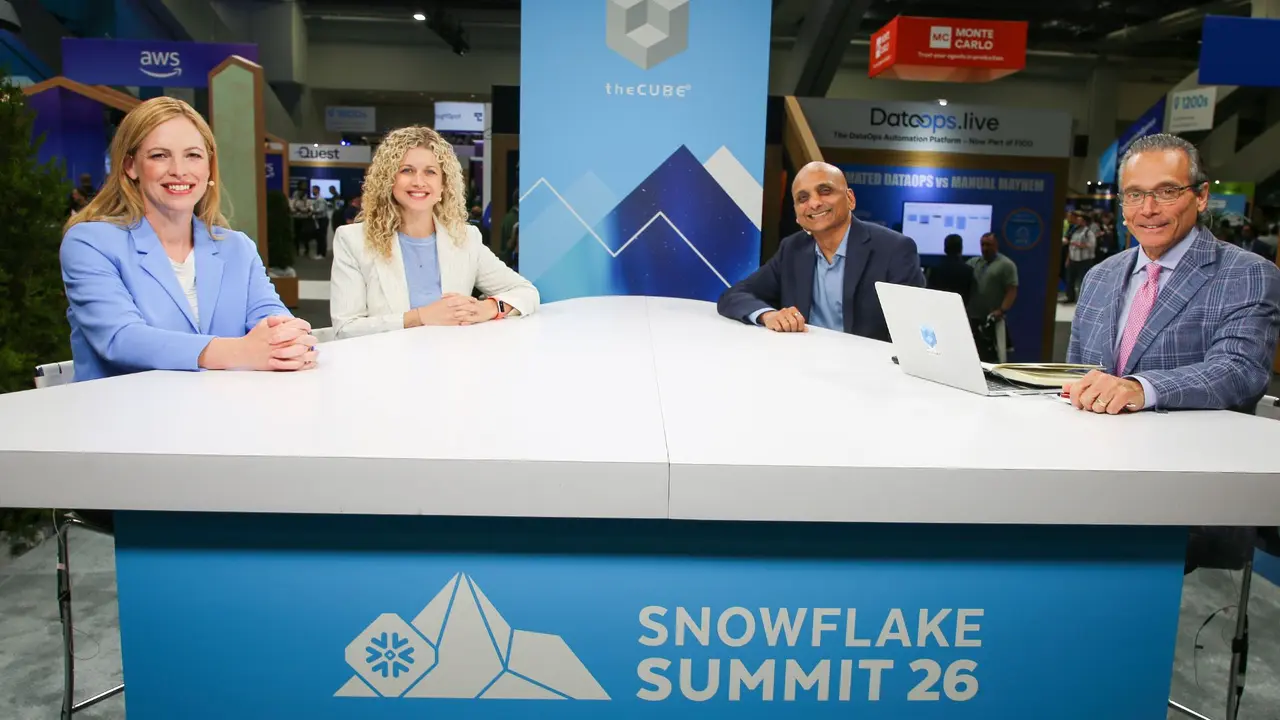
Source: SiliconANGLE
For Thomson Reuters, fiduciary grade AI represents an operational standard built on four components: authoritative content, investment in data security and safety, expert validation through subject matter experts who vet outputs, and transparent results
1
. Laura Safdie, head of legal innovation at Thomson Reuters, explained the stakes clearly: "The difference between using AI that's unconnected to legal data, unconnected to legal expertise can mean getting it wrong. And so we work with the professionals who need to get it right every time"1
. This standard ensures that professionals facing personal liability can trust AI outputs in their critical decision-making processes.CoCounsel, Thomson Reuters' legal AI assistant co-created by Safdie before the company acquired Casetext in 2023 for $650 million, exemplifies how fiduciary grade AI delivers trusted professional insights
1
. The assistant has evolved from an early retrieval-augmented generation approach into a fully agentic assistant natively built on Thomson Reuters' authoritative legal content, including Westlaw and Practical Law1
. Safdie noted that rebuilding around an agentic harness unlocks complex work products while keeping lawyers in control of every step, with Thomson Reuters' responsible AI team vetting every capability for hallucination and bias before deployment1
.Related Stories
Thomson Reuters selected Snowflake in 2021 for its ability to bridge enterprise-grade data governance with scalable infrastructure
2
. The company has created a single, secure source of truth that powers its internal My Data Space platform, where more than 1,500 internal users including data engineers, analysts, and business leaders access regulated data daily2
. By building semantic capability on Snowflake that unifies more than 23 previously fragmented customer master data sources, Thomson Reuters has given finance teams a single, trusted definition of core business terms1
. Kasiviswanathan emphasized that "self-serve is the future," noting that a secure governed platform removes bottlenecks and accelerates enterprise AI deployment1
.Leveraging Snowflake Cortex AI, Thomson Reuters is moving beyond data management to deliver AI at scale across the organization
2
. Caitlin Halferty, head of data and analytics at Thomson Reuters, stated: "With Snowflake Cortex, we're accelerating how we build and scale AI across Thomson Reuters. The real value is not just speed. It is the ability to innovate in a governed environment where our teams can turn complex regulatory data into actionable insights"2
. As the company consolidates data pipelines supporting flagship products like CoCounsel and Westlaw, key workloads are running up to 3.4 times faster, enabling teams to move from static reporting to near real-time insights . Complex analysis that previously took weeks now takes seconds, with manual data preparation eliminated across key workflows .Summarized by
Navi
[1]
04 Feb 2025•Technology

28 May 2026•Technology

13 Jul 2024

1
Technology

2
Policy and Regulation

3
Technology

News Categories