14 Sources
[1]
What Snowflake Summit 2026 signals about enterprise AI
The next phase of enterprise AI will be decided less by models and more by how enterprises govern, secure, and operationalize AI across fragmented environments. Most enterprises already have access to AI models, so that is no longer the differentiator. The real challenge begins after the demo ends. Organizations are now trying to determine how AI agents interact with ERP systems, supply chains, approvals, security policies, customer records, and operational environments that were never designed for autonomous systems. The reality is that ERP remains the system of record for many business decisions. If AI agents cannot operate within ERP governance, approval, and transaction frameworks, they remain assistants rather than operational participants. What makes this interesting is that Snowflake is not positioning itself as another AI platform vendor. The company is positioning itself to be the governance and orchestration layer that enterprises will build agentic AI around. Horizon Context, Semantic Studio, Cortex Sense, Coco, Cowork, Apache Iceberg interoperability, Model Context Protocol (MCP) connectivity, and the company's broader AI security strategy all point toward the same objective. The core message is that metadata, lineage, identity, policy enforcement, and business context should travel with the agent, not stay locked up in the platform it started in.
[2]
Agentic AI maturity drives Whoop's Snowflake AI scaling
Whoop is building agentic AI maturity on a foundation of enterprise health data Enterprise AI programs are moving beyond experimentation, but agentic AI maturity -- the ability to run governed, autonomous workflows at production scale -- remains out of reach for most organizations. The companies closing that gap fastest are the ones that invested early in clean data foundations. Whoop, the Boston-based health technology company known for its biometric wearable, is one of the clearest examples of what this process looks like in practice. The company's journey from elite-athlete fitness tracker to full-scale health platform -- now processing sensor data that captures heart rate, respiratory rate, heart rate variability, blood pressure and electrocardiogram readings -- has made data infrastructure a first-order strategic priority, according to Matt Luizzi (pictured, right), vice president of analytics at Whoop. "We're capturing a ton of sensor data -- this is data coming off the wrist that we're processing, storing in our data lake," Luizzi said. "And then we want to use analytics to improve the product experience, understand how to get the product into the hands of more customers. Snowflake sits at the center of that. We power our entire business analytics function by Snowflake. And more recently with AI, it's really transformed the way that we're able to accelerate our insight delivery and prove value to our members." Luizzi and Vivek Raghunathan (left), senior vice president of engineering and support at Snowflake Inc., spoke with theCUBE's Dave Vellante and Rebecca Knight at Snowflake Summit 2026, during an exclusive broadcast on theCUBE, SiliconANGLE Media's livestreaming studio. They discussed how Whoop is operationalizing AI workflows and advancing agentic AI maturity on Snowflake's data platform, along with interoperability strategies using Apache Iceberg and Polaris. (* Disclosure below.) Agentic AI maturity and the tribal knowledge opportunity The scale of Whoop's data challenge is not trivial. The company currently holds more than three petabytes of data in its data lake, with 20 terabytes added per day, making interoperability and open standards like Apache Iceberg essential for long-term flexibility, Luizzi noted. That foundation has enabled Whoop to adopt Snowflake's newest agentic tools -- including Snowflake CoCo, the platform's coding agent for enterprise data workflows -- with what Luizzi described as immediate, measurable results. "We've been putting a lot of effort into generating that clean semantic ontology over the past couple of years," Luizzi said. "And that's really enabled us to take products like CoCo Desktop and immediately dive in and see value. What we're seeing now is a shift in where humans are able to add value and where they're needed to add value." Raghunathan framed the broader platform strategy around two complementary personas. He previously co-founded Neeva Inc., the AI search engine acquired by Snowflake, giving him an engineer's perspective on where agentic tools are heading. Snowflake CoWork targets business users looking to extract insights from data, while Snowflake CoCo is built for developers and builders who construct the models, skills and intelligence those business users rely on. Both, he said, are present at every company. "I think a lot of what we are seeing is [that we need to] start from first principles and ask what are the jobs to be done," Raghunathan said. "Some of those activities will be activities where the input is well-defined and structured and the output is well-defined and structured. And if that's the case, then an agent will do that activity. There'll be a third class of activities -- the input is fuzzy, the output is fuzzy -- what I'd call fundamentally human activities." For Whoop, the practical effect of agentic AI maturity is already visible in how roles are evolving. The boundaries between what a product manager, analyst, designer, and engineer do are blurring as agents absorb tribal knowledge and automate workflows that once required specialized expertise, Luizzi explained. The outcome, he said, is not fewer humans but more output. "We're starting to see some early signs that we're really automating a lot of those more trivial workflows that just require tribal knowledge and manual work, and start to repurpose these same humans on these strategic value-add tasks for the business," Luizzi said. "What we're not seeing is the lack of need for humans. We're seeing all this [...] work kind of propagate and we're able to do a lot more things as a business, move faster, and ultimately deliver a lot more value to our customers." Here's the complete video interview, part of SiliconANGLE's and theCUBE's coverage of Snowflake Summit 2026 event: (* Disclosure: TheCUBE is a paid media partner for Snowflake Summit 2026. Sponsors of theCUBE's event coverage do not have editorial control over content on theCUBE or SiliconANGLE.)
[3]
Snowflake Summit 2026- how Snowflake is making a strategic shift towards agentic AI
Snowflake is usually a good bellwether for the rapid pace of technological change in enterprise IT. A few years ago, the technology firm was eager to prove it was the trusted platform for cloud services, not just a data warehouse. Now, after a series of feature releases, another tipping point has been reached, with Snowflake aiming to become the control plane for agentic AI. In his opening keynote to Snowflake Summit 2026 in San Francisco, CEO Sridhar Ramaswamy outlined his company's strategy, suggesting that its focus on agents will allow business and digital leaders to embrace rapid technological transformations enabled by AI: The very nature of work is changing. Day-to-day work is about partnering with and guiding intelligent agents, and soon they will be operating across your business continuously, autonomously. This truly is going to be the era of the agentic enterprise. At the heart of Snowflake's approach is the agentic control plane, an orchestration layer that helps professionals connect AI models and services in a tightly governed manner to the data that resides in their Snowflake platform. Ramaswamy said this layer will be crucial to ensuring that agents across a range of organizational functions are connected and useful: You can spin up agents across your business, but without a control plane, these agents are effective only in isolation and not really aware of each other. You need a way to coordinate across your context models and applications, so that decisions and actions happen seamlessly across your business. While the control plane will help businesses to exploit data in the Snowflake platform, the company will also use APIs and Anthropic's Model Context Protocol to allow agents to interact with other enterprise applications, such as Salesforce and Workday, and frontier AI models from the big technology providers. Interestingly, Snowflake's approach isn't just centered on external AI models and tools. The company is also continuing to develop its own agents as part of its control plane. At the event, Snowflake announced new features and a rebranding for Snowflake Intelligence, its personal agent for knowledge workers (now known as CoWork), and Snowflake Cortex Code, its coding agent for developers and data engineers (now known as Snowflake CoCo). Ramaswamy explained what he believes the agents mean for the firm's customers: You're able to turn ideas into working pipelines, applications, or agents using natural language - these are the building blocks of a system of decision. These are your agentic control planes, and they're already allowing incredible transformation across thousands of leading enterprises. Openness and inter-operability Four key premises ran through the company's messaging at Summit: delivering enterprise data that's ready for AI; providing flexibility over model choice; ensuring inter-operability across enterprises applications; and developing an agentic control plane enabled by Snowflake's CoCo and CoWork tools. While the company is eager to look towards to the future of the agentic enterprise, Ramaswamy said too many enterprises still struggle to exploit their data assets because they reside in fragmented silos with their own versions of the truth. He suggested Snowflake's strength has always been helping its customers bring sources together on a single platform. Yet while Snowflake's focus has traditionally been on honing its tightly integrated platform, the company recognizes, like so many other technology vendors, that the only way to stay competitive in an era of rapid technological innovation is to give its customers as much choice as possible. As Snowflake's EVP of product, Christian Kleinerman, recognized at the event, your favorite AI model today is unlikely to be your preferred model tomorrow: The notion that you need to put all your data in one platform and decide everything with that one vendor is a tale of the past. What we're offering is choice. If you already have data outside, you can use Snowflake to make reads or writes to that data. Kleinerman explained how Snowflake's approach to innovation is based on the premise that its agentic control plane will allow every professional in the enterprise, not just IT and data experts, to leverage AI. He suggested Snowflake's key differentiation is its long-established focus on security, compliance, and governance. By using Snowflake, CIOs can be confident that employees will use AI in a consistent and effective manner. To this end, the company announced other new features, including Datastream, a fully managed streaming service to simplify how organizations ingest real-time data into the Snowflake platform, and Horizon Context, a governed semantic foundation that ensures every person, tool, and AI agent operates from the same source of information. Agentic explorations While Snowflake's vision of an agentic control plane is based around openness and interoperability, it's interesting to note that the company is committed to developing its own agents via CoCo and CoWork. At a time when specialists like Anthropic and OpenAI are releasing new, powerful models on what feels like a weekly cadence, it would be easy for a company like Snowflake - who's specialism has traditionally been the cloud-based data platform - to focus on its core strength and leave agentic innovation to the frontier firms. However, when asked why Snowflake is placing so much focus on developing its own agents, Ramaswamy said to Diginomica that technology specialists have a duty to explore all areas of innovation in a world of rapid change. He said Snowflake's agentic explorations will allow it to develop better products in the future: I think anyone that is sitting out how users are going to interact with software is putting themselves in great strategic peril, and there is also a world of learning that comes from creating these products, both internally, but definitely with your customers. With a tool like CoCo, not only do we let you, the customer, implement a data pipeline faster, but we also get instrumentation on the things that users are struggling with. That kind of telemetry is invaluable. My take Snowflake is pivoting again. Once a database specialist, and still an expert in consolidating data sources in the cloud, the technology specialist is now going all-in on agentic AI. Along with its control plane, the company is developing and honing its own agents. It's a broad strategic play that shifts Snowflake into a new era of openness and interoperability.
[4]
Snowflake adds new AI services while continuing to build relationships with key model providers
Snowflake adds new AI services while continuing to build relationships with key model providers In the era of artificial intelligence, some companies have struggled to adopt artificial intelligence and others have pivoted to an AI framework that has yielded positive results. Snowflake Inc. this week confirmed it's firmly in the latter category. The cloud data platform giant took what amounted to a victory lap during its annual Snowflake Summit conference in San Francisco this week following a quarterly earnings report that saw the company increase revenue 33% from a year ago -- and its stock follow suit. In his keynote remarks on Monday, Chief Executive Sridhar Ramaswamy (pictured) offered a succinct explanation for his company's recent success. "The model is not your unique advantage. Why? Because your competitor has that model too," Ramaswamy said. "It's when you combine models with your data that things begin to shine." Framework for interoperable data Snowflake made a series of announcements today designed to further enable enterprises to combine models with data, covering interoperability, AI governance and application development. These included a new framework for interoperable data and AI with expanded support for Apache Iceberg. The company added linkages with Apache Iceberg v3 along with Snowflake Storage for Apache Iceberg Tables, enabling users to work across information inside and outside of Snowflake, while minimizing data movement. "We are as committed as anyone can be that no one feels like they are locked into Snowflake," Christian Kleinerman, executive vice president of product, during his keynote presentation today. "We are committed to making sure that Snowflake is open and interoperable." The company provided new services and support for its two flagship products - Cortex Code and Snowflake Intelligence, both rebranded this week as CoCo and CoWork, respectively. As the coding agent for developers, CoCo now supports desktop and mobile applications, with additional integrations for Slack and Anthropic PBC's Claude Code. CoWork has been expanded to serve as a personal work agent, with AI integrations through Model Context Protocol and a Deep Research capability that sources structured and unstructured enterprise data. A new context layer called Cortex Sense equips AI agents with more operational knowledge and business-associated definitions. "The vision behind CoCo and CoWork is we want very much to be that layer of intelligence," Ramaswamy said. "They are getting adopted because they are truly joyous products to use in terms of getting things done." Embracing frontier AI models This week's announcements and Snowflake's recent earnings momentum offered the picture of a company making a transition from being a data analytics warehouse to becoming a provider of fully managed AI services. Snowflake has assiduously built close relationships with Amazon Web Services Inc., Microsoft Corp. and Google LLC to enable its cloud-based platform. Now it's doing the same thing with AI frontier model powerhouses Anthropic and OpenAI Group PBC. "Our commitment to you is to always have the latest and greatest models available to you on Snowflake," Kleinerman said. The company formed a $200 million multiyear partnership with OpenAI in February. That same month, Snowflake also launched agentic AI capabilities using enhanced versions of its Cortex Analyst and Cortex Search query tools in combination with Anthropic's Claude 3.5 Sonnet. Snowflake is keenly aware that its AI strategy will depend heavily on enterprise trust and confidence in how proprietary data will be used and managed. Governance was a key focus on the announcements this week and the message was also reinforced by Anthropic President Daniela Amodei in a joint appearance with Ramaswamy during the conference on Monday. "We care about developing artificial intelligence responsibly and safely," Amodei said. "Trust is an accelerant, trust is something that helps you go faster. I just see a lot of potential for that to be one of the building blocks of the future." Building system of intelligence Behind the numerous announcements made by Snowflake this week can be found a significant shift in the firm's overall direction. As noted by SiliconANGLE's research analysts, Snowflake is moving up the AI software stack in a bid to become a system of intelligence, the enterprise context layer for organizing data, governance, business logic, and institutional knowledge so humans and agents can take appropriate action. Evidence for this can be seen in Snowflake's announcements this week. CoWork now plays a central role in the company's intent to deliver insights and impactful action for governing enterprise tasks. "We are in a world of ubiquitous intelligence," Kleinerman said. "That is what see with Snowflake CoWork. Think of the level of optimization and pace of business that's going to enable." Recent enhancements for Snowflake's Horizon Catalog include Intent-Driven Governance, a natural-language powered capability that translates business rules into programmatic governance policies. Users can leverage this feature to state goals in plain English and Snowflake will automatically handle the enforcement and audit documentation. "You express the intent, we take care of the details," Kleinerman said. By any measure, this sounds like a full-fledged AI company's value proposition, a sure indicator of what Snowflake intends to deliver and how it views itself in the enterprise information technology market for 2026. Yet this is also a story that remains to be written as Ramaswamy himself freely acknowledged in a briefing with media and analysts on Monday. "I think history will unfold itself," Ramaswamy told the gathering. "There is a little bit of a gold rush here for who can create value for customers faster. Every company needs to understand its core strengths and make sure that everything they build leverages those strengths. Strategy is important, but execution trumps strategy most of the time."
[5]
India's AI edge will come from talent, not compute, says Snowflake CEO
Snowflake CEO Sridhar Ramaswamy believes India's AI advantage lies in its talent and innovation under constraints, not just infrastructure. He advises focusing on engineering prowess and efficient systems, cautioning against solely measuring AI adoption by token usage and emphasizing business outcomes over consumption metrics. India's biggest opportunity in the artificial intelligence race may not come from building the largest AI infrastructure, but from its talent pool and ability to innovate under constraints, according to Snowflake chief executive Sridhar Ramaswamy. Speaking during a media briefing at Snowflake Summit 2026 in San Francisco, Ramaswamy said countries such as India are unlikely to outcompete larger economies purely on the basis of power generation and compute capacity as AI models become increasingly resource-intensive. "It is hard for a nation that large and that tightly constrained with respect to things like power to outcompete on the basis of just raw power generation," Ramaswamy said while answering ET's question. Instead, India should focus on areas where it already has a natural advantage, including engineering talent, open-source innovation and building efficient systems under constraints, he said. India is seeing a surge in investments aimed at building AI and data centre infrastructure, with major technology companies including Microsoft, Google and Amazon committing billions of dollars to expand their cloud and data centre footprint in the country. At the same time, concerns are growing globally about the energy and computing resources required to support increasingly powerful AI models. While acknowledging those challenges, Ramaswamy argued that constraints often drive innovation rather than limit it. "Operating within constraints can be as liberating as not having constraints, because you just end up thinking differently," he said. The debate around AI spending has intensified in the past weeks as companies grapple with rising token costs and growing AI bills. Some firms, including Uber and Microsoft, have reportedly tightened controls around AI usage after costs increased faster than expected. However, Ramaswamy also pushed back against the growing obsession with measuring AI adoption through token usage. "First of all, I think token maxxing is a terrible idea," he said, referring to the practice of encouraging employees to maximise their use of AI tools. According to him, companies should focus on business outcomes rather than consumption metrics. "The presence of good AI usage numbers does not indicate that you're being productive with AI, but a complete absence of numbers certainly indicates you have no clue," he said. The data and AI company is already seeing AI agents significantly reduce the time required for some tasks, with projects that once took months being completed in hours. However, he cautioned that higher AI usage alone should not be mistaken for productivity. The company is also working to lower AI costs by using smaller models for routine tasks while reserving more advanced models for complex reasoning and planning. Snowflake also unveiled new capabilities for CoCo, its AI coding agent formerly known as Cortex Code, and launched Datastream, a managed streaming service designed to bring real-time data into AI applications. "Anyone that thinks the trend line is fake simply isn't experiencing AI at the depth that it needs to be experienced," he said. For enterprises, the real question is no longer whether to adopt AI, but how to use it effectively and efficiently, Ramaswamy added. The reporter was in San Francisco at the invitation of Snowflake.
[6]
Snowflake Summit 2026: CoCo, CoWork Drive Partner Growth
'There is a little bit of a gold rush here in terms of who is able to create value for companies faster,' says Snowflake CEO Sridhar Ramaswamy. Snowflake used its annual Summit event to showcase advancements in its CoWork personal work agent formerly known as Snowflake Intelligence, its CoCo artificial intelligence coding agent formerly known as Cortex Code and its partner ecosystem as the AI era drives greater consumption of its data platform and tools. Solution providers "are critical to our go-to market," Snowflake CEO Sridhar Ramaswamy said in response to a question from CRN during a press conference at Summit 2026. Summit runs through Thursday in San Francisco. "What tools like CoCo make possible is much faster implementation, much faster time-to-value," Ramaswamy said. "There is a little bit of a gold rush here in terms of who is able to create value for companies faster." [RELATED: Snowflake CEO: 'I'm Not In The Business Of Selling AI. I'm In The Business Of Creating Value.'] Snowflake Summit 2026 Eric Walk, vice president of AI data platforms at St. Louis-based Snowflake solution provider Perficient, No. 61 on CRN's 2025 Solution Provider 500, told CRN in an interview that Snowflake has been building a truly unified data platform that brings together streaming, governance and other essential parts of the market. The Perficient customers he works with have sought platforms like Snowflake for the flexibility of taking action on their data regardless of the clouds they use, as just one example of the platform's power, he said. He also sees Snowflake expanding its class of potential users into knowledge workers through their advancements in CoWork. "It's huge for creating context to power AI," Walk said. As part of the product news coming out of Summit, Snowflake revealed that prebuilt CoCo Skills for common data engineering and AI workflows across all data are now generally available (GA). Other newly GA product innovations include a CoCo plugin for Anthropic's Claude Code and a secured local sandbox to operate agents in isolated local environments, according to Snowflake. Going GA soon are CoCo Cloud Agents for starting work in the Snowsight web-based GUI and running it in the cloud without running anything locally on a laptop, a native CoCo Desktop application and a Snowflake CoWork iOS mobile application. Public previews disclosed during Summit include a new CoCo Skills Catalog for discovering, sharing and reusing workflows across teams plus an integration with Vercel, according to the vendor. Upcoming public previews include CoCo Automations that power recurring, event-driven workflows, a CoCo mobile application, publishable dashboards for CoWork artifacts and integration with Salesforce Slackbot, VS Code and more. Coming to private preview soon is a CoCo extension with Microsoft Excel and a CoWork Cortex Sense capability for bringing together data, business definitions and operational knowledge for agents. CoCo is one of the biggest opportunities for Snowflake solution providers looking ahead, Amy Kodl, the vendor's senior vice president of worldwide alliances and channels, told CRN in an interview. CoCo has already improved time to go live by around 26 percent for some users, for example. "It's not just about technology for technology's sake," Kodl said. "It is about making sure we're driving those outcomes." Snowflake's competitive differentiator in the age of AI includes unlocking model choice flexibility for users and interoperability with a variety of cloud providers -- all while securing data and keeping it governed, Kodl said. The vendor has invested over $200 million in its partner ecosystem over the last 12 months as a sign of the continued importance of the community. "We're now asking that our partners are really driving towards outcomes -- that they're committing up front with the customers," she said.
[7]
Snowflake Says AI Is No Longer Just Tailwind -- It's Driving Business - Snowflake (NYSE:SNOW)
The company's shares surged more than 35% premarket after management directly tied accelerating growth to adoption of its AI products, particularly Cortex Code, or "Cocoa," its AI-powered coding and workflow platform. More importantly, Snowflake no longer appears to be framing AI as merely a future opportunity. It says AI is actively driving the business right now. "AI is accelerating consumption in our core platform," CEO Sridhar Ramaswamy said during the company's earnings call. That statement matters because investors have spent the last year debating whether AI would actually increase spending on enterprise software platforms -- or simply commoditize them. Snowflake is arguing the opposite is happening. Snowflake Says AI Is Creating A Flywheel Management repeatedly emphasized that AI products are pushing customers to migrate more workloads onto Snowflake faster in order to access enterprise data, governance and workflows needed to deploy AI systems securely. The company said Cortex Code and Snowflake Intelligence are seeing the "fastest adoption of any new products in our history." CFO Brian Robbins made perhaps the most important comment of the entire call. "Cocoa had the largest driver to the increase in our forecast," he said. That's a significant shift. For much of the past two years, AI discussions across software earnings calls have centered around pilots, experimentation and long-term possibilities. Snowflake is now explicitly linking AI products to raised guidance and accelerating growth. Product revenue growth accelerated to 34% year over year, while Snowflake raised its full-year product revenue outlook. Snowflake Wants To Become The 'Agent Control Plane' The company also revealed a much broader ambition than simply being a cloud data warehouse. Management repeatedly described Snowflake as an "agent control plane" -- essentially positioning the platform as the orchestration layer where enterprise AI agents interact with data, workflows and applications. "What customers increasingly want is one place to get work done," Ramaswamy said. That positioning could become increasingly important as enterprises move beyond chatbots toward AI agents capable of taking actions across systems and workflows. And judging by the market's reaction, investors appear increasingly willing to reward software companies that can prove AI is driving real revenue acceleration -- not just generating headlines. Market News and Data brought to you by Benzinga APIs To add Benzinga News as your preferred source on Google, click here.
[8]
Snowflake Unveils Agentic Enterprise Platform with New AI, Governance and Interoperability Features
Snowflake introduced new interoperability capabilities that enable organizations to seamlessly access, govern, share, and act on data across Snowflake, external lakes, and open systems without moving or duplicating data. New interoperability innovations including support for Apache Iceberg v3, Snowflake Storage for Apache Iceberg Tables, external engine access management, and support for Iceberg REST Scan Plan API establish a single, governed foundation for enterprise data and AI. Powered by Snowflake Horizon Catalog and Apache Polaris, these capabilities help organizations securely work from a single, live, governed copy of enterprise data across clouds, tools, engines, and enterprise systems. Snowflake is also enabling organizations to securely interact with their enterprise data through natural language with Snowflake CoCo and Snowflake CoWork, while Automatic Data Agents and Agent Sharing automatically transform shared datasets into conversational AI agents with governance built in.
[9]
Snowflake Just Dropped a Massive Upgrade for AI Agents
Snowflake helps organizations accelerate innovation and operationalize trusted AI through a unified control plane for enterprise data, context, and action Snowflake today announced at Snowflake Summit 26 a broad set of innovations that help organizations accelerate the shift to the agentic enterprise. Across Snowflake CoCo, Snowflake CoWork, Snowflake Horizon Catalog, and Snowflake's interoperable data platform, Snowflake is helping organizations build, govern, and operationalize AI on a single, connected, and trusted foundation. As enterprises move from AI experimentation to autonomous systems operating at scale, they need a platform that connects data, business context, governance, and action across the organization. Snowflake's latest innovations bring together AI agents, governed enterprise data, semantic understanding, and open interoperability into a unified control plane that enables teams to operationalize AI with confidence. "The future of enterprise AI will be defined by how well organizations connect intelligence, trusted data, and action across the business," said Vijayant Rai, Managing Director- India, Snowflake. "At Snowflake Summit 26, we're introducing innovations that help power the agentic enterprise, giving organizations a trusted foundation and control plane to build AI faster, operationalize it securely at scale, and enable teams and AI agents to work together from a shared business context wherever data lives." Snowflake CoCo Redefines Enterprise AI Development Snowflake announced major new capabilities for Snowflake CoCo, the coding agent where you build faster, helping builders automate workflows, develop applications, and operationalize AI through simple, outcome-based conversations. * New CoCo innovations expand the experience across desktop, mobile, Slack, VS Code, Claude Code, and Microsoft Excel, enabling builders to work from the tools and environments they already use. * Snowflake also introduced Snowflake Datastream, a fully managed streaming service for Apache Kafka® that enables organizations to power real-time AI apps and agents with fresh, continuously flowing data directly within Snowflake. * Together, CoCo and Datastream simplify how organizations build and operationalize real-time AI by combining AI-assisted development with governed, real-time data in a single platform. Snowflake CoWork Powers the Agentic Enterprise Snowflake also announced new innovations across Snowflake CoWork, the personal agent for knowledge workers to work smarter, helping organizations move faster from insight to impactful action. * New CoWork capabilities including Cortex Sense, Artifacts, Deep Research, User Skills, and personalization help teams interact with enterprise data and AI through a unified, context-aware agent experience. * CoWork enables organizations to move beyond reactive question-and-answer experiences toward proactive, personalized intelligence that helps teams automate workflows, accelerate decision-making, and operationalize AI across the business. Snowflake also introduced Cortex Training, extending Snowflake Cortex AI with fully managed infrastructure for customizing and training foundation models directly where enterprise data already lives. Snowflake Horizon Catalog Creates a Trusted Foundation for Enterprise AI Snowflake announced new innovations across Snowflake Horizon Catalog that redefine how enterprises govern, contextualize, and secure AI at scale. * New capabilities including Horizon Context help ensure every person, tool, and AI agent operates from the same trusted business context, while new AI security innovations provide purpose-built controls for governing and securing enterprise AI systems. * New security innovations including Agent Identity and enhancements to Snowflake Trust Center help organizations strengthen visibility, governance, and control as they scale AI and autonomous systems across the enterprise. Snowflake also introduced Adaptive Compute, which automatically optimizes compute and software resources in real time to deliver fast, efficient AI and application performance at enterprise scale without manual tuning or infrastructure management. Snowflake Advances Interoperability Without Compromise Snowflake introduced new interoperability capabilities that enable organizations to seamlessly access, govern, share, and act on data across Snowflake, external lakes, and open systems without moving or duplicating data. * New interoperability innovations including support for Apache Iceberg v3, Snowflake Storage for Apache Iceberg Tables, external engine access management, and support for Iceberg REST Scan Plan API establish a single, governed foundation for enterprise data and AI. * Powered by Snowflake Horizon Catalog and Apache Polaris, these capabilities help organizations securely work from a single, live, governed copy of enterprise data across clouds, tools, engines, and enterprise systems.
[10]
Inside the Snowflake & Anthropic Push for Trusted Enterprise AI
Snowflake and Anthropic today announced at Snowflake Summit 26 significant momentum in their strategic partnership. Enterprises are increasingly adopting Anthropic Claude in Snowflake Cortex AI, Snowflake's suite of AI products, driven by growing demand for governed, production-ready AI. Together, Snowflake and Anthropic are helping enterprises move from AI experimentation to production faster. Building on Snowflake's and Anthropic's expanded partnership from December 2025, which integrated Claude models directly into Cortex AI across all major cloud platforms and established a joint go-to-market strategy, Snowflake and Anthropic are helping global enterprises deploy AI agents on their most critical business data. Anthropic delivers frontier model capabilities through Claude, while Snowflake makes Claude enterprise-ready, bringing it directly to the data, governance, security, and collaboration environment where customers already operate. Through Cortex AI, customers can use Claude with their Snowflake data, deploy AI agents with enterprise-grade controls, and select the Anthropic model that best fits their specific workload without moving sensitive data outside the Snowflake environment. "The rapid adoption of models like Claude through Snowflake Cortex AI reflects a broader shift in what enterprises expect from AI," said Christian Kleinerman, EVP of Product, Snowflake. "Customers want AI that works directly on their governed data, not in isolated systems. We're seeing strong demand across our AI products, with Snowflake Cortex Code becoming the fastest-growing product in Snowflake's history. Together with Anthropic, we're helping organizations move from experimentation to production faster and laying the foundation for the agentic enterprise, where AI, data, and governance work together to drive real business outcomes." "Snowflake customers are increasingly using Claude to power cybersecurity investigations, accelerate financial analysis, build production data apps, and many other workflows," said Steve Corfield, Head of Global Business Development & Partnerships, Anthropic. "Snowflake brings the governed data environment enterprises already rely on, and Claude brings the reasoning to put that data to work. Together we're making it easy for organizations to use trusted AI on their most critical business data." Enterprise Momentum Across Customers and Partners As enterprises operationalize AI across critical workflows, customers are turning to Snowflake and Anthropic to support advanced use cases that require deep context, strong reasoning, and enterprise-grade controls. These include customer support and financial analysis, as well as life sciences research, developer productivity, and sales intelligence where real business context is critical. This momentum spans every industry as organizations look to run AI directly on governed data within the systems where their businesses already operate. Snowflake's partner ecosystem extends this value, helping joint customers design, deploy, and scale Snowflake and Anthropic AI solutions to drive real business outcomes. "As marketing environments grow more complex and data-driven, organizations need solutions that optimize performance while operating within a secure, scalable data foundation," said Hiten Mistry, SVP of Product, Basis. "Leveraging Claude with Snowflake's trusted environment would empower Basis to deliver deeper insights and more automation across the marketing lifecycle. Basis aligns with Snowflake in delivering the transparency, governance, and flexibility that enterprises need to drive measurable outcomes and scale marketing operations." "At Block, we're focused on building an AI-native operating layer that connects intelligent reasoning directly to the trusted data powering our ecosystems across our different brands (including Square, Cash App, and Afterpay)," said Arnaud Weber, Engineering Lead, Block. "By combining Anthropic Claude with Snowflake's governed data platform, our teams can investigate compliance and security issues in real-time, trace controls and requirements, surface operational insights, and automate workflows grounded in trusted enterprise data. Developers are also using Snowflake Cortex Code to build and operationalize these capabilities directly within Snowflake, creating a unified layer where AI can move seamlessly from analysis to action. This approach helps us reduce friction across investigations and decision-making, while maintaining the governance, performance, and scalability needed to apply AI responsibly across financial services and commerce." "Carvana manages a highly dynamic operation spanning inventory, logistics, financing, and customer demand," said Alex Devkar, Senior Vice President of Engineering and Analytics, Carvana. "That complexity makes AI most powerful when it can work securely with governed enterprise data inside the systems our teams already use. By combining Claude with Snowflake, we can move faster, apply AI more effectively, and maintain the controls required to operate at scale." "Our work with Snowflake and Anthropic brings together leading AI capabilities with a governed data foundation, enabling organizations to embed intelligence directly into their core business processes," said Jason Salzetti, Chair and CEO, Deloitte Consulting LLP. "Deloitte plays a critical role in helping clients design, build, and scale these solutions, accelerating time to value while supporting the alignment of AI to enterprise standards for risk, compliance, and performance. This collaboration is helping our joint clients turn AI ambition into measurable business outcomes." "As cyber threats become more sophisticated and move at machine speed, organizations need AI that can reason deeply while operating within a secure, governed data environment," said Dustin Hillard, CPTO, eSentire. "By leveraging Claude within Snowflake's trusted environment, we're able to power AI-led threat investigations that autonomously handle Tier 1 analysis, freeing our SOC analysts to focus on complex threats with greater speed and precision. This approach gives our customers the transparency, governance, and operational scale required to confidently deploy AI in mission-critical cybersecurity workflows." "At Indeed, our mission is to help people get jobs. We use intelligent, AI-driven solutions to make the hiring process seamless and efficient for everyone," Trey Henninger, VP Data and Analytics, Indeed. "Harnessing Anthropic Claude within Snowflake's trusted AI Data Cloud allows us to make our data interactable for all Indeed employees. This shift to self-service analytics means we move from data to insights much faster, ultimately improving the hiring process with personalized experiences for job seekers and sophisticated, data-driven tools for employers." "Notion is defining how AI and enterprise data come together in the modern workspace, bringing intelligence directly into the flow of everyday work," said Ravi Menon, Head of Data, Notion. "By integrating models like Claude with Snowflake's governed data platform, we're giving teams the ability to generate content, synthesize knowledge, and access real time business insights all in one place. We've created agents like Data Scout that pull directly from Snowflake, helping customers move from question to insight to action without friction. The result is a more powerful and trusted experience, where AI is grounded in secure, reliable data and teams can make faster, more confident decisions." Snowflake and Anthropic Co-Innovate to Bring Governed AI to the Enterprise Snowflake and Anthropic are partnering closely to help enterprises build AI that is powerful, secure, and deeply grounded in their business context. The two companies have rapidly expanded their co-innovation, working in lockstep to bring advanced AI capabilities into production for enterprise customers. This deep collaboration reflects a shared commitment to making AI practical, governed, and scalable for real business use cases. Key areas of innovation include:
[11]
Snowflake expands Anthropic partnership for enterprise AI By Investing.com
SAN FRANCISCO - Snowflake Inc. (NYSE:SNOW) and Anthropic announced Monday the expansion of their strategic partnership, integrating Anthropic's Claude models into Snowflake Cortex AI to support enterprise AI deployment. The announcement sent Snowflake shares surging 57.75% over the past week, pushing the stock to within 1% of its 52-week high of $285. The partnership builds on an agreement from December 2025 that integrated Claude models into Cortex AI across major cloud platforms. The companies stated that enterprises are using Claude through Snowflake for cybersecurity investigations, financial analysis, and data applications. Snowflake reported that Cortex Code, powered by models including Claude, has more than 7,100 users. The company described it as Snowflake's fastest-growing product. Christian Kleinerman, EVP of Product at Snowflake, stated the product translates prompts into production-ready pipelines and applications for Snowflake schemas and workflows. The momentum comes as Snowflake posted $5.03 billion in revenue over the last twelve months with 31% growth, though the company remains unprofitable with a loss of $3.51 per share. According to InvestingPro data, 29 analysts have revised their earnings upwards for the upcoming period, and analysts predict the company will be profitable this year. The integration allows customers to use Claude models with Snowflake data while maintaining governance and security controls within the Snowflake environment, according to a press release statement. Companies using the integration include Basis, Block, Carvana, eSentire, Indeed, and Notion. Block's Engineering Lead Arnaud Weber stated teams use the system to investigate compliance and security issues and automate workflows. eSentire's CPTO Dustin Hillard said the company uses Claude within Snowflake for AI-led threat investigations. The partnership includes several components: Snowflake Intelligence, which uses Claude for natural language queries across enterprise data; Cortex Agents, a framework for building enterprise AI agents; and participation in Claude Marketplace, where customers can apply existing Anthropic commitments toward Snowflake AI capabilities. Snowflake and Anthropic stated they are collaborating on Claude Code Security capabilities designed to help organizations identify and remediate vulnerabilities. Snowflake reported having more than 13,900 customers globally. With an $88.6 billion market cap and trading at a high revenue valuation multiple, InvestingPro analysis indicates the stock is currently overvalued relative to its Fair Value -- placing it among companies on the Most Overvalued list. Investors seeking deeper insights can access Snowflake's comprehensive Pro Research Report, one of 1,400+ available reports that transform complex Wall Street data into actionable intelligence. In other recent news, Snowflake Inc. reported first-quarter fiscal 2027 product revenue of $1.334 billion, marking a 33.9% increase year-over-year and surpassing FactSet consensus expectations by 5.3%. The company also exceeded operating income estimates by 35.2%, showcasing robust financial performance. Following these strong results, several firms raised their price targets for Snowflake. Monness, Crespi, Hardt increased its price target to $320, citing the company's raised full-year guidance and strong second-quarter outlook. Freedom Broker adjusted its target to $300, highlighting the accelerated monetization of AI products and core platform growth. Benchmark set a new target of $270, noting record sequential dollar growth in the quarter. Cantor Fitzgerald raised its price target to $282, emphasizing the positive impact of Snowflake's AI-driven growth. Additionally, HSBC upgraded Snowflake's stock rating to Buy, recognizing the momentum from the company's AI product, CoCo, which has scaled to over 7,100 accounts since February 2026. This article was generated with the support of AI and reviewed by an editor. For more information see our T&C.
[12]
Snowflake, Anthropic Expand Partnership Targeting Enterprise Adoption of AI Tools
Snowflake Inc. is an artificial intelligence (AI) data cloud company. The Company provides a platform which powers the AI data cloud, enabling customers to consolidate data into a single source of truth to drive insights, apply AI to solve business problems, build data applications, and share data and data products. Its cloud-native architecture includes three independently scalable but logically integrated layers across storage, compute, and cloud services. The storage layer ingests massive amounts and varieties of structured, semi-structured, and unstructured data. The compute layer provides dedicated resources to enable users to simultaneously access common data sets for many use cases with minimal latency. The cloud services layer enables users to securely use AI within applications, tools, and processes. Its platform supports a wide range of product categories for customers’ business objectives, including analytics, data engineering, AI, applications and collaboration.
[13]
Snowflake's AI Monetization Moves to Higher Gear, Morgan Stanley Says
Snowflake Inc. is an artificial intelligence (AI) data cloud company. The Company provides a platform which powers the AI data cloud, enabling customers to consolidate data into a single source of truth to drive insights, apply AI to solve business problems, build data applications, and share data and data products. Its cloud-native architecture includes three independently scalable but logically integrated layers across storage, compute, and cloud services. The storage layer ingests massive amounts and varieties of structured, semi-structured, and unstructured data. The compute layer provides dedicated resources to enable users to simultaneously access common data sets for many use cases with minimal latency. The cloud services layer enables users to securely use AI within applications, tools, and processes. Its platform supports a wide range of product categories for customers’ business objectives, including analytics, data engineering, AI, applications and collaboration.
[14]
Snowflake-Anthropic deepen AI handshake as India emerges as key market
Strong India AI demand, but siloed data slows adoption, says Snowflake With Snowflake deepening its partnership with Anthropic, company executives are making a strong bet on India as their growth engine. Not just as a key market, but a driver of business innovation as well. That's the sense I got during a media briefing for Snowflake Summit 26, where Christian Kleinerman, EVP of Product at Snowflake, was asked to describe India's strategic importance to Snowflake's Asia-Pacific roadmap. "India is incredibly, incredibly important for Snowflake from two parts," Kleinerman said in response, explaining further. "One, it's a large economy with a lot of potential to drive business directly, but also it's a country that houses large chunks of global 2,000 and larger organizations." He added that Snowflake runs "a number of programs to make sure that our technology not only reaches India in as good a way as possible, but also how we bring education to India about the usage of Snowflake, because we have a lot of users from multinational companies that sit in India." Also read: AI isn't about bigger models: Snowflake's Jeff Hollan on agentic AI future Vijayant Rai, who leads Snowflake's India business, was even more blunt in his take. "India is a very crucial growth engine for Snowflake," he said, before describing the scale of the company's local build-out. "Over the past 18 months or so, we've doubled our size, with massive investments. We also have the largest APJ partner ecosystem, which is so important for us serving both Indian customers and global customers based out of India," emphasised Rai. That dual mandate, of serving home-grown enterprises while supporting the India arms of global firms, is crucial to Snowflake's strategy. Rai highlighted the company's Pune centre of excellence, "which does amazing work for Snowflake globally," and to the country's software builders: "There's a whole lot of Indian software companies which build on top of Snowflake, amazing industry solutions across different industries." The Anthropic partnership to Snowflake's enterprise AI push India's importance is rising just at the right time for Snowflake as it sharpens its enterprise-AI proposition through Anthropic. At Summit 26, the two companies boosted momentum in a partnership that builds on their $200-million tie-up from December 2025. Among other things, it will allow Anthropic's Claude models to embed directly into Snowflake's Cortex AI suite across all major cloud platforms. Their combined pitch is geared towards AI governance. Anthropic provides world-class frontier reasoning through Claude, while Snowflake packages it as part of its enterprise-ready toolkit, running it where customers' governed data already lives, without having to move any sensitive info. "Customers want AI that works directly on their governed data, not in isolated systems," Kleinerman said in the announcement, noting that Snowflake Cortex Code (which is the firm's AI coding agent, now powered by models including Claude) has more than 7,100 enterprise customers. For Indian readers, the bottomline is important. Questions on ROI, interoperability, agent security, and streaming data during the media interaction reflected how seriously Indian enterprises are scrutinising AI spend. While India's appetite for AI remains strong, Kleinerman's highlighted the problem of data remaining siloed: "Data is still in many different systems, and that will slow down the adoption and the rollout of AI." His advice to Indian tech leaders is to get the data foundation right first. That is the bet Snowflake is making in India, that a market full of both ambitious domestic builders and global captive units will reward a platform promising AI with governance built in. With its India headcount doubling and Anthropic's Claude now at the core of its stack, the company is positioning the country as central to where enterprise AI goes next.
Share
Copy Link
At Snowflake Summit 2026, CEO Sridhar Ramaswamy unveiled a strategic shift positioning the company as the governance and orchestration layer for enterprise AI. The cloud data platform introduced CoCo and CoWork agents, Datastream for real-time data ingestion, and expanded Apache Iceberg support. Whoop demonstrated agentic AI maturity by processing 20 terabytes daily through Snowflake's platform, showcasing how AI agents can operate within governed enterprise workflows.
At Snowflake Summit 2026 in San Francisco, CEO Sridhar Ramaswamy signaled a fundamental shift in how the company views its position in the AI landscape. Rather than competing as another AI platform vendor, Snowflake is positioning itself as the control plane for agentic AI—the governance and orchestration layer that enterprises will build autonomous AI systems around
1
. "The model is not your unique advantage. Why? Because your competitor has that model too," Ramaswamy told attendees. "It's when you combine models with your data that things begin to shine"4
. The announcement marks a strategic evolution for the cloud data platform giant, which reported 33% revenue growth year-over-year, confirming its successful pivot to an AI-centric framework4
.
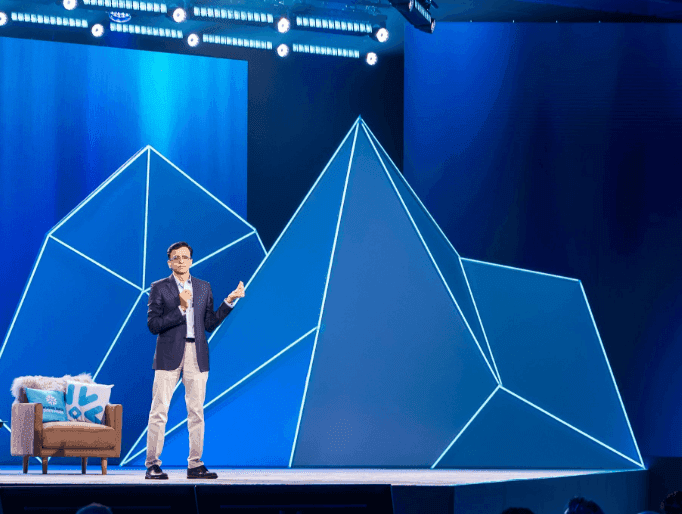
Source: diginomica
The real challenge facing enterprise AI isn't access to AI models—most organizations already have that. Instead, the difficulty begins after the demo ends, when companies try to determine how AI agents interact with ERP systems, supply chains, security policies, and operational environments never designed for autonomous systems
1
. Ramaswamy emphasized that without a control plane, agents remain effective only in isolation. "You need a way to coordinate across your context models and applications, so that decisions and actions happen seamlessly across your business," he explained3
. Snowflake's approach centers on ensuring metadata, lineage, identity, policy enforcement, and business context travel with the agent rather than staying locked in the platform where it originated1
. This focus on AI governance addresses a critical gap: if AI agents cannot operate within ERP governance and approval frameworks, they remain assistants rather than operational participants1
.Snowflake announced significant updates to its flagship AI products, rebranding Cortex Code as CoCo and Snowflake Intelligence as CoWork. CoCo serves as the coding agent for developers and data engineers, now supporting desktop and mobile applications with additional integrations for Slack and Anthropic's Claude Code
4
. CoWork has been expanded to function as a personal work agent, equipped with AI integrations through Model Context Protocol and a Deep Research capability that sources both structured and unstructured enterprise data4
. Vivek Raghunathan, senior vice president of engineering at Snowflake and co-founder of acquired AI search engine Neeva, explained that CoWork targets business users extracting insights from data, while CoCo is built for developers constructing the models and intelligence those users rely on2
. A new context layer called Cortex Sense equips AI agents with more operational knowledge and business-associated definitions4
.
Source: SiliconANGLE
Whoop, the Boston-based health technology company, provided one of the clearest examples of what agentic AI maturity looks like in production. The company currently holds more than three petabytes of data in its data lake, with 20 terabytes added per day from biometric wearables capturing heart rate, respiratory rate, heart rate variability, blood pressure, and electrocardiogram readings
2
. Matt Luizzi, vice president of analytics at Whoop, explained that investing early in clean data foundations enabled the company to adopt Snowflake's newest agentic tools with immediate, measurable results. "We've been putting a lot of effort into generating that clean semantic ontology over the past couple of years," Luizzi said. "And that's really enabled us to take products like CoCo Desktop and immediately dive in and see value"2
. The practical effect is visible in how roles are evolving—boundaries between product managers, analysts, designers, and engineers are blurring as agents absorb tribal knowledge and automate workflows that once required specialized expertise2
.Recognizing that the era of vendor lock-in is ending, Snowflake announced expanded support for Apache Iceberg v3 along with Snowflake Storage for Apache Iceberg Tables, enabling users to work across information inside and outside Snowflake while minimizing data movement
4
. Christian Kleinerman, executive vice president of product, stated: "We are as committed as anyone can be that no one feels like they are locked into Snowflake. We are committed to making sure that Snowflake is open and interoperable"4
. The company also introduced Datastream, a fully managed streaming service to simplify how organizations ingest real-time data into the Snowflake platform3
. Additionally, Horizon Context was announced as a governed semantic foundation ensuring every person, tool, and AI agent operates from the same source of information3
. These moves reflect Snowflake's recognition that favorite AI models today will likely change tomorrow, requiring maximum flexibility for customers3
.Related Stories
Snowflake is positioning itself as a fully managed AI services provider by building relationships with frontier model powerhouses. The company formed a $200 million multiyear partnership with OpenAI in February and launched agentic AI capabilities using Anthropic's Claude 3.5 Sonnet that same month
4
. "Our commitment to you is to always have the latest and greatest models available to you on Snowflake," Kleinerman promised4
. Anthropic President Daniela Amodei, appearing alongside Ramaswamy, emphasized that trust is crucial: "We care about developing artificial intelligence responsibly and safely. Trust is an accelerant, trust is something that helps you go faster"4
. Snowflake is keenly aware that its AI strategy depends heavily on enterprise trust in how proprietary data will be used and managed, making governance a central focus of this week's announcements4
.

Source: CXOToday
Ramaswamy pushed back against measuring AI adoption through token usage, calling "token maxxing" a terrible idea. "The presence of good AI usage numbers does not indicate that you require assistance, but a complete absence of numbers certainly indicates you have no clue," he said
5
. Companies should focus on business outcomes rather than consumption metrics, he advised. Snowflake is already seeing AI agents significantly reduce task completion time, with projects that once took months being completed in hours5
. The company is working to lower AI costs by using smaller AI models for routine tasks while reserving more advanced models for complex reasoning and planning5
. This approach reflects a broader shift in Snowflake's direction—moving up the AI software stack to become a system of intelligence, the enterprise context layer for organizing data, governance, business logic, and institutional knowledge so humans and agents can take appropriate action4
.Summarized by
Navi
[2]
[4]
03 Jun 2025•Technology

18 Mar 2026•Technology

04 Nov 2025•Business and Economy

1
Startups

2
Policy and Regulation

3
Technology