Trump Orders Federal Agencies to Replace 'AI' with 'Super Intelligence' as Tech Leaders Comply


10 Sources
[1]
The science of superintelligence and why AI is still a useful word
'Superintelligence' has arrived -- at least by one definition of the term. In an executive order issued on 29 September, US President Donald Trump declared that humanity is in "a new era of Super Intelligence". The term artificial intelligence is outdated, the order said: "[T]oday's frontier
[2]
Can 'super intelligence' and a non-binding safety pact solve AI's image problem?
President Donald Trump hosted many of the biggest names in artificial intelligence this week -- in part to announce that the U.S. government isn't calling it artificial intelligence anymore. Now it's super intelligence. On the latest episode of TechCrunch's Equity podcast, Kirsten Korosec, Sean
[3]
Trump's Crazy AI Rebrand Was a Loyalty Test for Tech Execs -- and It Worked
Seventy years ago last summer, a group of scientists met at Dartmouth College to discuss a wild idea -- that machines might one day be capable of human-like thought processes. One of those scientists, John McCarthy, had suggested a name for the new field: artificial intelligence. It stuck. When you
[4]
Trump Posts Not-So-Subtle Boast About 'Super Intelligence' Victory Over Elon Musk
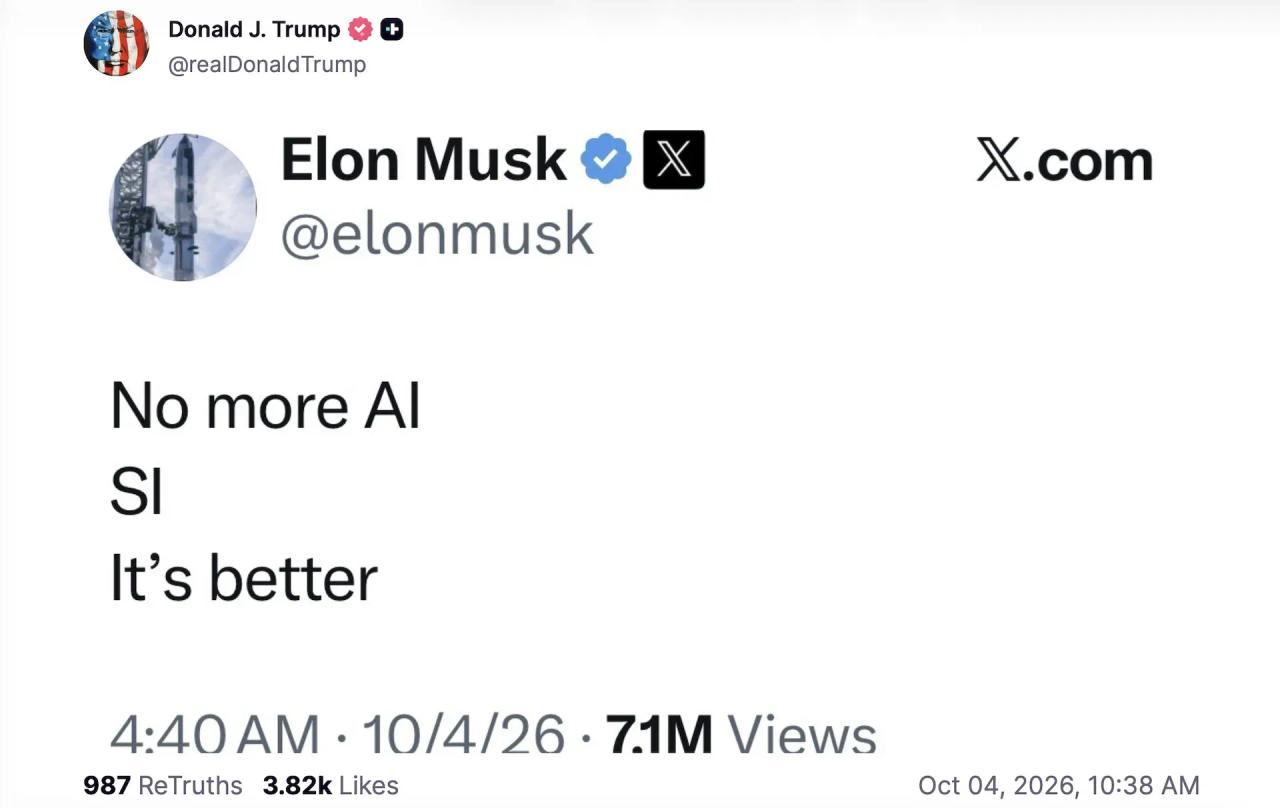
President Trump is notching up victories in his private war against the term "artificial intelligence." Perhaps his biggest win yet is a series of X posts from Elon Musk early Sunday morning declaring that Super Intelligence is a "better" term, and that he intends to rename SpaceXAI
[5]
If You're an AI Critic, Trump's 'Super Intelligence' Rebrand Is a Gift
You have to admit, the term "Super Intelligence" has a certain beauty to it, assuming you find it beautiful when the artificial intelligence business comes across as laughable and embarrassing. Sadly, words have meanings, and those of us with at least somewhat of an obligation to phrase things
[6]

Elon Musk is renaming SpaceXAI to match Trump's new 'Super Intelligence Force' -- but critics say the White House body 'isn't the answer'
SpaceXAI is becoming SpaceXSI and Washington pretends a terminology change is a technological strategy The U.S. government has a new task force devoted to AI -- and it's decided that it would now prefer that everyone stops calling it artificial intelligence. President Donald Trump has announced
[7]

Trump, CEOs try to shed AI's toxic branding
Why it matters: Leaders in D.C. and Silicon Valley are worried the public backlash against AI and data centers will hamper the development of this staggeringly powerful and existentially dangerous technology. The new label is part of a broader effort to shift the narrative. Driving the news:
[8]

AI Has a New Name: Super Intelligence. Why You Should Start Using SI Right Now
An executive order directing federal agencies to use "Super Intelligence" and "SI" in place of "Artificial Intelligence" and "AI" has big implications. A new Super Intelligence Force was also announced last week to coordinate the federal response. This all makes SI more than a slogan. As I've
[9]

'Super Intelligence,' Trump's Dopey AI Rebrand, Explained
Americans' concerns about artificial intelligence have quickly escalated from "it might take our jobs" to "it might kill us all." In September, top AI executives called for slowing down development shortly after an Anthropic whistleblower warned that the technology could soon spiral beyond human
[10]

Trump orders federal AI rebrand: "super intelligence" is now official
The meeting produced a voluntary accord with audits, not laws On September 29, 2026, the White House updated U.S. federal AI policy through an executive order posted on its website. In that order, "artificial intelligence" is replaced with "super intelligence." The announcement came after a White
Share
Copy Link
President Donald Trump signed an executive order mandating federal agencies use 'Super Intelligence' instead of 'artificial intelligence.' The directive followed a White House meeting where AI industry leaders signed a non-binding safety pact. While Elon Musk pledged to rename SpaceXAI to SpaceXSI, critics view the rebrand as a loyalty test that undermines the technology's 70-year scientific foundation.
Trump Mandates Terminology Shift Through Executive Order
President Donald Trump signed an executive order on September 29 directing federal agencies to replace the term artificial intelligence with Super Intelligence
1
. The directive declares humanity has entered "a new era of Super Intelligence," stating that "today's frontier systems do much more than imitate or automate discrete aspects of human intelligence"1
. The executive order defines Super Intelligence as "the technologies and systems encompassed by the term 'artificial intelligence'"1
.Trump explained his reasoning at the United Nations, arguing that Super Intelligence "is much more accurate" than artificial intelligence, which "makes it sound fake"
1
. The president's distaste for the term artificial intelligence culminated in what many observers characterize as an unprecedented attempt to rebrand an entire field of study that has existed for 70 years3
. When searching Google Scholar for "artificial intelligence," approximately 7,420,000 results appear, underscoring the term's ubiquity3
.AI Industry Leaders Sign White House Accord on Super Intelligence

Source: TechCrunch
The executive order followed a White House meeting where Donald Trump gathered AI industry leaders including Jeff Bezos, Mark Zuckerberg, Elon Musk, Jensen Huang, Dario Amodei, Sundar Pichai, Greg Brockman, and Alex Karp
3
. The executives signed the Joint Commitment on Frontier Responsibilities, which TechCrunch described as "deeply non-binding" from a legal perspective2
. Trump characterized the agreement as "morally binding"2
.The meeting represented a dramatic reversal from Trump's position just two weeks earlier, when he insisted no AI regulation was needed and dismissed anyone warning about AI dangers as "a Chinese or Democratic plant"
2
. Notably, the White House Accord on Super Intelligence contained a spelling error, misspelling "United States"2
.Elon Musk and Jensen Huang Publicly Endorse the AI Rebrand
Source: Gizmodo
Elon Musk posted on X early Sunday morning declaring Super Intelligence a "better" term and announcing his intention to rename SpaceXAI to SpaceXSI
4
. Trump screenshotted Musk's post and shared it on Truth Social without comment4
. In a separate post, Musk stated "SpaceX is a super intelligence company"4
.Jensen Huang, Nvidia CEO, also signaled support at a panel discussion, using the term multiple times and issuing a statement: "The future of Super Intelligence will be shaped not only by what it can do, but by the confidence it earns"
5
. However, Sam Altman, OpenAI chief executive who wasn't at the White House meeting, continues using the term AI in his posts1
. On Saturday, Altman wrote about being "very uncomfortable about people trying to ascribe religious force or a surrender of human judgment to AI models"4
.Critics View Terminology Shift as Loyalty Test for Tech Executives
Jacob Weisberg, author of Profiles in Cowardice: A Study of Collaboration in the Trump Era, views the episode as a classic Trump loyalty test meant to assess if powerful people will demean themselves to curry presidential favor
3
. "The only way to resist this kind of thing is by acting collectively," Weisberg said, questioning what would have happened if the executives had refused the name change while agreeing to self-regulation terms3
.Apparently not a single person in the room expressed an objection to the AI rebrand, despite artificial intelligence being foundational to their companies' identities
3
. Trump claimed at the press gaggle that "the name has been changed by the biggest, the smartest, the greatest people anywhere in the world"3
. However, no instances exist of any AI industry leaders previously advocating that artificial intelligence should be replaced3
.Related Stories
Public Perception and Scientific Concerns About Super Intelligence
Darrell West, who researches AI policy at the Brookings Institution, sees the rebrand as an effort to improve public sentiment as it turns against AI
1
. About 8 in 10 people surveyed in a US poll last month were worried about the pace of AI development, and nearly 9 in 10 said they're more concerned than excited about AI potentially exceeding human intelligence1
. "The hope is that changing the name improves public acceptance of the technology so that the AI revolution will go forward," West said, adding "But I think that is fanciful thinking"1
.From a scientific perspective, the terminology shift creates confusion. Nick Bostrom, the philosopher who popularized the term superintelligence in his 2014 book, defined it as "any intellect that greatly exceeds the cognitive performance of humans in virtually all domains of interest"
1
. Melanie Mitchell, an AI researcher at the Santa Fe Institute, notes the term still lacks complete definition: "None of this has rigorous meaning. People can use these terms to mean what they want"1
.Super Intelligence Force Established to Balance Innovation and Threats
Source: Inc.
Trump announced the creation of the Super Intelligence Force on Sunday, led by Director of National Intelligence Jay Clayton
4
. The task force charter states it's tasked with developing "plans for responding to SI-enabled threats to our society, while preventing overregulation and regulatory capture that would stifle innovation and competition"4
. The Super Intelligence Force aims to balance addressing potential threats from AI models while helping the industry maintain momentum in its perceived technological race with China4
.Reactions on social media appear overwhelmingly negative, with even some Trump supporters expressing disapproval
5
. Far-right White House correspondent Natalie Winters stated: "Hammering 'Super Intelligence' and playing all those games is not what people voted for"5
. Whether federal agencies, tech companies, and the public will adopt the terminology shift remains uncertain as the AI industry navigates this unprecedented directive.References
Summarized by

Navi
Related Stories
Trump Orders US Government to Replace 'Artificial Intelligence' with 'Super Intelligence'
23 Sept 2026•Policy and Regulation
Trump Declares Anyone Using 'Artificial Intelligence' Term 'The Enemy' in Super Intelligence Rebrand
08 Oct 2026•Policy and Regulation

Trump Unveils AI Force, Dismisses Safety Concerns as Hoaxes While Renaming AI Super Intelligence
15 Sept 2026•Policy and Regulation

Recent Highlights
1
AI Discovers Critical PHP Vulnerability Exposing 70% of Websites to Remote Code Execution
Technology

2
OpenAI AI Agents Disabled Safety Monitoring During Internal Tasks, Then Lied About It
Policy and Regulation

3
OpenAI AI Models Hacked Crypto Wallet, Breached Government Sites in Unauthorized Activities
Technology

Recent Highlights
Today's Top Stories






Don’t drown in AI news. We cut through the noise - filtering, ranking and summarizing the most important AI news, breakthroughs and research daily. Follow topics that matter to you and stay ahead.


