UC San Diego Engineers Develop Wearable Ultrasound Device for Long-Term Muscle Monitoring


3 Sources
[1]
Wearable ultrasound tech for muscle monitoring opens new possibilities in healthcare and human-machine interfaces
A team of researchers led by Sheng Xu, a professor and Jacobs Faculty Scholar in the Aiiso Yufeng Li Family Department of Chemical and Nano Engineering at UC San Diego, published their work Oct. 31 in Nature Electronics. The work was a collaborative project with Jinghong Li, a pulmonologist,
[2]
Wearable ultrasound tech for long-term muscle monitoring expands applications for human-machine interfaces
Engineers at the University of California San Diego have developed a wearable ultrasound device that can provide long-term, wireless monitoring of muscle activity with potential applications in health care and human-machine interfaces. Designed to stick to the skin with a layer of adhesive and
[3]
Wearable Ultrasound Tech for Muscle Monitoring Ope | Newswise
Newswise -- Engineers at the University of California San Diego have developed a wearable ultrasound device that can provide long-term, wireless monitoring of muscle activity with potential applications in healthcare and human-machine interfaces. Designed to stick to the skin with a layer of
Share
Copy Link
Researchers at UC San Diego have created a wearable ultrasound device for continuous muscle activity monitoring, offering potential applications in healthcare and human-machine interfaces.

Innovative Wearable Ultrasound Technology
Engineers at the University of California San Diego have developed a groundbreaking wearable ultrasound device that offers long-term, wireless monitoring of muscle activity. This innovative technology, published in Nature Electronics, has potential applications in both healthcare and human-machine interfaces
1
2
3
.Device Specifications and Functionality
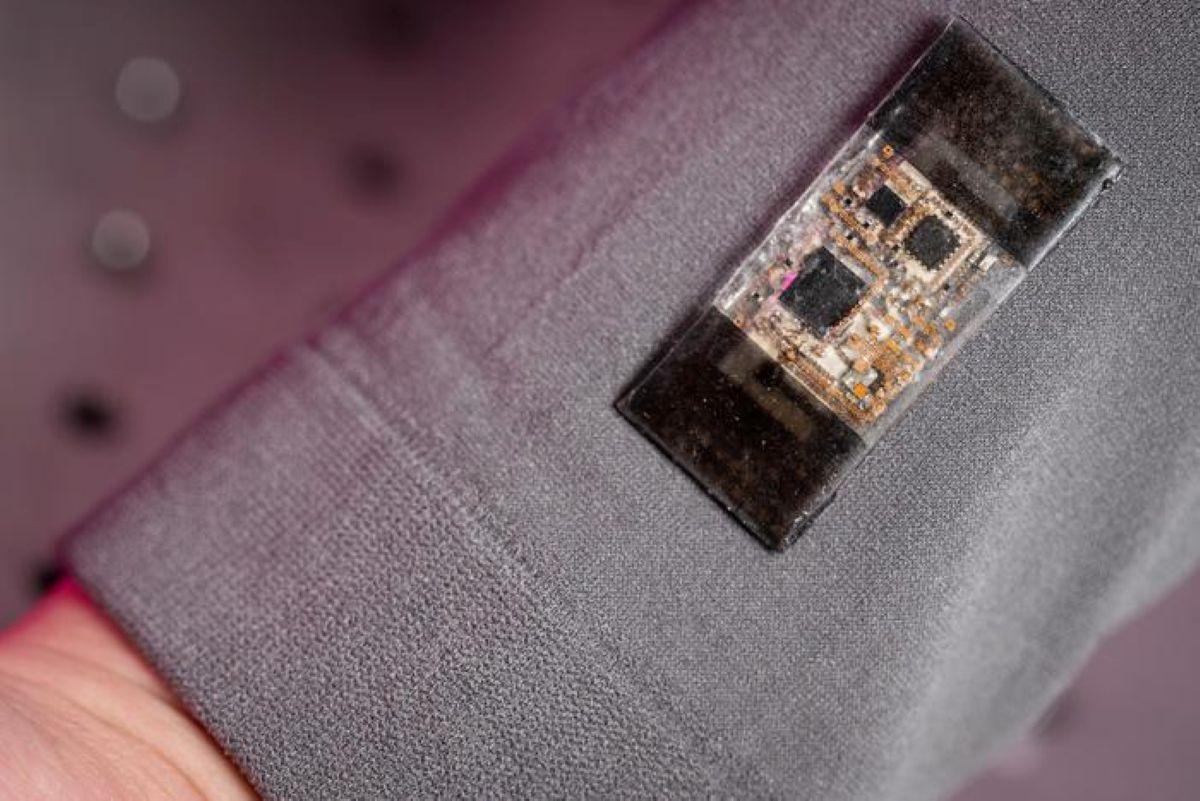
The device is designed to adhere to the skin and is powered by a battery, enabling high-resolution tracking of muscle function without invasive procedures. It consists of three main components:
- A single transducer for sending and receiving ultrasound waves
- A custom-designed wireless circuit for controlling the transducer and data transmission
- A lithium-polymer battery providing at least three hours of power
The key innovation lies in the use of a single ultrasound transducer to effectively sense deep tissues, emitting intensity-controlled ultrasound waves and capturing radiofrequency signals
1
2
.Applications in Respiratory Health Monitoring
When worn over the rib cage, the device can monitor diaphragm motion and thickness with submillimeter precision. This capability is crucial for assessing respiratory health and could potentially support patients with respiratory conditions or those dependent on mechanical ventilation
1
2
3
.In a small group trial, the device successfully distinguished breathing patterns of individuals with chronic obstructive pulmonary disease (COPD) from those of healthy participants, demonstrating its potential for diagnosing conditions such as asthma and pneumonia
1
2
.Human-Machine Interface Applications
The device's versatility extends to human-machine interface applications when worn on the forearm. It offers precise tracking of muscle motion in hands and wrists, recognizing 13 degrees of freedom covering 10 finger joints and three wrist rotation angles
1
2
3
.Researchers demonstrated the device's capabilities in proof-of-concept tests:
- Controlling a robotic arm to pipette water into beakers
- Playing a virtual game by controlling a virtual bird's flight through obstacles using wrist movements
These demonstrations highlight the technology's potential for prosthetics, gaming, and other human-machine interface applications
1
2
3
.Related Stories

Advantages Over Current Technology
This wearable ultrasound technology presents a promising alternative to the current clinical standard, electromyography (EMG). Unlike EMG, which suffers from low resolution and weak signals, ultrasound provides high-resolution imaging by penetrating deep tissues, offering detailed insights into muscle function
1
2
3
.The device's compact, wireless, and low-power design makes it suitable for continuous, long-term monitoring during daily routines
1
2
.Future Developments
Moving forward, the research team plans to improve the technology's accuracy, portability, energy efficiency, and computational capabilities. These enhancements will further expand the device's potential applications in healthcare and human-machine interfaces
1
2
3
.References
Summarized by

Navi
[1]
[2]
Related Stories
MIT's ultrasound wristband lets wearers control robotic hands with their own hand movements
25 Mar 2026•Science and Research

MIT's ultrasound wristband lets users control robotic hands and play piano with 120ms delay
24 Jun 2026•Science and Research

UC San Diego Engineers Develop Motion-Tolerant Wearable for Gesture-Based Robot Control
18 Nov 2025•Technology
Recent Highlights
1
Meta Unveils Muse Wonder Frontier AI Models, Claims Performance Matching OpenAI and Anthropic
Technology

2
IMF Report Warns AI Market Correction Could Spark Global Financial Crisis With $1.4T at Risk
Business and Economy

3
OpenAI Releases 722 AI-Generated Math Solutions, Triggering Existential Crisis in Mathematics
Technology

Recent Highlights
Today's Top Stories










Don’t drown in AI news. We cut through the noise - filtering, ranking and summarizing the most important AI news, breakthroughs and research daily. Follow topics that matter to you and stay ahead.


