Walden Robotics emerges with $300M to build humanoid robots that learn on factory floors


2 Sources
[1]
Walden Robotics launches with $300M, and no legs
Walden Robotics has launched from stealth with $300m and a $1.1bn valuation. The Toyota spin-out builds humanoids for factories, and it left off the legs on purpose. "If you listen to the people on the factory floor, they aren't ready, and they don't want them yet." That is Russ Tedrake, telling
[2]
US Toyota spinout's factory robots learn from experience on the job
A US robotics startup has emerged from stealth with a general-purpose robotics platform designed to deploy Physical AI robots that learn and improve while performing real work. Rather than relying on pre-programmed workflows, Walden Robotics' offerings continuously adapt through real-world
Share
Copy Link
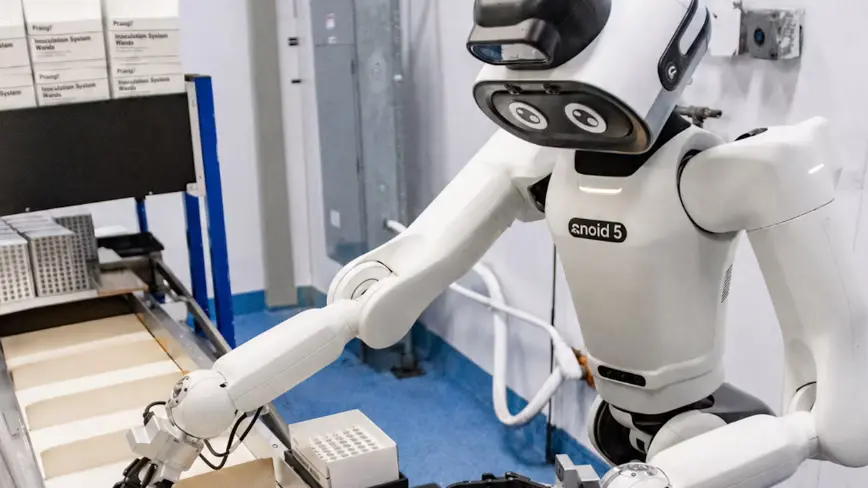
Walden Robotics, a Toyota spin-out, has launched from stealth with $300 million in funding at a $1.1 billion valuation. The Cambridge startup builds humanoid robots with wheeled bases instead of legs, designed to work safely alongside humans in factories. Its robots already operate in a Toyota plant, using Large Behavior Models to learn and improve from real-world experience.
Walden Robotics Launches With $300M and a Different Approach
Walden Robotics emerged from stealth this week with $300 million in seed funding and a $1.1 billion valuation, marking one of the most significant launches in the humanoid robots sector
1
. The Cambridge, Massachusetts-based robotics startup spun out from the Toyota Research Institute in January 2026 and has taken a deliberately different path from competitors by building humanoid robots on wheeled bases instead of legs2
.The seed round was co-led by Toyota and Deviation Capital, with participation from Nvidia, Boeing, Samsung Ventures, CoreWeave Ventures, Menlo Ventures, AE Ventures, and Prologis Ventures
1
. That investor roster represents a heavy commitment to a company barely six months old, signaling confidence in both the technology and its practical deployment strategy.Why Wheels Beat Legs in Factory Environments
Co-founder and CEO Dr. Russ Tedrake, who previously served as Senior Vice President of Large Behavior Models at the Toyota Research Institute and is a professor at MIT, explained the design choice clearly: "If you listen to the people on the factory floor, they aren't ready, and they don't want them yet"
1
. The decision to use wheeled bases instead of legs comes down to safety and practicality in manufacturing settings.Wheeled robots slow down and stop around people more easily, allowing them to meet existing factory safety rules without requiring new regulatory approvals
1
. The wheeled base also carries bigger batteries and more computing power, essential for machines built to work full eight-hour shifts. For industrial applications where endurance matters more than mimicking human form, this approach delivers immediate value.Robots Learn From Experience Through Physical AI

Source: Interesting Engineering
Walden Robotics has developed a general-purpose robotics platform that deploys Physical AI robots capable of continuous learning
2
. Rather than relying on pre-programmed workflows or fixed automation, the company's robots use Large Behavior Models and Diffusion Policy to acquire new skills through real-world experience2
.This AI-driven robotics advancements approach allows the machines to handle difficult-to-automate tasks from day one while continuously improving their performance through ongoing operation
2
. The robots learn from experience on the job, adapting to changing production needs and working safely alongside human employees without requiring extensive reprogramming for every new task.Already Operating in Toyota Manufacturing Plants
Unlike many robotics startups selling future promises, Walden Robotics is already delivering results. Since February, its robots have been performing production work at a Toyota manufacturing plant in North America, progressing from initial pilot to active factory operations in less than two months
2
. One robot has been working eight-hour shifts beside human teams, handling the repetitive tasks: loading and unloading car parts, cleaning machinery, and kitting parts for assembly1
.The company builds its own hardware, software, and AI in a full-stack approach, combining proprietary perception systems, deployment software, and real-world operational data
2
. According to Tedrake, "Providing real value to customers requires a deep understanding and respect for how manufacturing is done today"1
. Toyota's chief technology officer, Hiroki Nakajima, framed the collaboration in the company's language of kaizen and jidoka, keeping people at the center.Related Stories

Targeting Industries Beyond Automotive
While Walden's initial deployment is with Toyota, the company is working with strategic partners across multiple sectors including automotive, aerospace, semiconductors, electronics, logistics, and life sciences
1
2
. These industries face labor shortages, increasing product complexity, and pressure for higher productivity, driving demand for more flexible automation solutions2
.The company's focus on practical deployment in real production environments positions it differently in the competitive landscape. Rather than pursuing robotics demonstrations in controlled settings, Walden emphasizes close collaboration with manufacturers to deliver measurable value
2
.What This Means for the Humanoid Robot Market
Walden Robotics enters a crowded field where companies like 1X, LimX, and Booster are pouring billions into humanoid development
1
. Hyundai is scaling up Boston Dynamics' Atlas, and Morgan Stanley estimates the market could exceed $5 trillion by 20501
.Tedrake remains measured about the opportunity: "Everyone recognises the magnitude of the opportunity and the technology feels ready, but success is not assured. You have to think through the business case, the unit economics"
1
. The company's name references Thoreau's Walden, signaling an intent to free people for better work rather than replace them1
.The short-term implications center on whether wheeled humanoid robots can scale across industries faster than legged alternatives, with Walden's existing Toyota deployment providing crucial validation data. Long-term, the success of robots that learn from experience could accelerate adoption in sectors where traditional automation has struggled with variability and complexity. Watch for expansion announcements in aerospace and semiconductor manufacturing, where the company's approach to continuous learning may address persistent automation challenges.
References
Summarized by

Navi
[1]
[2]
Related Stories
RLWRLD Secures $14.8M to Develop Foundational AI Model for Advanced Robotics
16 Apr 2025•Technology

Former Tesla Lead Unveils Powerful Warehouse Robot, Launches Robotics Startup
23 Jul 2024

Robot.com launches R-noid humanoid robot to tackle labor shortages in kitchens and warehouses
23 Jun 2026•Technology
Recent Highlights
1
Microsoft and Nvidia Launch Surface Laptop Ultra: A $2,599 AI-Ready PC With RTX Spark Chip
Technology

2
Google Unveils Gemini 4 Argon AI Model, Restricts Access to Trusted Cyber Defenders
Technology

3
Trump Consulted Grok AI Before Ordering Venezuela Invasion and Capture of Nicolás Maduro
Policy and Regulation

Recent Highlights
Today's Top Stories






Don’t drown in AI news. We cut through the noise - filtering, ranking and summarizing the most important AI news, breakthroughs and research daily. Follow topics that matter to you and stay ahead.


