Waymo vs Tesla: Autonomous Vehicles Battle Intensifies as Cybercab Launch Looms


5 Sources
[1]
Waymo goes on offense ahead of Tesla's Cybercab launch
Waymo argued last week that fully autonomous vehicles are not possible without using a mix of sensors, and that "pure end-to-end" AI systems are not safe enough -- shots at Tesla, despite the Alphabet-owned company not naming names. The company took these swings in a blog post and an interview
[2]
Elon Musk's heterodox robotaxi philosophy gets put to the test
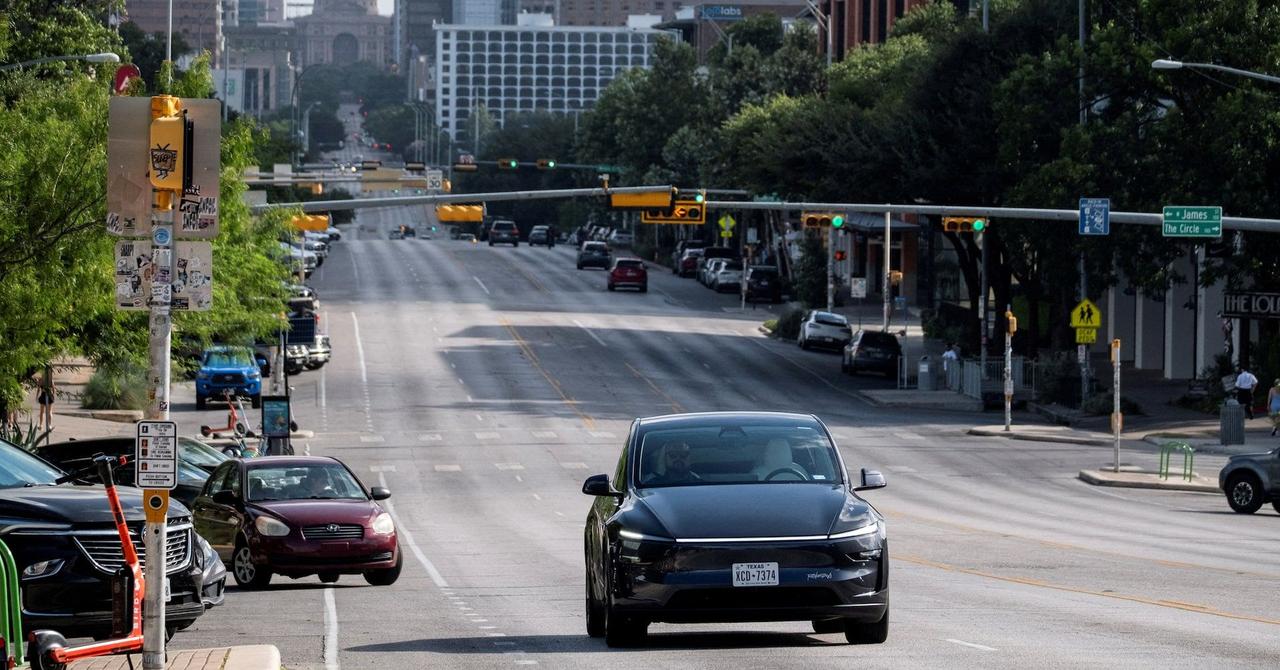
Believe it or not, the Tesla Cybercab is coming. Nearly two years after Elon Musk first unveiled the gold-tinted, gull-wing door sporting, steering wheel-free two-seaters as the future of Tesla's autonomy efforts, the company is finally putting them into operation as part of its robotaxi service
[3]
In a swipe at Tesla, Waymo says 'cameras... aren't enough'
As Tesla gears up for the official launch of its steering wheel and pedal-less Cybercabs, Waymo is issuing a stark warning about Elon Musk's approach autonomous driving. Srikanth Thirumalai, Waymo's VP of Onboard Software, doesn't specifically call out Musk or Tesla in a blog post, published
[4]
Waymo Takes A Not-So-Subtle Shot At Tesla's Self-Driving Strategy
* In a new blog post, Waymo laid out 10 takeaways from 200 million miles of autonomous operation. * It took some swipes at Tesla's approach to developing self-driving tech. * Waymo casted doubt on camera-only systems, end-to-end AI, and improving a Level 2 system to full autonomy. Waymo didn't
[5]
Waymo takes a shot at Tesla's self-driving: it's a 'false summit'
Waymo published a list of "10 AI lessons" from driving more than 200 million fully autonomous miles, and several of them read as a direct rebuke of Tesla's self-driving strategy -- without ever naming Tesla. The sharpest: trying to turn a driver-assist system into full autonomy is a "false
Share
Copy Link
Waymo publicly challenges Tesla's self-driving strategy just days before the Cybercab robotaxi launch. The Alphabet-owned company argues camera-only systems and end-to-end AI are insufficient for safe autonomous driving technology, citing its 200 million fully autonomous miles as proof that multi-sensor approaches are essential.

Waymo Challenges Tesla's Autonomous Driving Philosophy
Waymo launched a direct challenge to Tesla's self-driving strategy
1
just one week before Tesla's anticipated September 3 Cybercab launch event. In a blog post titled "10 AI Lessons from Driving 200+ Million Fully Autonomous Miles," Waymo's VP of Onboard Software, Srikanth Thirumalai, argued that fully autonomous vehicles require more than camera-only systems3
. "Cameras are incredible, but they aren't enough," Thirumalai wrote3
. "For years, there's been a debate over whether cameras alone could solve full autonomy. Now, after more than 200 million real-world miles, the data is clear: safe, fully autonomous operations at scale require more."Waymo's multi-sensor approach combines cameras, lidar, and radar to create what the company calls "a rich, redundant world view that no single sensor can replicate"
1
. The company currently operates a fleet of around 4,000 robotaxis across 14 U.S. cities, providing 500,000 paid trips per week1
. Thirumalai explained that lidar sensors "capture 3D geometry with millimeter precision" while radar tracks velocity and detects objects in conditions cameras cannot handle, such as heavy fog4
.Tesla's Camera-Only Bet Faces Scrutiny
Elon Musk has long championed a camera-only approach to autonomous driving technology, famously calling lidar "a fool's errand" and predicting that "anyone relying on lidar is doomed"
2
. At Tesla's 2019 Autonomy Day, Musk argued that since humans use their eyes to make driving decisions, autonomous vehicles should do the same2
. Tesla once relied on radar alongside cameras but eliminated the sensor in 2022 despite internal engineers warning that without radar, the system would be vulnerable to perception errors when cameras were obscured by rain or sunlight2
.The Cybercab robotaxi embodies Tesla's stripped-down philosophy. The purpose-built two-seater features no steering wheel or pedals and relies on a modified version of Full Self-Driving (FSD)
2
. Tesla argues this approach is more affordable to mass produce, with recent filings showing plans to build more than 125,000 Cybercabs annually1
. The company has started registering Cybercabs with the Texas DMV ahead of the September 3 event, though the scale of the initial deployment remains unclear1
.The 'False Summit' Critique and End-to-End AI Concerns
Waymo's sharpest criticism targeted Tesla's strategy of evolving its Level 2 driver-assist system into full autonomy. "Simply improving a driver-assist system (L2) for full autonomy is a false summit," Thirumalai stated
5
. "True Level 4 maturity can only be safely achieved by a purpose-built system, validated on closed courses and hardened by the uncompromising experience of driving without a human in the car." Waymo argues that neither billions of simulated miles nor millions of supervised human-present miles can replicate what a system learns when operating without human backup5
.Thirumalai also challenged pure end-to-end AI systems that take raw camera pixels and output steering commands directly—Tesla's core approach with FSD. "Pure end-to-end neural architectures run the risk of black box failures," he wrote
1
. "Even the best AI models with trillions of parameters still hallucinate. There is no click reboot or reload or refresh [in] physical AI. You have to deal with the consequences of it." Waymo contends that understanding how decision-making happens is critical for building trust in autonomous systems4
.Real-World Performance Gap Widens
The debate carries weight because of Waymo's operational lead. At Waymo co-CEO Dmitri Dolgov's recent Y Combinator talk, he acknowledged that cameras have improved enough to approximate human driving but argued that achieving superhuman performance requires more robust sensing
2
. "If you're targeting full autonomy and superhuman performance, you find that weak sensing just leads to a safety curve that flattens out way too early," Dolgov explained2
.Tesla's robotaxi service remains limited. After launching in Austin with human safety monitors, the company has only recently removed safety drivers from a majority of vehicles
1
. Tesla confirmed it has driven only 380,000 unsupervised miles—a distance Waymo covers in a single day5
. Musk once promised 1 million robotaxis on the road by 2020, but the company is years behind schedule1
.Related Stories
HD Maps and Sensor Fusion Advantages
Waymo's latest Ojai van system employs 13 cameras, 4 lidar units, 6 radars, plus microphones for comprehensive environmental awareness
4
. The company also uses HD maps as what Thirumalai calls a "powerful prior" to jump-start validation processes3
. While Musk considers detailed mapping "a really bad idea" because roads change constantly, Waymo treats maps as another input that's continuously updated through AI-driven systems3
. This sensor fusion approach provides redundancy—if one sensor fails, others maintain operational safety3
.Stakes Rise as Market Battle Approaches
The timing of Waymo's offensive matters. Tesla analyst Pierre Ferragu of New Street Research dismissed Waymo's arguments on social media, writing: "Waymo built a driving gas plant that AI at scale makes irrelevant"
1
. Waymo spokesperson Ethan Teicher responded by sharing an image depicting multiple threats, acknowledging the company faces criticism for its position1
.If Tesla proves the Cybercab can perform at scale using AI-driven autonomous driving with cameras alone, it would validate the company's software engineering approach and set up a major fight between the two companies
1
. The autonomous vehicle market could be worth hundreds of billions of dollars1
. However, Tesla still needs to demonstrate it can solve operational problems Waymo continues to discover while running thousands of self-driving cars, including navigating harsh weather and complex urban environments1
.FSD and Autopilot have been linked to dozens of fatalities and thousands of crashes while operating as driver-assist systems
2
. With the Cybercab lacking conventional controls, Tesla will bear full legal responsibility if the autonomous system fails—a sharp departure from blaming crashes on drivers who failed to supervise properly2
. Tesla's camera-only approach could also face regulatory hurdles, as New Jersey's legislature is considering legislation that would legalize robotaxis only if they include multiple sensors3
.References
Summarized by

Navi
[1]
Related Stories
Tesla Cybercab Launch Imminent in Austin as Driverless Vehicles Navigate Safety Questions
18 Aug 2026•Technology

Tesla Launches Robotaxi Service in Austin: Promises and Challenges
21 Jun 2025•Technology

The Global Robotaxi Race: Tesla Faces Stiff Competition from Chinese and American Rivals
16 Jul 2025•Technology

Recent Highlights



Recent Highlights
Today's Top Stories





Don’t drown in AI news. We cut through the noise - filtering, ranking and summarizing the most important AI news, breakthroughs and research daily. Follow topics that matter to you and stay ahead.


