XPeng Robotics Secures $900M to Fast-Track IRON Humanoid Robot Production by End of 2026


5 Sources
[1]
Chinese automakers are following Tesla's bet that robots are the next big profit machine
The hype around humanoid robots isn't particularly new. Thank Tesla CEO Elon Musk and his Optimus robot, as well as the myriad videos of Boston Dynamics' Atlas robot, for that. Behind that hype, though, there is real progress. The physical capabilities of robots continue to improve, and
[2]
XPENG's robotics arm has raised more than $900M ahead of its humanoid production run
The money lands with weeks to go before the company's end-of-year deadline for putting IRON on a production line. XPENG said on Monday that its robotics business has raised more than $900M in what the company described as its first funding round, a substantial sum for a unit that has yet to sell a
[3]
XPeng spins up humanoid ambitions with $900M Dogotix funding round
Chinese electric vehicle maker XPeng is making a major bet on humanoid robotics after its robotics unit, Dogotix, raised more than $900 million in an initial funding round. According to The Robot Report, the investment gives the Shenzhen-based robotics company a pre-money valuation of $5 billion
[4]
XPeng robotics raises $900M at $6.3B valuation for IRON robot push
XPeng's robotics business has raised over $900 million at a post-money valuation of more than $6.3 billion, the Chinese EV maker announced today. XPeng calls it the largest single-round private financing in the history of China's embodied AI industry. The round is meant to push XPeng's IRON
[5]

Xpeng's robotics unit valued at over $6.3 billion after record funding round
The proceeds will be used to develop robotics hardware and software, train and refine physical AI models, collect high-quality data, build end-to-end mass-production facilities, and support global expansion, the company said. CEO He Xiaopeng announced in June that he would personally lead the
Share
Copy Link
XPeng's robotics unit raised over $900 million at a $6.3 billion valuation in what the company calls China's largest single-round private financing in embodied AI. The funding will accelerate mass production of its IRON humanoid robot, targeting 1,000 units monthly by December 2026, as Chinese automakers race against Tesla in the humanoid robotics market.
XPeng Robotics Lands Record $900M in China's Largest Embodied AI Funding Round
XPeng's robotics arm has secured more than $900 million in what the Chinese automaker describes as the largest single-round private financing ever recorded in China's embodied AI industry
1
. The funding round, led by IDG Capital with participation from Gaorong Ventures, Tencent, and Alibaba, values the robotics business at more than $6.3 billion post-money4
. Of the total commitment, approximately $600 million comes from external investors, with about $200 million from an XPeng subsidiary and $100 million from leadership, including CEO He Xiaopeng and co-president Brian Gu who personally invested roughly $100 million1
4
.Mass Production of Humanoid Robots Targets December 2026 Deadline
The timing proves deliberate as XPeng races to put its IRON humanoid robot into mass production before year-end, a commitment that positions the automaker-backed humanoid robot ahead of Tesla Optimus, which has faced delays
2
4
. The company aims to reach monthly capacity of more than 1,000 IRON units by December 2026, with commercial deliveries in China and overseas markets scheduled for 20273
5
. Initial deployments will start close to home, with robots working as showroom assistants, tour guides, and factory floor workers at XPeng's own facilities2
. The longer-term target reaches for 1 million units annually by 2030, with He Xiaopeng suggesting robots could eventually be priced at levels "very similar to car prices" within five years2
.XPeng IRON Robot Demonstrates Advanced Physical AI Capabilities
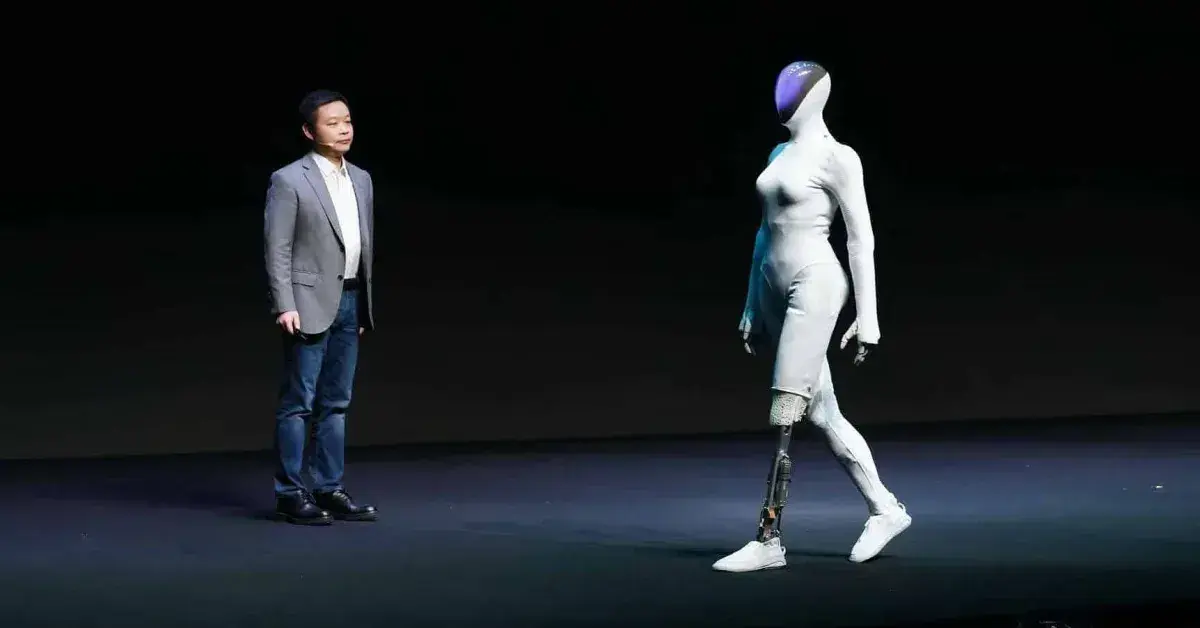
IRON, unveiled at XPeng's AI Day in November 2025, carries 76 degrees of freedom across its body and 21 in each hand, wrapped in what the company calls bionic muscle fascia—a synthetic skin designed to soften movement and balance safety with human-like appearance
2
4
. The humanoid robot runs on three of XPeng's in-house Turing AI chips delivering a combined 2,250 TOPS, allowing the company to run its physical AI foundation model directly on the robot for on-device autonomy without remote operation4
. The robot's fluid, human-like walk at the unveiling proved so convincing that online viewers accused XPeng of hiding a person in a costume, prompting He Xiaopeng to cut open the robot's leg on stage to reveal the wiring underneath4
. The demonstrated prototype represents a seventh-generation design, with an eighth generation earmarked as the production model2
.
Source: Electrek
Chinese Automakers Follow Tesla's Bet on Robotics as Next Profit Machine
XPeng stands as the Chinese automaker that most closely watches and follows Tesla's initiatives, particularly in autonomy and humanoid robots, according to Michael Dunne, CEO of advisory firm Dunne Insights
1
. "He sees razor-thin profit in cars on the near horizon. Robots look much more promising," Dunne noted, explaining why He Xiaopeng took personal charge of the robotics division in June 20261
. The move comes as XPeng reported a 17.6% revenue decline in the first quarter alongside widening net losses, having been profitable the quarter before2
. Management now describes the company as a physical AI business spanning humanoids, robotaxis, and flying vehicles rather than a carmaker with side projects2
. Other Chinese automakers including BYD, which unveiled a humanoid robot called Xiao Di, along with Changan, GAC, Li Auto, SAIC, and Seres, are also developing humanoid robots1
. AiMOGA, the robotics unit of Chery Automobile, reportedly began preparing for an IPO this month1
.Related Stories


Automotive Manufacturing Edge Meets Embodied AI Development Challenge
XPeng's core pitch centers on bringing "automotive-grade quality standards and large-scale mass production" to humanoid robots by leveraging the supply chain and factories built for EVs
4
. The company reported 103,295 vehicle deliveries in the second quarter of 2026, up 64.8% quarter-over-quarter, demonstrating its capacity to scale hardware at volume4
. "They have all the hardware to get the job done," Dunne observed. "Question is if they can catch Tesla on the AI side of the equation"1
. Building electric vehicles at scale requires complex supply chains, advanced manufacturing systems, and the ability to integrate mechanical, electrical, and software components—capabilities that could prove valuable as humanoid robotics moves from research laboratories toward commercial deployment in factories, warehouses, and stores3
. The robotics unit, operating as subsidiary Dogotix, will remain under XPeng with the parent company retaining roughly 82% ownership while spinning robotics assets, IP, and staff into a standalone entity over the next 18 months3
4
.
Source: TechCrunch
Broader Industry Movement Signals Humanoid Robotics Investment Surge
The funding arrives amid a surge of investment in embodied AI and humanoid robotics, with humanoid robotics companies receiving more than $8.7 billion in venture capital so far this year, according to Dealroom.co data, with Chinese companies accounting for around two-thirds of that funding
3
. The broader automotive industry shows increasing involvement, with Hyundai planning to bring Boston Dynamics' Atlas humanoid robot to its Georgia factory this year and eventually deploy the robots for tasks like parts sequencing by 20281
. Hyundai partnered with Google's AI research lab DeepMind to accelerate Atlas development and is opening a U.S. facility this year called a Robot Metaplant Application Center to teach robots how to map movements like lifts and turns1
. Supplier Mobileye acquired humanoid robot startup Mentee Robotics earlier this year for $900 million, while Rivian is developing robots through its Mind Robotics spinout1
. Watch for XPeng's ability to hit its December production deadline, which will test whether the industry is moving from impressive prototypes toward genuine industrial-scale robotics and whether raising outside capital for the robotics unit can keep spending off the carmaker's balance sheet while the vehicle business works through a difficult year2
3
.References
Summarized by

Navi
[1]
[2]
[3]
Related Stories
Recent Highlights



Recent Highlights
Today's Top Stories







Don’t drown in AI news. We cut through the noise - filtering, ranking and summarizing the most important AI news, breakthroughs and research daily. Follow topics that matter to you and stay ahead.


