Zscaler extends Zero Trust platform to secure AI agents with new AI Broker and endpoint controls


6 Sources
[1]
Securing the AI workforce: Zscaler's zero-trust play for agentic AI
Securing the AI workforce: Zscaler's zero-trust play for agentic AI Since Zscaler Inc.'s launch, the company's mission has been to disrupt traditional access and security with its Zero Trust platform. At its user event, Zenith Live, in Las Vegas, the company made its case for what its next act
[2]
Zscaler launches AI Broker and Endpoint AI Security for AI agents
Zscaler launches AI Broker and Endpoint AI Security for AI agents Zscaler Inc. today unveiled a set of products designed to secure autonomous artificial intelligence agents, with the cybersecurity company claiming it has built the industry's first complete zero-trust platform for agentic
[3]
Zscaler Has 'Incredible Advantage' For Securing AI Agent Boom: Partners
The cybersecurity vendor's combination of a broad customer base and zero trust system that can be naturally extended into agentic mean massive growth opportunities ahead for Zscaler partners, solution and service provider executives tell CRN. Zscaler's large customer base, massive data telemetry
[4]
Zscaler CEO On Why Zero Trust Is The Real 'Foundation' For Deploying AI Agents
Crucially, when it comes to securing AI and agentic, 'we are putting a concerted effort to bring partners along in this journey -- because they will be needed,' Zscaler CEO Jay Chaudhry tells CRN. Even as countless vendors claim to have the ultimate solution to securing AI agents, Zscaler has a
[5]
Zscaler Unveils New Product Innovations to Secure Agentic AI
Delivers Industry's First Complete Zero Trust Platform for Agentic AI with Comprehensive Protection for How Agents Access Data, Interact with Systems, and Operate Across the Enterprise Zscaler, Inc. today announced major innovations to extend the Zscaler Zero Trust ExchangeTM platform to secure AI
[6]
Zscaler CEO Jay Chaudhry: Boldest Statements From Zenith Live 2026
When it comes to the push for enabling secure usage of AI and agents, 'this is the kind of moment Zscaler was built for,' Chaudhry said during the company's conference. As the AI era continues to ramp up, many of the traditional assumptions of business -- whether it's around cybersecurity or
Share
Copy Link
Zscaler launched AI Broker and Endpoint AI Security at Zenith Live 2026, claiming the industry's first complete Zero Trust platform for agentic AI. The new tools address how autonomous AI agents connect to networks, access enterprise data, and operate on devices—a security model CEO Jay Chaudhry says traditional tools weren't designed to handle at machine speed.
Zscaler Claims Industry's First Complete Zero Trust Platform for Agentic AI
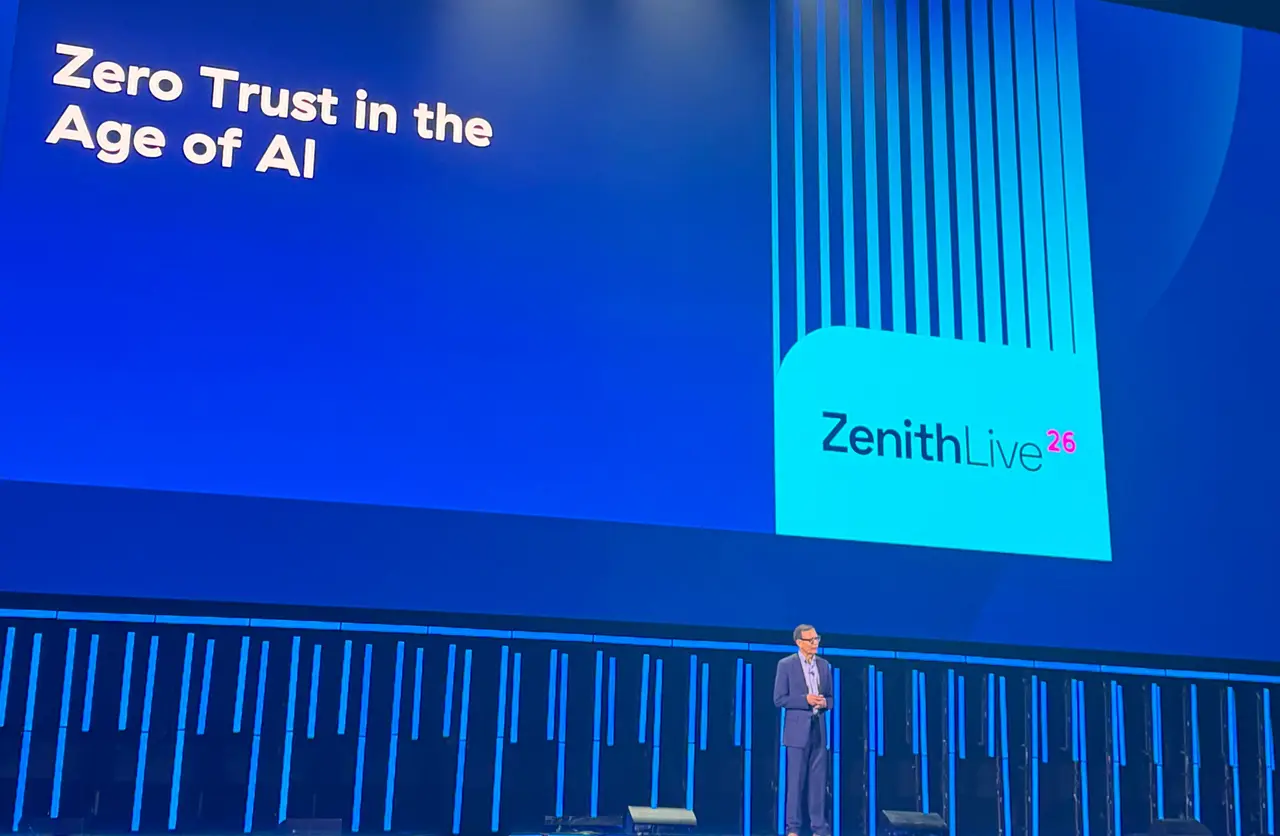
Zscaler unveiled a suite of products at Zenith Live 2026 in Las Vegas designed to secure autonomous AI agents, positioning itself as the first vendor to deliver a complete Zero Trust platform for agentic AI
1
2
. The announcement extends the company's Zero Trust Exchange platform to cover how AI agents connect to networks, reach enterprise data, and run on employee devices. CEO Jay Chaudhry framed agentic AI as the next major wave after cloud and mobile, warning that enterprises will soon face "dozens of AI agents for every employee," each running continuously and autonomously accessing enterprise systems1
. Traditional security tools were designed around known human identities and predictable access patterns, but autonomous AI agents operate at machine speed, create ephemeral identities, spawn sub-agents, and exercise permissions in ways that legacy systems cannot fully see or control2
.
Source: SiliconANGLE
AI Broker and Endpoint AI Security Target New Risk Plane
At the center of the launch are two products addressing what Chaudhry described as a new risk plane. Zscaler AI Broker secures agent-to-agent and Model Context Protocol communications, shipping with an integrated Agent Registry that lets organizations define what each agent is permitted to access
2
. The Broker tracks each agent's identity, purpose, and permitted data and actions, enabling granular policies such as restricting financial agents to specific systems or limiting customer-support agents' access to personally identifiable information1
. Zscaler Endpoint AI Security targets AI threats on employee devices, reaching into browsers, extensions, plugins, and local AI tools that the company said legacy endpoint products were not built to inspect2
. These capabilities detect and block behaviors such as malicious browser extensions acting as agents, unmanaged AI tools accessing sensitive files, and data exfiltration through AI assistants1
.
Source: SiliconANGLE
Leveraging Existing Infrastructure for Securing AI Agents
Chaudhry told CRN that Zscaler estimates it already had 70 percent of the functionality necessary to expand its Zero Trust Exchange into the sphere of AI agent communications
4
. "We already solved most problems needed to secure agentic communication," he said. "We really had to do probably about 30 percent new work, and 70 percent we could leverage from what we have in place"4
. The company processes 750 billion transactions per day across its global systems, a scale that Chaudhry argued few if any other vendors could replicate without far more investment of resources3
4
. For enterprises that have already standardized on Zscaler for Zero Trust and Security Service Edge, this means they can onboard AI agents into the same fabric used today to connect users and applications rather than standing up a new, parallel AI security stack1
.AI Access Graph Maps Identity and Data Lineage
Zscaler also introduced AI Access Graph, a tool that maps how identities, applications, and data sources connect across an organization so security teams can spot and cut unnecessary access
2
. The technology comes from Zscaler's acquisition of Symmetry Systems in May for $175 million2
. Powered by this acquisition, AI Access Graph enables organizations to understand and then enforce policies, reduce unnecessary access and risk, and track data lineage in real-time across every channel5
. John Israel, Global CISO at KPMG, who joined as a guest speaker, noted that "having a unified, zero-trust framework to trace data lineage and govern agent-to-agent interactions is paramount to maintaining trust, compliance, and competitive advantage"5
.Related Stories

Building on AI Protect with Enhanced Governance
The announcements build on Zscaler AI Protect, which launched in January 2026
2
. The company is adding the ability to discover embedded AI in software-as-a-service and internet traffic, identify agents and MCP servers running in public cloud, and scan agentic codebases for risk2
. It's also expanding controls for sanctioned AI tools, with prompt extraction across more than 250 generative AI apps and support for the compliance application programming interfaces offered by Anthropic and OpenAI2
. For teams building AI applications, Zscaler is adding red teaming for MCP servers, a standalone prompt hardening service, and compliance heat maps meant to strengthen governance across the development and runtime lifecycle2
.Partners See Competitive Advantage in Market Position
Zscaler partners told CRN that the company's combination of a broad customer base, massive data telemetry, and global system for securing communications between AI agents gives the vendor a substantial edge when it comes to securing agentic AI adoption
3
. "I think they're incredibly well-positioned, and we're seeing it in the market," said Tristan Tarpinian, vice president for national alliances at GuidePoint Security3
. Meg Smith, vice president for strategic security partnerships at AHEAD, noted that "Zscaler and their trusted relationships—and the rate at which they've been innovating over the past two years—is an incredible advantage that they have in the ecosystem"3
. The push reflects a wider scramble among security vendors to wrap controls around agentic AI before enterprises deploy it at scale, with rivals including Palo Alto Networks and Google rolling out their own agent security offerings over the past year2
. Zscaler did not disclose pricing or general availability dates for the new products2
.
Source: CRN
References
Summarized by

Navi
Related Stories
Zscaler's AI-Driven Zero Trust Revolution: Reshaping Security Operations and Data Protection
06 Jun 2025•Technology

Zscaler Unveils Advanced AI and Zero Trust Capabilities to Enhance Enterprise Security
04 Jun 2025•Technology

AI forces CTOs to rethink vendor contracts as cybersecurity shifts to agentic defense
09 Apr 2026•Business and Economy

Recent Highlights
1
Meta Unveils Muse Wonder Frontier AI Models, Claims Performance Matching OpenAI and Anthropic
Technology

2
IMF Report Warns AI Market Correction Could Spark Global Financial Crisis With $1.4T at Risk
Business and Economy

3
OpenAI Releases 722 AI-Generated Math Solutions, Triggering Existential Crisis in Mathematics
Technology

Recent Highlights
Today's Top Stories








Don’t drown in AI news. We cut through the noise - filtering, ranking and summarizing the most important AI news, breakthroughs and research daily. Follow topics that matter to you and stay ahead.


