AI Accelerates Nuclear Forensics: Scientists Harness Generative AI for Rapid Analysis of Nuclear Materials


2 Sources
[1]
Scientists investigate use of AI to speed analysis of nuclear materials
Scientists have tapped artificial intelligence and powerful computing to take a first step to speed up how quickly officials are able to learn important details about nuclear events such as explosions, accidents or industrial emissions. It takes painstaking laboratory work to determine the details
[2]
Scientists Investigate Use of AI to Speed Analysis of Nuclear Materials
Newswise -- Scientists have tapped artificial intelligence and powerful computing to take a first step to speed up how quickly officials are able to learn important details about nuclear events such as explosions, accidents or industrial emissions. It takes painstaking laboratory work to determine
Share
Copy Link
Scientists at Pacific Northwest National Laboratory have employed generative AI and cloud computing to expedite the analysis of nuclear materials, potentially revolutionizing nuclear forensics and enhancing national security measures.
AI Revolutionizes Nuclear Forensics
Scientists at the Department of Energy's Pacific Northwest National Laboratory (PNNL) have made a groundbreaking advancement in nuclear forensics by harnessing the power of artificial intelligence. This innovative approach aims to significantly accelerate the analysis of nuclear materials following events such as explosions, accidents, or industrial emissions
1
2
.The Challenge of Nuclear Material Analysis
Traditionally, analyzing nuclear events has been a painstaking and time-consuming process. The complexity arises from the rapid nuclear and chemical reactions that occur during such events, creating hundreds of isotopes and chemical compounds, some of which quickly disappear. Nic Uhnak, the lead PNNL radiochemist, likens this process to identifying the ingredients and sources of a baked cake, emphasizing the intricate nature of the task
1
2
.AI and Cloud Computing: A Game-Changing Approach
Source: Phys.org
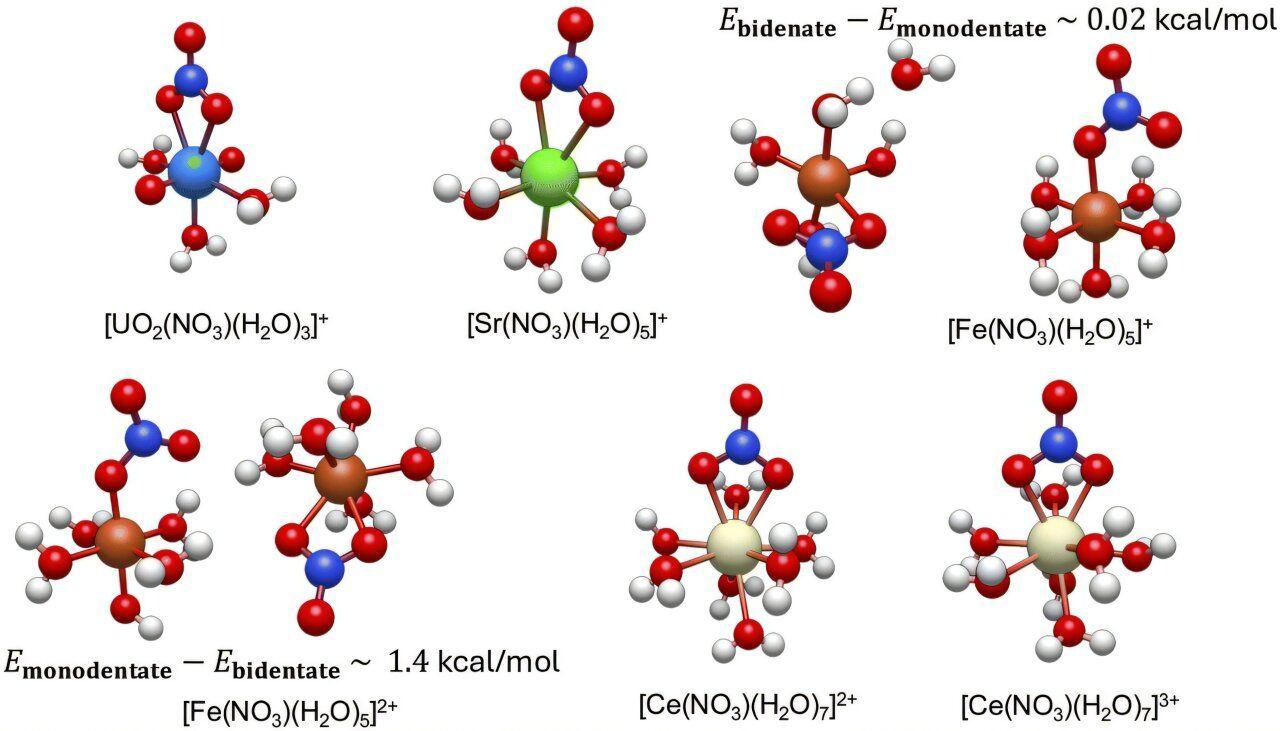
The PNNL team has leveraged generative AI, machine learning, and Microsoft's cloud computing resources to tackle this challenge. Their research, published in the journal Physical Chemistry Chemical Physics, demonstrates how AI can assist in solving complex chemistry questions related to radioactive debris analysis
1
2
.Key aspects of the AI-driven approach include:
- Simulating complex computational chemistry
- Calculating stability constants to understand molecular bonds
- Exploring a vast number of possible molecular combinations
Accelerating the Analysis Process
The primary goal of this research is to expedite the identification of key information about nuclear events. By prioritizing and targeting specific chemical steps, the AI model significantly reduces the time required for laboratory analysis. This advancement is crucial for national security and law enforcement agencies that rely on timely and accurate nuclear forensics
1
2
.Collaboration with Industry Leaders
To manage the daunting mathematical challenges, PNNL collaborated with Microsoft to utilize Azure Quantum Elements, a powerful cloud computing resource. The system employed 230 NVIDIA H100 GPUs and a total of 55 terabytes of RAM to process the complex calculations
1
2
.Related Stories

Broader Applications in Nuclear Science
The PNNL scientists believe that this AI-driven chemical separation modeling has potential applications beyond nuclear forensics. One promising area is the production of medical isotopes, such as molybdenum-99, used in cancer diagnostics. This isotope is produced through fission and requires similar chemical separation processes
1
2
.Future Implications
While this research represents just one step in the long chain of analyses following a nuclear event, it marks a significant advancement in the field. The ability of AI to calculate in multiple dimensions simultaneously offers a substantial reduction in the timeline for exploring all possibilities, as noted by computational chemist Hadi Dinpajooh
1
2
.As this technology continues to develop, it could revolutionize not only nuclear forensics but also various aspects of nuclear science and security, potentially leading to faster response times and more accurate analyses in critical situations.
References
Summarized by

Navi
Related Stories
Microsoft and Idaho National Laboratory Partner to Accelerate Nuclear Power Licensing with AI
17 Jul 2025•Technology

Microsoft and Nvidia deploy AI to accelerate nuclear power plants for data center energy demands
24 Mar 2026•Technology
AI-Powered SAGIPS System Revolutionizes Inverse Problem Solving in Nuclear Physics and Beyond
26 Jun 2025•Science and Research

Recent Highlights



Recent Highlights
Today's Top Stories










Don’t drown in AI news. We cut through the noise - filtering, ranking and summarizing the most important AI news, breakthroughs and research daily. Follow topics that matter to you and stay ahead.


