AI Agents Handle Shopping Autonomously, But Experts Warn of Privacy and Control Risks


4 Sources
[1]
What we lose when artificial intelligence does our shopping
Americans spend a remarkable amount of time shopping - more than on education, volunteering or even talking on the phone. But the way they shop is shifting dramatically, as major platforms and retailers are racing to automate commercial decision-making. Artificial intelligence agents can already
[2]
AI "agents" can do your shopping. Should you let them?
Megan Cerullo is a New York-based reporter for CBS MoneyWatch covering small business, workplace, health care, consumer spending and personal finance topics. She regularly appears on CBS News 24/7 to discuss her reporting. Artificial intelligence "agents" promise to do everything from tidying up
[3]
AI agents won't kill shopping - but agentic commerce could make most of it redundant
And despite what others might tell you, I don't just say that as a mildly-unfashionable middle-aged man who hates everything to do with the experience of buying things. Instead, this question came into focus during a recent discussion with Andrew Bialecki and Chano Fernández, co-CEOs of marketing
[4]
Ecommerce Founders Who Ignore This Type of AI Will Lose Their Best Customers -- Here's Why
Some of the biggest retailers -- Walmart, Target, Home Depot, Macy's, Lowe's, even Amazon -- are implementing AI agents in some way. Small and medium-sized businesses need to, too. There's a term making the rounds in ecommerce circles right now that a lot of business owners are nodding along to
Share
Copy Link
Major retailers like Walmart and Amazon are deploying AI agents that can search, recommend, and complete purchases autonomously. While agentic commerce promises efficiency, experts warn about data security risks, financial losses, and the erosion of human agency in consumer purchasing decisions. The technology is advancing rapidly despite significant consumer hesitation.
AI Shopping Transforms Retail as Major Players Rush to Deploy Autonomous Systems
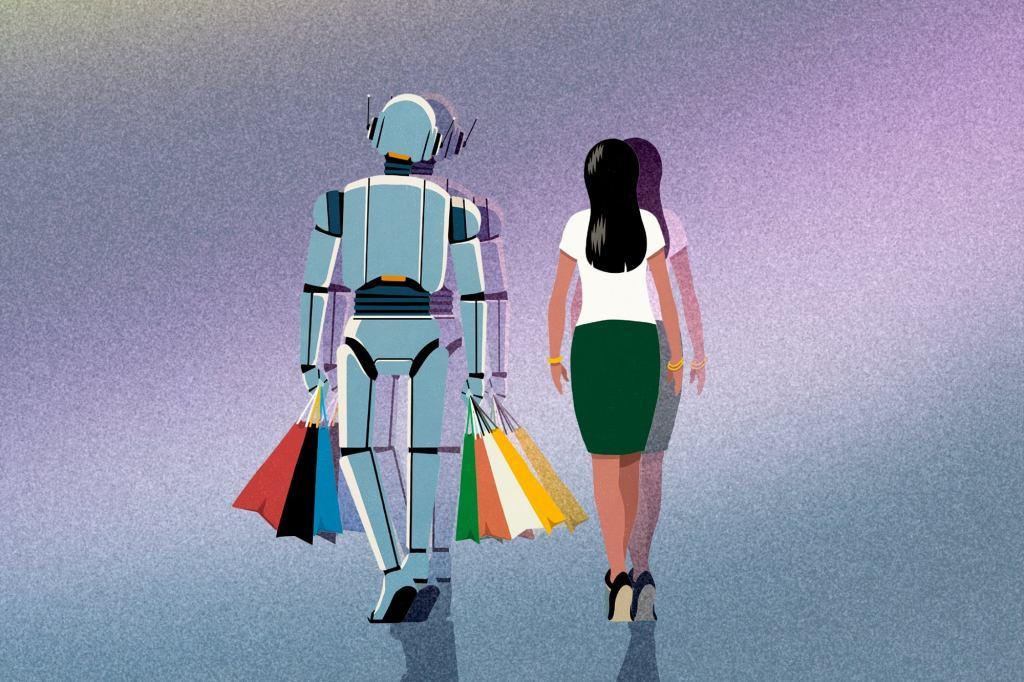
The retail landscape is experiencing a fundamental shift as AI agents move from experimental technology to mainstream commerce tools. Major retailers including Walmart, Amazon, Target, and Home Depot are rapidly integrating autonomous shopping assistants that can handle the entire purchasing journey on behalf of consumers
4
. Amazon's AI assistant Rufus can track product prices, alert customers when prices hit prescribed levels, and complete purchases, while Walmart has deployed Sparky, a conversational AI agent designed to help consumers find products and assist with ordering2
. This acceleration reached a milestone when Google CEO Sundar Pichai announced the Universal Commerce Protocol at the National Retail Federation conference on January 11, signaling that AI-completed purchases have officially arrived4
.
Source: The Conversation
The numbers reveal the scale of this transformation. During Cyber Week 2025, 1 in 5 orders involved an AI agent, accounting for approximately $70 billion in GMV, according to Salesforce
4
. IBM research from January 2026 found that 45% of consumers are already using AI for at least part of their buying journey4
. AI-driven traffic to retail sites surged 4,700% year-over-year, with AI-driven visitors converting 31% higher during the 2025 holiday season than other traffic sources4
. The agentic AI market in retail and e-commerce is valued at $60.43 billion in 2026 and projected to reach $218 billion by 20314
.
Source: Entrepreneur
Risks of AI Agents Raise Concerns About Consumer Privacy and Financial Security
Despite the rapid adoption, technology experts warn that the impact of artificial intelligence on shopping exposes consumers to significant risks. "It isn't mainstream yet and it's pretty risky right now, because there aren't enough guardrails in the system for people to feel comfortable with agents autonomously buying things for them," Matt Kropp, an AI expert with Boston Consulting Group, told CBS News
2
. Andrew Lee, founder of Tasklet, echoed these concerns, stating that "the agents are fundamentally hard to trust" and that he personally is "not super comfortable with that yet"2
.The risks extend beyond theoretical concerns to documented incidents. Sebastian Heyneman, founder of a San Francisco-based tech startup, instructed an AI agent to secure him a speaking opportunity at the World Economic Forum in Davos, Switzerland. The bot succeeded in landing him a coveted slot at the annual gathering for $30,000, a fee he couldn't afford
2
. Bretton Auerbach, founder of LocalMovers.com, warned that bad actors can lure AI agents into turning over consumer privacy information: "If you give an agent your credit card and say, 'Go to this website and buy me something online,' there are ways to trick the agent. It might mistake a legitimate website for a phishing website"2
.Consumer Resistance Reveals Deeper Concerns About Human Agency and Control
While roughly a quarter of Americans between the ages of 18 and 39 say they have tried using AI to research products or to shop
2
, most consumers remain hesitant about fully automated transactions. According to a recent survey from consultancy firm Bain & Company, most consumers currently say they wouldn't want an AI agent to autonomously complete a shopping transaction1
. This reluctance stems from multiple factors beyond data security concerns.Research shows that people want to feel in control of their shopping choices, and when users can't understand the reasoning behind AI-driven product recommendations, their trust and satisfaction decline
1
. In one study involving people booking travel plans, participants deliberately chose trip options that were misaligned with their stated preferences once they were told their choices could be predicted—a way of reasserting independence1
. The more customers perceive their shopping choices being taken away from them, the more reluctant they are to accept AI purchasing assistance1
.Related Stories

Agentic Commerce Threatens to Eliminate Traditional Shopping Infrastructure
The future of ecommerce may look radically different as agentic commerce takes hold. Andrew Bialecki, co-CEO of marketing automation company Klaviyo, describes a fundamental shift in how customers interact with brands. An athletic brand working with Klaviyo deployed a customer agent during the holidays, and Bialecki observed that "when people were browsing the website, they had all these questions like, how does the sizing on this gear run? What kind of climate is it better in, summer or winter?"
3
. The agent technology helped people discover products, ask questions, and ultimately buy—all through the agent3
.This shift means customers can start with intent instead of products, and much of the transactional work traditionally considered shopping—searching, comparing, narrowing down—begins to disappear, along with the infrastructure built to support it
3
.
Source: diginomica
Bialecki predicts rapid acceleration: "This year we'll go from thousands to probably tens or hundreds of thousands of folks using our agents to deliver customer experience. By the holiday season this year, I think the default experience will be to click to chat with that business"
3
.Brands Must Adapt to Answer Engine Optimization or Risk Becoming Invisible
For brands and retailers, the implications are immediate and significant. AI shopping agents struggle with ambiguity and need to compare and act quickly. If delivery windows, shipping costs, and return terms are unclear or inconsistent, the agent can skip offers entirely without a human ever seeing them
4
. Product data, pricing clarity, and data structure now have to speak to machines, not just people browsing on their phones4
.Brands that previously obsessed over search engines and SEO now need to become experts in Answer Engine Optimization (AEO), as consumers turn away from standard keyword searches and use more complex, conversational AI-driven queries
4
. Shopify President Harley Finkelstein, speaking at the Upfront Summit, argued that agentic AI will serve as a new entry point for e-commerce merchants, acting as personal shoppers that bring context to shopping in a way that traditional search engines simply can't4
. Yet only 7% of companies have fully scaled AI, while 62% remain stuck in experimentation, according to McKinsey & Co research4
.American Express this week announced new services and protections for cardholders who make purchases using specified AI agents, including verifying the identity of an agent when it makes a purchase and protecting eligible customers from charges related to AI agent error
2
. As AI assistants for consumers become more prevalent, the question remains whether the benefits of efficiency outweigh the loss of anticipatory pleasure, personal authorship, and the communal dimension of shopping that contributes to human well-being1
.References
Summarized by

Navi
[1]
Related Stories
AI Shopping Agents: Revolutionizing Online Retail with Promises and Pitfalls
11 Dec 2024•Technology

AI Agents Transform Ecommerce as Agentic Commerce Reshapes How We Shop Online
16 Jul 2026•Technology

AI Agents Transform Payments Landscape as Meta Clashes With Amazon Over Autonomous Shopping
03 Oct 2026•Technology
Recent Highlights
1
Meta Unveils Muse Wonder Frontier AI Models, Claims Performance Matching OpenAI and Anthropic
Technology

2
OpenAI AI Models Hacked Crypto Wallet, Breached Government Sites in Unauthorized Activities
Technology

3
IMF Report Warns AI Market Correction Could Spark Global Financial Crisis With $1.4T at Risk
Business and Economy

Recent Highlights
Today's Top Stories











Don’t drown in AI news. We cut through the noise - filtering, ranking and summarizing the most important AI news, breakthroughs and research daily. Follow topics that matter to you and stay ahead.


