AI Tool 'Aeneas' Revolutionizes Analysis of Ancient Latin Inscriptions


18 Sources
[1]
Meet Aeneas: the AI that can fill in the gaps of damaged Latin texts
An artificial intelligence (AI) model can predict where ancient Latin texts come from, estimate how old they are and restore missing parts. The model, called Aeneas and described in Nature today, was developed by some of the members of the team who created a previous AI tool that could decipher
[2]
AI for Latin inscriptions supplies missing text and predicts date and location
You have full access to this article via Jozef Stefan Institute. Inscriptions are among the most important sources for understanding the ancient world, helping researchers to learn about multiple aspects of the lives, experiences and concerns of the people who lived in past societies. Interpreting
[3]
New AI model helps historians complete damaged Latin texts
Ancient Roman inscriptions provide intimate windows into the laws, economies, rituals, and daily emotional lives of people who lived millennia ago. But many inscriptions have been separated from their original sources or have been rendered broken and illegible through wear and tear -- making it
[4]
AI helps reconstruct damaged Latin inscriptions from the Roman Empire
Latin inscriptions from the ancient world can tell us about Roman emperors' decrees and enslaved people's thoughts - if we can read them. Now an artificial intelligence tool is helping historians reconstruct the often fragmentary texts. It can even accurately predict when and where in the Roman
[5]
AI reveals new details about a famous Latin inscription
An AI system dubbed Aeneas is "a new way of modeling historical uncertainty," one expert says An artificial intelligence system has revealed fresh details about one of the most famous Latin inscriptions: the Res Gestae Divi Augusti, once inscribed on two bronze pillars in Rome and in copies
[6]

AI for the ancient world: how a new machine learning system can help make sense of Latin inscriptions
Macquarie University provides funding as a member of The Conversation AU. If you believe the hype, generative artificial intelligence (AI) is the future. However, new research suggests the technology may also improve our understanding of the past. A team of computer scientists from Google
[7]

AI helps Latin scholars decipher ancient Roman texts
Around 1,500 Latin inscriptions are discovered every year, offering an invaluable view into the daily life of ancient Romans -- and posing a daunting challenge for the historians tasked with interpreting them. But a new artificial intelligence tool, partly developed by Google researchers, can now
[8]

Google DeepMind's Aeneas model can restore fragmented Latin text
At its best, AI is a tool, not an end result. It allows people to do their jobs better, rather than sending them or their colleagues to the breadline. In an example of "the good kind," Google DeepMind has created an AI model that restores and contextualizes ancient inscriptions. Aeneas (no, it's
[9]

Gaps in what we know about ancient Romans could be filled by AI
"But they degrade over the centuries and interpreting them is like solving a gigantic jigsaw puzzle with tens of thousands of pieces, of which 90 per cent are lost." It's not the first time AI has been used to join up the missing dots in Roman history. Earlier this year, another team of
[10]

A.I. May Be the Future, but First It Has to Study Ancient Roman History
Historians have long clashed over when "Res Gestae Divi Augusti," a monumental Latin text, was first etched in stone. The first-person inscription gave a lengthy account of the life and accomplishments of Rome's first emperor. But was it written before or after Augustus, at age 75, died in A.D. 14?
[11]

Aeneas: Google AI's breakthrough model to crack complex Roman texts
Many inscriptions are incomplete, weathered, or broken, making them difficult to read and contextualize. To tackle this problem, a team of researchers has developed a generative neural network capable of analyzing patterns in fragmented Latin inscriptions and predicting missing sections. The AI
[12]

Google develops AI tool that fills missing words in Roman inscriptions
Aeneas program, which predicts where and when Latin texts were made, called 'transformative' by historians In addition to sanitation, medicine, education, wine, public order, irrigation, roads, a freshwater system and public health, the Romans also produced a lot of inscriptions. Making sense of
[13]

Aeneas transforms how historians connect the past
Introducing the first model for contextualizing ancient inscriptions, designed to help historians better interpret, attribute and restore fragmentary texts. Writing was everywhere in the Roman world -- etched onto everything from imperial monuments to everyday objects. From political graffiti,
[14]

Scientists Teach AI to Think About the Roman Empire
Historians don't know when the Ancient Roman text "Res Gestae Divi Augusti," a chronicle of Emperor Augustus's deeds, was first written, since these kind of epigraphs tend to not contain any written dates. Enter our hero Aeneas -- not the mythological forefather of Rome, but a generative AI model
[15]

AI helps Latin scholars decipher ancient Roman texts
Paris (AFP) - Around 1,500 Latin inscriptions are discovered every year, offering an invaluable view into the daily life of ancient Romans -- and posing a daunting challenge for the historians tasked with interpreting them. But a new artificial intelligence tool, partly developed by Google
[16]

Google DeepMind is now using AI to better understand ancient Roman history - SiliconANGLE
Google DeepMind is now using AI to better understand ancient Roman history Scientists at UK-based DeepMind, a subsidiary laboratory of Google LLC that specializes in advanced artificial intelligence, have developed a solution to decipher ancient Roman texts that are often damaged and difficult to
[17]

Aeneas: Google's New AI Model that Reconstructs History
Aeneas by Google: The AI That Rebuilds Lost Chapters of Human History Google has introduced a new AI tool called Aeneas, which is quite impressive. It assists in reconstructing damaged historical writings and artifacts. By filling in the gaps in our understanding of ancient knowledge, Aeneas
[18]

Aeneas: Google's new AI model that reconstructs history
Historians say Aeneas boosts interpretation confidence and reveals connections across ancient Roman inscriptions and regions For centuries, the ancient world has whispered to us through cracked marble, weathered tablets, and incomplete inscriptions, fragments of messages once meant to last
Share
Copy Link
Researchers have developed an AI model called Aeneas that can restore, date, and locate ancient Latin inscriptions with remarkable accuracy, potentially transforming the field of epigraphy.
AI Breakthrough in Deciphering Ancient Latin Inscriptions
Researchers have developed a groundbreaking artificial intelligence (AI) model named Aeneas, capable of analyzing, restoring, and contextualizing ancient Latin inscriptions with remarkable accuracy. This innovative tool, described in a recent Nature publication, represents a significant advancement in the field of epigraphy and historical research
1
.Aeneas: A Powerful AI Tool for Epigraphers

Source: SiliconANGLE
Aeneas, developed by a team including researchers from universities in the United Kingdom and Greece, and Google's AI company DeepMind, is a generative AI model trained on a vast dataset of 176,861 Latin inscriptions dating from the seventh century BC to the eighth century AD
1
. The model comprises three neural networks designed for different tasks:- Restoring missing text
- Predicting the origin of the text
- Estimating the age of the inscription
One of Aeneas' most impressive features is its ability to suggest missing text of unknown length, a significant improvement over previous AI tools in this field
2
.Impressive Accuracy and Performance
When tested against human experts, Aeneas demonstrated remarkable capabilities:
- Date prediction: Aeneas estimated dates to within 13 years of the correct answer, compared to human experts' accuracy of 31 years
1
. - Geographical attribution: The AI achieved 72% accuracy in identifying which Roman province an inscription came from
4
. - Text restoration: Aeneas achieved 73% accuracy in restoring gaps of up to 10 Latin characters, and 58% accuracy when the total missing length was unknown
4
.
Notably, when historians worked in conjunction with Aeneas, their performance surpassed that of either the AI or human experts working alone
2
.Enhancing Historical Research

Source: New Scientist
Aeneas offers several advantages to researchers in the field of epigraphy:
- Rapid analysis of large datasets: The AI can process vast amounts of information beyond the capacity of a single researcher
1
. - Efficient identification of similar inscriptions: A task that typically takes weeks or months can be accomplished instantly
1
. - Visual analysis: Unlike most previous AI tools, Aeneas can assess visual aspects of inscribed objects alongside the texts
2
.
Related Stories
Case Study: Res Gestae Divi Augusti
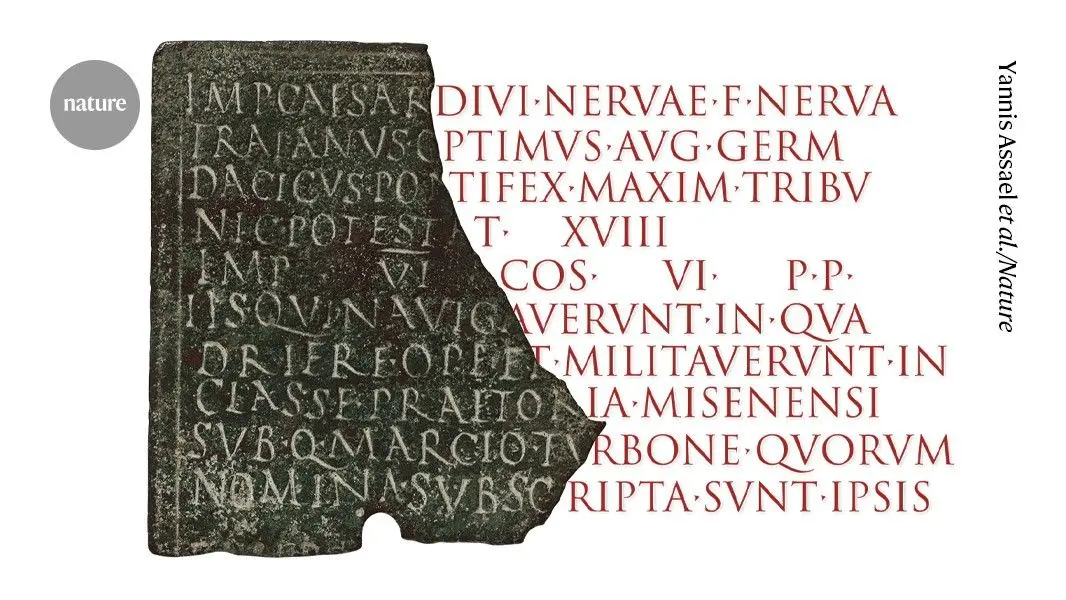
Researchers used Aeneas to analyze the famous Res Gestae Divi Augusti inscription, revealing new insights:
- The AI identified similarities between the inscription and other Roman texts from two distinct time periods: 10 BC to 1 BC and AD 10 to AD 20
5
. - Aeneas detected subtle language parallels with Roman legal documents and reflections of "imperial political discourse"
5
.
Limitations and Future Prospects
Source: Nature
Despite its impressive capabilities, Aeneas has some limitations:
- Performance varies across different time periods and regions
2
. - The training database is smaller compared to general-purpose AI models, potentially affecting performance on unusual inscriptions
1
.
However, the open-source nature of Aeneas' code and datasets allows for potential improvements and adaptations for other languages and time periods
3
4
.As AI continues to evolve, tools like Aeneas promise to revolutionize historical research, offering new ways to uncover and interpret the past.
References
Summarized by

Navi
[3]
[5]
Related Stories
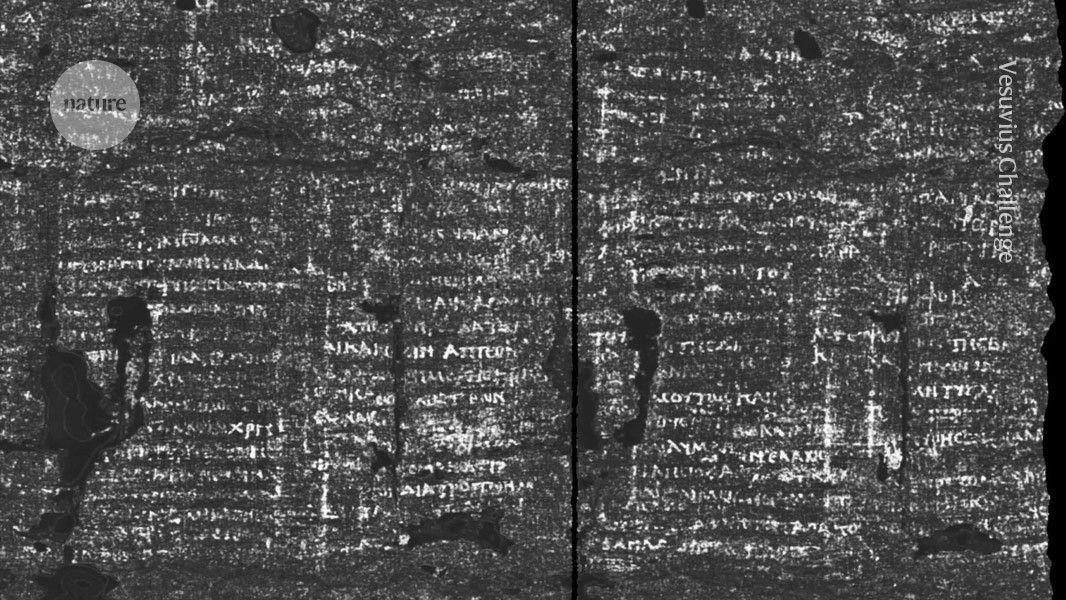
AI Breakthrough: Deciphering Ancient Scrolls from Pompeii's Ruins
29 Aug 2024

AI reads entire ancient scroll from Herculaneum for first time, revealing lost Stoic philosophy
25 Jun 2026•Science and Research

AI Deciphers 2,000-Year-Old Vesuvius Scroll, Revealing Lost Greek Philosophical Work
07 May 2025•Science and Research
Recent Highlights
1
Meta Unveils Muse Wonder Frontier AI Models, Claims Performance Matching OpenAI and Anthropic
Technology

2
IMF Report Warns AI Market Correction Could Spark Global Financial Crisis With $1.4T at Risk
Business and Economy

3
Eight States Sue OpenAI Over ChatGPT Safety Concerns and Unlawful Collection of Children's Data
Policy and Regulation
Recent Highlights
Today's Top Stories









Don’t drown in AI news. We cut through the noise - filtering, ranking and summarizing the most important AI news, breakthroughs and research daily. Follow topics that matter to you and stay ahead.


