AI in Healthcare: Promising but Costly, Requiring Human Oversight


5 Sources
[1]
Health Care AI Requires a Lot of Expensive Humans
Preparing cancer patients for difficult decisions is an oncologist's job. They don't always remember to do it, however. At the University of Pennsylvania Health System, doctors are nudged to talk about a patient's treatment and end-of-life preferences by an artificially intelligent algorithm that
[2]
Health Care AI Requires a Lot of Expensive Humans to Run
Despite the hype over artificial intelligence in medicine, the systems require consistent monitoring and staffing to put in place and maintain Preparing cancer patients for difficult decisions is an oncologist's job. They don't always remember to do it, however. At the University of Pennsylvania
[3]
Health care AI, intended to save money, turns out to require a lot of expensive humans
Artificial intelligence systems require consistent monitoring, experts say. Preparing cancer patients for difficult decisions is an oncologist's job. They don't always remember to do it, however. At the University of Pennsylvania Health System, doctors are nudged to talk about a patient's
[4]
Health care AI, intended to save money, turns out to require a lot of expensive humans
Preparing cancer patients for difficult decisions is an oncologist's job. They don't always remember to do it, however. At the University of Pennsylvania Health System, doctors are nudged to talk about a patient's treatment and end-of-life preferences by an artificially intelligent algorithm that
[5]

Health care AI, intended to save money, turns out to require a lot of expensive humans
KFF Health NewsJan 10 2025 Preparing cancer patients for difficult decisions is an oncologist's job. They don't always remember to do it, however. At the University of Pennsylvania Health System, doctors are nudged to talk about a patient's treatment and end-of-life preferences by an artificially
Share
Copy Link
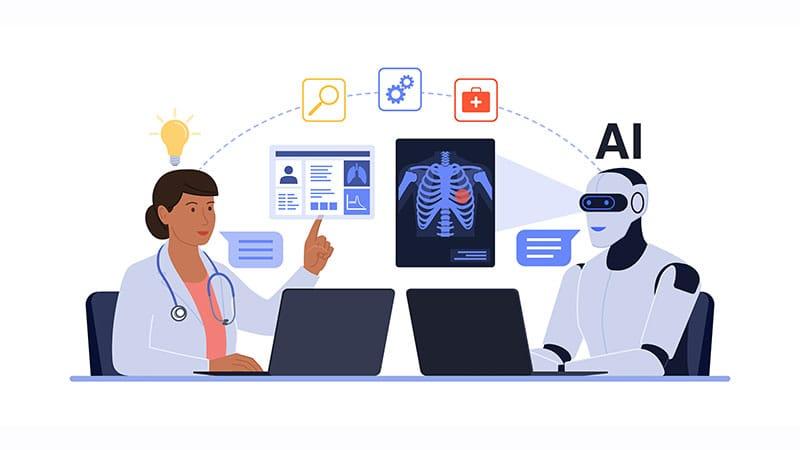
AI systems in healthcare, while promising, require significant human resources for implementation and maintenance. This challenges the notion that AI will reduce costs and improve efficiency in medical settings.

AI in Healthcare: Promise and Pitfalls
Artificial Intelligence (AI) in healthcare is often touted as a revolutionary force, promising improved efficiency and reduced costs. However, recent findings suggest that implementing and maintaining AI systems may require substantial human resources, potentially increasing healthcare costs
1
2
3
.The Reality of AI Implementation
At the University of Pennsylvania Health System, an AI algorithm predicts patients' mortality risk to prompt oncologists to discuss end-of-life care. However, during the COVID-19 pandemic, the algorithm's accuracy declined by 7 percentage points, potentially affecting hundreds of patients
1
2
3
. This incident highlights a crucial aspect of AI in healthcare: the need for constant monitoring and adjustment.The Hidden Costs of AI
Nigam Shah, chief data scientist at Stanford Health Care, raises a pertinent question: "Everybody thinks that AI will help us with our access and capacity and improve care and so on. All of that is nice and good, but if it increases the cost of care by 20%, is that viable?"
1
2
3
4
5
The implementation and maintenance of AI systems require significant investments:
- Continuous monitoring of algorithm performance
- Regular updates to maintain accuracy
- Specialized staff to manage and interpret AI outputs
- Powerful computing resources for data processing
Challenges in AI Evaluation
Jesse Ehrenfeld, past president of the American Medical Association, points out the lack of standardized evaluation methods for AI in healthcare. "We have no standards," he states, highlighting the difficulty in comparing different AI tools' performance
1
2
3
4
5
.A Stanford University study revealed that even advanced language models had a 35% error rate when summarizing patient medical histories, underscoring the potential risks of relying solely on AI for critical medical tasks
1
2
3
4
5
.Related Stories

Regulatory Concerns
FDA Commissioner Robert Califf expressed doubt about U.S. health systems' ability to validate AI algorithms in clinical settings, raising concerns about the readiness of healthcare institutions to properly implement and monitor AI technologies
1
2
3
4
5
.The Future of AI in Healthcare
Despite these challenges, the potential of AI in healthcare remains significant. Experts suggest that the future may involve AI systems monitoring other AI systems, with human oversight. However, this approach would still require substantial human involvement and resources
1
5
.As the healthcare industry continues to explore AI applications, it's becoming clear that the technology is not a simple plug-and-play solution. Instead, it requires careful implementation, constant monitoring, and significant human expertise to ensure its effectiveness and safety in medical settings.
References
Summarized by

Navi
[2]
[4]
Related Stories
AI in healthcare must define what should be automated before replacing human connection
06 Jul 2026•Health
AI in Healthcare: Balancing Innovation with Trust and Regulation
15 Oct 2024•Health

AI Diagnosis Outperforms Emergency Room Doctors in Harvard Study, Raises Questions on Patient Care
30 Apr 2026•Science and Research

Recent Highlights
1
Microsoft and Nvidia Launch Surface Laptop Ultra: A $2,599 AI-Ready PC With RTX Spark Chip
Technology

2
OpenAI Releases 722 AI-Generated Math Papers on GitHub, Igniting Fury Among Mathematicians
Science and Research

3
Trump Consulted Grok AI Before Ordering Venezuela Invasion and Capture of Nicolás Maduro
Policy and Regulation

Recent Highlights
Today's Top Stories










Don’t drown in AI news. We cut through the noise - filtering, ranking and summarizing the most important AI news, breakthroughs and research daily. Follow topics that matter to you and stay ahead.


