AI Infrastructure Investment Projected to Reach $31.6 Trillion by 2050, Dwarfing Historical Buildouts


4 Sources
[1]
AI data center investment projected to hit $32 trillion by 2050 -- infrastructure spending estimated to exceed capital requirements for railways, electrification, or the internet
Optimistic outlooks suggest the amount could go up to $50 trillion. PricewaterhouseCoopers LLP (PwC) estimates that spending on AI data centers could reach as much as $31.6 trillion in the next decade and a half, with optimistic outlooks suggesting that capital expenditure could potentially hit
[2]
PwC projects that the global investment in AI infrastructure will reach $31.6 trillion by 2050
Building the world's AI infrastructure will cost $31.6 trillion between now and 2050, according to modelling commissioned by PwC from Oxford Economics across 46 countries. Annual capital expenditure is projected to rise from $800bn this year to $1.8tn by 2050. The United States accounts for
[3]
PwC mapped where $31.6T in AI investment will land
Trillions of dollars in AI infrastructure spending are locked into the pipeline for the next quarter-century, but the destination is far from settled. PwC's Global Data Center Outlook, released September 2, 2026, projects $31.6 trillion in cumulative data center investment across 46 countries and
[4]
PwC Says the Global Race for Data Centers Is Set to Intensify
The rise of artificial intelligence is set to trigger a surge in data center investment. According to PwC's Global Data Center Outlook 2026-2050 study, $31.6tn is expected to be devoted to these infrastructures worldwide by 2050. Annual spending would rise from $800bn in 2026 to $1.8tn in 2050,
Share
Copy Link
PwC's Global Data Center Outlook forecasts $31.6 trillion in AI infrastructure spending through 2050, with the United States capturing nearly half at $15.1 trillion. Power availability and chip replacement cycles every four to six years emerge as critical challenges shaping the buildout.
PwC Report Projects Unprecedented Scale of AI Infrastructure Investment
Global investment in AI infrastructure is projected to reach $31.6 trillion by 2050, according to PwC's Global Data Center Outlook released in September 2026
2
. The analysis, built on modeling commissioned from Oxford Economics across 46 countries, reveals annual spending will climb from approximately $800 billion in 2026 to $1.8 trillion by 20501
3
. This capital expenditure scale surpasses historical infrastructure buildouts for railways, electrification, or the internet, with one critical difference: AI data center infrastructure requires continuous replacement rather than one-time investment1
.United States Dominates Global Data Center Investment Distribution
The United States is expected to capture nearly half of all global investment, accounting for $15.1 trillion in cumulative spending through 2050
2
3
. Asia Pacific follows with $8.2 trillion, led by China and India, while Europe is projected to attract $5.6 trillion over the same period1
4
. The Middle East is set to receive $1.1 trillion, with Africa accounting for approximately $255 billion3
. Clara Cutajar, PwC Australia's global infrastructure leader, emphasized that "AI infrastructure is becoming one of the defining capital allocation challenges of the next generation"2
.Equipment Costs Reshape Data Center Economics

Source: Market Screener
Information and communications technology equipment is expected to rise from 70% of total data center spending today to 93% by 2050
2
3
. This shift fundamentally changes what a data center represents as an asset. GPU development happens at breakneck pace, with Nvidia, AMD, and other manufacturers releasing new generations every two to three years1
. One Google architect noted that a data center GPU service life is only about one to three years, raising concerns that GPU depreciation could become the next major crisis for hyperscalers1
. Data centers must refresh their hardware every four to six years, transforming them from traditional infrastructure assets into businesses where costs are overwhelmingly equipment-driven1
2
.Power Availability Emerges as Primary Constraint
Source: Tom's Hardware
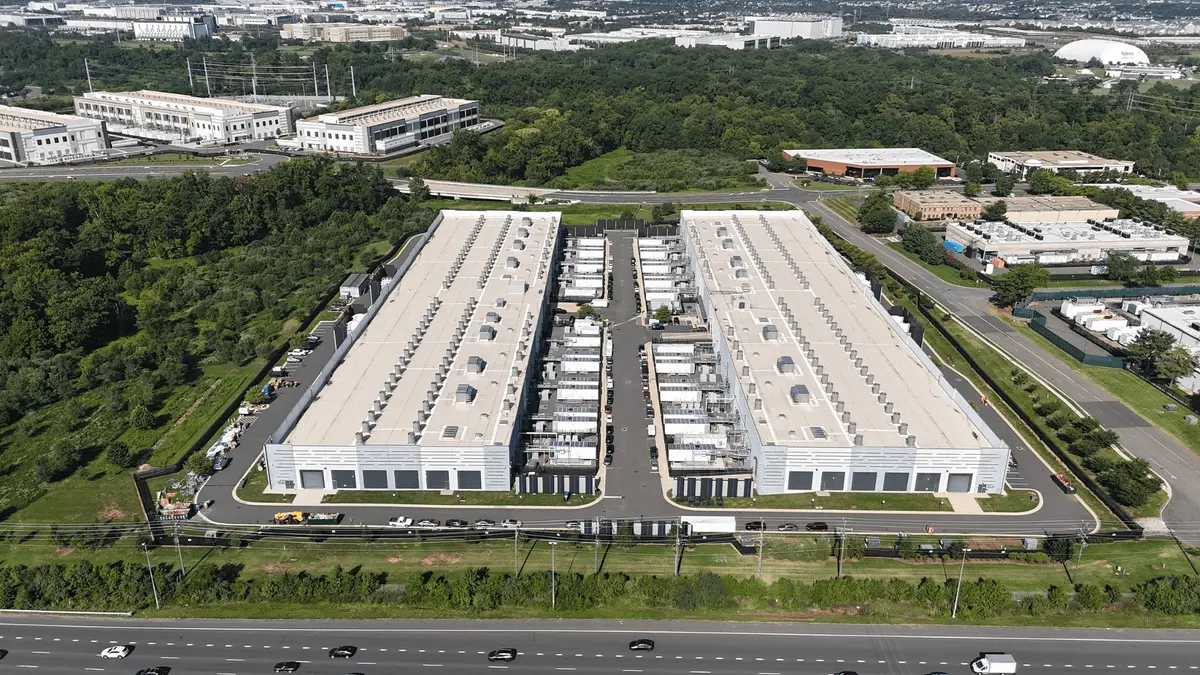
Power consumption sits atop PwC's list of five forces shaping where capital lands, described as "the binding constraint" in every region
3
. Data centers in the United States are forecasted to consume 20% of the country's total power supply by 20351
. Getting a new data center facility connected to the power grid can take four to ten years in many regions, far longer than the two to three years required for construction itself3
. International Energy Agency executive director Fatih Birol stated at the AI Action Summit in Paris in February 2025 that "there is no AI without energy, specifically electricity"3
. Grid connections, transformer lead times measured in years, and planning approvals all move more slowly than capital availability2
.Related Stories
Geopolitical Risks Could Slash Investment by $6 Trillion
Geopolitical tensions represent a major risk to the AI buildout. PwC modeled scenarios showing how trade policy shifts could reshape global AI infrastructure spending. Under tighter semiconductor export restrictions, cumulative global investment falls to approximately $25.5 trillion through 2050, roughly $6 trillion below the baseline forecast
3
4
. Annual investment could drop to about half the central forecast by 2030 under that scenario before supply chains gradually adapt3
. A digital sovereignty scenario shows cumulative spending easing to about $29.5 trillion as capital redirects toward regional priorities3
. Trade bans on rare earth elements and high-end chips could cut the global investment forecast by 20%1
.Near-Term Spending Aligns with Long-Range Forecasts

Source: The Next Web
Goldman Sachs Global Institute's analysis, published May 1, 2026, estimates approximately $7.6 trillion in cumulative capital spending on AI compute, data centers, and power from 2026 through 2031
3
. The firm's baseline projects $765 billion in annual spending on AI this year, growing to $1.6 trillion per year by 20313
. These near-term projections align broadly with PwC's long-range outlook, reinforcing confidence in the scale of the global race for data centers. Despite concerns that the current AI boom represents a bubble, with some AI tech companies carrying "hidden debt" worth around $1.65 trillion, Nvidia continues partnering with firms to build a $500 billion AI infrastructure fund1
. The industry has substantial capital available; the challenge lies in developing the physical infrastructure to support deployment at the projected scale2
.References
Summarized by

Navi
[2]
[3]
[4]
Related Stories
Data center deals hit $61 billion record as AI boom fuels infrastructure spending frenzy
19 Dec 2025•Business and Economy
AI Infrastructure Faces $4.2 Trillion Revenue Gap as Data Center Costs Double Every 12-16 Months
29 Sept 2026•Business and Economy

AI Data Centers Drive $580 Billion Investment Surge as Power Grid Struggles to Keep Pace
10 Nov 2025•Business and Economy
Recent Highlights
1
Meta Unveils Muse Wonder Frontier AI Models, Claims Performance Matching OpenAI and Anthropic
Technology

2
IMF Report Warns AI Market Correction Could Spark Global Financial Crisis With $1.4T at Risk
Business and Economy

3
OpenAI Releases 722 AI-Generated Math Solutions, Triggering Existential Crisis in Mathematics
Technology

Recent Highlights
Today's Top Stories







Don’t drown in AI news. We cut through the noise - filtering, ranking and summarizing the most important AI news, breakthroughs and research daily. Follow topics that matter to you and stay ahead.


