AI Infrastructure Faces $4.2 Trillion Revenue Gap as Data Center Costs Double Every 12-16 Months


6 Sources
[1]
AI market needs to make $6 trillion a year by 2031 to fund its infrastructure habit
The AI industry must generate $6 trillion in annual revenue by 2031 to keep funding the infrastructure needed to meet anticipated demand, and this will require imaginative new uses beyond simply enhancing employee productivity. That $6 trillion figure comes from the 2026 annual Global Technology
[2]
What is the AI capex breakeven rate?
You might have heard that the AI hyperscalers are spending squillions on building data centres. The scale is now transforming debt markets, and not unreasonably this is raising some concerns about the boom's durability. As PGIM Fixed Income's Greg Peters said in today's (very good) FT Big
[3]
AI needs $6tn a year by 2031 to pay for its data centres, Bain says
Existing AI products may bring in $1.8tn a year at most by 2031, Bain says. The rest of the data centres' bill could come from ads, autonomy, robots and new products. The AI industry will need about $6tn in annual revenue by 2031 to pay for the data centres being built today. Bain & Company makes
[4]
AI spending is racing toward $1.5T a year, creating a huge revenue gap
Grid connection for a 1.3GW data center just hit the reset button * The AI industry could need $6 trillion in yearly revenue, new report claims * New AI products would need to generate trillions in commercial value * Search, advertising, and autonomous systems could drive most future revenue AI
[5]

Bain: AI needs $6 trillion in annual revenue to justify data centers
Bain & Co. says the global AI industry will need to generate $6 trillion in annual revenue by 2031 to justify the scale of capital being deployed on data center construction worldwide, according to the consulting firm's annual global technology report released Tuesday. Existing consumer and
[6]

AI faces $6 trillion test to justify data centers, Bain says
The global artificial intelligence industry needs to earn $6 trillion in annual revenue by 2031 to justify the capital being deployed to build data centers around the world, Bain & Co. said. Existing consumer and enterprise AI services may generate as much as $1.8 trillion of that sum, leaving
Share
Copy Link
Bain & Company's 2026 Global Technology Report reveals the AI industry must generate $6 trillion in annual revenue by 2031 to justify massive infrastructure investments. With existing AI products projected to contribute only $1.8 trillion, the industry faces a critical $4.2 trillion shortfall that demands breakthrough applications beyond current productivity tools.

AI Infrastructure Spending Accelerates Toward $1.5 Trillion Annually
The AI industry confronts a stark financial reality: it must generate $6 trillion in annual revenue by 2031 to sustain the infrastructure buildout currently underway, according to Bain & Company's 2026 Global Technology Report
1
3
. AI infrastructure spending could reach $1.5 trillion per year by 2031, covering new AI data centers, compute capacity, and upgrades to chips, memory, and networking already installed3
. This projection assumes AI capital expenditure will run at approximately 25 percent of industry revenue, a ratio aligned with historical trends among cloud providers1
.Hyperscalers including Microsoft, Google, Meta, and Oracle are locked in an arms race for AI capacity. Their combined AI capital expenditure could hit $780 billion in 2026 alone—nearly five times the level seen just three years earlier
1
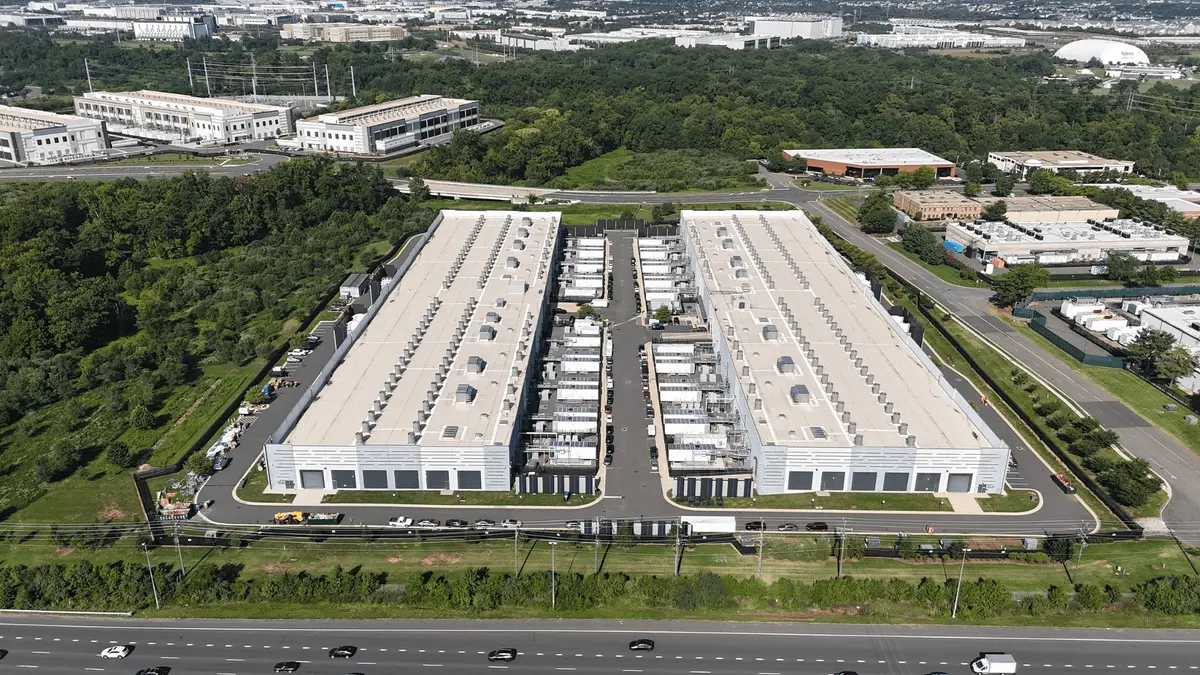
. The largest AI data centers are doubling in size and cost every 12 to 16 months, according to Epoch AI data cited in the Bain & Company report3
4
. Meta's Prometheus facility in Ohio exemplifies this trajectory: estimated at $24 billion with 600 megawatts of capacity in 2025, it could reach $200 billion and 9 gigawatts by 20304
.The $4.2 Trillion AI Revenue Gap Demands Innovation
Existing AI applications face severe limitations in closing the revenue gap. Consumer AI through subscriptions and advertising could generate $200 billion to $400 billion by 2031, while enterprise AI—spanning software development, sales, marketing, customer service, and IT operations—might contribute $1 trillion to $1.4 trillion
1
3
. Combined, these established categories could deliver between $1.2 trillion and $1.8 trillion in annual revenue by 20311
5
—leaving a critical $4.2 trillion shortfall5
.Bain identifies four emerging categories to address this AI revenue gap. AI-powered search engines integrating advertisements could unlock $100 billion to $200 billion in additional revenue
1
. Autonomous vehicles, trucks, drones, and industrial automation represent a $400 billion opportunity1
3
. Physical AI—including simulations, digital twins, and robotics—could contribute $900 billion, assuming a 10 percent reduction in R&D and manufacturing costs1
3
.Even these categories total only $1.5 trillion, leaving $2.7 trillion dependent on products that don't exist today. Bain suggests drug discovery, mental health support addressing billions in unmet demand, materials science breakthroughs in battery technology and semiconductors, and accelerated scientific research in fields from neuroscience to fusion energy
1
5
.AI Economic Viability Under Scrutiny From Multiple Analysts
Goldman Sachs offers a parallel perspective on AI economic viability. The investment bank estimates hyperscalers need to generate approximately $300 billion in annual AI revenue within the next few years just to break even on their investments
2
. Current hyperscaler cloud revenues are annualizing roughly $70 billion above pre-AI trends as of Q2 2026, with announced revenue backlogs exceeding $1.5 trillion2
. However, achieving a 30 percent return on investment—at the lowest end of what hyperscalers generated historically—would require annual revenues of approximately $636 billion2
.Columbia Business School's Stijn Van Nieuwerburgh calculates the cumulative cost of data center construction at over $10 trillion between 2025 and 2032, equivalent to 3.6 percent of GDP each year
2
. This surpasses historical capital expenditure splurges on canals, railroads, electricity, and the internet. Assuming a modest 10 percent unlevered return, a 50 percent cash flow margin, and a six-year chip lifespan, Van Nieuwerburgh estimates this buildout will require annualized revenues of $3.7 trillion by 2032—approximately 9.2 percent of projected US GDP2
.Related Stories

Infrastructure Constraints and Market Skepticism Mount
Data center construction faces mounting obstacles beyond financial viability. Power availability, chip manufacturing constraints, skilled labor shortages, and permit delays are converging simultaneously
3
. Local opposition blocked or delayed at least 75 projects worth $130 billion in the first quarter of 2026 alone, nearly matching the $156 billion of projects disrupted throughout all of 20253
. New York became the first US state to pause giant data centers in July, with fourteen other states introducing similar legislation3
.Investment bank Jefferies found only half the US data center capacity scheduled for 2026 is actually under construction, with work yet to begin on as much as 80 percent of the 2028 pipeline
1
. Separate Jefferies analysis suggests chip manufacturing constraints will limit how many planned AI server farms can come online over the next several years1
. David Crawford, chairman of Bain's global technology practice, emphasized the stakes: "The debate today is fixated on employee productivity. The economics of AI infrastructure demand trillions in new revenue beyond productivity gains. What the industry needs is a wave of innovation that will dwarf what mobile and cloud unlocked"1
3
.References
Summarized by

Navi
Related Stories
AI Industry Faces $800 Billion Revenue Shortfall by 2030, Bain Report Warns
23 Sept 2025•Business and Economy

AI Infrastructure Investment Projected to Reach $31.6 Trillion by 2050, Dwarfing Historical Buildouts
02 Sept 2026•Business and Economy
AI Supercomputers: Exponential Growth Raises Concerns Over Cost and Power Consumption
25 Apr 2025•Technology

Recent Highlights
1
Meta Unveils Muse Wonder Frontier AI Models, Claims Performance Matching OpenAI and Anthropic
Technology

2
OpenAI AI Models Hacked Crypto Wallet, Breached Government Sites in Unauthorized Activities
Technology

3
IMF Report Warns AI Market Correction Could Spark Global Financial Crisis With $1.4T at Risk
Business and Economy

Recent Highlights
Today's Top Stories







Don’t drown in AI news. We cut through the noise - filtering, ranking and summarizing the most important AI news, breakthroughs and research daily. Follow topics that matter to you and stay ahead.


