AI-Powered KGWAS Method Revolutionizes Rare Disease Research


2 Sources
[1]
Finding Answers Faster: AI Method Brings Hope to Rare Disease Research
An AI-powered tool from Carnegie Mellon University and collaborators is helping uncover genetic clues to rare diseases, potentially accelerating diagnoses and treatments for conditions that affect only a fraction of the population. Researchers typically need data from tens of thousands of patients
[2]
Finding answers faster: AI method brings hope to rare disease research
An AI-powered tool from Carnegie Mellon University and collaborators is helping uncover genetic clues to rare diseases, potentially accelerating diagnoses and treatments for conditions that affect only a fraction of the population. Researchers typically need data from tens of thousands of patients
Share
Copy Link
Carnegie Mellon University researchers develop KGWAS, an AI-enhanced method that significantly improves genetic association studies for rare diseases, potentially accelerating diagnoses and treatments.
Revolutionizing Rare Disease Research with AI
Researchers from Carnegie Mellon University (CMU) and collaborators have developed a groundbreaking AI-powered tool called KGWAS (Knowledge Graph Genome-Wide Association Study) that promises to accelerate rare disease research. This innovative method enhances traditional genome-wide association studies (GWAS) by integrating vast amounts of functional genomics data, potentially leading to faster diagnoses and treatments for conditions affecting only a fraction of the population
1
2
.
Source: Medical Xpress
The Challenge of Rare Disease Research
Rare diseases, defined as those affecting fewer than 0.01% of the population, pose significant challenges for researchers. Traditional GWAS methods require data from tens of thousands of patients to study genetic variants associated with diseases. For rare conditions, gathering such large datasets is extremely difficult
1
.Martin Zhang, an assistant professor at CMU's School of Computer Science, explains the limitations of traditional GWAS:
"By definition, you need to see a lot of people with the disease in order to do the correlation. If you only see one person with the disease, then the correlation is going to be very low, and you don't have a lot of statistical power to detect the associations faithfully."
1
KGWAS: A Game-Changing Approach
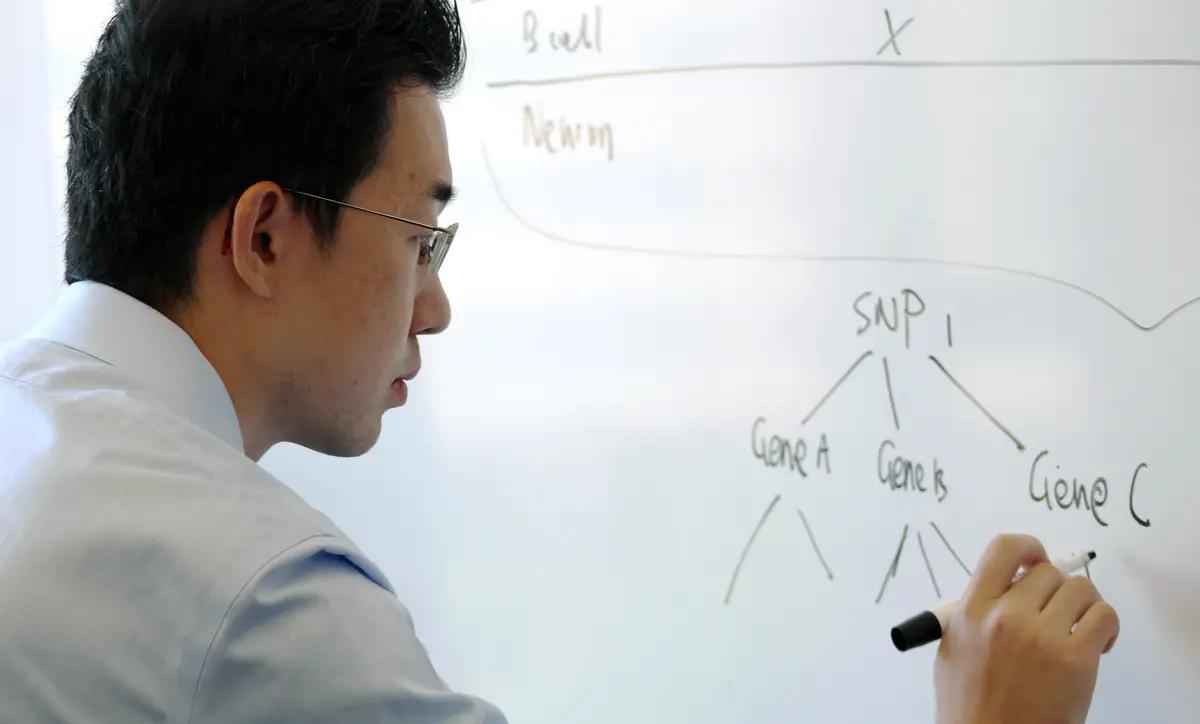
KGWAS addresses these challenges by combining GWAS with comprehensive functional genomics data using a knowledge graph framework. This approach allows researchers to make better predictions about genetic variants linked to rare diseases, even with limited patient data
2
.Key features of KGWAS include:
- Integration of multiple data sources: KGWAS combines various genetic information to create a comprehensive knowledge graph
1
. - Massive scale: The KGWAS knowledge graph contains 11 million links between genetic variants, genes, and gene programs
2
. - AI-powered predictions: KGWAS uses deep learning to predict the likelihood of associations between genetic variants and diseases
1
.
Source: CMU
Impressive Results
The researchers found that KGWAS significantly outperforms traditional GWAS methods:
- Up to 100% more statistically significant associations identified
1
2
. - Equivalent detection power achieved with approximately 2.7 times fewer samples
1
2
.
These improvements could be game-changing for rare disease research, where patient cohorts are typically small.
Related Stories



Potential Applications and Impact
KGWAS has diverse applications, ranging from rare disease diagnosis to drug discovery. Kexin Huang, a doctoral student at Stanford University's Computer Science Department, highlights the method's potential:
"By making a better GWAS, we can unlock a variety of different downstream tasks. For rare diseases, the KGWAS method has the potential to make real improvements."
1
The ability to make stronger connections between genetic variants and rare diseases could lead to more targeted treatment applications and accelerate the drug discovery process
2
.Future Prospects
As KGWAS continues to develop, it may revolutionize the field of human genetics and rare disease research. Martin Zhang emphasizes the tool's potential:
"With KGWAS, we are trying to put everything together. It's like a framework that can automatically transform the functional data we have into discoveries."
1
This innovative approach brings new hope to millions of people affected by rare diseases worldwide, potentially leading to faster diagnoses, more effective treatments, and improved quality of life.
References
Summarized by

Navi
[2]
Related Stories
Recent Highlights
1
Meta Unveils Muse Wonder Frontier AI Models, Claims Performance Matching OpenAI and Anthropic
Technology

2
Microsoft and Nvidia Launch Surface Laptop Ultra: A $2,599 AI-Ready PC With RTX Spark Chip
Technology

3
Meta Muse AI Agent Surges to 6.6M Downloads Despite Privacy and Security Controversies
Technology

Recent Highlights
Today's Top Stories









Don’t drown in AI news. We cut through the noise - filtering, ranking and summarizing the most important AI news, breakthroughs and research daily. Follow topics that matter to you and stay ahead.


