AI Stock Sell-Off Hammers Chipmakers as South Korean Market Plunges 25% in Month


18 Sources
[1]
AI stock sell-off continues as investors dump chipmakers
An AI stock sell-off continued on Tuesday as markets in Asia tumbled, with trading on South Korea's Kospi temporarily halted after it plunged 8 per cent and Tokyo sliding 4 per cent. Shares in SK Hynix shed as much as 10 per cent, while its larger rival, Samsung Electronics, fell more than 9 per
[2]
In Another Wild Day for South Korean Stocks, Market Surges 18 Percent
These days, South Korea's stock market can only be described as wild. The country's benchmark KOSPI rose 18 percent on Friday, capping a volatile week marked by huge price swings that triggered mandatory pauses in trading on Tuesday and Wednesday to give the market a breather during sharp
[3]
Is AI facing a big financial reckoning?
Sharp falls in the value of chip makers have stoked investor concerns that the euphoria around AI related companies is fading. Shares in Korean chip makers SK Hynix and Samsung are down 46% and 35% respectively over the last month as investors worry the recent boom in demand for the chips that
[4]
Investors ditch chip stocks as fears of AI bubble grow
Once again, fears of an AI investment bubble are rattling investors. Earlier, trading on South Korea's stock market had to be halted after a steep sell-off. The latest bout of nerves is being caused by news that chip giant Nvidia is investing three-quarters of a trillion dollars to help fund
[5]
Shares in Asian chip firms plunge further as AI sell-off continues
Drop comes after South Korean company SK Hynix's results undershot investors' expectations Shares in companies linked to AI have plunged further after disappointing results from the South Korean chipmaker SK Hynix, sending the country's stock market tumbling for the second day in a row. Seoul's
[6]
Chip firms fall in US and Asia as AI jitters rattle investors
Shares in major chip firms have fallen sharply in the US and Asia as a sell-off in artificial intelligence-related stocks deepened. Trading on South Korea's benchmark Kospi index was paused temporarily on Tuesday morning after sliding by 8%. It fell further after the 20-minute halt was lifted to
[7]
AI sell-off intensifies as investors ditch chip stocks
Samsung and SK Hynix fall by more than 10% amid renewed fears over AI spending and Chinese competition The sell-off in AI stocks has intensified, driving South Korea's stock market down to its lowest level in three months. Investors continued to ditch chip stocks on Tuesday, amid rising concerns
[8]
AI sell-off deepens as chip stocks slump in market retreat - business live
Stock markets are tumbling in Asia, as an AI sell-off pushes investors to dump some of the biggest chip stocks in the industry. The South Korean Kospi dropped more than 10% on Monday, with trading halted at one point, and Japan's Nikkei fell more than 4%. Shares in the chip companies SK Hynix and
[9]

Global Market: Samsung, SK Hynix plunge up to 11% as investors reassess AI chip boom
South Korean chip stocks experienced sharp declines on Tuesday. Major companies like Samsung Electronics and SK Hynix saw significant drops. Investors scaled back artificial intelligence-related bets due to spending sustainability worries. Concerns over China's semiconductor advancements also
[10]

KOSPI Sinks Over 12% in Worst Two-Day Drop Ever as AI Chip Sell-Off Deepens After SK Hynix Misses Expecta
Index Bleeds From 52-Week Highs The heavy losses compound a horrific month for South Korean equities. Following a massive nearly 11% crash on Tuesday, the KOSPI's latest 5.99% slide pushes the index significantly lower, falling over 39.66% from its 52-week high of 9,385.59. Because heavyweights
[11]

Kospi, Nikkei 225 Rise After Microsoft, Amazon Lift AI Confidence
Asian stock markets bounced back strongly on Friday after Microsoft and Amazon posted better-than-expected earnings. Strong cloud growth renewed confidence in AI spending and lifted technology shares across South Korea, Japan, and Taiwan. The Kospi recorded its biggest one-day gain, while the
[12]

Korea's AI Rocket Ship Lifts Off Again
Global investors appear to have treated the washout as an opportunity to rebuild exposure to two companies sitting near the centre of the AI hardware chain. Takeaways by Dark Side of the Boom ™ * Korea's record rebound looks less like a fresh speculative surge and more like the violent reversal
[13]

AI rally lifts markets, Dax flirts with record high
Investors' enthusiasm for chip stocks returned after encouraging growth figures from Microsoft and Amazon. Strong cloud growth and capital spending that came in below fears eased concerns about runaway costs for artificial intelligence (AI). Microsoft shares soared more than 15% on Thursday. Amazon
[14]
Korea's Kospi Logs Record Daily Gain, Defying Efforts to Tame Wild Swings -- Update
South Korea's share market achieved its biggest daily rise on record, confounding officials' attempts to limit wild swings in equities and restrain mom-and-pop investors from taking on debt to buy stocks exposed to the global AI boom. The benchmark Kospi index, dominated by the nation's largest
[15]
Korea's Kospi Heads for Record Daily Gain, Defying Efforts to Tame Wild Swings
South Korea's share market is on track for its biggest daily rise on record, confounding officials' attempts to limit wild swings in equities and restrain mom-and-pop investors from taking on debt to buy stocks exposed to the global AI boom. The benchmark Kospi index, dominated by the nation's
[16]
Korean Equities Lead Asian Rally on Renewed AI Enthusiasm
South Korean stocks surged Friday morning on renewed enthusiasm over spending related to the artificial-intelligence boom, leading the region's equity markets higher, while the yen weakened, giving up some of its sharp gains overnight. Chip and technology shares in Asia climbed in the wake of
[17]
Asian chip stocks slide as China competition fears rattle AI trade
SEOUL, July 28 (Reuters) - Asian semiconductor stocks tumbled on Tuesday, with South Korea leading the regional selloff, as investors questioned lofty valuations amid concerns over AI infrastructure financing and intensifying competition from China. Shares in memory-chip giants Samsung Electronics
[18]
Asian Equities Slide on Growing Doubts Over AI Spending
Asian equities slid Tuesday morning, with Korean markets leading losses amid growing worries over spending linked to the artificial-intelligence boom. Chip and technology stocks dragged stock markets lower across Asia after the U.S. Philadelphia Semiconductor Index fell 2.2% on Monday, extending a
Share
Copy Link
The South Korean stock market faced unprecedented turmoil as AI stock sell-off intensified, with trading halted after the Kospi plunged 8 percent. SK Hynix shares dropped 45 percent from June highs despite record profits, while Samsung Electronics fell over 9 percent, wiping $570 billion off market value and raising questions about the sustainability of AI spending.
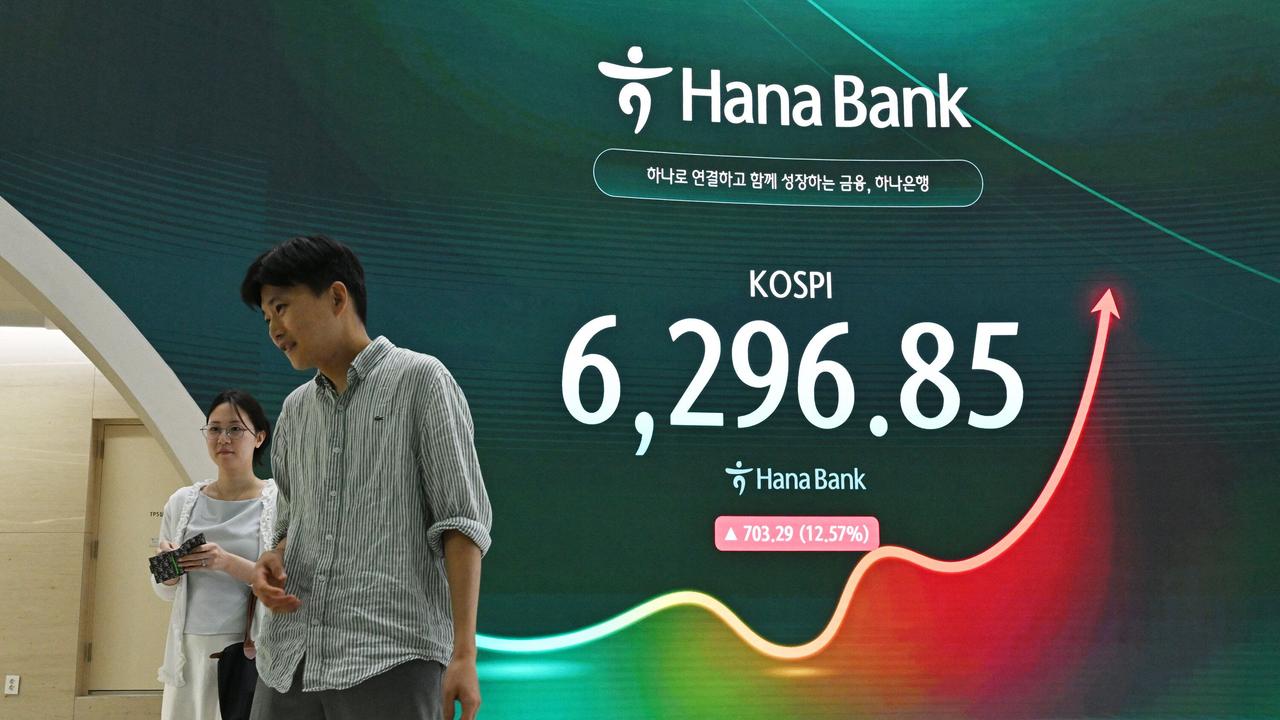
South Korean Stock Market Faces Historic Collapse
The South Korean stock market experienced severe turbulence as an AI stock sell-off accelerated, forcing trading halts on the Kospi after it plunged 8 percent on Tuesday
1
. The benchmark index has fallen approximately 25 percent over the past month and is down by a third from its June peak1
. The dramatic decline represents one of the sharpest corrections in a major global market, driven primarily by concerns about the sustainability of AI spending and potential over-supply in the semiconductor industry.SK Hynix, the world's second-largest memory chip maker, saw its shares tumble as much as 10 percent, with Seoul-listed shares falling about 45 percent since hitting a record high above 3 million won ($2,041) in June
1
. This wiped approximately $570 billion off its market value, marking one of the world's steepest declines over the period, second only to SpaceX1
. Samsung Electronics, its larger rival, fell more than 9 percent1
. Together, these two companies account for about 40 percent of the South Korean stock market and more than half its market capitalization, giving them outsized influence over the Kospi's movements1
5
.Record Profits Fail to Satisfy Investors
Despite SK Hynix reporting second-quarter operating profit of about 64 trillion won, up sevenfold from a year earlier, with revenue more than tripling to roughly $57 billion, the results undershot investor expectations
1
5
. Gary Tan, a portfolio manager at Allspring Global Investments, noted that "SK Hynix delivered strong results, but in today's AI market, strong is no longer enough. Investors were looking for additional catalysts, particularly around long-term agreements and shareholder returns, to support a memory sector that has become the epicentre of the AI trade"5
. The disappointing reaction highlights growing doubts about the durability of Big Tech spending on AI infrastructure and whether chipmakers can maintain their explosive growth trajectory.AI Investment Bubble Concerns Spread Across Asia
The sell-off extended beyond South Korea, hitting Asian chip firms across the region. Japan's Nikkei 225 dropped more than 4 percent as semiconductor stocks declined, with memory chip company Kioxia plunging as much as 18 percent
1
. Kioxia has plunged 50 percent in the past month, despite briefly being Japan's biggest company by market value1
. Other semiconductor-related stocks, including Lasertec, Disco, Tokyo Electron and Renesas, were also sharply down1
. Taiwan's TSMC, the world's largest contract chipmaker, fell 3 percent in Taipei5
. One senior equities trader in Tokyo expressed shock at the speed of the decline, stating: "I can't remember seeing anything this bad or violent"1
.Circular Financing and Over-Supply Fears
Investor confidence has been shaken by multiple factors, including concerns about circular financing where suppliers invest money in their customers, artificially inflating demand
4
. Nvidia's reported investment of three-quarters of a trillion dollars to help fund AI infrastructure projects has raised skepticism about whether this represents genuine market demand4
. Additionally, concerns over future over-supply have weighed on sentiment after South Korea's leading chipmakers unveiled aggressive expansion plans1
. SK Hynix and Samsung plan to build two new chip plants apiece in South Korea as part of a combined 800 trillion won ($530 billion) investment to double their production capacity for DRAM chips over five years1
. US rival Micron Technology has also raised planned domestic investment to $250 billion through 20351
.Leveraged Investments Amplify Market Volatility
Analysts point to leveraged investments by retail investors as a key factor amplifying market volatility. Small-time investors had led the charge on buying chipmakers' stocks, many using borrowed money
5
. While this pushed stocks higher during last month's rally, it has worsened the sell-off as many have been forced to pull their money out when prices started falling2
. Chan H Lee, managing partner at Petra Capital Management, noted that "stock has gone up too much, too fast this year, so this kind of correction is inevitable," but predicted a rebound soon as deleveraging nears completion1
. Han Ji-young, an analyst at Kiwoom Securities, observed that "hopes of the market rebounding today after a 10% plunge yesterday faded, triggering panic selling and forcing most stock investors to book losses"5
.Related Stories

Wild Swings and Dramatic Recovery
In a dramatic reversal, the Kospi surged 18 percent on Friday, capping an extraordinarily volatile week that saw mandatory trading pauses on Tuesday and Wednesday
2
. Samsung Electronics shares soared 27 percent while SK Hynix climbed 30 percent2
. The rally followed comments from Microsoft and Amazon confirming plans to continue increasing spending on building computing capacity for AI infrastructure despite already staggering outlays2
. New regulatory measures from the South Korean government aimed at easing market volatility also kicked in Friday, lifting hopes for stability2
. Khoon Goh, head of Asia research at ANZ, characterized the situation: "The Kospi has been trading like a meme stock or crypto. It's not normal behavior for a major index"2
.Broader Implications for AI Ecosystem
The turbulence reflects a financial reckoning across the AI ecosystem as investors scrutinize whether hyperscalers can charge end users enough to justify the hundreds of billions being spent on buying memory chips and building data centers
3
. Leading tech investor Eileen Burbidge told the BBC that "the AI bubble hasn't burst but it's letting out air," as various factors darken the mood3
. Meta shares are down 15 percent over the last month, while SpaceX has seen its shares fall 14 percent from its IPO debut and nearly 50 percent from its June peak3
. Meanwhile, Apple has benefited as investors seek safe havens, with its stock rising 21 percent over the last month to reclaim its title as the world's most valuable company from Nvidia3
5
.Market Stabilization Measures and Future Outlook
South Korea's finance minister, Koo Yun-cheol, told the national assembly the government was reviewing market stabilization measures to address the unprecedented volatility
5
. Despite the turbulence, analysts remain cautiously optimistic about the industry's near-term outlook, citing long-term supply agreements that improve earnings visibility1
. KB Securities analyst Kim Dong-won expects sales to Big Tech companies and data center operators to account for 70 percent of SK Hynix's revenue, up from 30 percent in 20171
. Some analysts argue the sell-off has made SK Hynix shares increasingly attractive, trading at just 4.4 times forward earnings compared to Micron's 6.2 times1
. Shawn Oh of NH Investment & Securities called the recent pullback a "compelling buy" opportunity, citing attractive valuations and ongoing deleveraging among Korean retail investors1
. Watch how hyperscalers communicate their AI infrastructure spending plans and whether memory chip prices stabilize or continue pressuring demand.References
Summarized by

Navi
Related Stories
AI Stocks Tumble as Investors Question Massive AI Infrastructure Spending and Valuations
13 Jul 2026•Business and Economy
South Korea's AI stocks now set the tone for global markets as chipmaker swings ripple worldwide
17 Jul 2026•Business and Economy

AI Stocks Crash as Asian Markets Plunge 7% Amid Growing Concerns Over AI Trade Sustainability
13 Oct 2026•Business and Economy

Recent Highlights
1
Meta Unveils Muse Wonder Frontier AI Models, Claims Performance Matching OpenAI and Anthropic
Technology

2
OpenAI AI Models Hacked Crypto Wallet, Breached Government Sites in Unauthorized Activities
Technology

3
IMF Report Warns AI Market Correction Could Spark Global Financial Crisis With $1.4T at Risk
Business and Economy

Recent Highlights
Today's Top Stories







Don’t drown in AI news. We cut through the noise - filtering, ranking and summarizing the most important AI news, breakthroughs and research daily. Follow topics that matter to you and stay ahead.


