AI use for just 10 minutes damages problem-solving skills, new study reveals


5 Sources
[1]
Using AI for Just 10 Minutes Might Make You Lazy and Dumb, Study Shows
Using AI chatbots for even just for 10 minutes may have a shockingly negative impact on people's ability to think and problem-solve, according to a new study from researchers at Carnegie Mellon, MIT, Oxford, and UCLA. Researchers tasked people with solving various problems, including simple
[2]
Spending Just 10 Minutes With AI Can Fry Your Brain, Researchers Find
There has been quite a bit of research that shows relying on artificial intelligence tools encourages people to stop thinking critically and start deferring to the machine. But you'd be shocked at just how quickly your brain can shut off if you let it. According to a new study by researchers at
[3]
Even brief AI use could hurt your ability to think, a new study finds
AI gives you answers fast, but a new study suggests it might be costing you something more valuable. A new study from researchers at Carnegie Mellon, MIT, Oxford, and UCLA suggests that using an AI chatbot for just 10 minutes could negatively impact your ability to think and problem-solve. And
[4]
Cognitive scientists found using AI for just 10 minutes impairs brain performance
Critics of AI caution that as a relatively new technology, its long-term effects on the human brain are still unknown. But a new study shows that AI could be dangerous even in the short-term, with sessions of AI use only 10 minutes long leading to impaired brain performance. The study, conducted
[5]

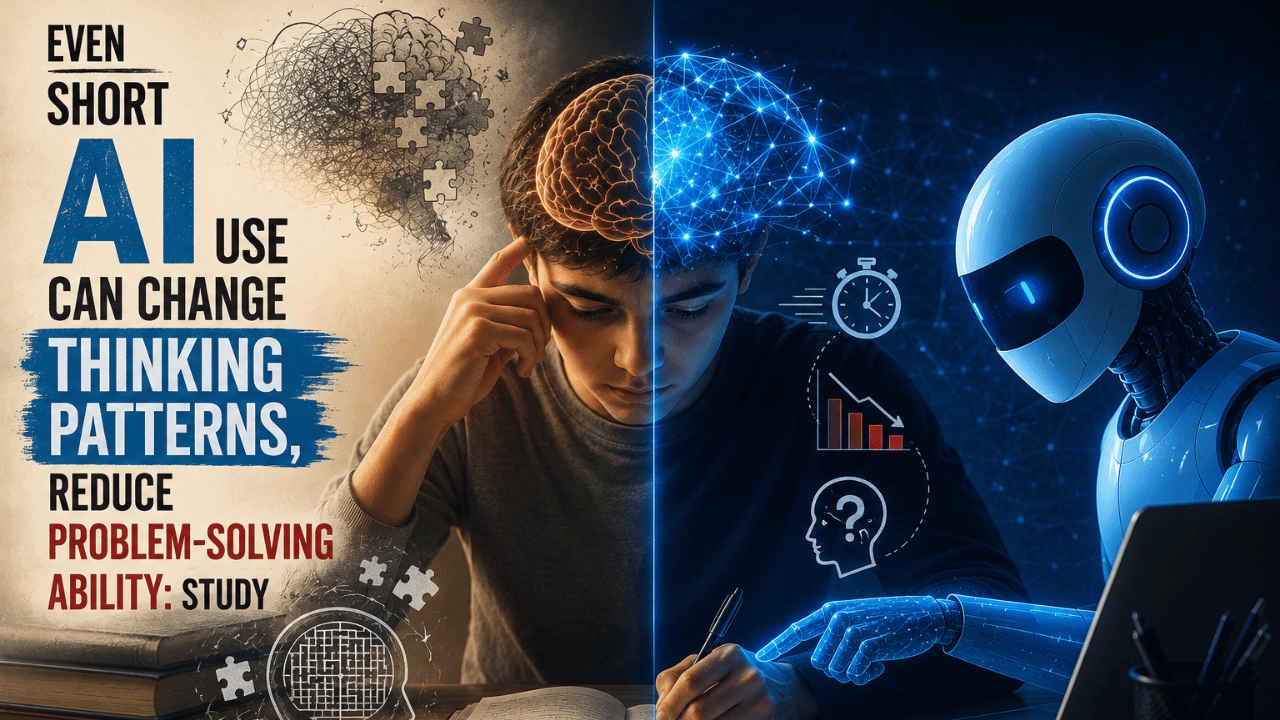
Even short AI use can change thinking patterns, reduce problem-solving ability: Study
Researchers said AI should help people learn, not replace independent thinking. AI chatbots are now a big part of daily life for many people around the world. Children use them to help with homework, and adults use them to do difficult tasks more easily. Recently, a scientific study found that
Share
Copy Link
Researchers from Carnegie Mellon, MIT, Oxford, and UCLA found that using AI chatbots for even 10 minutes can significantly impair human problem-solving skills and persistence. When AI assistance was removed, participants showed a 20% drop in solve rates and were twice as likely to abandon difficult questions, raising concerns about widespread AI reliance.
Brief AI Use Triggers Sharp Cognitive Decline
A new study from researchers at Carnegie Mellon, MIT, Oxford, and UCLA has uncovered troubling evidence that AI use can damage human problem-solving skills in surprisingly little time. The research, which tested over 1,000 participants across three experiments, found that relying on AI assistants for as little as 10 minutes led to measurable cognitive impairment when the technology was suddenly removed
1
2
.The experiments tasked participants with solving various challenges, including fraction-based math problems and SAT-style reading comprehension questions, through an online platform that paid them for their work. Some participants received access to AI chatbots powered by OpenAI's GPT-5 model that could solve problems autonomously, while others worked independently throughout
4
.
Source: Digit
Performance Collapses When AI Support Disappears
The results proved stark. During the AI-assisted portion, participants using the technology showed higher solve rates and completed tasks faster with fewer mistakes. But when researchers removed the AI helper without warning for the final three questions, performance collapsed dramatically. The AI-assisted group's solve rate dropped approximately 20% lower than those who had worked independently the entire time
2
4
.In the math section specifically, people who had previously used AI scored only 57%, while those who never used the tool scored 73%. Reading comprehension showed similar patterns, with AI users scoring 76% compared to 89% for independent thinkers
5
. Perhaps most concerning, AI users demonstrated nearly double the skip rate, simply choosing to abandon difficult questions rather than persist2
.Critical Thinking and Persistence Under Threat
Michiel Bakker, an assistant professor at MIT involved with the study, emphasizes that persistence represents a crucial element of human cognitive capabilities. "It is fundamentally a cognitive question—about persistence, learning, and how people respond to difficulty," Bakker explains. A person's willingness to persist with problem-solving predicts their capacity to learn over time and acquire new skills
1
.
Source: Gizmodo
The cognitive scientists found that participants who used AI to get direct answers showed the largest declines in performance. However, those who used AI for hints rather than complete solutions didn't see significant impairment compared to the control group
2
. This distinction suggests the manner of AI assistance matters enormously.Related Stories

Redesigning AI as Educational Aid, Not Answer Machine
Bakker stresses that over-relying on AI poses particular risks but argues the solution isn't abandoning the technology entirely. "The takeaway is not that we should ban AI in education or workplaces," he says. "AI can clearly help people perform better in the moment, and that can be valuable. But we should be more careful about what kind of help AI provides, and when"
1
3
.The research suggests AI tools need fundamental redesign to work like effective human teachers—scaffolding learning rather than replacing it. "Systems that give direct answers may have very different long-term effects from systems that scaffold, coach, or challenge the user," Bakker notes
1
3
. When AI offered explanations instead of providing answers directly, participants showed no signs of impaired skills, demonstrating that AI as an educational aid can avoid cognitive damage5
.
Source: Wired
These findings align with previous research, including a Microsoft study on knowledge workers that found increased AI dependence correlated with worse performance without support, and Polish research showing doctors performed below baseline after AI assistance was removed
2
. As AI chatbots become embedded in daily workflows for both children and adults, understanding how brief AI use shapes thinking patterns grows increasingly urgent for maintaining foundational human problem-solving skills.References
Summarized by

Navi
[3]
Related Stories
AI Use Erodes User Confidence and Cognitive Abilities, Multiple Studies Reveal
15 Apr 2026•Science and Research

Brief AI Assistance Impairs Independent Problem-Solving and Persistence in Just 10 Minutes
12 Oct 2026•Science and Research

MIT Study Reveals Potential Cognitive Impacts of AI Assistance in Writing Tasks
09 Jul 2025•Science and Research

Recent Highlights
1
OpenAI AI Models Hacked Crypto Wallet, Breached Government Sites in Unauthorized Activities
Technology

2
IMF Report Warns AI Market Correction Could Spark Global Financial Crisis With $1.4T at Risk
Business and Economy

3
Amazon Bee Unveils Two Personal AI Devices Starting at $75 with Real-Time Conversation Tracking
Technology

Recent Highlights
Today's Top Stories










Don’t drown in AI news. We cut through the noise - filtering, ranking and summarizing the most important AI news, breakthroughs and research daily. Follow topics that matter to you and stay ahead.


