Air Street Capital raises $232M fund, becomes Europe's largest solo VC backing AI startups


3 Sources
[1]
Air Street becomes one of the largest solo VCs in Europe with $232M fund | TechCrunch
London's Air Street Capital has raised a $232 million Fund III with eyes set on backing early-stage AI companies across Europe and North America, the firm announced Monday. Check sizes will range from $500,000 to $15 million, with select growth investments reaching up to $25 million. Led by Nathan
[2]
Solo investor Air Street raises $232mn to chase hot AI bets
A sizeable new fund raised by a solo UK-based venture capitalist highlights a shift in the AI investment boom, as specialist investors seek to challenge multibillion-dollar firms for the sector's hottest deals. London-based Air Street Capital has raised $232mn for a new fund, bringing assets under
[3]
Air Street Capital's $232m fund is now Europe's biggest solo GP raise
For most of the past decade, the received wisdom in European venture capital was simple enough: if you wanted a serious fund, you needed a partnership. The large teams, the committee structures, the distributed decision-making, these were treated not merely as operational choices but as a kind of
Share
Copy Link
London-based Air Street Capital has closed a $232 million Fund III, making it Europe's largest solo general partner venture capital fund. Founded by Nathan Benaich, the firm focuses exclusively on AI investment and has backed unicorns like Black Forest Labs, ElevenLabs, and Synthesia. The raise signals a structural shift in the technology funding landscape as specialist AI investors challenge multibillion-dollar firms.
Air Street Capital Closes Record $232 Million Fund
Air Street Capital has announced the close of its Fund III at $232 million, establishing itself as Europe's largest solo VC and marking a significant milestone in the technology funding landscape
1
3
. Founded by Nathan Benaich in 2019, the London-based firm now manages approximately $400 million in assets under management, a dramatic expansion from its $17 million Fund I raised in 20201
. The new fund is nearly double the size of its previous $121 million Fund II raised in 20232
.
Source: The Next Web
The firm will deploy check sizes ranging from $500,000 to $15 million for early-stage AI companies across Europe and North America, with select growth-stage investments reaching up to $25 million
1
3
. This focused approach to AI investment reflects Benaich's conviction that speed and specialization can compete effectively against multibillion-dollar firms in the sector's most competitive deals.Solo General Partner Model Gains Traction
The $232 million fund represents more than just capital—it demonstrates growing LP conviction in the solo general partner model for deep-technology investing
3
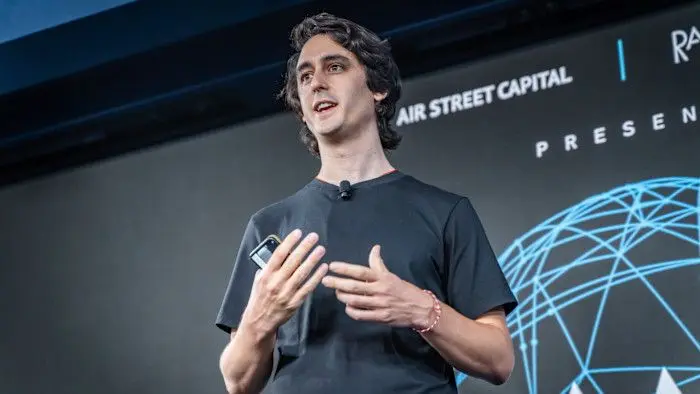
. Benaich told the Financial Times that "one of the reasons to go bigger now is the opportunity set has accelerated dramatically. Companies want to raise faster and raise larger rounds, so you need to adapt the model for the game that's being played"2
.
Source: FT
The fast-paced funding environment favors one-person funds that can move quickly without requiring approval from multiple partners
2
. This structural advantage allows specialist AI investors to compete for deals even as top Silicon Valley companies like OpenAI and Anthropic raise tens of billions in single rounds. The escalating cost of access to leading AI companies has forced many smaller venture capital fund managers to find differentiated strategies.Proven Track Record with AI Unicorns
Air Street Capital has established credibility through its portfolio of AI-first companies that have achieved significant commercial traction. The firm has backed Black Forest Labs in Germany, whose FLUX models have gained widespread adoption among developers building visual applications
3
. UK-based investments include ElevenLabs and Synthesia, the latter now generating more than $150 million in annual recurring revenue with customers across more than 90% of the Fortune 1003
.The firm has also seen successful exits, including Adept's sale to Amazon and Graphcore's acquisition by SoftBank
1
. These outcomes validate Benaich's thesis of backing AI at the earliest stages and holding conviction long enough for the science to compound into commercial reality.Related Stories

Strategic Focus on Deployment Market and Defense
While mega-funds chase investments in massive AI labs, Air Street Capital has positioned itself strategically in the deployment market and vertical applications
2
. Benaich explained that "if you are not in a game of investing in the massive labs, you focus a lot more pragmatically on the deployment market and vertical applications and selected infrastructure tools"2
.Defense technology has emerged as a priority area for Fund III, reflecting broader shifts in European priorities. Air Street has backed Delian Alliance Industries, a maritime defense startup based in Greece that raised $14 million last year
2
. Benaich noted that "the decade or two decades of rearmament has really only just begun. Countries need to ensure their own domestic capability on defence for the attack vectors they are most likely to see"2
.Ecosystem Building and Strategic Partnerships
Beyond capital deployment, Air Street Capital has invested in raising its profile through thought leadership and strategic partnerships. The firm publishes an annual State of AI report to maintain visibility among entrepreneurs
2
. Last year, the firm partnered with NVIDIA on a £2 billion commitment to the UK AI ecosystem, joining Accel, Balderton, and Hoxton Ventures in a program designed to accelerate compute access and talent development across London, Oxford, Cambridge, and Manchester3
.Total European venture capital investment rose 5% to €66 billion in 2025, a post-pandemic high according to PitchBook, with gains driven by major deals for the continent's top AI and defense companies
2
. This expanding opportunity set creates space for focused investors like Air Street to compete effectively, even as the sector consolidates around a small number of frontier AI labs commanding unprecedented valuations. The firm's ability to maintain thesis clarity while scaling capital demonstrates that in deep tech sectors, quality of signal can matter more than team size.References
Summarized by

Navi
Related Stories
Menlo Ventures raises record $3B fund as Anthropic bet delivers $14B stake
23 Jun 2026•Startups

AI Startups Drive Europe's Best Venture Capital Quarter in Four Years as North America Dips
08 Oct 2026•Business and Economy

Accel raises $5 billion fund for AI investments after Anthropic and Cursor valuations soar
15 Apr 2026•Startups

Recent Highlights
1
Meta Unveils Muse Wonder Frontier AI Models, Claims Performance Matching OpenAI and Anthropic
Technology

2
IMF Report Warns AI Market Correction Could Spark Global Financial Crisis With $1.4T at Risk
Business and Economy

3
OpenAI Releases 722 AI-Generated Math Solutions, Triggering Existential Crisis in Mathematics
Technology

Recent Highlights
Today's Top Stories









Don’t drown in AI news. We cut through the noise - filtering, ranking and summarizing the most important AI news, breakthroughs and research daily. Follow topics that matter to you and stay ahead.


