Alibaba Unveils Zhenwu V900 AI Chip, Plans 20GW Datacenter Expansion and 10 Trillion Parameter Models


16 Sources
[1]
Alibaba unveils Zhenwu V900 AI accelerator, claims it's 'the most powerful AI chip in China' -- accelerator supports 500,000 chip supercluster with a 10T-parameter Qwen model on the roadmap
Alibaba unveiled its powerful new Zhenwu V900 chip and ambitious Qwen model plans at the Apsara Conference 2026, the AP reports. Alibaba CEO Eddie Wu calls the Zhenwu 900 the most powerful AI chip in China, with three times the performance of the previous-generation M890. The chip is meant to
[2]
Alibaba Cloud plans six-year stroll to 20GW of datacenters, reveals chip to power them
Chinese tech giant Alibaba has outlined an ambition to expand its datacenter fleet to 20GW of capacity, and chip that will help it get there. CEO Eddie Wu announced those ambitions today at Alibaba's Apsara conference, where he delivered a speech that likened current AI applications to light
[3]
Alibaba plans AI model with 5 trillion to 10 trillion parameters, unveils new chip
BEIJING, Sept 22 (Reuters) - Alibaba Group (9988.HK), opens new tab plans to train a new artificial intelligence model with 5 trillion to 10 trillion parameters, Chief Executive Eddie Wu said on Tuesday, as the Chinese technology giant laid out a sweeping push across AI models, chips and data
[4]
'China's most powerful AI chip': Alibaba's Zhenwu V900
The most powerful AI chip in China today, delivering three times the performance of its predecessor, the Zhenwu M890. That is how Eddie Wu described the processor Alibaba unveiled on Tuesday. The chief executive was speaking at Apsara, the company's annual cloud conference, in Hangzhou. The chip
[5]

Alibaba wants to expand data center capacity past 20 GW by 2032, says its new V900 AI chip can scale to 500,000-card clusters, but will 'China's most powerful AI chip' be enough to displace Nvidia GPUs?
* Alibaba's T-Head unveiled the Zhenwu V900 with 216GB of memory, 1.2TB/s links, and a claimed 3x gain over the already-shipping M890 * Very few details associated with its raw performance: Alibaba gave no FLOPS, node, foundry, or power figures, and both specs it did share project it will trail
[6]

Alibaba says it built the 'most powerful AI chip in China' as the country races to catch up with the U.S. | Fortune
Alibaba's announcement came as U.S. AI leaders, including Anthropic CEO Dario Amodei, are warning that China's development of AI poses a threat to the United States and calling for an overall slowdown on development of the technology. Chinese leader Xi Jinping is set to arrive in Washington on
[7]

Alibaba unveils Zhenwu V900 AI chip, plans 10 trillion parameter model
Alibaba unveiled a new AI chip and plans for a significantly larger AI model on Tuesday at its annual Apsara Conference in Hangzhou, China, as Chinese and U.S. leaders prepare to meet this week in Washington with AI competition expected to feature prominently in their talks. Alibaba Group CEO
[8]

Alibaba unveils what it calls China's most powerful chip and ambitious AI model plans
HONG KONG -- China's Alibaba unveiled new artificial intelligence chip technologies and plans for more powerful models on Tuesday, including what it said was China's most powerful AI chip, days ahead of a meeting between Chinese and U.S. leaders at which competition to lead on AI technology is
[9]

China's Alibaba Unveils New Powerful Chip and Ambitious AI Model Plans
HONG KONG (AP) -- China's Alibaba unveiled new artificial intelligence chip technologies and plans for more powerful models on Tuesday, including what it said was China's most powerful AI chip, days ahead of a meeting between Chinese and U.S. leaders at which competition to lead on AI technology is
[10]

Alibaba: China's Alibaba launches international data centre push
Chinese tech giant Alibaba unveiled plans on Wednesday to expand its overseas data centres, targeting markets across Europe and the Middle East. Alibaba is targeting more than 20 gigawatts of global data centre capacity by 2032, Wu said during the firm's annual flagship conference in
[11]

Alibaba Brags That Its Next-Gen Zhenwu V900 AI Chip Offers More On-Package Memory Than NVIDIA H200, Outlines Plans To Deploy 20 GW Of Compute, And Teases 4-10 trillion parameters For Upcoming Qwen Models
Alibaba stole the show at today's Apsara Conference in Hangzhou, China, detailing ambitious compute deployment plans, offering tantalizing details about its upcoming Zhenwu V900 chip, and laying down the gauntlet by disclosing between 4 trillion and 10 trillion parameters for its upcoming Qwen 4.5
[12]

Alibaba Challenges Nvidia With New Triple Processing Power Chip - Alibaba Gr Hldgs (NYSE:BABA)
Alibaba Group Holding Limited (NYSE:BABA) stock rose Tuesday as investors weighed the company's new AI chip and aggressive cloud infrastructure expansion plans. At Alibaba Cloud's Apsara Conference, the company introduced the Zhenwu V900, which it describes as China's most powerful AI chip. The
[13]
Alibaba Just Supercharged its AI Ambitions: New Zhenwu V900 AI Chip Promises 3X Performance, Targets 20GW
Alibaba Group Holding Ltd. (NYSE:BABA) unveiled its latest artificial intelligence (AI) chip and announced plans to significantly expand its data center capacity at Alibaba Cloud's annual Apsara Conference. On Tuesday, the tech giant introduced Zhenwu V900, its new AI chip. The chip is touted to
[14]

Alibaba Stock Rises as New AI Chip Boosts China Tech Ambitions
Alibaba shares rose Tuesday after the Chinese technology giant announced major advances in artificial intelligence, including a new AI chip and its largest AI model. The developments helped lift Alibaba's American depositary receipts 3.3% in premarket trading. However, the company continues to
[15]

Why is Alibaba stock surging today? By Investing.com
Investing.com -- Alibaba stock surged 3.7% to HK$116.8 on Tuesday after the company unveiled a new artificial intelligence chip and flagged an ambitious commitment to AI infrastructure. CEO Eddie Wu took the stage at the company's annual Apsara Cloud Conference in Hangzhou and unveiled a new
[16]
Alibaba unveils new AI chip, calls it China's most powerful By Investing.com
Investing.com-- Alibaba Group (HK:9988) on Tuesday unveiled a new artificial intelligence chip which it touted as China's most powerful, with the internet giant also announcing plans for a major expansion in data center capacity in the coming years. Alibaba CEO Eddie Wu unveiled the new chip- the
Share
Copy Link
Alibaba CEO Eddie Wu unveiled the Zhenwu V900 at Apsara Conference 2026, calling it China's most powerful AI chip with three times the performance of its predecessor. The company plans to scale Alibaba Cloud to 20GW capacity by 2032 and train AI models reaching 5-10 trillion parameters, positioning itself against U.S. export controls.
Alibaba Debuts Zhenwu V900 as China's Most Powerful AI Chip
Alibaba CEO Eddie Wu introduced the Zhenwu V900 AI chip at the Apsara Conference 2026, declaring it China's most powerful AI chip with three times the performance of the previous-generation M890
1
. Developed by Alibaba's T-Head semiconductor unit, the processor features 216GB of memory and 1,200GB/s of inter-chip bandwidth, representing substantial upgrades from the M890's 144GB memory and 800GB/s interconnect1
. The chip handles both high-precision model training and ultra-low-precision inference, supporting formats from FP32 down to FP4 natively4
. T-Head enhanced the Tensor Core arithmetic unit specifically for improved instruction precision in FP8 and FP4 formats, alongside richer scaling factor formats under MXFP8 and MXFP42
. Mass production and commercial release are scheduled for the first quarter of 2027, accelerated from the original third-quarter timeline1
.
Source: The Register
Scaling to 500,000-Chip Supercluster for Frontier Model Training
The Zhenwu V900 can scale to a supernode cluster comprising up to 500,000 cards, a dramatic increase from the M890's maximum configuration of 128 chips
1
. T-Head states that more than 1,000 V900 chips can function as a single system for frontier model training and inference1
4
. However, Alibaba released limited technical specifications, omitting FLOPS figures, process node details, foundry information, and power consumption metrics1
. This contrasts with Huawei's competing Ascend 960PR, scheduled for third quarter 2027, which lists 192GB memory capacity, 2.4TB/s memory bandwidth, and a 2.2TB/s scale-up interconnect1
. As of May, T-Head had shipped more than 560,000 Zhenwu chips to over 400 external customers, a count Alibaba now places above 650 customers spanning industries from automotive to language models and embodied intelligence1
4
. Alibaba expects significant growth in annual AI chip shipments and plans to refresh the Zhenwu lineup annually, with a J900 model due in third quarter 20284
5
.AI Model with 5 Trillion to 10 Trillion Parameters on Roadmap
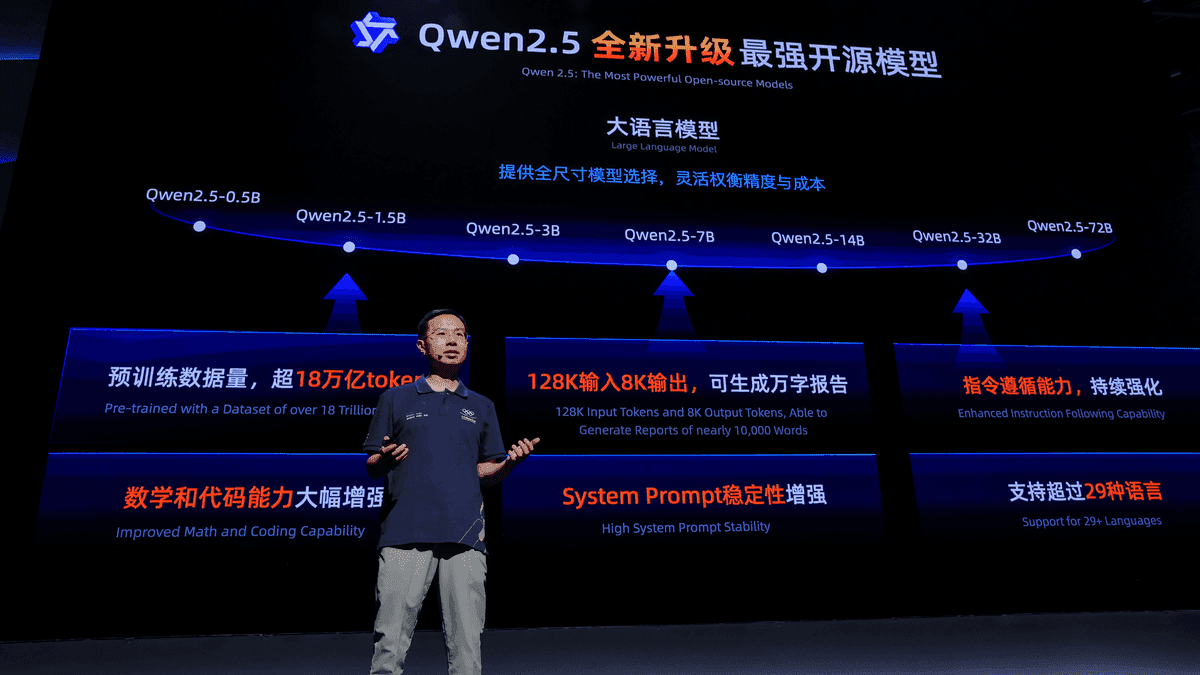
Alibaba is currently training Qwen 4 and has placed Qwen 4.5 and Qwen 5 on its roadmap, with both models targeting 5 trillion to 10 trillion parameters
3
4
. This represents a substantial increase from the current Qwen 3.8-Max flagship model with 2.4 trillion parameters and surpasses Moonshot's Kimi K3 at 2.8 trillion parameters1
. Eddie Wu framed this scaling as a pathway to artificial superintelligence, with larger models targeting longer and more complex tasks4
. The Qwen team is exploring recursive self-improvement (RSI), a technology where models identify their own weaknesses, run experiments, and generate training data with minimal human involvement2
4
. Wu described the progress as meaningful, though details remain limited4
. Alibaba claims Qwen 3.8-Max ran 33 iterative cycles over a month of automated runs, achieving an Artificial Analysis score improvement from 40 to 451
. A separate chip-design experiment involving more than 10,000 EDA tool calls over 60-plus hours demonstrated a 42% area reduction without performance loss1
.
Source: TechRadar
Related Stories
Alibaba Cloud Targets 20GW of Datacenters by 2032
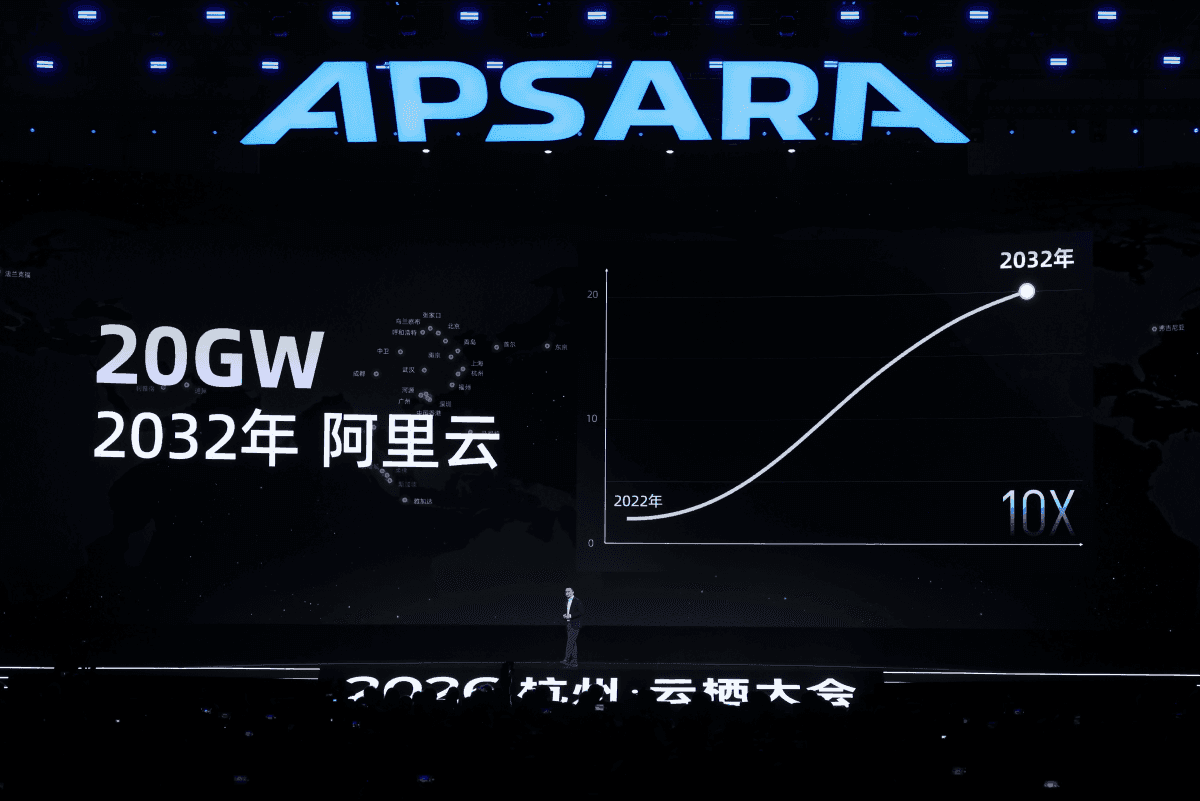
Alibaba Cloud aims to expand data center capacity past 20GW by 2032, a sixfold increase from its current approximately 4GW footprint
2
5
. Citigroup estimates this capacity could generate more than $160 billion in external revenue for Alibaba Cloud4
. For context, commercial real estate firm Cushman and Wakefield reports 37.7GW of datacenters currently under construction in the United States alone2
4
. SpaceX had roughly 1.4GW of AI computing capacity mid-year with plans to exceed 10GW in 20271
4
. Eddie Wu acknowledged that global shortages across the AI infrastructure supply chain are limiting how quickly Alibaba can scale its compute infrastructure1
4
. Alibaba Cloud plans to bring AI supernodes online at commercial scale this quarter, though Wu did not specify construction locations4
. Nomura expects future buildouts to blend owned, leased, and third-party-financed sites5
. Alibaba has committed more than $53 billion over three years to its AI expansion and raised approximately $10.2 billion in a follow-on share sale in August4
.
Source: Tom's Hardware
U.S. Export Controls Drive China's Self-Sufficiency Push
U.S. export controls keep Nvidia GPUs, particularly advanced Hopper products, largely out of China, forcing domestic companies toward self-sufficiency in AI hardware
4
5
. Nvidia's latest 10-Q filing shows shipments of datacenter Hopper products to China were under 1% of its $89 billion in datacenter revenue for the quarter ending July 265
. The same controls largely block Chinese firms from using TSMC for advanced chip manufacturing4
. Neil Shah, vice president at Counterpoint Research, told the Associated Press that using extra computing power to compensate for chip limitations helps China maintain strength locally4
. However, Counterpoint's Parv Sharma noted that narrowing the gap also depends on China's ability to advance its own foundries, not just chip design4
. Huawei unveiled competing chip technology at its Connect conference last week, having previously shelved its global Ascend rollout due to high domestic demand1
. The announcements came one day before Chinese President Xi Jinping's summit with President Donald Trump in Washington, where AI remains a top agenda item1
. Alibaba's Hong Kong-listed shares rose 5.1% on Tuesday following the Apsara Conference announcements4
.References
Summarized by

Navi
[2]
[4]
Related Stories
Alibaba reveals Zhenwu M890 AI chip but admits struggling with production scale
20 May 2026•Technology

Alibaba Develops AI Inference Chip Amid China's Push for Semiconductor Independence
28 Aug 2025•Technology

Alibaba Forges AI Partnership with Nvidia, Unveils Global Expansion Plans
24 Sept 2025•Business and Economy

Recent Highlights
1
Microsoft and Nvidia Launch Surface Laptop Ultra: A $2,599 AI-Ready PC With RTX Spark Chip
Technology

2
Meta Muse AI Agent Surges to 6.6M Downloads Despite Privacy and Security Controversies
Technology

3
Scientists Build AI Model That Reconstructs Images From Brain Scans in Record Time
Science and Research

Recent Highlights
Today's Top Stories








Don’t drown in AI news. We cut through the noise - filtering, ranking and summarizing the most important AI news, breakthroughs and research daily. Follow topics that matter to you and stay ahead.


