Alta Ares raises €50M to scale AI drone interceptors already deployed in Ukraine


2 Sources
[1]
Alta Ares raises €50M for AI drone interceptors
The two-year-old French firm's AI interceptors have already downed Russian Shaheds over Ukraine. Air Street Capital led the round as Europe races to close its air-defence gap. A Shahed attack drone costs tens of thousands of euros. The missiles traditionally fired to shoot one down can cost a
[2]
French counter-drone startup Alta Ares raises EUR50 million
PARIS, June 8 (Reuters) - Alta Ares, a French startup focusing on counter-drone technology, said on Tuesday it had raised EUR50 million in its second funding round, helped by surging demand for air defence systems to combat the mass-produced drones playing a decisive role in Russia's war in
Share
Copy Link
French defense-tech startup Alta Ares closed a €50 million funding round for its AI-powered drone interceptors, which have already downed Russian Shaheds over Ukraine. The two-year-old company builds cost-effective systems designed to counter the inverted economics of modern warfare, where cheap attack drones force militaries to fire million-euro missiles in response.
French Startup Secures Major Funding for Combat-Proven Systems
Alta Ares, a Paris-based defense-technology company founded in 2024, announced on Tuesday it had closed a €50 million funding round led by Air Street Capital, with participation from Cherry Ventures, OTB Ventures, and Harpoon Ventures
1
. The French startup raises €50 million to accelerate production of its AI drone interceptors, which address a critical gap in modern air defense systems2
. This follows a €2 million funding round completed in May 2025, signaling rapid investor confidence in the company's approach to counter-drone technology2
.Solving the Economics of Costly Drone Defense
The pitch behind Alta Ares centers on fixing the inverted economics of modern warfare. A Shahed attack drone costs tens of thousands of euros, while the missiles traditionally fired to shoot one down can cost a million or more
1
. NATO allies now face coordinated salvos that can combine more than 600 drones and dozens of missiles in a single night, making the old air-defense model unsustainable1
. Alta Ares builds AI-guided interceptors designed to detect, track, and destroy aerial threats including drones, cruise missiles, and glide bombs at a fraction of traditional costs1
.Two Interceptor Systems Combat-Tested in Ukraine
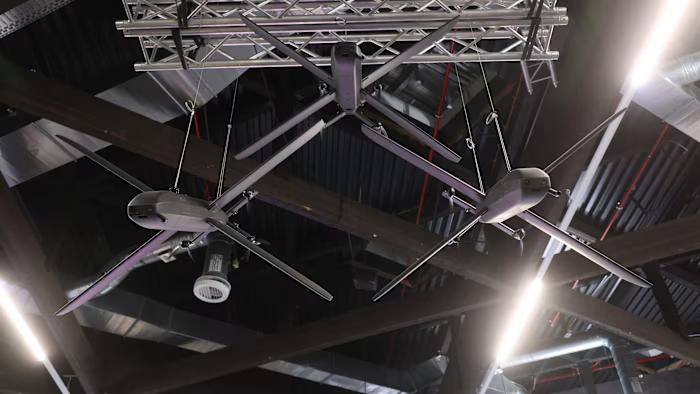
The company fields two distinct interceptor platforms. X-Lock is a short-range system with a roughly 15km radius, built specifically for Shahed-136-type drones
1
. Black Bird is a faster, turbojet-powered interceptor with a 30km reach, aimed at harder targets such as KH-101 cruise missiles and FAB-500 glide bombs1
. Both systems are engineered to work in arctic and desert conditions, and Alta Ares says its AI-powered ammunition has been combat-tested in Ukraine, where its interceptors have already downed Russian Shaheds1
2
. The systems are currently deployed across three active conflict zones in Europe, the Middle East, and Asia1
.Related Stories
Battlefield Feedback Sharpens Autonomous AI Systems
Constant battlefield feedback from the Russia-Ukraine war has become a core advantage for Alta Ares, allowing the company to refine its autonomous AI systems in real combat conditions
1
. This operational record serves as its primary selling point against a growing field of autonomous drone-killers in the defense technology sector. CEO Hadrien Canter stated that "modern warfare is defined by speed, mass, and, above all, the capacity for continuous adaptation. Alta Ares was born from this operational reality directly on the battlefield"1
. NATO recognized this approach by awarding Alta Ares an innovation award in March 20251
.European Defense Tech Boom and Expansion Plans
The funding arrives amid a European defense-tech boom that has seen sector funding more than double, with startups racing to plug the continent's air defense systems protection gap
1
. Germany has captured around 90 percent of the continent's defense-tech investment in early 2025, making Alta Ares one of France's most prominent responses1
. The new capital will fund industrial scale-up, additional hires by year-end, and offices in the Middle East and Asia, alongside production facilities in Toulouse and Kyiv1
. Alta Ares aims to develop its activities in Poland, Germany, and the United States2
. Air Street Capital's Nathan Benaich called Alta Ares "a new generation of European defence players" with potential to become a "global leader in counter-UAS"1
.References
Summarized by

Navi
[1]
[2]
Related Stories
Harmattan AI raises $200M from Dassault Aviation, becomes defense unicorn at $1.4B valuation
12 Jan 2026•Startups

AI Drone Maker Tekever Hits $6.4 Billion Valuation After $580 Million Defense Tech Funding
23 Sept 2026•Startups

Veterans Spearhead Europe's Defence Tech Revolution Amid Ukraine War Investment Surge
04 Sept 2025•Business and Economy
Recent Highlights



Recent Highlights
Today's Top Stories







Don’t drown in AI news. We cut through the noise - filtering, ranking and summarizing the most important AI news, breakthroughs and research daily. Follow topics that matter to you and stay ahead.


