AMD MEXT Tackles DRAM Supply Crisis With AI-Powered Flash Memory Technology


2 Sources
[1]
AMD Talks Up Their MEXT Software Amid RAM Crisis - Linux Support But Not Open-Source
This summer AMD acquired the company MEXT for their AI-powered predictive memory technology to make flash memory such as NVMe SSDs behave more like DRAM. AMD MEXT with EPYC servers allows for flash memory as DRAM tiering and uses a predictive AI engine for handling the tiering in an effective way.
[2]
AMD Unveils MEXT Memory Solution: Leverages Flash To Mitigate DRAM Costs While Expanding Capacities & Retaining Similar Performance Even With 50% Cut In DDR5
AMD MEXT is a brand new memory solution that utilizes Flash to mitigate DRAM costs and supply concerns across EPYC CPUs. AMD MEXT Aims To Address The Ongoing DRAM Crisis Through An Innovative "Flash-Based" Memory Solution The memory supercycle continues to rage, and supply/demand continues to
Share
Copy Link
AMD announced MEXT, an AI-powered memory solution that uses flash storage to mitigate the ongoing DRAM supply crisis. The technology can cut DRAM usage by 20-75% while maintaining similar performance, offering up to 83% cost savings for data centers facing severe RAM supply constraints and elevated memory prices.
AMD MEXT Addresses Critical DRAM Supply Crisis
AMD unveiled MEXT, an AI-powered memory solution designed to combat the escalating DRAM supply crisis affecting data centers worldwide
2
. The predictive memory technology enables flash memory such as NVMe SSDs to function as DRAM tiering, directly addressing RAM supply constraints that have pushed DRAM costs to comprise 75% of total server expenses2
. While DRAM prices historically dropped from $50 million per GB in the 1970s to $8 per GB in the 2010s, recent prices have surged beyond $10 per GB and continue rising2
.How AI-Driven Memory Optimization Works
The memory solution employs an AI engine featuring transformer-based LLMs specifically designed for memory page management
2
. MEXT's AI-driven memory optimization uses predictive algorithms to handle data placement between DRAM and flash storage, pushing "soon-to-be-needed" pages to DRAM while offloading cold data to flash memory as DRAM2
. The self-improvement algorithm trains in under one second, runs on a single EPYC core, and requires no GPU, making it remarkably efficient2
. This tiering optimization addresses a critical inefficiency: 50-80% of total DRAM in data centers remains underutilized as memory pages "go cold," with Microsoft Azure and META experiencing 50% DRAM overprovisioning2
.Performance Benchmarks Across Workloads
AMD MEXT delivers substantial performance per dollar improvements across diverse applications. In Agentic AI workloads, a 50% DRAM and 50% MEXT configuration achieves a 90% increase in performance per dollar within 5-agent workflows, while a 25% DRAM and 75% MEXT mix nets a 3.4x increase in the same concurrency task
2
. For EDA/Chip Design using Synopsys PrimeTime on AMD EPYC CPUs, MEXT retains up to 95% of total DRAM performance even with a 50% cut in DDR5, delivering a 1.9x performance per dollar ratio2
. On Azure VMs running Spark TPC-DS with 5th Gen EPYC processors, the technology enables up to 99% performance on a 3-node cluster with a 50% DRAM/MEXT split versus all-DRAM baseline configurations2
.Technical Architecture and Components
MEXT comprises three core components designed for seamless integration with AMD EPYC CPUs
2
. The Linux kernel module is a lightweight, low-overhead driver that works with any Linux OS, providing the foundation for tiering optimization1
2
. The AI Engine features an ensemble of AI models including transformer-based LLMs that continuously train and infer in real-time2
. RAM View serves as an observability platform illustrating real-time memory utilization, helping administrators monitor hot data and cold data distribution2
.Related Stories
Cost Savings and Capacity Expansion
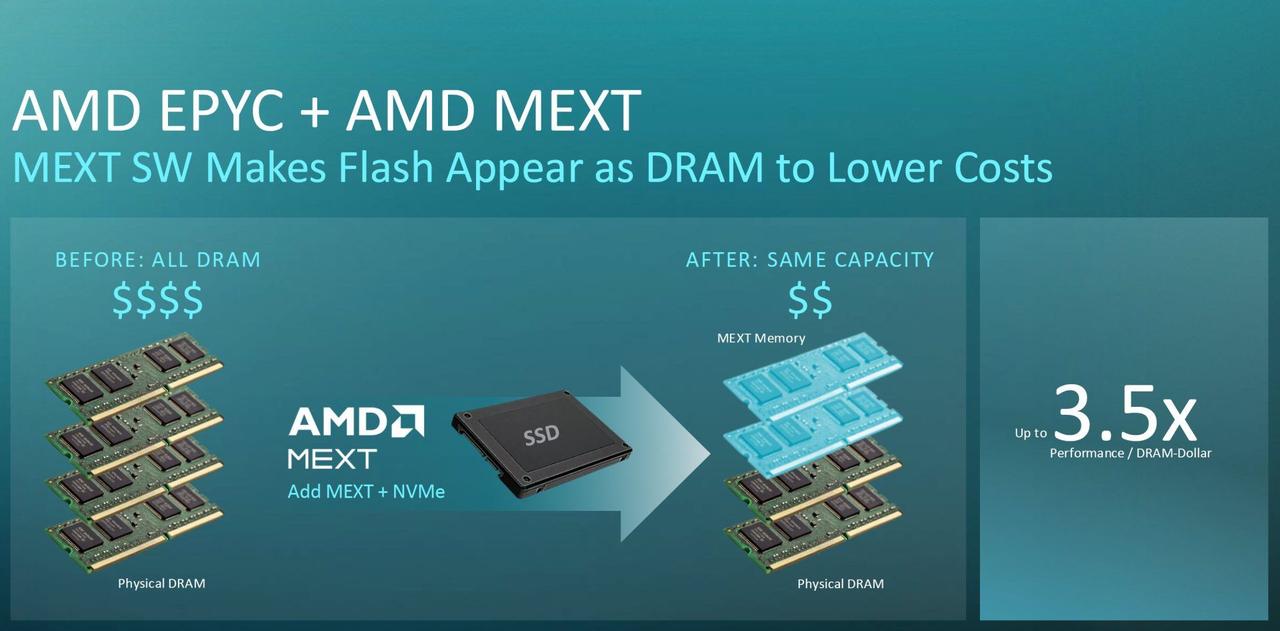
Source: Wccftech
The memory solution offers two primary benefits: reducing DRAM usage to mitigate DRAM costs, and expanding memory capacities at lower expenses
2
. Physical DRAM paired with MEXT can cut DRAM usage by 20-75% while maintaining similar performance, even when running flash storage as system memory2
. When paired with MEXT, physical DRAM can deliver a 3x return in capacity at significantly lower costs than adding traditional DRAM2
. AMD projects 83% savings versus an all-DRAM alternative, avoiding $4.9 million in DRAM costs on initial 145 server deployments scaling to 2,000 servers by 20272
.Licensing Model Raises Questions
While AMD typically champions open-source software, MEXT represents a departure from this approach
1
. The technology is available only through AMD customer and sales channels and is not open-source or publicly available1
. AMD announced MEXT is currently in Phase 1, ready for deployment across servers with abundant cores and dedicated NVMe drives or bays2
. Phase 2 will make MEXT available to license with RAM View pre-installed2
. AMD has hinted at expanding MEXT's application beyond data centers into client segments, suggesting potential consumer-facing implementations2
.References
Summarized by

Navi
Related Stories
AMD acquires MEXT to solve memory constraints with AI-powered tiering technology
15 Jun 2026•Technology
Meta repurposes DDR4 memory in DDR5 servers with custom chip to cut AI infrastructure costs
03 Jul 2026•Technology
AMD Unveils Next-Gen AI Accelerators: MI325X and MI355X to Challenge Nvidia's Dominance
11 Oct 2024•Technology

Recent Highlights



Recent Highlights
Today's Top Stories









Don’t drown in AI news. We cut through the noise - filtering, ranking and summarizing the most important AI news, breakthroughs and research daily. Follow topics that matter to you and stay ahead.


