9 Sources
[1]
AMD forecasts quarterly revenue above expectations as AI chip demand stays strong
May 5 (Reuters) - Advanced Micro Devices (AMD.O), opens new tab forecast second-quarter revenue above Wall Street expectations on Tuesday, helped by keen demand for its data-center chips as cloud computing companies accelerate spending on artificial-intelligence infrastructure. Shares of the company jumped roughly 5% in extended trading after surging about 60% so far this year. AMD is seen by analysts and investors as a leading challenger to Nvidia's (NVDA.O), opens new tab dominance in AI chips, commonly referred to as graphics processing units or GPUs. But the company has tapped a new AI hardware opportunity in the form of central processing units as companies move from training models to running applications based on the technology, a process known as inference. Sales for both types of server chips are recorded in AMD's data center segment, which jumped 57% to $5.8 billion in the first quarter, whereas analysts expected revenue of $5.64 billion, according to data compiled by LSEG. Earlier this year, AMD said it had agreed to sell up to $60 billion worth of artificial-intelligence chips to Meta Platforms (META.O), opens new tab over five years in a deal that allows the Facebook owner to purchase as much as 10% of the chip firm. AMD also struck a deal with OpenAI last year. The company expects quarterly revenue of $11.2 billion, plus or minus $300 million, compared with estimates of $10.52 billion. The company expects adjusted gross margins of about 56% for the second quarter, compared with analyst expectations of 55.4%. For the first quarter, adjusted for stock compensation and other items, AMD reported per-share earnings of $1.37 on revenue of $10.25 billion. Analysts expected revenue of $9.89 billion and earnings of $1.29 per share. While analysts perceive AMD as best-positioned to benefit from the surging CPU demand due to market share gains and product roadmap, competition from Intel (INTC.O), opens new tab, which gave a strong revenue forecast last month, has increased. After struggling with its chip production for several quarters, Intel is now ramping up its in-house manufacturing efforts to cater to growing CPU demand, posing a threat to AMD, which is beholden to tight manufacturing capacity at Taiwan's TSMC. Unlike Intel, which designs and manufactures chips in-house, AMD outsources its manufacturing to contract chipmakers like TSMC. The semiconductor industry is also grappling with a global shortage of memory chips, stemming from a rush to secure supply of high-bandwidth memory used in data centers alongside GPUs and CPUs. The sharp increase in memory prices is also expected to hit demand for consumer electronics - a key market for AMD - as pricier computers are expected to turn consumers away. The company's Client and Gaming segment, which includes its consumer hardware, rose 23% to $3.6 billion compared with a year ago. AMD stock has far outperformed Nvidia's year-to-date gain of 6% and the broader Philadelphia Semiconductor Index's 48% rise, as of Monday's close. Reporting by Zaheer Kachwala in Bengaluru and Max A. Cherney in San Francisco; Editing by Sriraj Kalluvila and Matthew Lewis Our Standards: The Thomson Reuters Trust Principles., opens new tab * Suggested Topics: * Artificial Intelligence Max A. Cherney Thomson Reuters Max A. Cherney is a correspondent for Reuters based in San Francisco, where he reports on the semiconductor industry and artificial intelligence. He joined Reuters in 2023 and has previously worked for Barron's magazine and its sister publication, MarketWatch. Cherney graduated from Trent University with a degree in history.
[2]
AMD tops estimates for first quarter as data center revenue jumps 57%
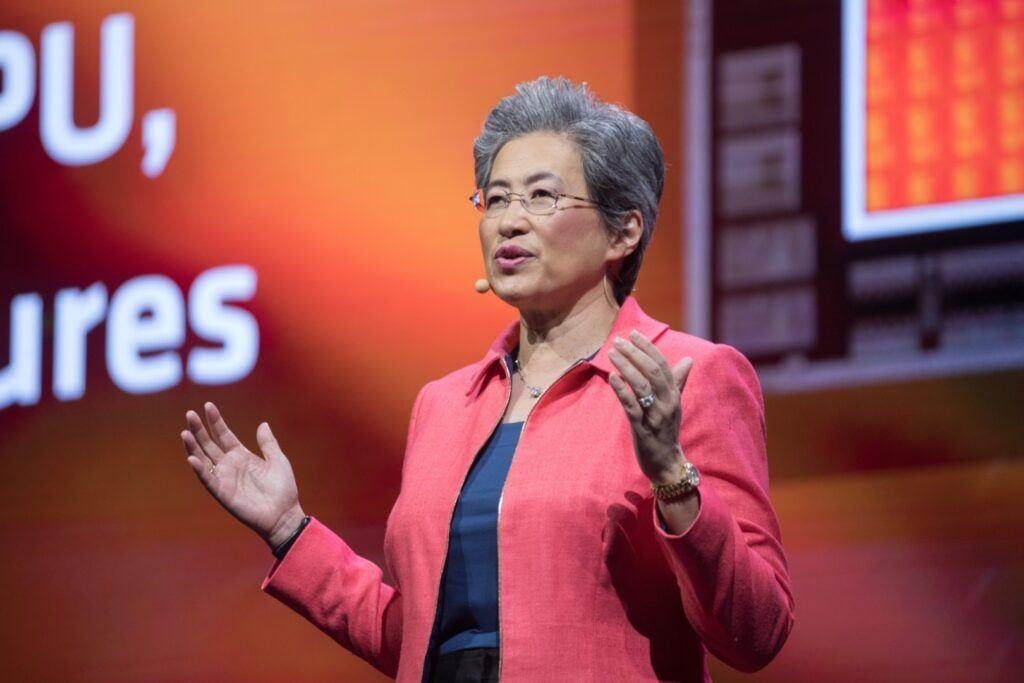
AMD CEO Lisa Su unveils the AMD vision for Advancing Al.Courtesy: AMD Advanced Micro Devices reported first-quarter earnings Tuesday that topped expectations, while the company's revenue forecast also exceeded estimates as demand soars for chips to power artificial intelligence workloads. Here's how the chipmaker did versus LSEG consensus estimates for the quarter ended in March: Revenue jumped 38% from $7.44 billion a year ago, the company said in a release on Tuesday. Data center sales climbed 57% to $5.8 billion from $3.67 billion in the same period a year earlier. For the second quarter, AMD said it expects about $11.2 billion in revenue, versus expectations of $10.52 billion, according to LSEG. AMD's stock has been on a tear, more than tripling over the past year, including a 66% jump so far in 2026. While the company has trailed far behind rival Nvidia in the market for graphics processing units (GPUs) to power AI data centers, investors have poured into AMD's stock more recently on optimism that the opportunity is large enough for multiple players. Unlike Nvidia, AMD has long been a leading maker of central processing units, or CPUs, which are enjoying a major renaissance as agentic AI shifts compute needs. AMD shares popped last week when AMD and Intel announced they'll pair up on a new instruction set for x86 CPUs. The new feature, called AI Compute Extensions, aims to increase performance and energy efficiency by boosting compute density by 16 times. The chip industry has faced a global memory shortage because of insatiable AI demand as well as capacity constraints for both manufacturing and advanced packaging, and supply chain challenges due to the war in Iran. That's all contributing to a frenzy in a number of semiconductor-related names. Intel just had its best month ever in April, with shares more than doubling as the company reported first-quarter results that trounced analysts' estimates. Shares of memory maker Micron are up more than 700% in the past year, pushing the company's market cap past $700 billion. In addition to CPUs and GPUs, AMD is also expected to ship its first full rack-scale system for AI data centers, Helios, later this year. It's meant to rival Nvidia's Grace Blackwell and Vera Rubin systems that sell for upwards of $3 million.
[3]
AMD's stock rises on surging demand for CPUs and GPUs for AI workloads - SiliconANGLE
AMD's stock rises on surging demand for CPUs and GPUs for AI workloads Semiconductor giant Advanced Micro Devices Inc. coasted to another solid earnings and revenue beat as it delivered its first-quarter financial results today. Its guidance for the current quarter came up strong too, thanks to soaring demands for data center chips that power artificial intelligence workloads. The company reported earnings before certain costs such as stock compensation of $1.37 per share, coming in ahead of Wall Street's target of $1.29 per share. Revenue for the period soared by an impressive 38% from a year earlier to $10.25 billion, well ahead of the analysts' $9.89 billion consensus estimate. That helped the chipmaker to improve its bottom line, with net income for the quarter coming to $1.38 billion, up from $709 million one year earlier. AMD's AI chip sales fall within its data center segment, and it was predictably the best performing unit, with sales rising 57% from a year earlier to $5.8 billion. The company said it benefited from strong demand for its EPYC server chips and the continued ramping of its Instinct graphics processing units. The company's other segments did okay, too. Client and gaming, which accounts for the sale of central processing units and GPUs for personal computers and consoles, delivered $3.6 billion in revenue, up 23% from a year earlier. Meanwhile the embedded segment, which is focused on smaller chips for specialized, industrial and "always-on" applications, generated $873 million in sales, up 6%. For the current quarter, AMD said it's looking for sales of around $11.2 billion at the midpoint of its guidance range, well ahead of the Street's forecast of $10.52 billion. Chief Executive Lisa Su (pictured) said on an earnings call that the company's data center division is now the "primary driver" of both revenue and earnings growth. "Looking ahead, we expect server growth to accelerate meaningfully as we scale supply to meet demand," she added. Earlier, Su told analysts that the company has "strong and increasing confidence" with regards to its ability to generate "tens of billions of dollars" in sales within the data center segment next year. She also hopes to "exceed our long-term growth target of greater than 80% in the coming years." Shares of AMD have been on a roll for a long time, and the stock has gained more than 253% over the last 12 months, and is up almost 66% in the year to date. While the company still trails Nvidia Corp. by a long way in terms of revenue, investors have poured money into the company, believing that the AI market is more than big enough to support multiple chipmakers. AMD's stock gained more than 16% in late trading on the back of today's results. The chipmaking industry has been contending with a global shortage of memory components as a result of the insatiable demand from the AI industry, and those problems have been worsened by supply chain challenges due to the war in Iran. However, these disruptions have been a boon for chipmakers. Intel Corp. just delivered its best-ever month, with its first-quarter results crushing analyst's forecasts to send its stock up more than 24% in a single day. In the year to date, it has risen by a stunning 194%. Meanwhile, shares of the memory chip maker Micron Technologies Inc. have soared more than 700% in the last year, with Sandisk Corp. showing similar gains. Another chipmaker, GlobalFoundries Inc., delivered its first-quarter results today, comfortably beating expectations on earnings and revenue and providing a bullish forecast too. Its stock gained more than 9%, pushing its gains in the year to date to 112%. Where AMD differs from Nvidia is that it's also a key player in the CPU business, and these chips are enjoying a renaissance of sorts amid the rise of "agentic AI" systems that automate work on behalf of humans. GPUs can often be overkill for AI agents, which run far more efficiently on CPUs, and that has benefitted AMD immensely. Last week, AMD's stock jumped on the news that it's teaming up with its longtime rival Intel Corp. to develop a new instruction set for x86 CPUs. They're developing a new feature called AI Compute Extensions, and claim it will be able to enhance the performance and energy efficiency of CPUs by increasing compute density by up to 16 times. On the GPU front, AMD is planning to ship its first-ever rack-scale system for AI data centers, called Helios, later this year. It's a rival to Nvidia's Grace Blackwell and Vera Run rack-scale systems for data centers, which sell for upwards of $3 million. Su told analysts on the call that both OpenAI Group PBC and Meta Platforms Inc. have agreed to buy the Helios systems when they're available, cementing the company's status as a viable alternative for AI giants and "hyperscalers" that require more compute power. Meta's multiyear deal with the company will see it deploy up to six gigawatts of GPUs across its global data center network, as well as AI-optimized CPUs. According to Su, the company expects to start shipping its first chips to Meta and OpenAI in the second half of the year. "Together with our previously announced OpenAI partnership, these engagements position AMD as a core partner to the world's largest AI infrastructure builders, with deep co-engineering relationships and multiyear visibility into large-scale deployments," she said.
[4]
AMD forecasts revenue above expectations on strong AI demand, shares jump 12% - The Economic Times
Advanced Micro Devices anticipates strong second-quarter revenue driven by high demand for its AI chips. The company's data center segment shows significant growth. However, competition is increasing from Intel, and a global memory chip shortage could affect consumer electronics sales. AMD's stock has seen substantial gains this year. Advanced Micro Devices forecast second-quarter revenue above Wall Street expectations on Tuesday, helped by keen demand for its data-center chips as cloud-computing companies accelerate spending on artificial-intelligence infrastructure. Shares of the company jumped 12% in extended trading after surging about 65% so far this year. AMD is seen by analysts and investors as a leading challenger to Nvidia's dominance in AI chips, commonly referred to as graphics processing units or GPUs. But the company has tapped a new AI hardware opportunity in the form of central processing units as companies move from training models to running applications based on the technology, a process known as inference. AMD now expects the server CPU addressable market to grow at greater than 35% annually, reaching over $120 billion by 2030, CEO Lisa Su said on a post-earnings conference call. This is higher than the 18% yearly growth rate it forecast in November. Sales for both types of server chips are recorded in AMD's data center segment, which jumped 57% to $5.8 billion in the first quarter, whereas analysts expected revenue of $5.64 billion, according to data compiled by LSEG. "AMD is levered to insatiable AI compute demand, and this quarter showed that demand is real, but the focus now shifts to how efficiently they can convert that into high-margin revenue," said Jake Behan, head of capital markets at Direxion. GROWING COMPETITION IN CPU MARKET While analysts perceive AMD as best-positioned to benefit from the surging CPU demand due to market share gains and product roadmap, competition from Intel, which gave a strong revenue forecast last month, has increased. After struggling with its chip production for several quarters, Intel is now ramping up its in-house manufacturing efforts to cater to growing CPU demand, posing a threat to AMD, which is beholden to tight manufacturing capacity at Taiwan's TSMC. Unlike Intel, which designs and manufactures chips in-house, AMD outsources its manufacturing to contract chipmakers like TSMC. Intel shares were up 4.5% in extended trading. "It (AMD) may need to look to qualify Intel sooner than later for future products as that precious additional capacity will be needed based on the expedited success of NVIDIA's AI roadmap," said Daniel Newman, CEO of tech research firm Futurum Group. Earlier this year, AMD said it had agreed to sell up to $60 billion worth of artificial-intelligence chips to Meta Platforms over five years in a deal that allows the Facebook owner to purchase as much as 10% of the chip firm. AMD also struck a deal with OpenAI last year. The company expects quarterly revenue of $11.2 billion, plus or minus $300 million, compared with estimates of $10.52 billion. It also forecast server CPU revenue to grow by more than 70% year-on-year in the second quarter. The company expects adjusted gross margins of about 56% for the second quarter, compared with analyst expectations of 55.4%. For the first quarter, adjusted for stock compensation and other items, AMD reported per-share earnings of $1.37 on revenue of $10.25 billion. Analysts expected revenue of $9.89 billion and earnings of $1.29 per share. Memory crunch weighs on demand The semiconductor industry is also grappling with a global shortage of memory chips, stemming from a rush to secure supply of high-bandwidth memory used in data centers alongside GPUs and CPUs. The sharp increase in memory prices is also expected to hit demand for consumer electronics - a key market for AMD - as pricier computers are expected to turn consumers away. The company's Client and Gaming segment, which includes its consumer hardware, rose 23% to $3.6 billion compared with a year ago. Executives said AMD is planning for second-half PC shipments to be lower owing to higher memory and component costs, and expects second-half gaming revenue to decline more than 20% compared with the first half. AMD stock has far outperformed Nvidia's year-to-date gain of 5% and the broader Philadelphia Semiconductor Index's 55% rise, as of Tuesday's close.
[5]
AMD CEO Lisa Su Predicts Explosive AI-Driven Server CPU Boom, Foresees Revenue Opportunity Of Over $120 B
AMD Raises Server CPU TAM As Agentic AI Accelerates Demand During AMD's first-quarter 2026 earnings call, Su said the company now expects the server CPU total addressable market to grow more than 35% annually through the end of the decade, up sharply from its prior 18% projection shared in November. "CPUs are a very critical part of data center infrastructure," Su said, adding that AI-driven workloads are increasing compute requirements much faster than anticipated. AMD previously estimated the server CPU market would reach roughly $60 billion by 2030. That figure has now doubled as enterprises and hyperscale cloud providers ramp AI deployments that require more CPUs for orchestration, inference and broader infrastructure support. Lisa Su Says CPUs Are Essential To AI Infrastructure Boom Su also said that while GPUs remain central to AI acceleration, CPUs are increasingly necessary for managing AI agents, processing data and supporting head nodes in data centers. "As AI adoption scales, you need more inferencing," Su said. "They all require CPUs for orchestration and the data processing." She added that AMD is seeing stronger-than-expected customer demand across cloud and enterprise markets, fueled by rapid adoption of agentic AI systems. AMD Targets 50% Server CPU Share Amid EPYC Expansion AMD also said it expects server CPU revenue to grow more than 70% year over year in the second quarter, supported by strong demand for its EPYC processor portfolio, including Turin and future Venice chips. Su said AMD remains confident it can capture more than 50% of the growing server CPU market by expanding production capacity and broadening its processor lineup. "CPUs are critical for so many tasks that you are seeing a lot more discussion about CPUs in the market," she said during the call. AMD Q1 Earnings Beat Wall Street Estimates AMD reported first-quarter revenue of $10.25 billion, surpassing Wall Street expectations of $9.89 billion. Adjusted earnings came in at $1.37 per share, ahead of analyst estimates of $1.29 per share. The company's overall revenue climbed 38% compared to the same period last year. For the second quarter, AMD projected revenue of about $11.2 billion, with a possible variance of $300 million, exceeding analyst forecasts of $10.52 billion. The company also expects adjusted gross margin to improve to roughly 56%, up from 55% in the first quarter. Price Action: In after-hours trading on Tuesday, AMD shares surged 16.54% to $414. During the regular session, it closed at $355.26, reflecting a 4.02% gain, according to Benzinga Pro. According to Benzinga Edge Rankings, AMD is positioned in the 96th percentile for Momentum, highlighting robust performance across short, medium and long-term trading periods. Disclaimer: This content was partially produced with the help of AI tools and was reviewed and published by Benzinga editors. Photo Courtesy: jamesonwu1972 on Shutterstock.com Market News and Data brought to you by Benzinga APIs To add Benzinga News as your preferred source on Google, click here.
[6]
AMD Triples Server CPU Forecast to $120 Billion as Agentic AI Rewrites Demand, CEO Says EPYC Verano Built Purely For AI
AMD has just announced its earnings for Q1 2026, posting a record revenue of $10.3 billion driven by strong demand for its EPYC CPUs & Instinct accelerators in the AI segment. AMD's CEO outlined an "outstanding" first quarter for the company, with revenue of $10.3 billion, a 38% increase versus the previous year. This growth was driven mainly by strong demand in the data center and AI segments, which were up 7% year over year and 57% versus the previous year. The following is the breakdown of AMD's Q1 2026 earnings: "We delivered an outstanding first quarter, driven by accelerating demand for AI infrastructure, with Data Center now the primary driver of our revenue and earnings growth," said Dr. Lisa Su, AMD chair and CEO. "We are seeing strong momentum as inferencing and agentic AI drive increasing demand for high-performance CPUs and accelerators. Looking ahead, we expect server growth to accelerate meaningfully as we scale supply to meet demand. Customer engagement around MI450 Series and Helios is strengthening, with leading customer forecasts exceeding our initial expectations and a growing pipeline of large-scale deployments providing us with increasing visibility into our growth trajectory." CEO Dr. Lisa Su highlighted the AMD EPYC-powered cloud instances, which saw a 50% increase year over year, now running in over 1600 cloud instances. EPYC-powered cloud instances increased nearly 50% year-over-year to more than 1,600, with instances optimized for virtually every enterprise workload and expanded availability across the largest global cloud providers. In Enterprise, demand accelerated, with record revenue and record sell-through in the quarter. We expanded our customer base with new wins across financial services, healthcare, industrial, and digital infrastructure companies, while also building momentum with mid-market and SMB customers. Dr. Lisa Su - AMD CEO Despite the market being highly constrained and AMD's heavy reliance on TSMC for the production of its CPUs, the company stated that they are well-positioned to continue gaining share with its EPYC CPUs. The upcoming AMD EPYC Venice CPUs will feature the Zen 6 core architecture and will be made on the 2nm tech from TSMC, delivering some big gains. AMD says that Venice spans a broad set of CPUs with SKUs that are optimized for throughput, performance per watt, and performance per dollar. Verano also got a mention during the earnings call with Lisa Su, calling it a CPU that's purpose-built for AI infrastructure. Verano is expected in 2027 and will be a more cost-optimized offering on SP7 platforms. We are well-positioned to continue gaining share as more enterprises standardize on EPYC across on-prem and hybrid environments, based on our leadership performance and TCO. Looking ahead, our sixth-gen EPYC Venice processor, built on our Zen 6 architecture and 2-nanometer process technology, is designed to extend our leadership across cloud, enterprise, and AI workloads. The Venice family spans a broad set of CPUs optimized for throughput, performance per watt, and performance per dollar, including Verano, our first EPYC CPU purpose-built for AI infrastructure. Dr. Lisa Su - AMD CEO AMD also fired back at Arm-based CPU offerings, which are gaining momentum in the AI segment, with Arm itself launching its AGI chip for Agentic AI workloads. Lisa Su has said that Venice widens their competitive advantage with a 2x performance throughput per socket, and leading performance/efficiency versus ARM-based AI solutions. Across the portfolio, Venice widens our competitive advantage, delivering substantially higher performance per socket and per watt versus competitive x86 offerings, and more than 2x throughput per socket versus leading ARM-based AI solutions. Customer demand is very strong, with more customers validating and ramping platforms at this stage than with any prior EPYC generation, and we remain on track to launch Venice later this year. Looking more broadly, we are seeing a meaningful acceleration in customer demand driven by the rapid scaling of AI workloads across both cloud and enterprise. Increasing and agentic AI are increasing the need for server CPU compute, as these workloads require additional CPU processing for orchestration, data movement and parallel execution, in addition to serving as the head nodes for GPUs and accelerators. As a result, we are seeing both stronger near-term demand and deeper engagement with customers on long-term capacity planning. At our Financial Analyst Day in November, we outlined a server CPU market growing at approximately 18% annually over the next 3-5 years. Dr. Lisa Su - AMD CEO The Agentic AI demand has driven the chipmakers to readjust their supply chains rapidly, and AMD estimates that its CPU TAM will now grow greater than previously anticipated, with 35% growth on an annual scale, and reaching revenue of over $120 billion by 2030. Based on the demand signals we are seeing today, and the structural increase in CPU compute requirements driven by agentic AI, we now expect the server CPU TAM to grow at greater than 35% annually, reaching over $120 billion by 2030. In response to this demand, we are working closely with our supply chain partners to meaningfully increase our wafer and backend capacities to support this growth. As a result, we now expect server CPU revenue to grow by more than 70% year-over-year in the second quarter, with robust growth continuing through the second half of 2026 and into 2027 as we ramp our next-generation EPYC processors. Dr. Lisa Su - AMD CEO The following are the closing remarks from CEO Dr. Lisa Su: AMD is uniquely positioned to lead in this next phase of AI, with leadership products across high-performance server CPUs and AI accelerators, and the ability to optimize them together as fully integrated rack-scale solutions. We have a world-class supply chain and are making significant investments to expand capacity and execute at scale. Dr. Lisa Su - AMD CEO AMD's exceptional Q1 2026 performance marks a pivotal moment in the company's trajectory, solidifying its emergence as a formidable force in the AI-driven computing era. With record revenue of $10.3 billion -- fueled primarily by explosive 57% growth in its Data Center segment -- AMD has demonstrated that high-performance CPUs and accelerators like EPYC and Instinct are becoming indispensable as enterprises scale AI infrastructure, particularly for inferencing and agentic AI workloads. Under Dr. Lisa Su's leadership, AMD has not only delivered strong across-the-board gains but also positioned itself at the forefront of the next wave of AI innovation. The accelerating demand for CPU compute to orchestrate complex AI systems, combined with upcoming advancements such as the Zen 6-based Venice processors on 2nm technology and purpose-built solutions like Verano, underscores the company's commitment to leadership in performance, efficiency, and total cost of ownership. Looking ahead, AMD's optimistic outlook -- highlighted by a significantly expanded server CPU market opportunity exceeding $120 billion by 2030 and robust expected growth through 2027 -- reflects its ability to capitalize on structural shifts in the industry. By strengthening supply chain capabilities, deepening customer relationships across cloud and enterprise segments, and maintaining a competitive edge over both traditional and emerging architectures, AMD is well-equipped to sustain momentum and capture greater market share in the rapidly evolving landscape of AI infrastructure.
[7]
AMD Tops Q1 Expectations During 'Accelerating' AI Demand - Advanced Micro Devices (NASDAQ:AMD)
Advanced Micro Devices stock is among today's top performers. Why is AMD stock surging? AMD Q1 Earnings Highlights AMD posted first-quarter revenue of $10.25 billion, beating analyst estimates of $9.89 billion. The chipmaker reported adjusted earnings of $1.37 per share for the quarter, beating estimates of $1.29 per share, according to Benzinga Pro. Total revenue increased 38% on a year-over-year basis. Here's a breakdown of revenue by segment. Data Center: $5.8 billion, up 57% year-over-year Client and Gaming: $3.6 billion, up 23% year-over-year Embedded: $873 million, up 6% year-over-year AMD reported $2.5 billion of first-quarter operating income and ended the period with approximately $5.59 billion in cash and cash equivalents. "We delivered an outstanding first quarter, driven by accelerating demand for AI infrastructure, with Data Center now the primary driver of our revenue and earnings growth," said Lisa Su, chair and CEO of AMD. "We are seeing strong momentum as inferencing and agentic AI drive increasing demand for high-performance CPUs and accelerators. Looking ahead, we expect server growth to accelerate meaningfully as we scale supply to meet demand." What's Next For AMD? AMD expects second-quarter revenue of approximately $11.2 billion, plus or minus $300 million, versus estimates of $10.52 billion. Second-quarter adjusted gross margin is expected to be approximately 56% versus 55% in the first quarter. AMD executives will further discuss the quarter on an earnings call with investors and analysts at 5 p.m. ET. AMD Stock Rises After Hours AMD Price Action: AMD shares were up approximately 66% year-to-date heading into the print. The chip stock was up 6.27% in after-hours on Tuesday, trading at $377.53 at the time of publication, according to Benzinga Pro. Image: Shutterstock.com Market News and Data brought to you by Benzinga APIs To add Benzinga News as your preferred source on Google, click here.
[8]
AMD shares soar 16% as AI data center demand powers Q1 results beat By Investing.com
Investing.com -- AMD on Tuesday posted quarterly earnings and guidance that topped expectations fuelled chiefly by outsized demand in the artificial intelligence industry. AMD shares surged over 16% to $413.41 after hours, with the stock extending gains after CEO Lisa Su flagged strong momentum in the company's server and data center unit. Discover more earnings insights on InvestingPro Su said in a post earnings call that data centers now represented AMD's primary revenue driver, and that server revenue was expected to surge over 70% year-on-year in the current quarter. Su touted AMD's recent partnership with Meta to deploy more AI processing capacity, and said shipments were on track to begin in the second half of the year. The company had signed a $60 billion chip supply deal with the Instagram owner. Su also flagged a positive outlook for the broader CPU total addressable market-- to grow 35% annually, reaching just over $120 billion by 2030. The new forecast was substantially higher than the 18% growth AMD forecast in November. AMD is one of the big players in the U.S. semiconductor market. It designs and develops high-performance chip components that power personal computers, data centers, gaming consoles, and artificial intelligence processes. AMD is seen as the biggest competitor to market-leader Nvidia for high-end GPUs that process and power artificial intelligence capabilities. Though AMD lags NVDA in terms of market share, its stock performance has significantly outstripped its rival. Shares of AMD are up 65.9% YTD, compared to NVDA's 5.4% gain and the benchmark S&P 500's 6.1% advance. The Santa Clara, California-based firm earned $1.37 per share on an adjusted basis on revenue of $10.25 billion for Q1 2026. Analysts had expected a profit of $1.27 per share on revenue of $9.85 billion. AMD sees Q2 revenue of about $11.2 billion, plus or minus $300 million. Analysts had expected a revenue of $10.50 billion. The guidance implies a Y/Y increase of 50.6% and a Q/Q increase of 9.1%. The chip designer's quarterly results come at a time when processes such as AI inference and agentic AI have led to a rise in demand for CPU server chips, shifting the narrative that the AI boom was concentrated to GPUs. This trend was clearly showcased by U.S. legacy chipmaker Intel's quarterly results last month. Investors are now looking at AMD to see whether it can capitalize on this surge in server CPU demand. Turning to AMD's segments, its data center business, seen by analysts and investors as the firm's biggest driver, pulled in revenue of $5.78 billion in Q1 2026, up 57% Y/Y. AMD's EPYC processors and Instinct GPUs are popular products to power cloud computing and AI workloads. "AMD monster data center numbers another validation sign for AI Revolution bull thesis," Wedbush's Dan Ives, a well-known Wall Street tech bull, said on X. Meanwhile, AMD's client and gaming business, which caters to individual consumers, gamers, and corporate clients, brought in revenue of $3.61 billion, up 23% Y/Y. AMD's Ryzen processors and Radeon graphic cards are the flagship products of this segment. But AMD flagged some future weakness in the sector, due to rising memory and component costs. The chip designer's earnings report also comes at a time of conflicting indicators in the AI trade. While major hyperscalers and Magnificent 7 members Alphabet, Microsoft, and Meta last week posted strong results that continued to point at big growth in the AI space, they also recommitted to or increased capital expenditure plans to augment their AI capabilities. The earnings updates came following a report that AI leader OpenAI had missed internal targets on revenue and user growth. Additional reporting by Ambar Warrick
[9]
AMD forecasts quarterly revenue above expectations as AI chip demand stays strong
May 5 (Reuters) - Advanced Micro Devices forecast second-quarter revenue above Wall Street expectations on Tuesday, betting on resilient demand for its data-center chips as cloud providers accelerate spending on artificial intelligence infrastructure. The company expects quarterly revenue of $11.2 billion, plus or minus $300 million, compared with estimates of $10.52 billion, according to data compiled by LSEG. AMD, long seen by analysts and investors as a leading challenger to Nvidia's dominance, is tapping into a new AI hardware opportunity in the form of central processing unit (CPU) as companies move from training models to deploying them, a process known as inference. Earlier this year, AMD said it had agreed to sell up to $60 billion worth of artificial intelligence chips to Meta Platforms over five years in a deal that allows the Facebook owner to purchase as much as 10% of the chip firm. Shares of the company rose around 1% in volatile extended trading on Tuesday after surging about 60% so far this year. The stock has far outperformed Nvidia's 6% gain, and the broader Philadelphia semiconductor index's 48% rise, as of Monday close. While analysts perceive AMD as best-positioned to benefit from the surging CPU demand due to market share gains and product roadmap, competition from Intel, which gave a strong revenue forecast last month, is heating up. After struggling with its chip production for several quarters, Intel is now ramping up its in-house fabrication efforts to cater to growing CPU demand, posing a threat to AMD, which is beholden to extremely tight capacity at TSMC. The semiconductor industry is also grappling with a global shortage of memory chips, stemming from a rush to secure supply of high-bandwidth memory used in data centers alongside GPUs and CPUs. The sharp increase in memory prices is also expected to hit demand for consumer electronics - a key market for AMD - as pricier computers are expected to turn consumers away. (Reporting by Zaheer Kachwala in Bengaluru; Editing by Sriraj Kalluvila)
Share
Copy Link
AMD reported first-quarter revenue of $10.25 billion, beating Wall Street estimates of $9.89 billion, with data center revenue surging 57% to $5.8 billion. The chipmaker now projects second-quarter revenue of $11.2 billion, well above expectations, as demand for both CPUs and GPUs for AI workloads accelerates. CEO Lisa Su doubled the company's server CPU market forecast to over $120 billion by 2030.
AMD delivered a decisive beat on both earnings and revenue for its first quarter, reporting revenue of $10.25 billion against Wall Street expectations of $9.89 billion, representing a 38% jump from $7.44 billion a year ago
1
. The company posted adjusted earnings of $1.37 per share, surpassing analyst estimates of $1.29 per share2
. Net income for the quarter reached $1.38 billion, nearly doubling from $709 million one year earlier3
. Shares jumped roughly 12% to 16% in extended trading, extending the stock's remarkable run of approximately 60% to 65% gains so far this year1
4
.
Source: Wccftech
The data center segment emerged as the primary driver of AMD's growth, with revenue climbing 57% to $5.8 billion in the first quarter, exceeding analyst expectations of $5.64 billion
1
. This segment has become the "primary driver" of both revenue and earnings growth, according to CEO Lisa Su3
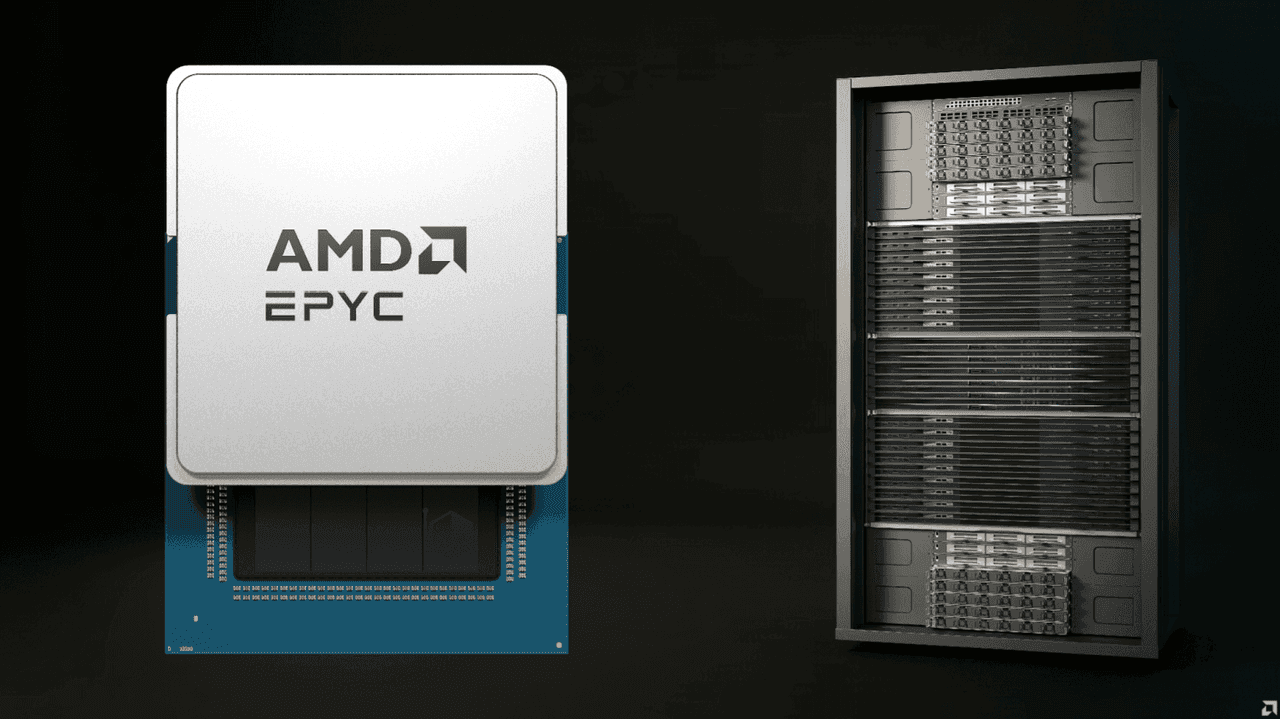
. The company benefited from strong demand for its EPYC server chips and the continued ramping of its Instinct graphics processing units3
. AMD is positioned as a leading challenger to Nvidia's dominance in AI chips, though the company has also tapped into a significant opportunity in central processing units as enterprises shift from training AI models to running applications through inference1
.Source: Market Screener
In a striking revision, Lisa Su announced that AMD now expects the server CPU market to grow at greater than 35% annually, reaching over $120 billion by 2030—a dramatic increase from the 18% yearly growth rate forecast in November
4
5
. This doubling of the total addressable market reflects the surge in agentic AI systems that automate work on behalf of humans, which run far more efficiently on CPUs than GPUs2
. Su emphasized that CPUs are essential for orchestration, inference, and broader AI infrastructure support, stating that "as AI adoption scales, you need more inferencing" and "they all require CPUs for orchestration and the data processing"5
. AMD expects server CPU revenue to grow more than 70% year-over-year in the second quarter and remains confident it can capture more than 50% of the growing server CPU market5
.
Source: SiliconANGLE
AMD has secured significant partnerships that cement its status as a viable alternative for AI infrastructure. Earlier this year, the company agreed to sell up to $60 billion worth of artificial-intelligence chips to Meta Platforms over five years, allowing the Facebook owner to purchase as much as 10% of AMD's chip output
1
. AMD also struck a deal with OpenAI last year1
. Both OpenAI and Meta have committed to purchasing AMD's upcoming Helios rack-scale system for AI data centers when it becomes available later this year, a rival to Nvidia's Grace Blackwell and Vera Rubin systems that sell for upwards of $3 million2
3
.AMD forecasts second-quarter revenue of $11.2 billion, plus or minus $300 million, significantly above Wall Street estimates of $10.52 billion
1
. The company expects adjusted gross margins of approximately 56% for the second quarter, compared with analyst expectations of 55.4%1
. Su expressed "strong and increasing confidence" in the company's ability to generate "tens of billions of dollars" in data center segment sales next year and hopes to "exceed our long-term growth target of greater than 80% in the coming years"3
. Jake Behan, head of capital markets at Direxion, noted that "AMD is levered to insatiable AI compute demand, and this quarter showed that demand is real, but the focus now shifts to how efficiently they can convert that into high-margin revenue"4
.Related Stories
While analysts view AMD as best-positioned to benefit from surging AI chip demand due to market share gains and product roadmap, competition from Intel has increased after the rival chipmaker delivered a strong revenue forecast last month
1
. After struggling with chip production for several quarters, Intel is now ramping up its in-house manufacturing efforts to cater to growing demand, posing a threat to AMD, which relies on tight manufacturing capacity at Taiwan's TSMC1
. Unlike Intel, which designs and manufactures chips in-house, AMD outsources its manufacturing to contract chipmakers like TSMC1
. Intel shares rose 4.5% in extended trading following AMD's results4
. Last week, AMD's stock jumped when the company announced a partnership with Intel to develop a new instruction set for x86 CPUs featuring AI Compute Extensions, which aims to increase performance and energy efficiency by boosting compute density by 16 times2
.The semiconductor industry is grappling with a global memory chip shortage stemming from a rush to secure supply of high-bandwidth memory used in data centers alongside GPUs and CPUs
1
. The sharp increase in memory prices is expected to impact demand for consumer electronics as pricier computers may turn consumers away1
. AMD's Client and Gaming segment, which includes consumer hardware, rose 23% to $3.6 billion compared with a year ago1
. However, executives indicated AMD is planning for second-half PC shipments to be lower due to higher memory and component costs, and expects second-half gaming revenue to decline more than 20% compared with the first half4
. Supply chain challenges due to the war in Iran have further complicated the situation2
. Despite these headwinds, AMD stock has far outperformed Nvidia's year-to-date gain of 5% to 6% and the broader Philadelphia Semiconductor Index's rise of 48% to 55%1
4
.Summarized by
Navi
[3]
[4]
04 Nov 2025•Business and Economy

04 Feb 2026•Business and Economy

31 Jul 2024

1
Health

2
Technology

3
Policy and Regulation