AMD Ryzen AI MAX+ 495 Gorgon Halo leaked with 192GB memory and Radeon 8065S GPU


2 Sources
[1]
AMD Ryzen AI Max+ PRO 495 Spotted With 192GB Memory and New iGPU
AMD appears to be preparing a new flagship mobile APU, as the Ryzen AI Max+ PRO 495 has surfaced in an early PassMark database entry. The listing, recorded on April 15, provides the first indication of this processor, which is expected to lead the Ryzen AI Max 400 "Gorgon Halo" lineup aimed at
[2]
AMD Ryzen AI MAX+ 495 "Gorgon Halo" Leak Smokes Strix Halo by 10%, Packs 192GB Memory and Radeon 8065S
AMD's next-generation Halo flagship, the Ryzen AI MAX+ 495, has leaked out, featuring a 10% bump in performance & a new Radeon 8065 iGPU. Earlier this year, we reported that AMD was working on a new Halo family called Ryzen AI MAX 400, and codenamed Gorgon Halo. Just like Strix Point to Strix
Share
Copy Link
AMD's next-generation flagship mobile APU, the Ryzen AI MAX+ 495 Gorgon Halo, has surfaced in PassMark benchmarks. The processor features 16 Zen 5 cores, a new Radeon 8065S GPU, and unprecedented 192GB memory support—exceeding the 128GB limit of its predecessor. Early tests show a 10% performance improvement, positioning it as a powerful solution for AI workloads and professional content creation.
AMD Unveils Next-Generation Flagship Mobile APU
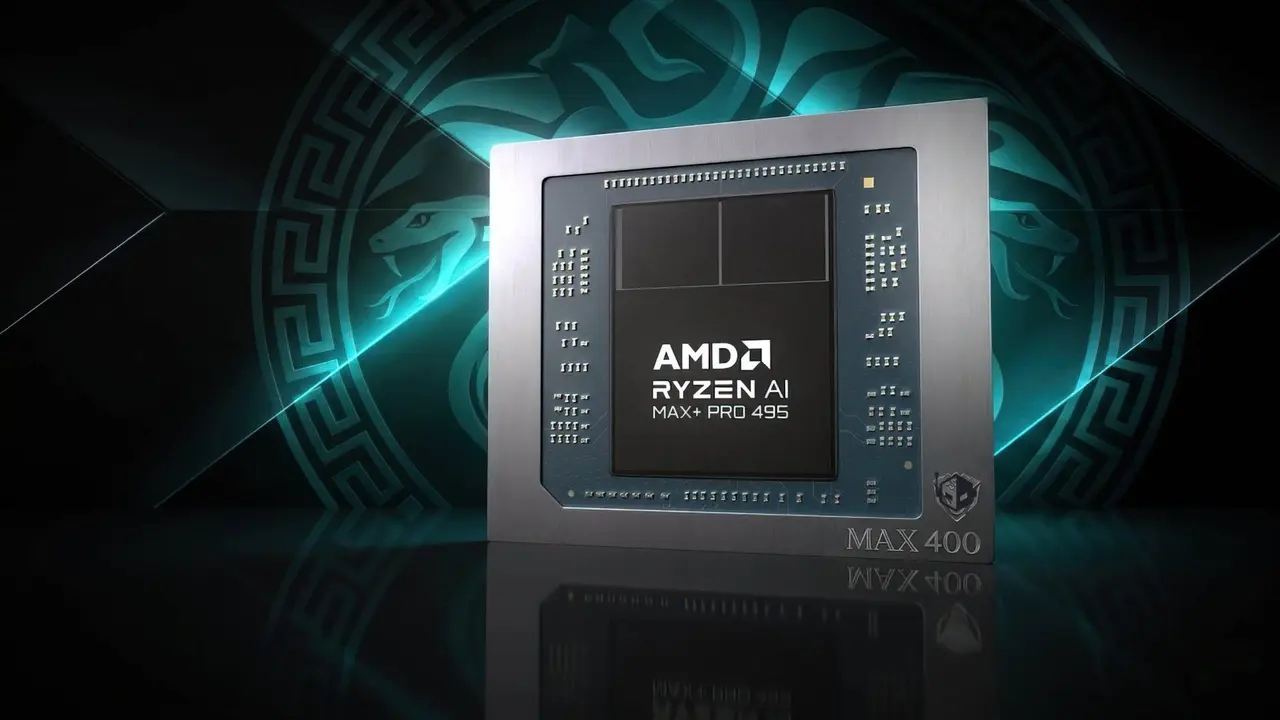
AMD appears ready to expand its high-performance mobile processor lineup with the Ryzen AI MAX+ 495, a flagship chip that has emerged in early PassMark benchmark listings. The processor, part of the Ryzen AI MAX 400 family codenamed Gorgon Halo, represents AMD's latest effort to dominate the professional and enterprise laptop market with enhanced capabilities tailored for AI workloads and intensive computing tasks
1
2
.
Source: Wccftech
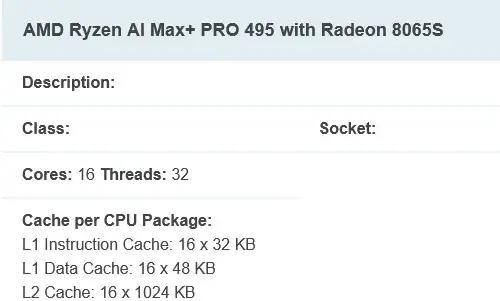
The leaked benchmark, recorded on April 15, reveals that the AMD Ryzen AI MAX+ 495 features a 16-core, 32-thread configuration built on Zen 5 cores. This mobile APU operates at improved clock speeds while maintaining 16 MB of L2 cache and 64 MB of L3 cache, aligning it with the demands of high-performance workstations
2
. The processor was spotted on an HP system with motherboard code 8F6D, indicating that OEM validation is already underway and platform integration is progressing1
.
Source: Guru3D
Radeon 8065S GPU Marks Incremental Graphics Advancement
The AMD Ryzen AI MAX+ 495 pairs its CPU cores with a Radeon 8065S GPU, representing a step beyond the Radeon 8060S found in the previously known Ryzen AI MAX+ PRO 395. While detailed architectural differences remain unclear, the updated GPU designation suggests a revision with higher clock speeds, though core count increases are not expected
1
2
. In PassMark testing, the GPU scored 1,232 points in 2D and 18,427 points in 3D benchmark runs, demonstrating solid integrated graphics performance for professional applications2
.192GB Memory Support Breaks Previous Limits
One of the most significant revelations is the processor's 192GB memory support, a substantial increase from the 128GB limit seen in earlier Strix Halo systems. The test platform utilized LPDDR5X memory, consistent with AMD's approach to unified memory in its AI-focused APUs
1
. This expanded memory capacity directly benefits workloads that rely heavily on large datasets, including AI inference, machine learning, and content creation1
.The increased memory capacity proves particularly valuable for running Large Language Models (LLMs). Based on current VRAM allocation patterns, approximately 168 GB of memory—87.5% of the total—could be allocated to the GPU, enabling professionals to run substantially larger AI models locally on laptops
2
. The tested configuration also included 2 TB of SSD storage alongside a 120Hz display with 2560x1600 resolution2
.Related Stories

Performance Gains Over Previous Generation
The leaked benchmark results show the AMD Ryzen AI MAX+ 495 scored 4,293 points in single-core and 57,525 points in multi-core tests, delivering a 10% performance improvement over the Ryzen AI MAX+ PRO 395
2
. This positions the processor at 192nd overall in multithread performance and 119th in single-thread performance out of 5,872 CPUs in PassMark's database1
.Like the transition from Strix Point to Strix Halo, Gorgon Halo offers similar architectures as Gorgon Point "Ryzen AI 400" SoCs but elevates the configurations with more cores, a beefier GPU, and substantially more memory in a chiplet design
2
. The standard Ryzen AI 400 "Gorgon" laptop SoCs are already available in markets, suggesting the Halo lineup could launch either later this year or early next year, with potential announcements expected at Computex 20262
.References
Summarized by

Navi
Related Stories
AMD's Ryzen AI Max Series: Pushing Boundaries in Mobile Computing
19 Dec 2024•Technology

AMD prices Ryzen AI Halo at $3,999 with June preorders, challenges Nvidia's DGX Spark dominance
21 May 2026•Technology
AMD prepares Ryzen AI MAX 400 'Gorgon Halo' refresh with faster clocks and enhanced AI power
23 Jan 2026•Technology
Recent Highlights
1
Meta Unveils Muse Wonder Frontier AI Models, Claims Performance Matching OpenAI and Anthropic
Technology

2
IMF Report Warns AI Market Correction Could Spark Global Financial Crisis With $1.4T at Risk
Business and Economy

3
OpenAI Releases 722 AI-Generated Math Solutions, Triggering Existential Crisis in Mathematics
Technology

Recent Highlights
Today's Top Stories










Don’t drown in AI news. We cut through the noise - filtering, ranking and summarizing the most important AI news, breakthroughs and research daily. Follow topics that matter to you and stay ahead.


