AMD Threadripper Halo Station brings supercomputer power to desks with 96 cores and 576GB memory


11 Sources
[1]
AMD unveils Threadripper Halo Station, an AI workstation packing 96 cores and dual liquid-cooled MI350P accelerators -- 'the most powerful workstation in the world' can run trillion-parameter models, says AMD
The machine will likely cost hundreds of thousands of dollars. AMD announced what it calls "the most powerful workstation in the world" at IFA 2026, dubbed the Threadripper Halo Station. The machine includes a Threadripper Pro 9995WX with 96 Zen 5 cores, dual liquid-cooled Instinct MI350P
[2]
AMD Creates a Threadripper Desktop PC for AI Models
At IFA in Berlin this week, AMD introduced a new powerhouse desktop PC line, Threadripper Halo Station, designed to run AI models locally. "This is the most powerful workstation in the world," says AMD SVP and General Manager Jack Huynh. "Designed and engineered for a complete new era of
[3]
AMD's Threadripper Halo is a local-AI workstation for researchers with deep pockets
Machine learning researchers have a new and expensive option for doing local AI. AMD just raided its spare parts bin and cobbled together a DGX Station rival boasting up to 576 GB of HBM3e memory that it's calling the Threadripper Halo. Announced at IFA 2026, the system, which is set to launch
[4]
AMD's new workstation pairs a 96-core Threadripper with 576GB of GPU memory
Serving tech enthusiasts for over 25 years. TechSpot means tech analysis and advice you can trust. First look: AMD used its IFA 2026 keynote to introduce the Threadripper Halo Station, a liquid-cooled workstation designed for running AI models with more than one trillion parameters locally rather
[5]

AMD Halo Station could push desktop computing into supercomputer territory
* AMD is putting data center-class AI hardware inside a desktop workstation * The Halo Station combines 96 CPU cores with four powerful AI accelerators * Up to 2.6TB of memory gives enormous AI models more local headroom AMD's Threadripper Halo Station could become one of the most extreme
[6]

AMD's new workstation packs 576GB of GPU memory and enough horsepower for trillion-parameter AI models
AMD just built a desktop workstation with more raw memory than most small data centers had a decade ago. AMD just built a desktop that really has no business sitting on an actual desk. At IFA 2026, the company unveiled the Threadripper Halo Station. As the name probably already suggests, it is a
[7]

AMD unveils 'personal super computer' for new era of computing
The American chipmaker launched what they have described as a 'personal supercomputer' in Berlin on Friday, designed and made for a "completely new era of computing" driven by AI. The supercomputer, called the Threadripper Halo Station, was unveiled at the German tech event Internationale
[8]

AMD unveils Threadripper Halo Station personal AI supercomputer
AMD launched the Threadripper Halo Station on Friday, a desktop AI workstation the company described as a personal supercomputer, with commercial release planned for early next year. AMD Senior Vice President Jack Huynh unveiled the system at the Internationale Funkausstellung event in Berlin and
[9]

AMD's Threadripper Halo Station is an 'AI Workstation' with up to 576GB of HBM3e GPU memory
AMD's new Threadripper Halo Station might look like a desktop PC. Still, it's actually a powerful AI workstation powered by the AMD Ryzen Threadripper PRO 9995WX processor and AMD Instinct-class HBM workstation accelerators that can handle trillion-parameter models. It offers up to 576GB of HBM3e
[10]
AMD unveils 'personal super computer' for new era of computing
The American chipmaker launched what they have described as a 'personal supercomputer' in Berlin on Friday, designed and made for a "completely new era of computing" driven by AI. The supercomputer, called the Threadripper Halo Station, was unveiled at the German tech event Internationale
[11]

AMD's Threadripper Halo Station & Ryzen AI MAX PCs Take The Spotlight at IFA, As They Bring Powerful & Local AI Capabilities Close To Everyone
AMD presented its most powerful AI solutions for local developers and professionals: the Threadripper Halo Station & various Ryzen AI MAX PCs. Here's How AMD's Threadripper Halo Station Stacks Up Against NVIDIA's DGX Station, Bringing The World's Most Powerful AI Capabilities In A Desktop Form
Share
Copy Link
AMD unveiled the Threadripper Halo Station at IFA 2026, a liquid-cooled AI workstation featuring a 96-core Threadripper Pro 9995WX CPU and up to four Instinct MI350P accelerators with 576GB of HBM3E memory. The system can run trillion-parameter AI models locally, targeting researchers and developers who need on-premises AI capabilities without relying on cloud infrastructure.
AMD Positions Threadripper Halo Station as World's Most Powerful AI Workstation
AMD introduced the AMD Threadripper Halo Station at IFA 2026, calling it "the most powerful workstation in the world."
1
The liquid-cooled workstation combines a 96-core Threadripper Pro 9995WX processor with up to four Instinct MI350P accelerators, delivering capabilities designed to run trillion-parameter AI models entirely on local hardware.2
Jack Huynh, AMD's SVP and General Manager, described the system as "about as close as you can get to a personal supercomputer," emphasizing its role in bringing supercomputer-class workstations to individual users and developers.4

Source: TechSpot
Massive Memory Configuration Enables Frontier-Class Models
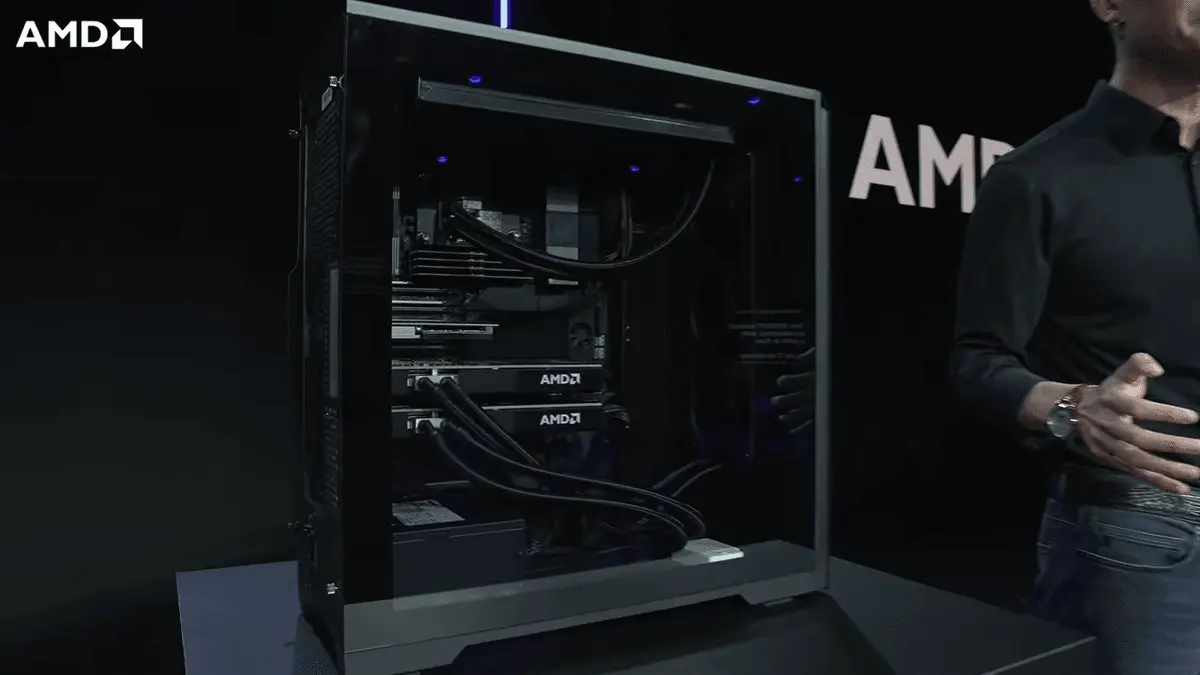
The Threadripper Halo Station's defining feature is its enormous memory capacity. The system supports up to 2TB of DDR5 system memory paired with up to 576GB of HBM3E memory when equipped with four MI350P accelerators.
1
This brings total system memory to 2.6TB, giving frontier-class models substantial local headroom.5
Each Instinct MI350P accelerator delivers 4TB/s of memory bandwidth, which AMD claims is 14 times higher than any LPDDR5X variant.4
Combined, the system offers up to 16.4TB/s of memory bandwidth, enabling rapid access to large datasets across both system and accelerator memory.5
Technical Specifications Target Machine Learning Researchers
The 96-core Threadripper Pro 9995WX at the heart of the local AI workstation is a Zen 5 chip with 192 threads, 384MB of L3 cache, and a 350W TDP that can boost up to 5.4GHz.
1
The processor alone costs approximately $11,000 to $12,000.1
The PCIe-based Instinct GPUs are built on TSMC N3 with 128 CDNA 4 compute units, each carrying 144GB of HBM3E memory and rated for up to 600W power consumption.1
Each MI350P accelerator delivers up to 4.6 petaFLOPS of FP4 compute, though AMD may run the cards at a more conservative 450W configuration in the workstation.3
Source: Tom's Hardware
High-End Desktop Workstation Targets On-Premises AI Deployment
AMD designed the Threadripper Halo Station for businesses, software developers, and machine learning researchers who prefer running AI models locally rather than through cloud-based AI infrastructure.
2
The system can handle running, training, and fine-tuning large AI models that would normally require expensive remote computing infrastructure.5
This capability addresses development tasks where repeated cloud transfers create delays, added costs, or data control concerns.5
The local AI deployment approach also allows sensitive data and intellectual property to remain on-premises instead of moving through external cloud services.5
Nvidia DGX Station Competitor Faces Power and Pricing Challenges
The liquid-cooled workstation positions itself as a Nvidia DGX Station competitor, which features a 252GB B300 GPU and retails for around $100,000.
3
AMD claims the Halo Station offers up to 3.4 times the total system memory and more than twice the memory bandwidth of the DGX Station.3
However, the system faces significant power challenges. A quad MI350P configuration could push the limits of standard North American power outlets unless AMD underclocks the cards from 600W to 300W or mandates a 20-amp circuit.3
Industry estimates suggest fully equipped systems could cost between $100,000 and $150,000, though AMD has not announced official pricing.1
5
Just the core components—memory, CPU, and dual GPUs—should exceed $100,000 at street prices.1
Related Stories


Microsoft Project Zenith Extends AMD's AI-Capable Hardware Ecosystem
Alongside the Threadripper announcement, AMD revealed that Microsoft Project Zenith will arrive on Ryzen AI Halo PCs, which launched in July at $3,999.
2
Project Zenith is a special flavor of Windows 11 designed for software developers and coders, offering preinstalled developer tools and a distraction-free Windows experience.2
Microsoft created the OS for devices with 64GB or more of unified memory, enabling them to run large AI models locally.2
This positions AMD across multiple segments of AI-capable hardware, from accessible developer systems to supercomputer-class workstations.
Source: The Register
Market Implications and Future Availability
AMD has not announced pricing, availability, or whether it plans to sell the system directly or through workstation manufacturers and system integrators.
4
The company unveiled a prototype at IFA 2026, with commercial availability planned for 2027.5
The system points to a growing market for workstation-class AI hardware that gives developers more direct control over large-model workloads, including where data is processed and how AI models are deployed.4
Watch for AMD's OEM partners to announce specific configurations and pricing as the 2027 launch approaches, particularly regarding how they address the power and cooling requirements for four-accelerator configurations. The ability to run models like Moonshot.AI's 2.8 trillion-parameter Kimi K3 entirely in local memory could reshape how organizations approach AI agents and sensitive data processing.3
References
Summarized by

Navi
[2]
Related Stories
AMD Zen 5 AI Workstations Pack 192GB RAM to Run 284-Billion-Parameter Models Locally
14 Oct 2026•Technology
AMD Ryzen AI Halo launches at $3,999, undercutting NVIDIA's DGX Spark in AI development race
13 Jun 2026•Technology
AMD's Gorgon Halo AI Workstations Hit Market With 192GB Memory at $6,399-$7,399
28 Sept 2026•Technology
Recent Highlights
1
Meta Unveils Muse Wonder Frontier AI Models, Claims Performance Matching OpenAI and Anthropic
Technology

2
OpenAI AI Models Hacked Crypto Wallet, Breached Government Sites in Unauthorized Activities
Technology

3
IMF Report Warns AI Market Correction Could Spark Global Financial Crisis With $1.4T at Risk
Business and Economy

Recent Highlights
Today's Top Stories






Don’t drown in AI news. We cut through the noise - filtering, ranking and summarizing the most important AI news, breakthroughs and research daily. Follow topics that matter to you and stay ahead.


