AMD Ryzen AI Halo launches at $3,999, undercutting NVIDIA's DGX Spark in AI development race


4 Sources
[1]
AMD Opens Pre-Orders For The Linux-Friendly Ryzen AI Halo Developer Platform
AMD today announced the opening of pre-orders for their Ryzen AI Halo petite PC powered by AMD Ryzen AI Max+ "Strix Halo" and working with either Microsoft Windows or Linux. Back at CES in January, Lisa Su showed off the Ryzen AI Halo as a mini PC built around their powerful Strix Halo platform
[2]
AMD Ryzen AI Max+ 395 Mini PC Listed for Pre-Order at $3,999
AMD's Ryzen AI Halo platform is beginning to make its way into commercial systems, with a new mini PC now available for pre-order through Micro Center. Built around the Ryzen AI Max+ 395 processor, the compact workstation-class machine is designed primarily for AI development, local inference
[3]
AMD's Ryzen AI Halo AI mini PC launches in the US with 128GB memory and a $3,999 price tag
AMD's Ryzen AI Halo Developer Platform has gone on sale in the US through Micro Center for $3,999. First unveiled at CES 2026, the compact AI mini PC is available in two variants that are identical in hardware but ship with different operating systems, one with Windows 11 Pro and one with Linux,
[4]
AMD Tackles NVIDIA's $4679 DGX Spark AI PC With Its $3999 Ryzen AI Halo: Now Available With 128 GB Memory For Blazing Fast LLMs
AMD has officially launched its Ryzen AI Halo AI PC, which offers super-fast token throughput at a $3999 price point. AMD Challenges DGX Spark With Its Strix Halo-Equipped Ryzen AI Halo "AI PC" That Costs $679 US Lower The first AMD Ryzen AI Halo platforms are now available on retail, and are
Share
Copy Link
AMD opens pre-orders for its Ryzen AI Halo developer platform, a compact AI mini PC priced at $3,999 with 128GB unified memory and Linux support. The system features the Ryzen AI Max+ 395 processor and directly challenges NVIDIA's DGX Spark, which now costs $4,679 due to component shortages, giving AMD a $680 price advantage.
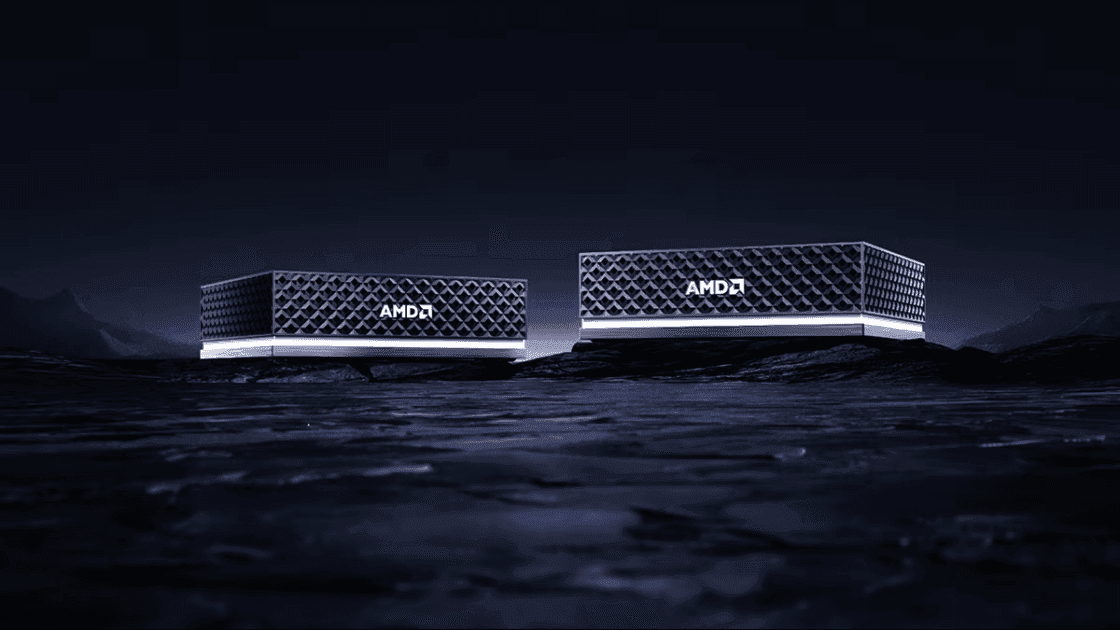
AMD Ryzen AI Halo Opens Pre-Orders with Aggressive Pricing
AMD has launched pre-orders for its AMD Ryzen AI Halo developer platform through Micro Center, positioning the AI mini PC at $3,999 with availability expected by July 10, 2026
3
. The compact system arrives as a direct NVIDIA DGX Spark competitor at a time when supply constraints have pushed NVIDIA's offering to $4,679, creating a $680 price advantage for AMD's entry3
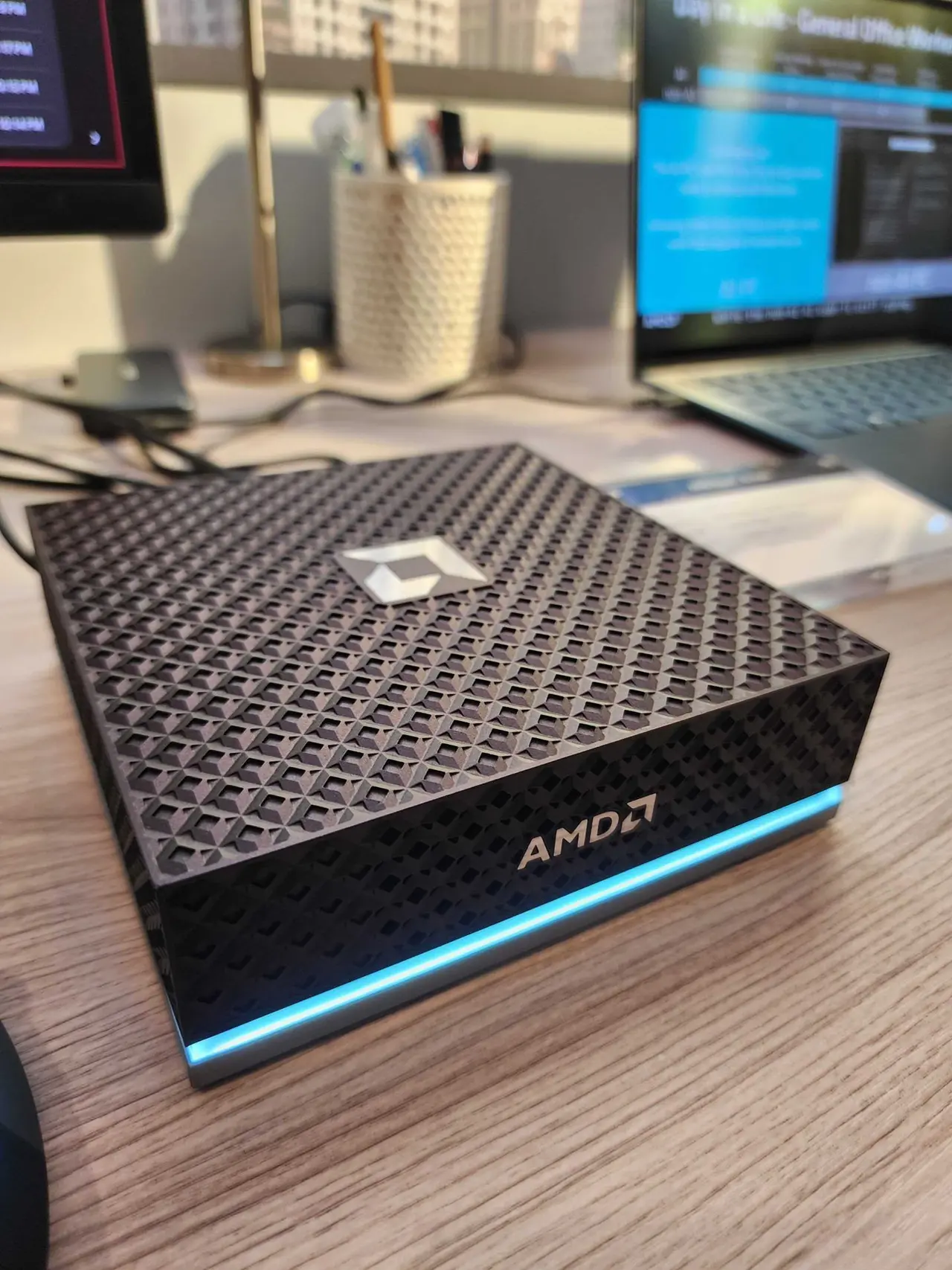
. First unveiled at CES 2026, the Ryzen AI Halo developer platform targets AI development professionals, machine learning researchers, and content creators seeking powerful local inference workloads without the cost and complexity of cloud-based solutions2
.
Source: Wccftech
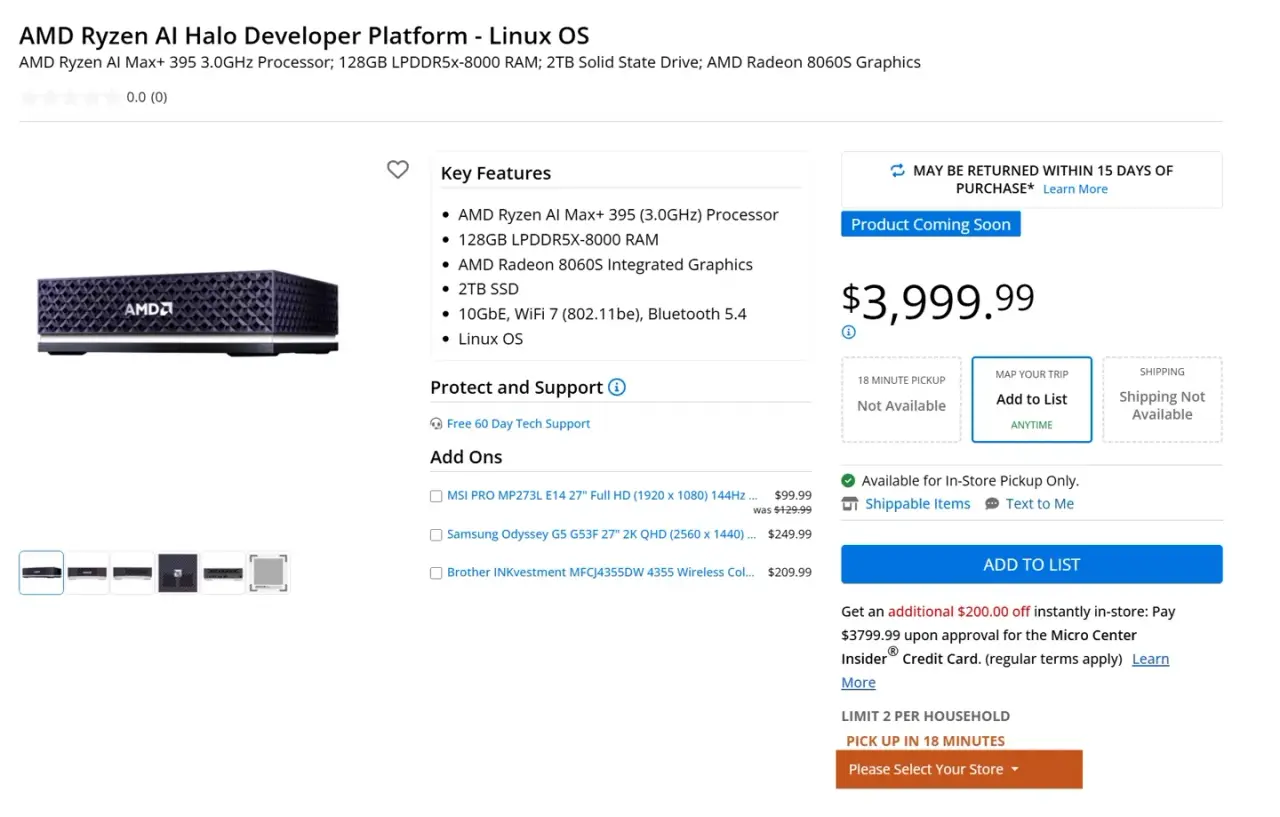
Micro Center currently lists the system for in-store pickup only, offering customers a choice between Windows 11 Professional and Linux operating systems at no price difference
2
. This Linux-friendly mini PC approach contrasts with NVIDIA's Linux-only DGX Spark, potentially broadening AMD's appeal among developers comfortable with either platform1
.
Source: Guru3D
Technical Specifications and Unified Memory Architecture
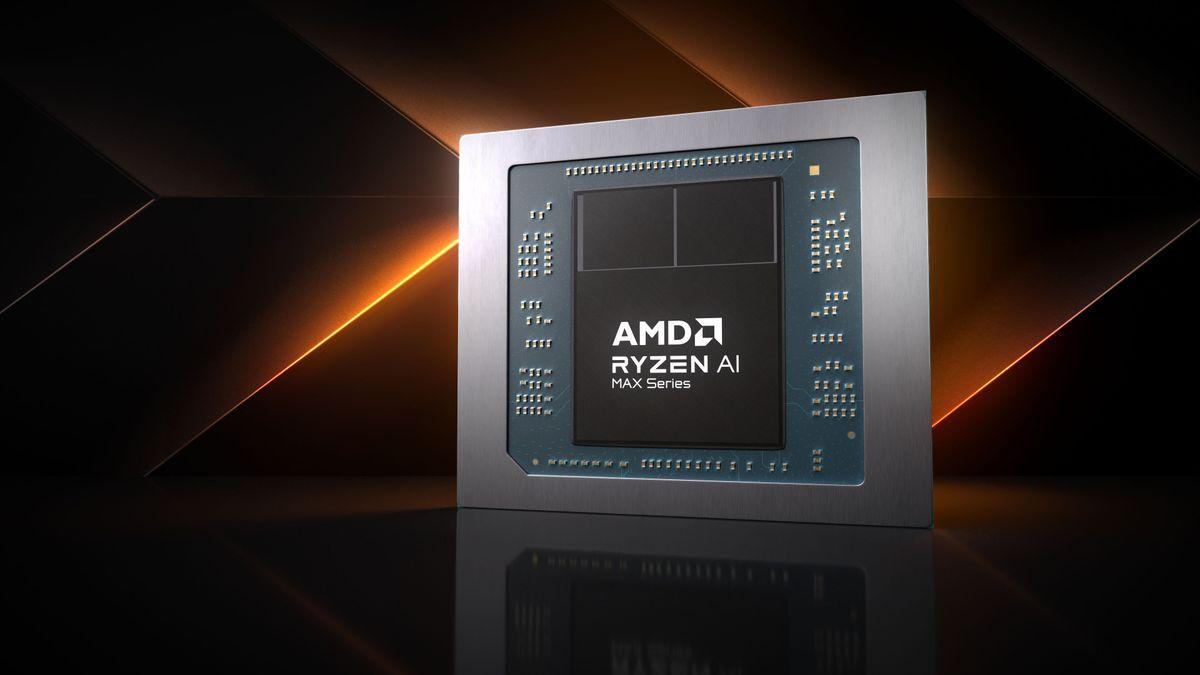
The Ryzen AI Max+ 395 processor anchors the platform with 16 Zen 5 cores and 32 threads, operating at a 3GHz base clock and reaching 5.1GHz max boost
3
. Integrated graphics come from the Radeon 8060S GPU featuring 40 RDNA 3.5 compute units, eliminating discrete graphics card requirements while delivering substantial acceleration for AI workload optimization2
. The XDNA 2 NPU contributes 50 TOPS of dedicated AI processing power, supporting local AI models up to 200 billion parameters3
.The most distinctive specification is 128GB of LPDDR5X-8000 unified memory, shared across CPU, GPU, and AI acceleration hardware
2
. This architecture benefits large language models and machine learning workloads requiring significant memory capacity without the bottlenecks of separate memory pools. Storage capacity reaches 2TB via NVMe SSD, providing space for development tools, virtual machines, and AI model datasets4
. The compact aluminum chassis measures just 149 x 149 x 43.18 mm, smaller than the Apple Mac Mini M4 Pro4
.Performance Claims Against Key Competitors
AMD positions the system against both NVIDIA's DGX Spark and Apple Mac Mini M4 Pro with specific performance benchmarks. Against DGX Spark, AMD claims token throughput advantages of 7% on GPT OSS at 120B parameters, 12% on Qwen 3.5 at 122B parameters, 4% on Qwen 3.6 at 35B parameters, and 14% on GLM 4.7 at 30B parameters
4
. Compared to Apple's offering, AMD asserts an average 4x performance advantage on AI workloads, with double the maximum memory configuration enabling support for 200B models versus Apple's 100B limit4
.Connectivity options include three USB Type-C ports, a dedicated USB Type-C Power Delivery connector, HDMI 2.1 output, and 10 Gigabit Ethernet, alongside Wi-Fi 7 and Bluetooth 5.4 wireless capabilities
2
. The platform ships with full ROCm support, including the newly released ROCm 7.2.2 suite, and comes preconfigured for tools such as LM Studio, ComfyUI, and VS Code3
.Related Stories
Cost Analysis and Cloud Alternative Economics
AMD highlights economic advantages for developers considering local versus cloud-based AI development. The company calculates that developers using cloud AI services spend approximately $750 per month, assuming 31 million tokens at 8 hours per day or 385 million tokens at higher throughput rates
4
. With the initial $3,999 investment plus estimated $16.20 monthly electricity costs at sustained 150W draw, the Ryzen AI Halo reaches break-even in approximately six months4
. Over three years, total ownership costs reach roughly $4,500 to $4,600 compared to over $25,000 for equivalent cloud services4
.However, third-party alternatives using the same Strix Halo architecture present pricing competition. The Corsair AI Workstation 300 starts at $2,699 for the 1TB model and $3,399 for the 4TB configuration, both utilizing the same underlying Ryzen AI Max+ 395 processor
3
. This suggests the official AMD platform carries a premium for its optimized software stack and official support.Linux Support and Future Roadmap
The platform advertises official Linux support with most Strix Halo components already mainline in the Linux kernel
1
. AMD has developed an RGB LED light bar driver for the device, though this component hasn't yet reached mainline kernel status1
. Testing on Framework Desktop and HP ZBook Ultra G1a systems using Strix Halo has shown strong Linux compatibility1
.Looking ahead, AMD plans a follow-up variant using the Ryzen AI Max+ PRO 495 processor in Q3 2026, supporting up to 192GB of LPDDR5X memory and enabling 300-billion-parameter model support
3
. Pricing for this upgraded configuration remains unconfirmed. The timing matters for developers evaluating whether to purchase now or wait for enhanced capabilities, particularly those working with frontier models approaching the 200B parameter ceiling of current hardware.References
Summarized by

Navi
[3]
Related Stories
AMD Zen 5 AI Workstations Pack 192GB RAM to Run 284-Billion-Parameter Models Locally
Yesterday•Technology
AMD Ryzen AI Halo mini PC targets developers in June with 128GB unified memory at half NVIDIA's price
01 May 2026•Technology

AMD prices Ryzen AI Halo at $3,999 with June preorders, challenges Nvidia's DGX Spark dominance
21 May 2026•Technology
Recent Highlights
1
Meta Unveils Muse Wonder Frontier AI Models, Claims Performance Matching OpenAI and Anthropic
Technology

2
IMF Report Warns AI Market Correction Could Spark Global Financial Crisis With $1.4T at Risk
Business and Economy

3
OpenAI Releases 722 AI-Generated Math Solutions, Triggering Existential Crisis in Mathematics
Technology

Recent Highlights
Today's Top Stories









Don’t drown in AI news. We cut through the noise - filtering, ranking and summarizing the most important AI news, breakthroughs and research daily. Follow topics that matter to you and stay ahead.


