Central banks warn AI bubble could trigger global recession as Big Tech spending hits $1 trillion


18 Sources
[1]
How the AI bubble could pop and take down the global economy, according to the BIS
Central bank for central banks sees shades of dotcom mania in hyperscaler capex binge The central bank for central banks is concerned about the eye-watering sums being invested into AI, and it's raising the specter of a global recession should the bubble burst. In its annual report for 2026, the
[2]
AI hopes and fears dominate global central bank meet
SINTRA, Portugal, July 1 (Reuters) - Seeping into just about every conversation at this week's meeting of the world's top central bankers was one big unknown: how artificial intelligence will impact the world economy and therefore their mandate to ensure financial stability. The consensus of those
[3]
AI 'exuberance' risks ending in lengthy investment bust, BIS warns
Big Tech's AI spending spree risks ending in a damaging and lengthy "investment bust" that could rattle financial markets and damage the global economy, the Bank for International Settlements has warned. The Basel-based organisation, which advises the world's central banks, said the prospect of
[4]
What Went on at This Meeting of Powerful Central Bankers Won't Ease Your Mind About an AI Bubble
Central bankers are some of the most powerful people in the world, and we should all pay attention to what they're saying and hearing. With that in mind, I have troubling news. According to Reuters' Wednesday report from the European Central Bank's annual meeting in Sintra, Portugal, AI is being
[5]

AI's hopes and fears take over the world's big central-bank gathering
At the ECB's Sintra forum, the people who set interest rates spent three days trying to price a technology that refuses to sit still. Every summer the world's most powerful central bankers decamp to a hillside town outside Lisbon to argue about the economy in relative calm. This year the argument
[6]
The BIS warns an AI bust could hit credit markets as hard as the 2008 financial crisis
The BIS warned that an AI investment bust could be as disruptive to credit as 2008, flagging circular financing and poorly disclosed risk in its annual report. The Bank for International Settlements warned on Sunday that an AI investment bust could hit credit markets with disruption comparable to
[7]

The AI boom's historical warning
The risk is that AI follows the same pattern at a moment when the global economy is unusually reliant on a single investment boom to keep the expansion on track. Flashback: Some of the world's greatest technological breakthroughs -- canals, railroads, the internet -- sparked enormous investment
[8]

The central bank of central banks just released its flagship annual report -- and it sees a $1 trillion AI investment boom headed for a reckoning | Fortune
The canal mania of the 1830s. The British railway bubble of the 1840s. The dot-com crash of 2000. Each began with a genuine technological breakthrough that attracted more capital than commercial returns could ultimately justify. Each ended in a recession. The Bank for International Settlements --
[9]

Americans Increasingly Alarmed About Tech Industry's Looming AI Bubble
Can't-miss innovations from the bleeding edge of science and tech From coast to coast, the people of the United States are growing resentful of AI. It's not hard to see why: they're constantly told the tech will take their jobs and leave them for broke, while the data centers used to train them
[10]

The AI boom could trigger the next crash, central banks warn
The vast surge of investment in AI, which has powered global stock markets to record highs, risks ending in a financial bust, the Bank for International Settlements warns, as the build-up's hidden costs begin to surface in company accounts and consumer prices alike. In its Annual Economic Report,
[11]

Big Tech is all in on AI. Now all they need is customers.
Aimee Picchi is the associate managing editor for CBS MoneyWatch, where she covers business and personal finance. She previously worked at Bloomberg News and has written for national news outlets including USA Today and Consumer Reports. This week's selloff in technology stocks underscores a
[12]

BIS Warns AI Debt Bubble Could Spark Global Financial Crisis
The AI investment surge is a potential flashpoint for systemic risk, "as financing has relied on enormous debt and highly leveraged nonbank structures that can rapidly unwind," one analyst said in response to the report. The Bank for International Settlements has warned that artificial
[13]

The AI boom won't burst all at once. It will pop in 'rolling bubbles': Macquarie
Macquarie expects the AI investment boom to unwind through a series of "rolling bubbles" rather than a single crash, as different segments of the AI ecosystem heat up and cool down over time. Global AI investment has surged to about $850 billion in 2026, far exceeding historical technology
[14]
AI investment boom may fuel financial risks: BIS
The Bank for International Settlements (BIS) has cautioned about the financial dangers linked to the rapid growth of AI, pointing to issues of overinvestment and high valuations. There's a growing worry that advanced AI models could increase cyber threats, calling for stronger collaborations. New
[15]

BIS Warns That AI Spending May Not Be Sustainable | PYMNTS.com
In its annual report published Sunday (June 28), BIS names AI as one of four pressure points facing the global economy. "Optimism surrounding AI may not last, despite its promise of future productivity gains," BIS said in a news release accompanying the report. "The current surge in capital
[16]

The Bank for International Settlements worries about potential effects of AI debt
The Bank for International Settlements published its Annual Economic Report on June 28, warning that the AI boom is becoming a source of financial instability. That alone is not surprising. What is surprising is the specific mechanism the BIS is worried about: not whether AI pays off, but who will
[17]

AI hopes and fears dominate global central bank meet
SINTRA, Portugal, July 1 (Reuters) - Seeping into just about every conversation at this week's meeting of the world's top central bankers was one big unknown: how artificial intelligence will impact the world economy and therefore their mandate to ensure financial stability. The consensus of those
[18]
BIS Sees Peril for Economy, Financial System in AI Investment Boom
Fierce competition to dominate artificial intelligence risks driving investment spending to excessive levels, threatening the profitability of leading firms and a sharp reversal that could tip some economies into recession, the Bank for International Settlements said Sunday. In its annual report
Share
Copy Link
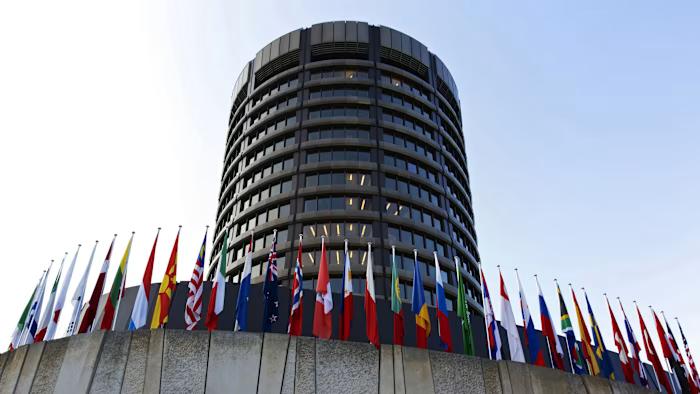
The Bank for International Settlements has raised alarms about the AI bubble, comparing current AI exuberance to the dotcom boom and historical investment manias. With hyperscalers set to spend over $1 trillion on AI in 2026, central bankers warn that disappointing returns could trigger an AI investment bust with severe macroeconomic risks of AI affecting financial stability worldwide.

Central Bank Sounds Alarm on AI Bubble and Global Economic Risks
The Bank for International Settlements has issued a stark warning about the AI bubble, comparing the current wave of massive investments in AI to historical episodes that ended in economy-wide recessions. In its 2026 annual report, the BIS—often described as the central bank for central banks—drew parallels between today's AI exuberance and past investment manias including canal mania in the 1830s, British railway expansion in the 1840s, electrification enthusiasm of the 1920s, and the dotcom boom of the 1990s
1
.All these episodes shared a common trait: genuine technological breakthroughs that attracted capital in excess of what commercial returns could ultimately justify. The BIS report states that these periods "ended with an eventual reversal in investment, inducing economy-wide recessions," highlighting the potential for similar macroeconomic risks of AI today
3
.Hyperscalers Pour Over $1 Trillion Into AI Infrastructure
The scale of current capital expenditures is staggering. Amazon forecasts spending $200 billion in 2026, Microsoft projects $190 billion, Google approximately $180 billion, and Meta up to $140 billion
1
. The BIS estimates that the five largest hyperscalers are set to invest more than $1 trillion on AI-related infrastructure in 2026 alone, with inflationary conditions around memory and intense competition driving spending even higher.These commitments are outpacing earnings and free cash flow, forcing some firms to issue debt to raise additional financing. The investment race appears partly driven by the perception that only a small number of players with superior technology will ultimately dominate market shares
1
. Big Tech companies have flooded global credit markets, raising hundreds of billions of dollars to fund AI projects while taking advantage of corporate credit spreads near their lowest level this century3
.AI Investment Bust Could Trigger Financial Stability Crisis
The prospect of an AI investment bust poses serious threats to financial stability. "Disappointment in returns could trigger a sudden pullback in financing and turn the capex boom into a protracted investment bust with potential knock-on effects on the financial conditions," the BIS warned
1
.Intense competition is leading tech giants to overcommit resources to investment projects with uncertain returns, leaving all firms vulnerable to disappointments in AI payoffs. As competitive pressure drives spending higher, the net economic surplus for the tech industry declines and could turn negative in adverse scenarios. Given AI companies' rising leverage and growing footprint in credit markets, a major shift in optimistic sentiment could have serious financial knock-on effects
1
.Central Bankers Grapple With AI's Impact on the Global Economy
At the European Central Bank's annual Sintra forum in Portugal, AI dominated discussions among the world's top central bankers. The consensus: AI has the power to disrupt everything and create problems they cannot yet imagine, affecting financial markets, labor markets, bank lending, security, and power demand
2
.Torsten Slok at Apollo Global Management captured the dilemma facing policymakers: "If AI overdelivers, it will impact financial stability. If AI underdelivers, it will impact financial stability"
2
. Federal Reserve Chairman Kevin Warsh called AI "the biggest time of consequence to each of our economies, I think, in our lifetime," comparing the current moment to the early stages of the internet revolution2
.Supply Constraints and Inflation Amplify Economic Risks
The BIS report cited concerns about supply-side roadblocks including electricity availability, chip shortages, and grid connection bottlenecks. AI datacenters are already pressuring energy prices and input costs with potential spillovers to inflation
1
.These temporary shortages may amplify over-investment as firms attempt to lock in future capacity through long-dated contracts that further expose them to demand disappointments. Should inflation spike or AI-led investment collapse, macroeconomic consequences could be amplified by existing financial vulnerabilities. Policy rates tightened to control inflation may precipitate a sharp pullback in asset prices after a prolonged period of exuberant risk-taking, triggering disruptive macro-financial feedback loops
1
.Related Stories


Productivity Gains Remain Elusive Despite Massive Spending
The backdrop to these concerns is troubling: while enterprises running pilots report some efficiency gains at an employee level, few report discernible productivity gains from AI projects deployed at scale in production environments
1
. US output per hour rose only about 2.2% last year, appearing more like recovery from a weak patch than the transformative step change technology boosters describe5
.This disconnect between the investment boom and actual productivity gains raises questions about whether returns will justify the unprecedented capital being deployed. Bank of Canada Governor Tiff Macklem noted that "the internet proved to be better than anybody imagined, created whole new businesses, but we still got the dotcom bubble. It doesn't mean there can't be a period where the market gets ahead of itself"
2
.AI-Driven Financial Bubbles Pose Unique Threats
University of Pennsylvania professor Itay Goldstein warned about AI-driven financial bubbles created through algorithmic coordination. "Something that is even more advanced and potentially more disturbing, is the ability of these algorithms to coordinate on a manipulative path of prices. These algorithms indeed manage to achieve this kind of manipulation, creating bubbles leading to crashes, and this, I think, has more significant implications for financial stability"
2
.The opacity of AI-sector financing compounds vulnerabilities as corporations create webs of private arrangements and circular financing, with datacenter facility lease terms often not fully disclosed. Vulnerabilities extend to supplier ecosystems, including engineering, procurement, and construction contractors whose balance sheets are comparatively weak, leaving them exposed to any capex pullback by hyperscalers
1
.What This Means for Markets and Monetary Policy
A major equity market correction associated with AI could have broader implications today than in past bubbles because households have greater exposure to shares relative to their wealth and income
3
. The major AI firms committed roughly $300 billion to capital expenditures in 2025 alone, and that spending lands as demand on the economy long before any productivity gains materialize5
.Central bankers face a difficult balancing act: easing monetary policy today based on productivity leaps that have not yet arrived would be risky with demand already running hot, yet tightening too aggressively could puncture the AI bubble and trigger the very financial crisis they seek to avoid. What the Sintra forum produced was not a decision but shared unease—the people who set the price of money left having agreed on the size of the question and very little about the answer
5
.References
Summarized by

Navi
[4]
Related Stories
Central Banks Confront AI as Transformative Economic Force at Jackson Hole Symposium
29 Aug 2026•Policy and Regulation
AI boom complicates monetary policy as central banks struggle to read blurred economic signals
28 Jul 2026•Policy and Regulation
Fed Officials Clash Over AI Investment Risks as Spending Reaches $2.4 Trillion
05 Aug 2026•Policy and Regulation

Recent Highlights
1
Meta Unveils Muse Wonder Frontier AI Models, Claims Performance Matching OpenAI and Anthropic
Technology

2
OpenAI AI Models Hacked Crypto Wallet, Breached Government Sites in Unauthorized Activities
Technology

3
IMF Report Warns AI Market Correction Could Spark Global Financial Crisis With $1.4T at Risk
Business and Economy

Recent Highlights
Today's Top Stories







Don’t drown in AI news. We cut through the noise - filtering, ranking and summarizing the most important AI news, breakthroughs and research daily. Follow topics that matter to you and stay ahead.


