10 Sources
[1]
Anthropic's New Product Aims to Handle the Hard Part of Building AI Agents
Anthropic announced Wednesday the launch of a new product that aims to make it easier for businesses to build and deploy AI agents. The tool, Claude Managed Agents, offers developers out-of-the-box infrastructure to build autonomous AI systems, simplifying a complex process that was previously a barrier to automating work tasks. The move positions Anthropic to capitalize on its rapidly growing enterprise business. On Tuesday, the company said that its annualized recurring revenue has surpassed $30 billion, roughly three times higher than it was in December 2025. Both Anthropic and OpenAI, which also has an agent platform called Frontier, are racing to build out robust enterprise offerings as they prepare to go public as soon as this year. The majority of Anthropic's recent revenue growth has come from Claude Platform, an enterprise product that allows developers to tap into the company's AI models through an API, according to Anthropic's head of product for the Claude Platform, Angela Jiang. Developers have been using Anthropic's API to deploy AI agents, such as Claude Code, in their workspace. Jiang argues there's a notable gap between what Anthropic's models are capable of and what businesses are using them for. The new tool "enables any business to take the best-in-class infrastructure and deploy a fleet of Claude agents to do whatever work they need," says Jiang. Managed Agents will give developers an agent harness, which describes all of the software infrastructure that wraps around an AI model to help it work agentically, or take actions on behalf of a user. In practice, a harness is made up of software tools, a memory system, and other infrastructure. Agents made through Claude Managed Agent will also come with a built-in sandboxed environment, in which the agent can spin up software projects in a secure setting. The product also allows developers to create agents that can run autonomously for hours in the cloud, monitor what other Claude agents are doing, and toggle permissions that allow agents to access certain tools. "When it comes to actually deploying and running agents at scale, that is a complex distributed-systems engineering problem," says Katelyn Lesse, head of engineering for the Claude Platform. "A lot of customers we're talking about previously had a whole bunch of engineers whose job it would have been to build and run those systems at scale. Now that we are giving them that bit out of the box, they're able to have those same engineers be focused on the core competencies of their business and of their product." In a demo shared with WIRED, the AI productivity startup Notion showed how it's using Managed Agents to power a client onboarding feature. Eric Liu, a Notion product manager, demoed how he could off-load a long list of tasks within Notion to a Claude Managed Agent, which was able to start ticking off client onboarding tasks one by one. The product in the demo runs in Notion, but Liu opened a dashboard on the Claude Platform and looked at how the agents were working and what tools they were using. Wall Street investors have grown wary of software stocks in recent months as Anthropic has released a wide range of enterprise offerings, which some believe could make traditional software-as-a-service companies obsolete. Whether that threat materializes or not, Managed Agents makes clear that Anthropic still has significant ground to cover before most enterprises are fully running on Claude.
[2]
Anthropic will let your agents sleep on its couch
Want to run your business on autopilot? For better or worse, Managed Agents might help with that If you need AI agents to do a lot of ongoing tasks for your business, Anthropic has a new answer for you. The Claude maker has introduced Managed Agents, a service to help organizations create and deploy cloud-hosted knowledge work automations. Agents, for those who haven't been following along, consist of machine learning models given access to software tools in an iterative loop. Claude Code is a coding agent that can emit programming code with the assistance of models like Opus 4.6 and permitted command line tools like bash, yoked together through a client-side harness - an orchestration tool. Those using Claude Code can create sub-agents that specialize in certain tasks, like frontend design. These are defined by Markdown files and YAML data - words that steer the underlying model toward training data related to functional interface patterns as opposed to code efficiency or some other goal. "An agent is a reusable, versioned configuration that defines persona and capabilities," Anthropic explains in its documentation. "It bundles the model, system prompt, tools, MCP servers, and skills that shape how Claude behaves during a session." Running an agent involves some degree of planning and configuration followed by monitoring and feedback - you give it a task, the agent attempts to comply, and it either asks further questions or proceeds to generate its interpretation of the desired response - until your token quota or your API budget has been exhausted. Hence the appeal of Managed Agents: Anthropic is offering to make the agentic process a bit more hands-off and more scalable, which for organizations might have some appeal. "Shipping a production agent requires sandboxed code execution, checkpointing, credential management, scoped permissions, and end-to-end tracing," the company said in a blog post. "Managed Agents handles the complexity. You define your agent's tasks, tools, and guardrails and we run it on our infrastructure. A built-in orchestration harness decides when to call tools, how to manage context, and how to recover from errors." Where personal agent usage (for coding at least) tends to be semi-autonomous - you give the agent some tasks and check in as the model implements specific features - Claude Managed Agents is intended for longer periods of unsupervised action (a.k.a. spending). Managed agents are designed to muck around in their managed environment, reading files, running commands, browsing the web, and executing code without much oversight. The mundane aspects of LLM interaction - compacting sessions to free up context space, for example - are left to the machines. Anthropic recommends Managed Agents for tasks that require a long time to complete and lots of tool calls, can operate in cloud-hosted secure containers, and benefit from persistent file and conversation data. The Managed Agents service isn't just for coding, which remains the primary commercial use case for Claude to date. Anthropic suggests that its hosted ghost workers can handle a broad set of office tasks - a position underscored by Claude Cowork's declaration of general availability on Thursday. The AI biz emphasizes the general utility of its toilbots in a YouTube testimonial from Notion product manager Eric Liu that describes how Notion uses Managed Agents to ship code and produce websites and presentations. This involves, for example, asking the managed agents to consolidate project assets, create Slack channels, research competitor home pages, and send emails with project timelines. All this could be yours for the low, low price of standard platform rates, plus $0.08 per session-hour for active runtime. ®
[3]
Anthropic scales up with enterprise features for Claude Cowork and Managed Agents - 9to5Mac
Claude Cowork, available on macOS, is losing the "research preview" label today as Anthropic introduces enterprise capabilities. Separately, Anthropic is reclaiming the AI agent narrative with Claude Managed Agents. Anthropic introduced Claude Cowork three months ago as a research preview. Since then, the ability to let Claude manage workflows on the Mac has only matured. Starting today, Claude Cowork includes six features built especially for enterprise use: You can learn more about each feature in the company's announcement post. Anthropic says Claude Cowork for macOS and Windows is now generally available for all paid subscribers. Meanwhile, Anthropic has a new public beta tool called Claude Managed Agents. Managed Agents are "a suite of composable APIs for building and deploying cloud-hosted agents at scale," the company says. Until now, building agents meant spending development cycles on secure infrastructure, state management, permissioning, and reworking your agent loops for every model upgrade. Managed Agents pairs an agent harness tuned for performance with production infrastructure to go from prototype to launch in days rather than months. Companies like Notion, Asana, and Sentry have already used Managed Agents to create new solutions with Claude. Now the new tool is available on the Claude Platform for all builders. Both developments follow the introduction of Claude Mythos Preview and Project Glasswing. Anthropic isn't releasing its most powerful AI model that it announced this week. Instead, it's working with companies, including Apple, to use Mythos as a cybersecurity tool for discovering and resolving software vulnerabilities.
[4]
Anthropic's Claude Managed Agents gives enterprises a new one-stop shop but raises vendor 'lock-in' risk
Anthropic announced a new platform last week, Claude Managed Agents, aiming to cut out the more complex parts of AI agent deployment for enterprises and competes with existing orchestration frameworks. Claude Managed Agents is also an architectural shift: enterprises, already burdened with orchestrating an increasing number of agents, can now choose to embed the orchestration logic in the AI model layer. While this comes with some potential advantages, such as speed (Anthropic proposes its customers can deploy agents in days instead of weeks or months), it also, of course, then also turns more control over the enterprise's AI agent deployments and operations to the model provider -- in this case, Anthropic -- potentially resulting in greater "lock in" for the enterprise customer, leaving them more subject to Anthropic's terms, conditions, and any subsequent platform changes. But maybe that is worth it for your enterprise, as Anthropic further claims that its platform "handles the complexity" by letting users define agent tasks, tools and guardrails with a built-in orchestration harness, all without the need for sandboxing code execution, checkpointing, credential management, scoped permissions and end-to-end tracing. The framework manages state, execution graphs and routing and brings managed agents to a vendor-controlled runtime loop. Even before the release of Claude Managed Agents, new directional VentureBeat research showed that Anthropic was gaining traction at the orchestration level as enterprises adopted its native tooling. Claude Managed Agents represents a new attempt by the firm to widen its footprint as the orchestration method of choice for organizations. Anthropic is surging in orchestration interest Orchestration has emerged as an important segment for enterprises to address as they scale AI systems and deploy agentic workflows. VentureBeat directional research of several dozen firms for the first quarter of 2026 found that enterprises mostly chose existing frameworks, such as Microsoft's Copilot Studio/Azure AI Studio, with 38.6% of respondents in February reporting using Microsoft's platform. VentureBeat surveyed 56 organizations with more than 100 employees in January and 70 in February. OpenAI closely followed at 25.7%. Both showed strong growth between the first two months of the year. Anthropic, driven by increased interest in its offerings, such as Claude Code, over the past year, is putting up a fight. Adoption of the Anthropic tool-use and workflows API increased from 0% to 5.7% between January and February. This tracks closely with the growing adoption of Anthropic's foundation models, showing that enterprises using Claude turn to the company's native orchestration tooling instead of adding a third-party framework. While VentureBeat surveyed before the launch of Claude Managed Agents, we can extrapolate that the new tool will build on that growth, especially if it promises a more straightforward way to deploy agents. Collapsing the external orchestration layer Enterprises may find that a streamlined, internal harness for agents compelling, but it does mean giving up certain controls. Session data is stored in a database managed by Anthropic, increasing the risk that enterprises become locked into a system run by a single company. This may be less desirable for some firms and compete with their desires to move away from the locked-in software-as-a-service (SaaS) applications in the current stacks, which many hope that AI will facilitate. The specter of vendor lock-in means agent execution becomes more model-driven rather than direct by the organization, happens in an environment enterprises don't fully control, and behavior becomes harder to guarantee. It also opens the possibility of giving agents conflicting instructions, especially if the only way for users to exert any control over agents is to prompt them with more context. Agents could have two control planes: one defined by the enterprises' orchestration system through instructions and the other as an embedded skill from the Claude runtime. This could pose an issue for highly sensitive and regulated workflows, such as financial analysis or customer-facing tasks. Pricing, control and competitive set Balancing control with ease is one thing; enterprises also consider the cost structure of Claude Managed Agents. Claude Managed Agents introduces a hybrid pricing model that blends token-based billing with a usage-based runtime fee. This makes Managed Agets more dynamic, though less predictable, when determining cost structures. Enterprises will be charged a standard rate of $0.08 per hour when agents are actively running. For example, at $0.70 per hour, a one-hour session could cost up to $37 to process 10,000 support tickets, depending on how long each agent runs and how many steps it takes to complete a task. Microsoft, currently the leader according to VentureBeat's directional survey, offers several orchestration offerings. Copilot Studio uses a capacity-based billing structure, so enterprises pay for blocks of interactions between users and agents rather than the number of steps an agent takes. Microsoft's approach tends to be more predictable than Anthropic's pricing plan: Copilot Studio starts at $200 per month for 25,000 messages. Compared to similar competitors like OpenAI's Agents SDK, the picture becomes murky. Agents SDK is technically free to use as an open-source project. However, OpenAI bills for the underlying API usage. Agents built and orchestration with Agents SDK using GPT-5.4, for example, will cost $2.50 per 1 million input tokens and $15 per 1 million output tokens. The enterprise decision Claude Managed Agents does give enterprises who find the actual deployment of production agents too complicated a reprieve. It reduces their engineering overhead while adding speed and simplicity in a fast-changing enterprise environment. But that comes with a choice: lose control, observability and portability and risk further vendor lock-in. Anthropic just made a case for why its ecosystem is becoming not just the foundation model of choice for enterprises, but also the orchestration infrastructure. It becomes more imperative for enterprises to balance ease with lesser control.
[5]
'Go from prototype to launch in days rather than months': Anthropic reveals Claude Managed Agents, promises to make agent building '10x faster'
Claude Managed Agents is Anthropic's centralized agentic platform * Claude Managed Agents is Anthropic's new AI agent management platform * Enterprises can use it for sandboxing, coordination, governance and multi-agent collaboration * The platform is in public beta with consumption-based pricing, self-evaluation is in research preview Anthropic has revealed a new enterprise-focused platform for building and running AI agents, and it hopes to be able to help its customers "go from prototype to launch in days rather than months." The new Claude Managed Agents platform comes in response to an AI agent building experience that, today, is fragmented, dependent on a lot of engineering and hard to scale. Claude Managed Agents should be able to reduce that engineering overhead considerably, standardizing deployment so that engineering teams can focus on logic and solving real-world problems rather than the underlying infrastructure. Claude Managed Agents makes it easier (and quicker) to deploy AI agents The company highlighted four of the key proposals included within the new platform: secure sandboxing; long-running autonomous sessions; multi-agent coordination so that agents can "parallelize complex work"; and governance, identity management and execution tracing. All of these show AI evolving from handling simple tasks to entire workflows, with multiple agents now able to collaborate end-to-end. "Managed Agents is purpose-built for Claude," Anthropic wrote, signalling a similar position to OpenAI and Microsoft's offerings. While centralized platforms introduce the risk of vendor lock-in, they give companies like Anthropic and customers more control over safety. And just like Anthropic's recent introduction of Code Review, "Claude self-evaluates and iterates until it gets there" - a tool that's currently in research preview. Early adopters include Notion and Asana, with Anthropic claiming to have seen 10x improvements in time to ship. The new platform uses the increasingly popular consumption-based pricing model, combining standard Claude Platform token rates plus $0.08 per session-hour for active runtime. The Managed Agents platform itself is now open in public beta. Follow TechRadar on Google News and add us as a preferred source to get our expert news, reviews, and opinion in your feeds. Make sure to click the Follow button! And of course you can also follow TechRadar on TikTok for news, reviews, unboxings in video form, and get regular updates from us on WhatsApp too.
[6]
Anthropic launches Claude Managed Agents to speed up AI agent development - SiliconANGLE
Anthropic launches Claude Managed Agents to speed up AI agent development Anthropic PBC today launched Claude Managed Agents, a cloud service that customers can use to build artificial intelligence agents. The company says that the offering shortens the development workflow from months to weeks. Deploying a production-grade agent requires software teams to build not only the agent itself but also a significant amount of scaffolding. Developers must configure a container in which the agent can perform tasks without risking production systems. Additionally, they must set up the infrastructure on which the container will run, observability features and other components. Claude Managed Agents automates many of those tasks. It's accessible through a set of application programming interfaces. According to Anthropic, customers will be billed for the Claude model usage of their agents plus a fee of $0.08 per agent runtime hour. Developers can start a Claude Managed Agents project by providing a description of tasks they wish to automate with an AI agent. From there, they must specify the tools, or third-party applications, that the agent should use to perform the specified tasks. They can also define cybersecurity rules to regulate details such as whether a tool can be activated without user permission. Claude Managed Agents automatically spins up an isolated container for each agent. That container hosts software components specified in advance by the agent's developer. For example, a company building a website design agent might wish to equip its sandbox with a browser. Claude Managed Agents automates much of the work involved in state management. That's the task of managing the data used by AI agents to complete tasks. A coding assistant, for example, might incorporate programming advice from the public web into its prompt responses. State management also encompasses more sensitive data such as the login credentials with which an agent signs into cloud-hosted tools. Tool orchestration is another task that Claude Managed Agents promises to eas. When an agent receives a prompt, the service determines which of the tools at its disposal should be used to generate an answer. An error recovery mechanism enables agents to pick off where they left off after an outage interrupts their work. Two of Claude Managed Agents' features are currently in research preview. The first enables an agent to spin up other agents when working on complex tasks. According to Anthropic, the other feature configures Claude to automatically refine prompt response quality. The company says that the latter capability "improved outcome task success by up to 10 points over a standard prompting loop" in internal testing.
[7]
Claude Managed Agents brings hosted deployment tools to developers
Anthropic launched Claude Managed Agents, a cloud service designed for artificial intelligence agent development that reduces workflow duration from months to weeks. The service automates the setup and management processes typically required for deploying operational AI agents. Development projects necessitate the configuration of containers, infrastructure, and observability features. Claude Managed Agents simplifies these tasks and is accessible via application programming interfaces (APIs). Customers will incur charges based on Claude model usage, plus an hourly fee of eight cents per agent runtime. To initiate a project, developers provide a description of tasks for automation. They must identify tools or third-party applications for the agent and establish cybersecurity parameters governing tool activation protocols. Each agent operates within an isolated container hosting pre-defined software components. For instance, a web design agent could include a browser within its sandboxed environment. Claude Managed Agents additionally automates state management tasks, including handling sensitive data like login credentials. It streamlines tool orchestration, selecting the appropriate tools for generating responses to prompts. Moreover, the service features an error recovery mechanism, allowing agents to resume operations post-disruption. Currently, two features are in research preview: the capability for an agent to create additional agents for complex tasks and a function to enhance prompt response quality. According to Anthropic, this latter feature yielded a 10-point improvement in task success rates during internal testing. Initial users of Claude Managed Agents include Notion Inc., Rakuten Group Inc., and Asana Inc. Anthropic reports that several customers have successfully integrated AI agents developed through the service into their existing products.
[8]
Anthropic's New Agents Product Pressures a Crowded Startup Category | PYMNTS.com
By completing this form, you agree to receive marketing communications from PYMNTS and to the sharing of your information with our sponsor, if applicable, in accordance with our Privacy Policy and Terms and Conditions. That's proven harder than expected. Enterprises experimenting with agents have run into a familiar set of challenges, from maintaining context across sessions to coordinating multistep workflows, integrating with internal systems like CRMs and databases and staying within strict security and compliance guardrails. Most companies have not built that infrastructure themselves Instead, they have turned to a growing category of startups offering orchestration layers, workflow engines, and agent management tools, a category Claude Managed Agents is now taking on more directly. The offering is now in public beta. Early customers Notion, Rakuten and Asana have used the platform to deploy agents across functions including project management, HR, finance and software development. The shift reflects a broader transition in how AI systems are deployed internally. Early adoption centered on using large language models for chat interfaces, copilots and isolated automation tasks. The next phase is execution, where AI systems are expected to complete end-to-end workflows with minimal human input. That shift also introduces complexity. A single task, such as processing an insurance claim or handling a customer support escalation, can require multiple steps, decision points and system integrations. Agents must retrieve and update data, call external tools and adapt based on intermediate results. Maintaining consistency across those steps, especially over long-running tasks, has been one of the hardest problems to solve. Startups have emerged to address this gap. Many offer frameworks that allow developers to define workflows, manage memory and integrate models with enterprise systems. Others focus on reliability, adding guardrails, monitoring and retry mechanisms to reduce failure rates. Anthropic's approach is to bundle those capabilities into its own platform. Claude Managed Agents lets enterprises define tasks, connect tools and deploy agents without building a separate orchestration layer. The result: less need to stitch together multiple vendors or build custom infrastructure, while shifting more of the application logic closer to the model itself. The agent infrastructure market has been one of the busiest corners of enterprise AI over the past two years. Agentic AI startups attracted $2.8 billion in venture funding in the first half of 2025 alone. For example, Sierra, which builds customer service AI agents and was co-founded by former Salesforce co-CEO Bret Taylor and ex-Google VP Clay Bavor, raised $350 million at a $10 billion valuation in September 2025. The company reached $100 million in annual recurring revenue in under two years. As recently as last week, Sycamore raised a $65 million seed round led by Coatue and Lightspeed to build what its founder described as a full agentic orchestration layer for enterprise deployments. For enterprises, the calculus shifts from assembling multiple vendors to buying the capability in one place. For startups selling the missing pieces, that's a harder position to defend. The commercial logic is straightforward. Selling model access generates revenue, but it does not make Anthropic hard to replace. A managed platform does. Once a company's agents run on Anthropic's infrastructure, the workflows and operational setup become embedded in how the business runs, raising the cost of switching, according to Startup Fortune. Anthropic crossed a $30 billion annualized revenue run rate this month, up from roughly $9 billion at year-end 2025, driven largely by enterprise demand as reported by PYMNTS. Claude Managed Agents extends that relationship further up the stack, from model provider to execution environment. It's a familiar pattern in enterprise technology. Cloud providers spent a decade absorbing functions like database management, deployment pipelines and monitoring that had been handled by separate vendors. The companies that built those middle-layer tools either differentiated or got folded into the platform. AI infrastructure is following the same arc.
[9]
Anthropic Rolls Out Managed Agents in Claude to Simplify Enterprise AI Deployment
has announced a new feature for Claude called Managed Agents. This feature helps developers build and deploy AI agents much faster. The company describes Claude Managed Agents as a 'suite of composable APIs for building and deploying cloud-hosted agents at scale.' Managed Agents is a set of composable APIs that run on Anthropic's own infrastructure. Developers only need to describe what the agent should do, what tools it can use, and what guardrails should be in place. A built-in orchestration system then decides when to use tools, how to manage context, and how to recover from errors.
[10]
Anthropic adds Managed Agents to Claude for faster AI deployment: All details
Anthropic describes Claude Managed Agents as a 'suite of composable APIs for building and deploying cloud-hosted agents at scale.' Anthropic has announced a new feature for Claude called Managed Agents. This feature aims to help developers build and deploy AI agents much faster. The company describes Claude Managed Agents as a 'suite of composable APIs for building and deploying cloud-hosted agents at scale.' Until now, creating AI agents meant handling complex backend work such as secure infrastructure, state management, setting permissions and constantly updating systems when models changed. With Managed Agents, developers can now 'go from prototype to launch in days rather than months,' according to Anthropic. Also read: Meta launches Muse Spark AI: What it is and what it can do Managed Agents is a set of composable APIs that run on Anthropic's own infrastructure. Instead of worrying about operational challenges, developers only need to describe what the agent should do, what tools it can use, and what guardrails should be in place. A built-in orchestration system then decides when to use tools, how to manage context and how to recover from errors. Anthropic says the Managed Agents includes production-grade agents with secure sandboxing, authentication and tool execution handled for you. Also, agents can run for hours in long sessions and their progress is saved even if there are disconnections. There's also support for multi-agent coordination in the research preview. The company has also built governance controls into the system. This means agents can access real systems using scoped permissions, identity management and detailed execution tracking. Also read: Anthropic launches Project Glasswing to fight AI-driven cyberattacks, know how Managed Agents is designed specifically for Claude models. In the research preview, developers can define outcomes and success criteria, and Claude will 'self-evaluate and iterate until it gets there.' 'In internal testing around structured file generation, Managed Agents improved outcome task success by up to 10 points over a standard prompting loop, with the largest gains on the hardest problems,' Anthropic said. Managed Agents is now available in public beta on the Claude Platform.
Share
Copy Link
Anthropic unveiled Claude Managed Agents, a new platform designed to streamline AI agent deployment for businesses. The tool provides out-of-the-box infrastructure that handles complex engineering challenges, allowing companies to deploy autonomous AI systems in days instead of months. This comes as Anthropic's annualized revenue surpasses $30 billion, driven largely by enterprise adoption.
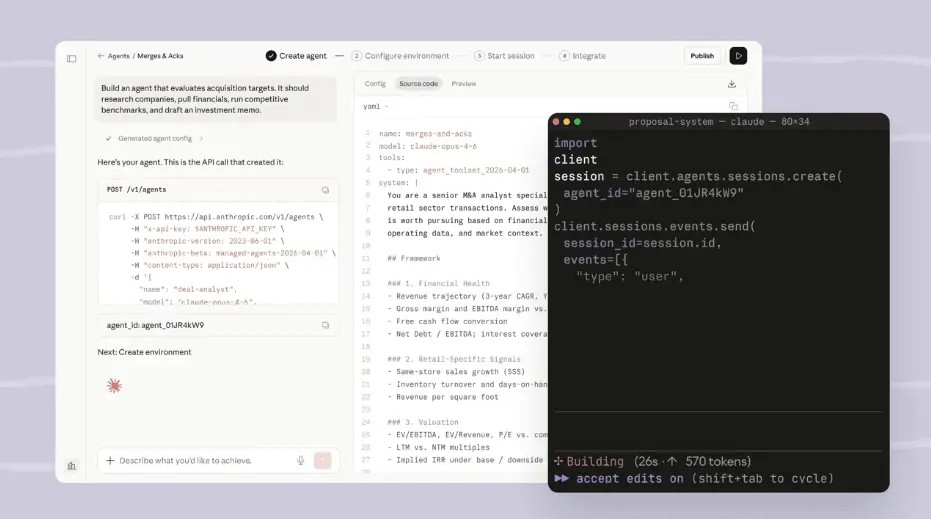
Anthropic announced the launch of Claude Managed Agents, a new platform designed to simplify the process of building AI agents for businesses
1
. The tool addresses a critical barrier that has prevented many organizations from automating complex work tasks: the engineering overhead required to deploy autonomous AI systems at scale2
. By providing production infrastructure out of the box, Anthropic aims to help enterprises move from prototype to launch in days rather than months5
.
Source: SiliconANGLE
The platform arrives as Anthropic's enterprise business experiences explosive growth. The company revealed that its annualized recurring revenue has surpassed $30 billion, roughly three times higher than December 2025 figures
1
. Much of this growth stems from the Claude Platform, which allows developers to access Anthropic's AI models through an API. Both Anthropic and OpenAI are racing to build robust enterprise offerings as they prepare for potential public offerings this year1
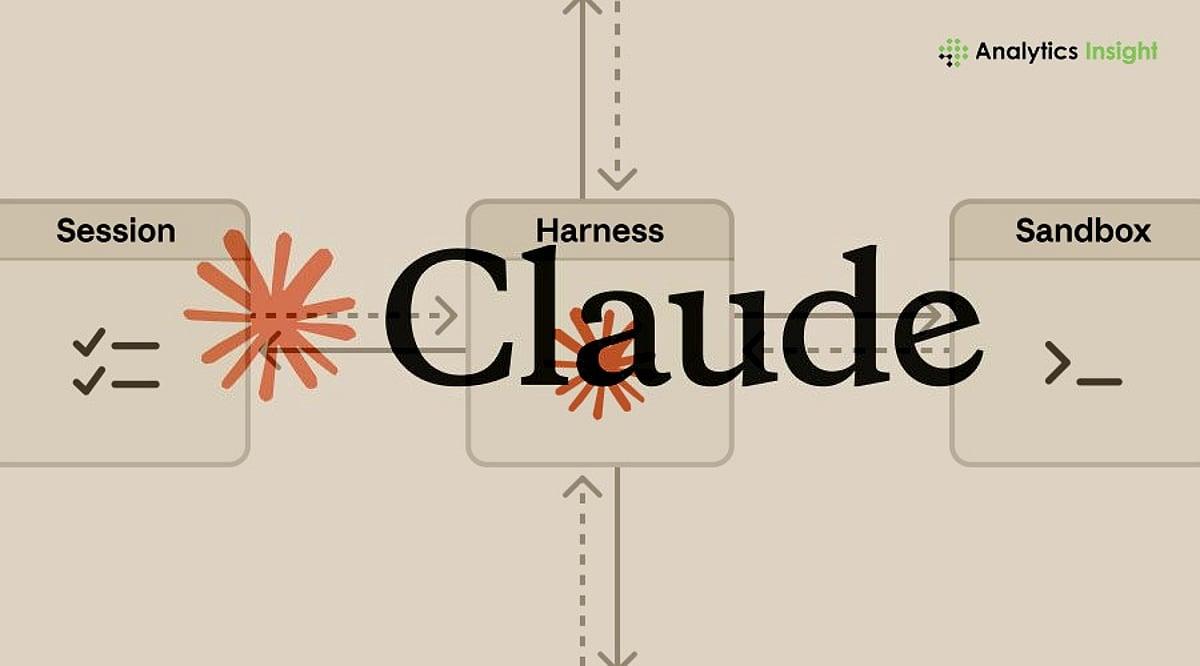
.Claude Managed Agents provides developers with an agent harness—the software infrastructure that wraps around an AI model to enable agentic behavior
1
. This harness includes software tools, memory systems, and a sandboxed environment where agents can spin up software projects securely1
. The platform also enables long-running autonomous sessions in the cloud, multi-agent coordination for parallel task execution, and granular permissions that control which tools agents can access2
.
Source: Analytics Insight
"When it comes to actually deploying and running agents at scale, that is a complex distributed-systems engineering problem," said Katelyn Lesse, head of engineering for the Claude Platform
1
. The platform handles credential management, checkpointing, scoped permissions, and end-to-end tracing—tasks that previously required dedicated engineering teams2
. This allows engineers to focus on core business competencies rather than infrastructure maintenance.The orchestration harness built into Claude Managed Agents automatically decides when to call tools, how to manage context, and how to recover from errors
2
. Early adopters including Notion and Asana have reported 10x improvements in time to ship5
. Notion product manager Eric Liu demonstrated how the platform powers client onboarding features, with managed agents handling tasks like consolidating project assets, creating Slack channels, researching competitor websites, and sending project timeline emails2
.While Claude Managed Agents promises to simplify AI agent deployment, it represents an architectural shift that raises questions about vendor lock-in
4
. By embedding orchestration logic in the AI model layer rather than using external frameworks, enterprises cede more control to Anthropic over their AI operations4
. Session data is stored in databases managed by Anthropic, potentially making it harder for organizations to switch providers or maintain independence4
.

Source: VentureBeat
VentureBeat research from early 2026 shows Anthropic gaining traction in the orchestration space, with adoption of its tool-use and workflows API increasing from 0% to 5.7% between January and February
4
. Microsoft's Copilot Studio/Azure AI Studio led with 38.6% adoption, while OpenAI followed at 25.7%4
. The research indicates that enterprises using Claude tend to adopt Anthropic's native orchestration tooling rather than third-party frameworks.For highly regulated workflows in sectors like finance or customer service, the reduced control over agent execution environments could pose challenges
4
. Organizations must weigh the speed and convenience of cloud-hosted AI automations against the need for independent oversight and the flexibility to switch vendors.Related Stories
Claude Managed Agents uses a hybrid pricing model that combines standard Claude Platform token rates with $0.08 per session-hour for active runtime
2
. This consumption-based approach makes costs dynamic but potentially less predictable4
. For example, a one-hour session processing 10,000 support tickets could cost up to $37, depending on agent runtime and task complexity4
.Alongside the Managed Agents launch, Anthropic announced that Claude Cowork is now generally available for all paid subscribers on macOS and Windows, shedding its "research preview" label
3
. The platform now includes six enterprise-focused features for workflow management. These developments follow Anthropic's introduction of Claude Mythos Preview and Project Glasswing, with the company working with partners including Apple to use Mythos as a cybersecurity tool for discovering software vulnerabilities3
.As Wall Street investors grow wary of traditional software-as-a-service companies potentially being displaced by AI agents, Anthropic's expanding enterprise offerings signal both opportunity and disruption ahead
1
. The platform is now available in public beta, with self-evaluation capabilities in research preview5
.Summarized by
Navi
[2]
[3]
[4]
1
Health

2
Technology

3
Technology