10 Sources
[1]
Despite Its Busted AI, Apple Just Stole Nvidia's Crown as the Most Valuable Company
Apple, the AI laggard, just briefly became a more valuable company than Nvidia, the AI leader. On Friday, Apple's $4.89 market valuation briefly and barely beat Nvidia's $4.85, more than a year after the chipmaker was last dethroned from its leading position in the stock market. Apple has been trailing in the AI space and taking it slow while competitors make huge, reckless leaps. An AI catch-up effort has long been promised, but the AI-enhanced Siri only made its public debut last week, following delays that pushed the timeline off for more than a year. And everyone is waiting to see what the Cupertino giant has to offer at its big September product launch. Meanwhile, Nvidia has enjoyed becoming the poster child of success in the AI hype era. The company became the first to hit a $5 trillion valuation benchmark late last year, inking one multibillion-dollar deal after another to become the primary supplier of the AI buildout. But that position at the center of all this dealmaking may have caused some investors to grow wary of the company. In the last few months, soaring financial commitments from AI hyperscalers like Microsoft, despite limited returns from AI, have alarmed people, with some analysts even painting out doomsday scenarios of this investment turning the tech giants' cash flow negative. If that happens, that would certainly hit Nvidia's profits as well, considering it's the primary hardware supplier for all of them, which is why some experts have begun to fear that Nvidia's revenue growth might be peaking. That growing fear among investors is something company executives, including CEO Jensen Huang, have spent the last couple of months trying to ease. Apple, on the other hand, may have been smart to keep its AI capex within a reasonable range, analysts argue, giving the tech giant enough leeway to continue competing in AI without overshooting. "Apple is less exposed to capex intensity and better positioned to monetize AI via services, ecosystem lock-in, and hardware upgrades," BRI Wealth Management head of investment Toni Meadows told Reuters. On top of that, Apple's iPhone sales have continued to be strong, even when global smartphone shipments have hit record lows due to the memory chip shortage. Some major AI news out of China could have also partially inspired Friday's stock move. On Thursday, Chinese artificial intelligence startup Moonshot debuted its latest model, Kimi K3, a gigantic soon-to-be open-weight model with 2.8 trillion parameters. The announcement sent waves across the American AI industry, particularly for the model's high performance across multiple benchmarks compared to the latest costlier offerings from the frontier American AI companies. The last time a cheaper Chinese model proved serious competition to more expensive frontier American counterparts was with DeepSeek's R1 back in January 2025. Shortly after the model's debut, Nvidia lost its most valuable company position to Microsoft, and didn't regain it until June 2025. When it comes to running open models locally, the Mac mini has seen a lot of demand as a go-to AI machine.
[2]
Apple dethrones Nvidia to regain title of world's most valuable company
Shift in pecking order illustrates that investors are reassessing outlook for artificial intelligence Apple overtook Nvidia on Friday to become the world's most valuable company, reshuffling the top ranks of tech heavyweights as investors reassess the outlook for artificial intelligence. Apple was last valued at $4.88tn as â its shares held steady, while Nvidia â was roughly at $4.86tn, after a 3.5% decline. Nvidia became the first company in the world to surpass a $5tn market valuation in October, a landmark that propelled it into a rarefied territory that was far beyond the reach of its rivals. Being superseded by Apple does not necessarily signal a lasting change in the companies' relative standing. The chipmaker remains a major beneficiary of AI-related spending, and its graphics processors are powering much of the generative AI frenzy. The shift in the pecking order illustrates that investors are broadening their focus beyond the most obvious beneficiaries of the AI boom, such as Nvidia, which had been at the helm for nearly a â year. Apple is reclaiming the top spot for the first time since April last year. "Apple was seen as a laggard in the AI race because it wasn't spending to develop models, but now sentiment has changed," said Toni Meadows, head of â investment at BRI Wealth Management. Last month, the company rolled out a long-delayed overhaul of Siri, betting the upgraded assistant would help close the gap with big tech rivals and new-age startups in the crucial AI race. For a company that was often seen trailing in the AI race, the milestone reflects Apple's efforts to establish itself more firmly among the sector's leading players, and could shape how CEO Tim Cook's final months at the helm are viewed. Cook is preparing to cede his role to hardware veteran John Ternus in September. Nvidia could reclaim the top spot if sentiment shifts. Apple is in a delicate position, having raised prices to offset rising costs - a strategy that could hurt demand. "I don't see any meaningful distinction. Nvidia likely to be a significant â participant in whatever happens going forward," said Benjamin Hall, vice-president, alpha research at Segal Marco Advisors. However, the AI enthusiasm has spread to other corners of the semiconductor industry. The bigger winners this year have been memory chipmakers such as Micron, which crossed $1tn in market value in May as investors embraced the significance of memory chips in AI infrastructure. South Korea's SK Hynix also listed on the Nasdaq earlier this month, adding another player to the race for investor attention. "The new entrants to the market could spread out the focus away from the pure Magnificent Seven names into a wider number of names," Hall said. The eye-watering chips rally ran into turbulence in July as investors reassessed the sustainability of the artificial intelligence trade, knocking the Philadelphia SE Semiconductor index down almost 19% from its all-time highs. Despite the steep fall, the index has performed better than Nvidia so far this year.
[3]
Apple Closes in on Nvidia in Race for World's Most Valuable Company
By Niket Nishant and Shashwat Chauhan July 17 (Reuters) - Apple is within striking distance of overtaking â Nvidia â as the world's most valuable company, a milestone â that would reshuffle the ranks of tech heavyweights as investors reassess the outlook for AI. Apple was last valued at $4.90 trillion as its shares rose marginally in premarket trading on Friday, while Nvidia was roughly at the same level, following a 2.4% decline. If Apple overtakes Nvidia, it would reclaim the top spot for the first time since April last year. The close race shows that investors are broadening their focus beyond the obvious beneficiaries of the AI boom, such as Nvidia, which has been at â the helm for nearly â a year. "Apple was seen as a laggard in the AI race because it wasn't spending to develop models, but now sentiment has changed," said Toni Meadows, head of investment at BRI Wealth Management. "Apple is less exposed to capex intensity and better positioned to monetize AI via services, ecosystem lock-in, and hardware upgrades. The re-rating reflects confidence in earnings durability rather than speculative AI upside." For a company that was often seen trailing in the AI race, the narrowing gap with Nvidia reflects Apple's efforts to establish itself more firmly among the sector's leading players, and could shape how CEO Tim Cook's final â months at â the helm are viewed. Cook is preparing â to cede his role to hardware veteran John Ternus in September. Last month, the company rolled out a long-delayed overhaul of Siri, betting the upgraded assistant would help close the gap with Big Tech rivals and new-age â startups in the crucial AI race. Some analysts say Apple is sitting on an AI gold mine in the form of the personal data that lives on every iPhone. The data could make Siri's answers more useful and the assistant more capable. The challenge is that such data is locked away in operating systems in the name of privacy and the company would have to find a way to unlock its value. AI SPENDING LIFTS NEW WINNERS Nvidia became the first company in the world to surpass a $5 trillion â market valuation in October, a landmark that propelled it into a rarefied territory that was far beyond the reach of its â rivals. Even if Nvidia is superseded by Apple, it would not necessarily signal a lasting change in the companies' relative standing. The chipmaker remains a major beneficiary of AI-related spending, and its graphics processors are powering much of the generative AI frenzy. Nvidia could also reclaim the top spot if sentiment shifts. Besides, Apple is in a delicate position itself, having raised prices to offset rising costs -- a strategy that could hurt demand. "I don't see any meaningful distinction should Nvidia lose its crown. It's likely to be a significant participant in whatever happens going forward," said Benjamin Hall, vice president, alpha research at Segal Marco Advisors. However, the AI enthusiasm has spread to other corners of the semiconductor industry. The bigger winners this year have been memory chipmakers such as Micron, which crossed $1 trillion in market value in May as investors embraced the significance of memory chips in â AI infrastructure. South Korea's SK Hynix also listed on the Nasdaq earlier this month, adding another player to the race for investor attention. "The new entrants to the market could spread out the focus away from the pure Magnificent Seven names into a wider number of names," Hall said. The eye-watering chips rally ran into turbulence in July as investors reassessed the sustainability of the artificial intelligence trade, knocking the Philadelphia SE Semiconductor index down almost 19% from its all-time highs. Despite the steep fall, the index has performed better than Nvidia so far this year. (Reporting by Niket Nishant and Shashwat Chauhan in Bengaluru; Editing by Shinjini Ganguli)
[4]
Apple and Nvidia tango at the top
Amidst a fierce battle for market supremacy, Apple and Nvidia are vying for the top spot, each showcasing unique strengths. Apple remains anchored in consumer services and hardware, while Nvidia thrives in the generative AI space. Investors are shifting their focus beyond mere speculations on AI's future, recognizing the solid foundations both companies have established, indicating that this rivalry is far from over. Last week, Apple briefly reclaimed the title of the world's most valuable company, touching about $4.9 tn in market value against Nvidia's roughly $4.8 tn. The chipmaker edged back ahead. But the two are now locked in a neck-to-neck battle for top-dog slot. Beyond the numbers, this signals investors looking beyond AI's speculative upside. Apple has deliberately stayed away from the AI infrastructure race, choosing to focus on consumer services rather than building AI models. This made it a laggard in m-cap sweepstakes as AI mania gripped investors. Nvidia was the obvious beneficiary. But the rally has hoisted other chipmakers like Micron and SK Hynix as well. But both consumer-focused Apple and chipmaker Nvidia stand to gain no matter the outcome. Consumer electronics is caught on the wrong side of the chip wars. Apple recently increased prices of its MacBooks and iPads due to soaring AI demand for memory and storage chips. But its lower capex intensity allows it to monetise AI easier. It recently overhauled Siri to catch up with leaders in the AI race. A combo of AI services, a closed ecosystem and hardware upgrades places Apple at an advantage to cash in. Nvidia, on its part, is coming down from a market valuation of over $5 tn because of a shift in sentiment. The company's GPUs will keep powering generative AI. Over the years, Nvidia has built an ecosystem to lock developers into its platform. It focuses on research, design and software while outsourcing its chips to contract manufacturers. Much like Apple's strategy in consumer electronics. The two companies have created unique business models in their respective industries to build wide moats around their near-monopolies. Expect them to continue duking it out for top slot.
[5]
Sentiment Around Apple's Position In AI Has Changed, Says Analyst, With Company "Less Exposed To Capex Intensity," Than Its Rivals, Giving It A Monetization Edge
Google, Microsoft, Meta, OpenAI, and others had aggressively invested in infrastructure that was deemed necessary to carry the wave of artificial intelligence. During the same period, Apple was believed to have taken a backseat, with its stance met with incessant criticism by analysts and investors, who stated time and time again that Apple was falling far behind in the race. Now, one analyst believes that sentiment has changed because, unlike its competitors, the company has not only reduced capex intensity risk but also made its position invaluable for opening another revenue stream through its robust Services division. This advantage, in turn, should allow for increased hardware upgrades, making it quite a unique turn of events for Apple because demand for PCs and smartphones has waned due to the RAM shortage. Unwillingness to invest in developing better AI models has rewarded Apple, but the ongoing memory crisis can adversely affect progress The latest statistics revealed that Apple had surpassed NVIDIA as the most valuable company on the planet, with its market capitalization at $4.88 trillion, while NVIDIA held second place at $4.86 trillion. While the AI boom has rewarded a multitude of companies while introducing uncertainties in the industry, Apple would be the last company to obtain any benefit, seeing as how it has barely made any progress in this space. The iPhone maker only recently introduced Siri AI, a revamped version of Apple Intelligence and a step towards righting its wrongs after it misled consumers into believing that upgrading to the latest iPhones would grant them exclusive generative AI features. Toni Meadows, head of investment at BRI Wealth Management, informed Reuters that the sentiment around Apple's position has changed. Instead of being viewed as an entity that's at a severe disadvantage because it's not spending top dollar in developing newer AI models, Meadows states that Apple won't be under the same pressure as other hyperscaler firms that continuously need to inject billions and billions of dollars in investments to keep up in the AI race. As a result, Apple can bundle AI into its Services sector, which can further lead to increased upgrade cycles. "Apple was seen as a laggard in the AI race because it wasn't spending to develop models, but now sentiment has changed. Apple is less exposed to capex intensity and better positioned to monetize AI via services, ecosystem lock-in, and hardware upgrades. The re-rating reflects confidence in earnings durability rather than speculative AI upside." Other analysts have argued that Apple possesses personal data that can be transformed into a massive financial opportunity once it allows Siri to access that information. Though it's likely that the Cupertino firm will keep its hands off this decision in the name of privacy. As a result, Apple will bank on Services and hardware upgrades to perform the heavy lifting, but its iPhone 18 Pro and iPhone 18 Pro Max face lower shipments due to the ongoing shortage. However, if you noticed, Apple isn't expected to announce the base iPhone 18 later this year, and according to Citi, demand for the expensive models is more resilient, even during this crisis, meaning that Apple doesn't necessarily need to leverage AI to extensively contribute to its revenue and market capitalization. Follow Wccftech on Google to get more of our news coverage in your feeds.
[6]
Apple unseats Nvidia to become world's most valuable company as AI bets shift
In a remarkable turn of events, Apple has dethroned Nvidia to reclaim its status as the world's most valuable company. This change underscores a significant recalibration of investor perspectives regarding the artificial intelligence landscape, highlighting a shift in focus. With Apple's market value hitting $4.88 trillion compared to Nvidia's $4.86 trillion, this milestone marks a pivotal moment reflecting a wider investor interest beyond solely AI sectors. Apple overtook Nvidia on Friday to become the world's most valuable company, reshuffling the top ranks of tech heavyweights as investors reassess the outlook for artificial intelligence. Apple was last valued at $4.88 trillion as its shares held steady, while Nvidia was roughly at $4.86 trillion, following a 3.5% decline. US MarketsPowered By As on 17 Jul 2026, 08:05 PM IST S&P 500 Top Gainers Travelers Companies365.11(8.08%) LyondellBasell Industries59.96(3.73%) Dow30.36(3.60%) Allstate249.96(3.35%) Gainers" S&P 500 Top Losers Synopsys366.73(-12.06%) Cadence Design Systems321.10(-11.94%) Intuitive Surgical357.00(-11.27%) Coterra Energy32.56(-8.62%) Losers" The shift in the pecking order illustrates that investors are broadening their focus beyond the most obvious beneficiaries of the AI boom, such as Nvidia, which had been at the helm for nearly a year. Apple is reclaiming the top spot for the first time since April last year. "Apple was seen as a laggard â in â the AI race because it wasn't spending to develop models, but now sentiment has changed," said Toni Meadows, head of investment at BRI Wealth Management. "Apple is less exposed to capex intensity and better positioned to monetize AI via services, ecosystem lock-in, and hardware upgrades. The re-rating reflects confidence in earnings durability rather than speculative AI upside." For a company that was often seen trailing in the AI race, the milestone reflects Apple's efforts to establish itself more firmly among the sector's leading players, and could shape how CEO Tim Cook's final months at the helm are viewed. Cook is preparing to cede his role to hardware veteran John Ternus in September. Last month, the company rolled out a â long-delayed overhaul of Siri, betting the upgraded assistant would help close the gap with Big Tech rivals and new-age startups in the crucial AI race. Some analysts say Apple is sitting on an AI gold mine in the form of the personal data â that lives on every iPhone. The data could make Siri's answers more useful and the assistant more capable. The challenge is that such data is locked away in operating systems in the name of privacy and the company would have to find a way to unlock its value. AI SPENDING LIFTS NEW WINNERS Nvidia became the first company in the world to surpass a $5 trillion market valuation in October, a landmark that propelled it into a rarefied territory that was far beyond the reach of its rivals. Being superseded by Apple does not necessarily signal a lasting change in the companies' relative standing. The chipmaker remains a major beneficiary of AI-related spending, and its graphics processors are powering much of the generative AI frenzy. Nvidia could also reclaim the top spot if sentiment shifts. Besides, Apple is in a delicate position itself, having raised prices to offset rising costs -- a strategy that could hurt demand. "I don't see any meaningful distinction. Nvidia likely to be a significant participant in whatever happens going forward," said Benjamin Hall, â vice president, alpha research at Segal Marco Advisors. However, the AI enthusiasm has spread to other corners of the semiconductor industry. The bigger winners this year have been memory chipmakers such as Micron, which crossed $1 trillion in market value in May as investors embraced the significance of memory chips in AI infrastructure. South Korea's SK Hynix also listed on the Nasdaq earlier this month, adding another player to the race for investor attention. "The new entrants to the market could spread out the focus away from the pure Magnificent Seven names into a wider number of names," Hall said. The eye-watering chips rally ran into turbulence in July as investors reassessed the sustainability of the artificial intelligence trade, knocking the Philadelphia SE Semiconductor index down almost 19% from its all-time highs. Despite the steep fall, the index has performed better than Nvidia so far this year.
[7]
The tech crown switches hands: Apple dethrones Nvidia as $4 trillion king By Investing.com
Apple briefly reclaimed the title of the world's most valuable company, unseating AI darling Nvidia in a major market shakeup this Friday. As investors begin to look beyond the pure hardware plays of the artificial intelligence boom, Apple's valuation hit a staggering $4.88 trillion. Meanwhile, a 3.5% slide in Nvidia's stock dragged the chipmaker down to $4.86 trillion, ending its nearly year-long reign at the top. Nvidia later bounced off lows, closing the gap. This marks the first time Apple has worn the market-cap crown since April 2025. For months, Apple was dismissed by some as a slow-mover in the generative AI race, seemingly reluctant to spend heavily on developing foundational models. Now, Wall Street is changing its tune. Instead of getting bogged down in capital-intensive model building, Apple is increasingly viewed as uniquely positioned to monetize AI through its massive services arm, ecosystem lock-in, and hardware upgrade cycles. For investors, this market-cap shift reflects rock-solid confidence in Apple's earnings durability rather than speculative AI upside. Apple's resurgence coincides with massive internal shifts and a broadening market rally: * The Changing of the Guard: The timing is poetic. CEO Tim Cook is preparing to step down in September, handing control to hardware veteran John Ternus. * Siri Gets Smart: Apple is finally closing the AI gap. Last month's long-awaited Siri overhaul was a direct shot at tech rivals and new-age startups, proving Apple is ready to compete. * Pricing Power: While Apple has raised prices to offset rising costs -- a move that could test consumer demand -- investors remain bullish on its brand loyalty. Nvidia isn't going anywhere. The company that broke the historic $5 trillion ceiling in October 2025 remains the undisputed engine of the generative AI sector. However, the wider semiconductor market is starting to share the spotlight. Memory powerhouse Micron crossed the $1 trillion mark in May, and South Korea's SK Hynix made a splashy Nasdaq debut earlier this month. Even with the Philadelphia SE Semiconductor index dipping nearly 19% from its July peak, it continues to outperform Nvidia's stock year-to-date. The AI gold rush is maturing. Investors are no longer just looking at who is building the picks and shovels, but who is best positioned to sell the services built on top of them.
[8]
Apple vs. Nvidia: the turtle's return to the AI race
It's hard not to think of Jean de La Fontaine's moral as Apple briefly retakes the top spot among the world's biggest market caps. Over the past two years, the iPhone maker has had a rocky ride. First lifted by huge expectations around Apple Intelligence, the company then took fire after what many saw as a disappointing rollout of its AI features, fueling the narrative of a missed turn. Yet Apple has managed to reverse the trend thanks to the commercial success of the iPhone 17 and a new generation of more affordable Macs that has been well received. In just a few months, the group has moved from AI laggard to a company once again able to deliver strong commercial momentum. More striking than the rebound itself is the shift in how investors view the stock. While Microsoft, Meta, Alphabet and Amazon ramp up massive spending on AI infrastructure and models, Apple is now seen as a tech-sector "safe haven." That perception is reinforced by a deliberate strategic choice: instead of building its own generative AI model for the iPhone, the group is expected to rely on Google's Gemini. The approach lets Apple benefit from AI advances without bearing the same level of spending as its rivals. At the same time, questions are mounting over valuations across the AI heavyweights. Investors are weighing the risk of a speculative bubble and the prospect of a slowdown in the semiconductor investment cycle that has broadly supported markets in recent years. In that context, Apple looks like a more defensive alternative within the mega-cap tech universe. If Nvidia remains the emblem of the AI revolution today, Apple's climb is a reminder that on Wall Street, the top spot depends not only on technological firepower, but also on the ability to keep investors convinced over time.
[9]
Apple is an AI winner without heavy capital spending, says expert
STORY: Apple overtook Nvidia on Friday to become the world's most valuable company, reshuffling the top ranks of tech heavyweights as investors reassess the outlook for artificial intelligence. Apple was last valued at $4.88 trillion as its shares held steady, while Nvidia was roughly at $4.86 trillion, following a 3.5% decline. "The apple reclamation of the largest market cap in the equity market is really a sign of the fact that investors are concerned with this level of CapEx that's being used to underwrite the AI explosion and are looking for stocks that are not spending capital investments," says Lynch. The shift in the pecking order illustrates that investors are broadening their focus beyond the most obvious beneficiaries of the AI boom, such as Nvidia, which had been at the helm for nearly a year. "Why is it working now for Apple? In fairness, they finally have a credible AI plan at their worldwide developer conference recently, they ruled out a new series, AI. It's going to integrate across all these different apps."
[10]
Apple tops Nvidia as world's most valuable company as AI bets shift
STORY: Apple overtook Nvidia on Friday to become the world's most valuable company, reshuffling the top ranks of tech giants as investors reassess the outlook for AI. The shift in the pecking order illustrates how investors are looking beyond the most obvious beneficiaries of the AI boom, such as Nvidia. Apple is reclaiming the top spot for the first time since April of last year. :: Nvidia :: $4.88 trillion ::$4.86 trillion. The iPhone maker's market cap on Friday hit $4.88 trillion, edging out Nvidia at $4.86 trillion. :: Apple For Apple, a company often seen trailing in the AI race, the milestone reflects the company's efforts to establish itself more firmly as a leading AI player. Apple last month rolled out a long-delayed overhaul of Siri, betting it would help close the gap ?with Big Tech rivals and newer startups. Some analysts say Apple is also sitting on an AI gold mine with the personal data that lives on every iPhone. :: Apple The challenge is that such data is locked away in operating systems in the name of privacy and the company would have to find a way to unlock its value. :: Nvidia For Nvidia, being superseded by Apple does not necessarily signal a lasting change in the company's standing. The chipmaker remains a major beneficiary of AI-related spending, and its graphics processors are powering much of the generative AI frenzy. :: Nvidia Last fall, Nvidia became the first company in the world to surpass a $5 trillion market valuation, propelling it into a rarefied territory that was far beyond the reach of its rivals. Nvidia could also reclaim the top spot ... amid shifting AI sentiment.
Share
Copy Link
Apple briefly surpassed Nvidia on Friday with a market valuation of $4.88 trillion versus Nvidia's $4.86 trillion, reclaiming the top spot for the first time since April last year. The shift signals changing investor sentiment as Apple's lower capital expenditure approach to artificial intelligence gains favor over Nvidia's infrastructure-heavy model, despite the chipmaker's dominance in generative AI hardware.
Apple overtook Nvidia on Friday to become the world's most valuable company, marking a significant reshuffling in tech valuations as investor sentiment shifts around artificial intelligence strategies. Apple reached a market valuation of $4.88 trillion while its shares held steady, narrowly surpassing Nvidia's $4.86 trillion after the chipmaker experienced a 3.5% decline
2
. This marks the first time Apple has reclaimed the top spot since April last year, ending Nvidia's nearly year-long reign at the helm3
.
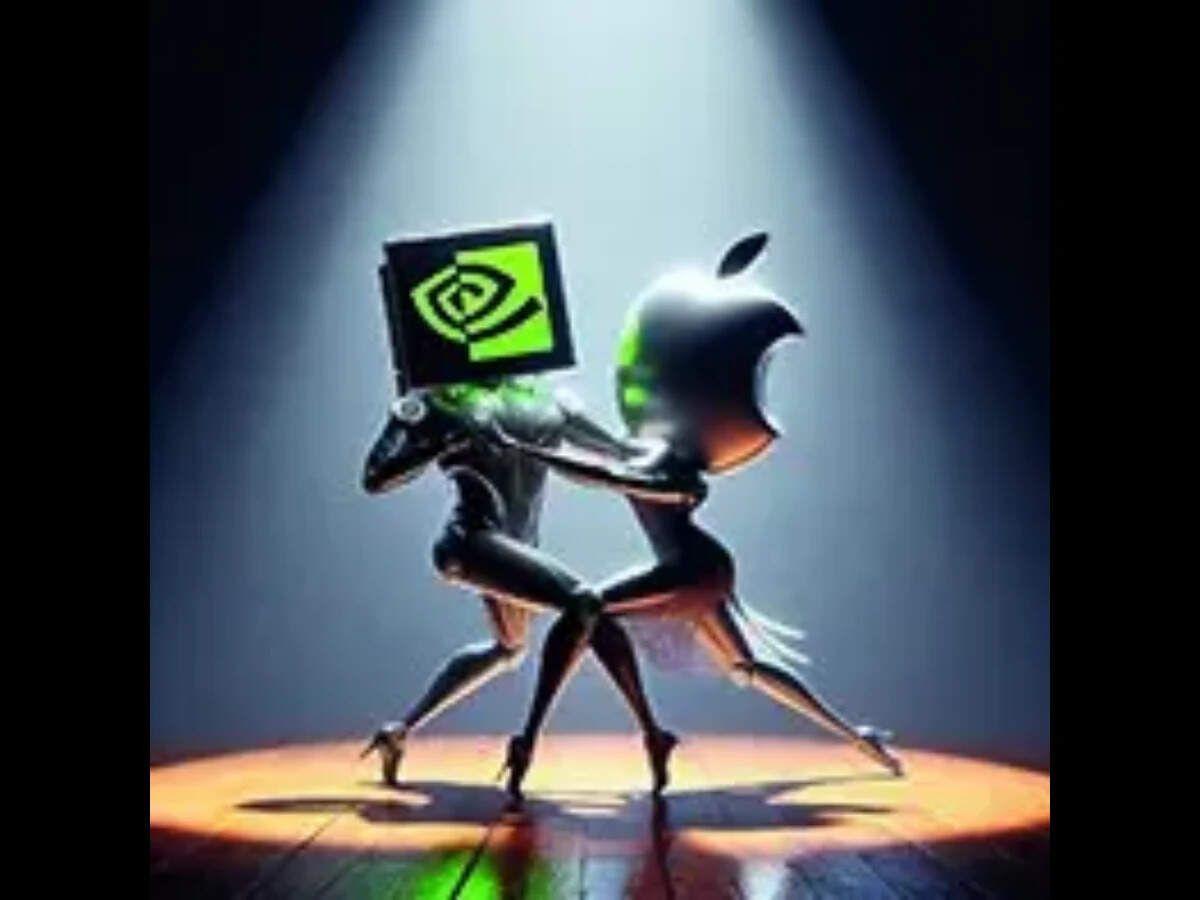
Source: ET
The market capitalization battle between these tech giants illustrates how investors are broadening their focus beyond the most obvious beneficiaries of the AI boom. Nvidia became the first company in the world to surpass a $5 trillion market valuation in October, propelling it into rarefied territory far beyond its rivals
2
. However, the shift in the pecking order demonstrates that investor sentiment is evolving as concerns mount about soaring capital expenditure commitments from AI hyperscalers like Microsoft, despite limited returns from artificial intelligence initiatives1
.Apple was long viewed as a laggard in the AI race, taking a measured approach while competitors made aggressive investments in AI infrastructure. "Apple was seen as a laggard in the AI race because it wasn't spending to develop models, but now sentiment has changed," said Toni Meadows, head of investment at BRI Wealth Management
2
. The company's AI-enhanced Siri only made its public debut last week following delays that pushed the timeline off for more than a year1
.

Source: Wccftech
Last month, Apple rolled out a long-delayed Siri overhaul, betting the upgraded assistant would help close the gap with Big Tech rivals and new-age startups in the crucial AI race
3
. This milestone could shape how CEO Tim Cook's final months at the helm are viewed, as Cook is preparing to cede his role to hardware veteran John Ternus in September2
.Apple's strategic restraint on capital expenditure has emerged as a competitive advantage rather than a weakness. "Apple is less exposed to capex intensity and better positioned to monetize AI via services, ecosystem lock-in, and hardware upgrades. The re-rating reflects confidence in earnings durability rather than speculative AI upside," Meadows explained
3
. This approach through ecosystem monetization and the Services division gives Apple multiple revenue streams without the pressure of continuous multibillion-dollar infrastructure investments5
.
Source: Gizmodo
Meanwhile, Nvidia remains a major beneficiary of AI-related spending, with its GPUs powering much of the generative AI frenzy. The chipmaker's graphics processors continue to be essential for AI infrastructure, and it has built an ecosystem to lock developers into its platform
4
. However, growing fears among investors that Nvidia's revenue growth might be peaking have contributed to the recent shift in tech valuations1
.Related Stories
The AI enthusiasm has spread to other corners of the semiconductor sector, creating new winners beyond the traditional leaders. Memory chipmakers such as Micron crossed $1 trillion in market value in May as investors embraced the significance of memory chips in AI infrastructure
3
. South Korea's SK Hynix also listed on the Nasdaq earlier this month, adding another player to the race for investor attention2
.Benjamin Hall, vice president of alpha research at Segal Marco Advisors, noted that "the new entrants to the market could spread out the focus away from the pure Magnificent Seven names into a wider number of names"
3
. The Philadelphia SE Semiconductor index fell almost 19% from its all-time highs in July as investors reassessed the sustainability of the artificial intelligence trade, though it has still performed better than Nvidia so far this year2
.External factors have also influenced recent market movements. Chinese artificial intelligence startup Moonshot debuted its latest model, Kimi K3, a gigantic soon-to-be open-weight model with 2.8 trillion parameters on Thursday
1
. The announcement sent waves across the American AI industry for the model's high performance across multiple benchmarks compared to costlier offerings from frontier American AI companies, potentially contributing to Friday's stock movements.Being superseded by Apple does not necessarily signal a lasting change in the companies' relative standing. Nvidia could reclaim the top spot if sentiment shifts, and Apple faces its own challenges, having raised prices to offset rising costsâa strategy that could hurt demand
2
. Some analysts argue that Apple is sitting on an AI gold mine in the form of personal data that lives on every iPhone, though unlocking this value while maintaining privacy commitments remains a challenge3
. Both companies have created unique business models to build wide moats around their near-monopolies in consumer hardware and AI infrastructure respectively4
.Summarized by
Navi
26 Oct 2024â¢Technology

05 Nov 2024â¢Business and Economy

10 Oct 2024â¢Business and Economy

1
Technology

2
Science and Research

3
Technology



