2 Sources
[1]
NVIDIA Alpamayo 2 Super, the Frontier Open Model for Robotaxis and Autonomous Vehicles, Now Available for Commercial Use
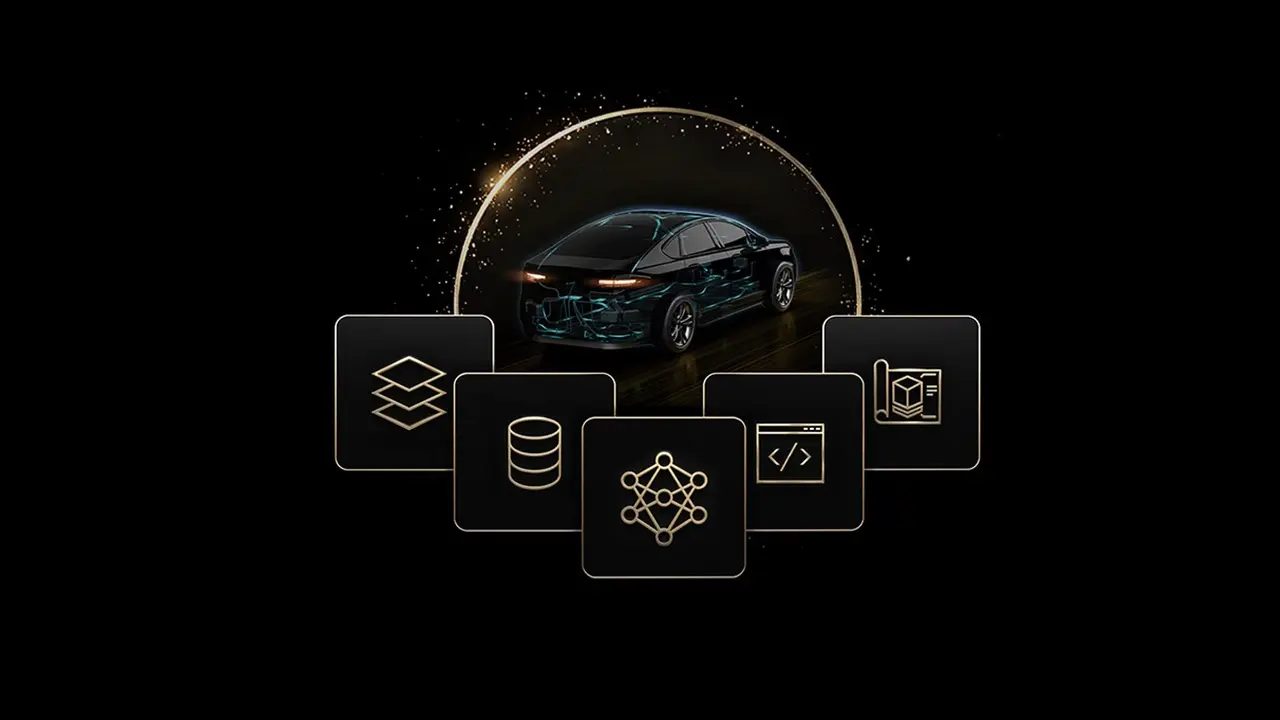
Open commercial licensing, benchmark‑leading reasoning and inspectable decisions bring autonomous vehicles, including robotaxis, closer to production and widescale deployment. For robotaxis and other autonomous vehicles (AVs), the hardest problems aren't the everyday scenarios. They're the rare, complex situations that are difficult to anticipate and train for. Handling these long‑tail events takes more than just object detection and motion prediction. AVs must understand the situation, reason about cause and effect, choose the right action and turn that decision into a safe, comfortable path -- all in real time and in a way developers can inspect, validate and trust. NVIDIA Alpamayo 2 Super, available now for commercial use, is part of the Alpamayo family, the most-adopted open reasoning models for autonomous driving on Hugging Face, supporting a wide range of AV-relevant capabilities within a single foundation model. Built on NVIDIA Cosmos 3 Super Reasoner and post‑trained with reinforcement learning, the model advances the AV ecosystem on two fronts: open commercial licensing and leading multitask capabilities for autonomous driving. Alpamayo 2 Super is part of NVIDIA's growing collection of open models, datasets and tools for autonomous driving, expanding access, strengthening competition, giving developers greater control and supporting safer, more transparent AV deployment. Open Licensing for Production AVs Alpamayo 2 Super is available on Hugging Face under OpenMDW‑1.1, the Linux Foundation's permissive license for open AI model distributions. The license covers fine‑tuning, derivative models and commercial redistribution, allowing AV developers, automakers, truckmakers and suppliers to adapt Alpamayo to their own data, driving policies and deployment strategies. This openness lets AV researchers and companies keep control of their own data and infrastructure, as well as own the value they create through specialized models and accumulated know‑how. Such control is essential for workflows involving proprietary fleets and safety. Earlier Alpamayo releases were initially introduced for R&D. The OpenMDW license is now being applied across the entire Alpamayo model family so developers can deploy any of the models commercially without requiring additional permissions. This creates a direct path from adaptation to deployment. Open weights make that path economically viable. Teams can build on advanced reasoning without re‑training every foundation capability from scratch or paying frontier‑model costs for every task, matching the right model to the right job at the right cost. Alpamayo 2 Super enables frontier-scale reasoning in cloud-based development workflows, where developers can generate high-quality reasoning traces, synthetic training data and teacher outputs for model distillation. Within the Alpamayo model family, Alpamayo 2 Super delivers the highest reasoning and driving performance for multimodal autonomous driving development, while Alpamayo 1.5 and Alpamayo 1 provide more cost-efficient options for cloud-based development and model distillation. The resulting distilled models can then be optimized for efficient, real-time inference in production vehicles. Together, the Alpamayo model family provides a cloud-to-car workflow that combines frontier-scale reasoning with scalable deployment across commercial AV fleets. For AV programs, that means frontier‑scale reasoning in the cloud and efficient, specialized models in the vehicle -- a more sustainable way to scale safe autonomy into commercial fleets. Benchmark-Leading Reasoning at Frontier Scale Alpamayo 2 Super ranks first on LingoQA, an autonomous driving reasoning benchmark, among nearly 40 models evaluated. In NVIDIA testing using the Lingo‑Judge metric, it outperformed Qwen2.5‑VL 72B by 17.0 points, Gemini 2.5 Pro by 15.1 points and GPT‑4o by 23.2 points, demonstrating state‑of‑the‑art reasoning for driving‑centric scenarios. Alpamayo 2 Super also ranks first across all autonomous driving benchmarks evaluated by NVIDIA, underscoring its leading performance across a broad range of AV capabilities. Alpamayo 2 Super offers 3x the scale of the 10‑billion‑parameter NVIDIA Alpamayo 1.5 and Alpamayo 1 models. The added capacity helps the model better generalize reasoning from sparse examples -- a critical capability for the rare, multi‑agent interactions where conventional systems often struggle. The model reasons over full‑surround camera coverage, fusing views from the vehicle's front, sides and rear. This 360‑degree context enables richer understanding of lane changes, merges, unprotected turns and complex intersections, where risks commonly arise. A Multitask Foundation Model for Robotaxis and Autonomous Driving For each driving situation, Alpamayo 2 Super can produce five tightly coupled outputs: * A trajectory describing the vehicle's planned path. * A chain‑of‑causation (CoC) trace that explains the reasoning behind the decision. * A meta‑action (e.g., yield, lane changes, stops) that captures the model's intent. * Reasoning auto-labels that generate CoC annotations for training and validation data. * Visual question answering responses with 2D visual grounding that link the model's answers to specific regions in camera images. Together, these outputs offer insight into the model's decision-making process. Developers can tie what the model observed to the action it selected, making decisions easier to understand, critique and validate. CoC traces integrate with NVIDIA Halos safety‑validation workflows and support AI safety aligned with ISO/PAS 8800 requirements, providing a stronger foundation for AV safety engineering. Alpamayo 2 Super can also be deployed as an autolabeler to generate CoC labels and perform visual question answering with 2D grounding on proprietary fleet data. By linking its reasoning to specific regions in camera images, the model can transform raw driving clips into richer training data, compressing annotation cycles from months to days. Beyond planning and auto-labeling, Alpamayo 2 Super supports scene understanding, model critiquing and knowledge distillation. These multitask capabilities enable developers to use a single foundation model across more of the development stack, simplifying tooling and accelerating iteration. An Open Ecosystem for Reasoning‑Based AVs Alpamayo 2 Super is part of a broader family of open models, frameworks and datasets for AV development. Other tools in the family include: * NVIDIA AlpaSim, which provides closed‑loop simulation. * NVIDIA AlpaGym, which enables high‑throughput reinforcement learning. * NVIDIA Physical AI Open Datasets, which supply data for training and testing. * Open training recipes and an autolabeling pipeline to accelerate model development, training and validation. Alpamayo has already surpassed 500,000 downloads on Hugging Face, reinforcing its position as the most-adopted open reasoning model family for autonomous driving on the platform. Download NVIDIA Alpamayo 2 Super on Hugging Face to explore the model, evaluate its reasoning capabilities and start building the next generation of robotaxis and autonomous vehicles.
[2]
Nvidia opens up Alpamayo 2, a driving model that reasons out loud
The open model for robotaxis does not just plan a route; it explains the decision behind it, and it is now cleared for commercial use. Nvidia wants self-driving cars to explain themselves. The company has released Alpamayo 2 Super, an open AI model for robotaxis that does not just plan a route but reasons about why, and it is now available for commercial use. The model is Nvidia's pitch for a more interpretable kind of autonomy. Rather than a black box that spits out a steering angle, Alpamayo produces a chain of reasoning, a trajectory, and a plain-language account of the decision behind it. Under the hood it is a vision-language-action model of about 34 billion parameters, built on Nvidia's open world models, the Cosmos family it has been pushing as a foundation for robotics and physical AI. It pairs a large reasoner with a smaller action expert that turns thought into a driving path. The model takes in video from up to seven cameras for a full 360-degree view, and it is aimed squarely at Level 4 driving, the tier where a car handles everything within a defined area without anyone at the wheel. The headline feature is what Nvidia calls a chain of causation. The model can show the reasoning behind a decision, whether to yield, change lane, or stop, which matters enormously in a domain where regulators and courts will want to know why a car did what it did. The bet behind it is that reasoning fixes autonomy's trust problem. A car that can justify a swerve is easier to certify, audit, and defend than one that simply acts, which is as much a regulatory strategy as a technical one. It is genuinely open, at least by the industry's standards. The weights sit on Hugging Face under a permissive Linux Foundation licence, the inference code is on GitHub, and the auto-labelling pipeline has been open-sourced too. The full model is not meant to ride in the car. Alpamayo 2 Super is a teacher, designed to be distilled into smaller versions that run on Nvidia's in-vehicle DRIVE chips, which is where the business quietly reasserts itself. That is the tell. Nvidia gives the model away and sells the silicon, the Thor and Hyperion hardware the distilled versions are tuned to run on, a familiar move for a company that would rather own the platform than any single app. The approach has found an audience. Nvidia says the Alpamayo models have been downloaded around 400,000 times since the family launched in January, and its self-driving stack already sits behind efforts like Uber's robotaxi push in Munich. Nvidia has been at this a long time. Its cars have learned to drive by watching humans for years, and Alpamayo is the reasoning-first evolution of that work, arriving just as robotaxis move from pilots to paying services. 'Alpamayo is the moment cars begin to safely reason, not just drive,' said Nvidia chief executive Jensen Huang, framing the release as a step-change rather than an increment. The claims deserve some caution. Benchmarks are not roads, rivals are circling, and Nvidia has already been beaten on at least one robotics benchmark, a reminder that owning the tools is not the same as winning the race. There is a hardware catch, too. The full model is memory-hungry, needing tens of gigabytes of GPU memory to run, which keeps the frontier version firmly in the hands of well-resourced developers rather than hobbyists. The openness is not entirely selfless, either. An industry that standardises on Nvidia's model, tools, and data tends to standardise on its chips, which is the outcome the free download is really designed to produce. Open models are becoming the norm at the driving frontier. Sharing weights and data lets a whole industry improve the same base rather than each firm starting from scratch, and Nvidia would rather set that base than watch a rival do it. Still, an open, reasoning-capable driving model is a notable thing to hand the industry. If autonomous cars are ever to be trusted, being able to ask them why may come to matter as much as how well they drive.
Share
Copy Link
NVIDIA has released Alpamayo 2 Super, an open AI model designed for robotaxis and autonomous vehicles that not only plans routes but explains the reasoning behind every decision. Now available for commercial use under a permissive license, the 34-billion-parameter model ranks first on autonomous driving reasoning benchmarks and processes 360-degree camera views to handle complex driving scenarios.
NVIDIA has launched Alpamayo 2 Super for commercial use, marking a shift in how autonomous vehicles handle complex driving scenarios
1
. The open AI model addresses a core challenge in robotaxis and autonomous vehicles: rare, unpredictable situations that conventional systems struggle to navigate. Built on NVIDIA Cosmos 3 Super Reasoner and enhanced through reinforcement learning, Alpamayo 2 Super ranks first on LingoQA, an autonomous driving reasoning benchmark, outperforming Gemini 2.5 Pro by 15.1 points and GPT-4o by 23.2 points1
. The model is now available on Hugging Face under the OpenMDW-1.1 license, a permissive framework from the Linux Foundation that covers fine-tuning, derivative models, and commercial redistribution1
.
Source: NVIDIA
Alpamayo 2 Super operates as a vision-language-action system with approximately 34 billion parameters, processing multimodal inputs from up to seven cameras for full 360-degree coverage
2
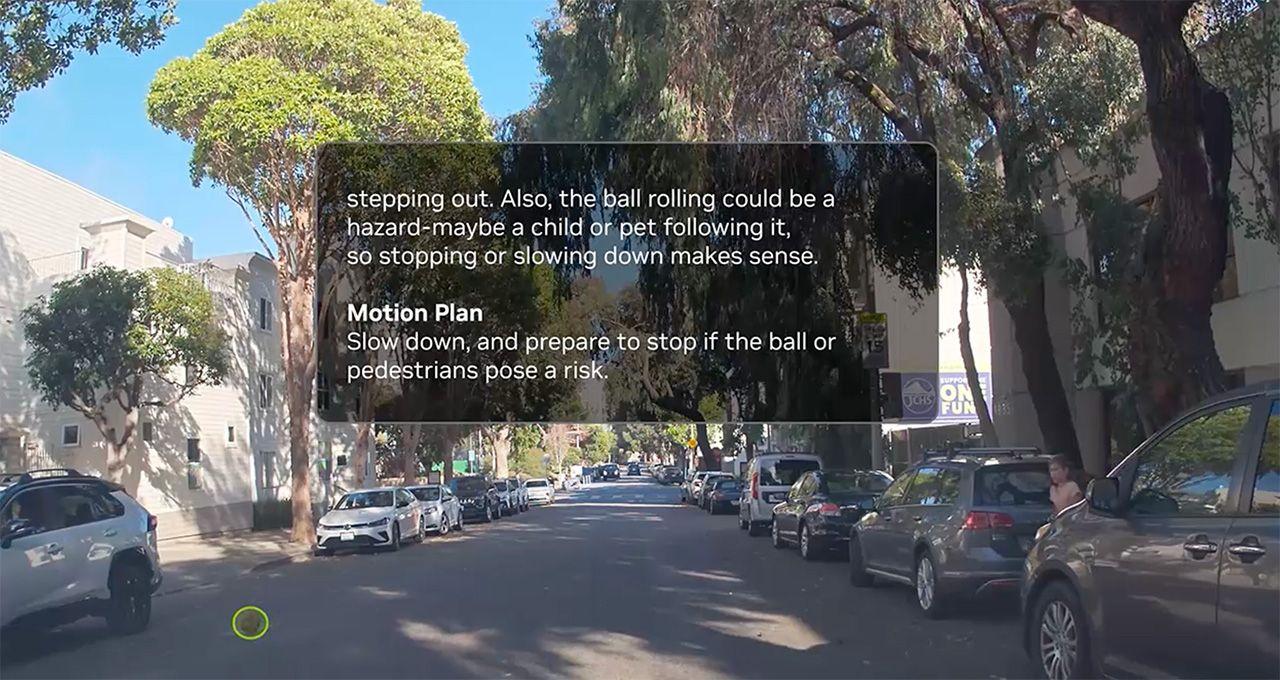
. The model produces five interconnected outputs for each driving situation: a planned trajectory, a chain-of-causation trace explaining the reasoning, risk assessments, natural language descriptions, and action commands1
. This chain-of-causation capability addresses what NVIDIA describes as autonomy's trust problem, allowing regulators and developers to understand why a vehicle made specific decisions2
. The approach targets Level 4 autonomous driving, where vehicles handle all driving tasks within defined areas without human intervention2
.The model introduces cloud-to-car workflows that separate development from deployment. Alpamayo 2 Super delivers frontier-scale reasoning in cloud environments where developers generate high-quality reasoning traces, synthetic training data, and teacher outputs for model distillation
1
. These distilled versions can then run efficiently on NVIDIA DRIVE chips in production vehicles, creating a sustainable path for commercial autonomous vehicle fleets1
2
. The full model requires tens of gigabytes of GPU memory, positioning it as a teacher model rather than one that runs directly in vehicles2
. This architecture allows developers to access advanced reasoning capabilities without re-training foundation models from scratch or incurring frontier-model costs for every task1
.Related Stories
Alpamayo 2 Super offers three times the scale of the 10-billion-parameter Alpamayo 1.5 and Alpamayo 1 models, enabling better generalization from sparse examples
1
. This expanded capacity proves critical for long-tail events—rare, multi-agent interactions where conventional detection and prediction systems often fail. The model processes full-surround camera coverage, fusing views from front, side, and rear cameras to understand lane changes, merges, unprotected turns, and complex intersections where risks commonly emerge1
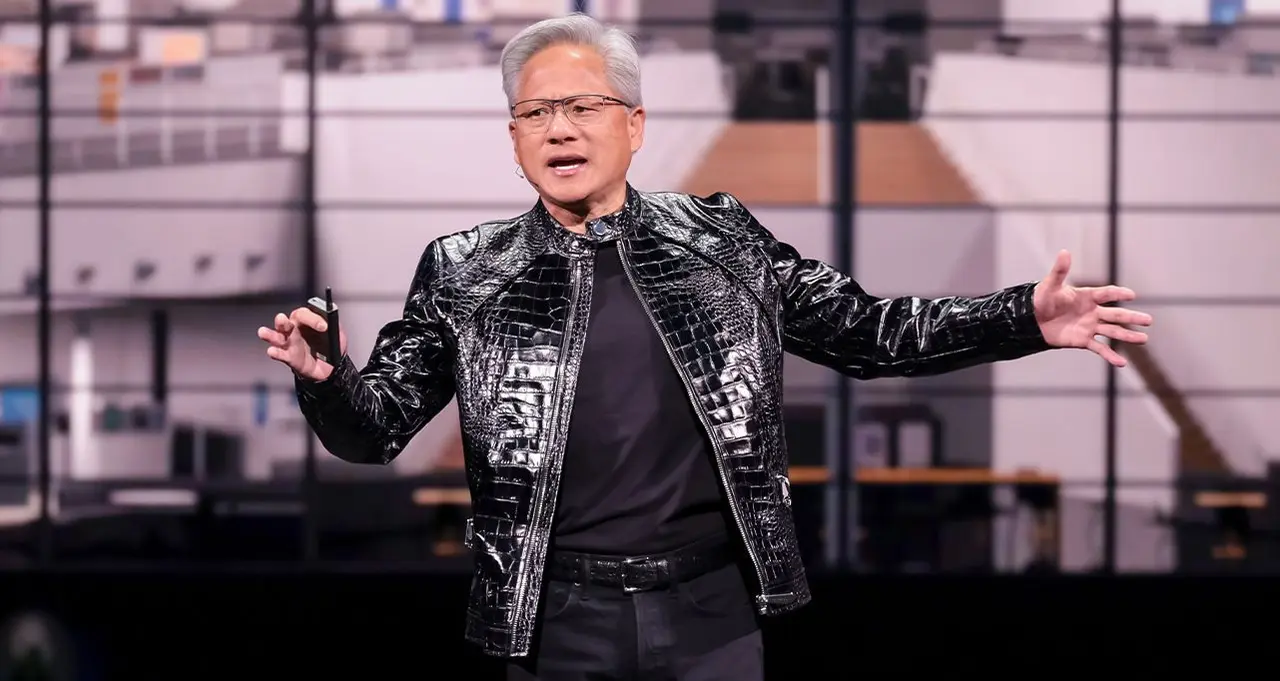
. According to Jensen Huang, NVIDIA's chief executive, "Alpamayo is the moment cars begin to safely reason, not just drive"2
.The OpenMDW-1.1 license now applies across the entire Alpamayo model family, allowing developers to deploy any version commercially without additional permissions
1
. This openness lets autonomous vehicle researchers and companies maintain control over proprietary data and infrastructure while owning the value created through specialized models1
. The Alpamayo models have been downloaded approximately 400,000 times since the family launched in January, and NVIDIA's self-driving stack already supports initiatives like Uber's robotaxi deployment in Munich2
. The strategy positions NVIDIA to set industry standards while selling the hardware—DRIVE chips including Thor and Hyperion—that distilled models are optimized to run on2
. As robotaxis transition from pilot programs to commercial services, the ability to audit and certify explainable driving decisions may prove as important as raw driving performance2
.Summarized by
Navi
01 Dec 2025•Technology

06 Jan 2026•Technology

06 Jan 2026•Technology

1
Technology

2
Technology

3
Technology