Apple Intelligence will automatically change your compromised passwords with one tap in iOS 27


8 Sources
[1]
Apple's Siri AI Will Automatically Fix Your Weak Passwords. Can You Trust It?
Worried about your passwords falling into the wrong hands? Apple's iOS 27 is here to help with a security update for the Passwords app. Introduced with iOS 18 in 2024, Apple Passwords helps create and store passwords while alerting you to passwords that are weak, compromised, or reused across
[2]
Apple's iOS 27 goes all agentic on compromised passwords, promises to change them with one tap
Apple says that its next-gen operating system will allow users to update their weak and compromised passwords with a single tap. Upgrades coming to iOS 27, announced at Tim Cook's last Worldwide Developers Conference (WWDC) this week, introduce a significant change to the way users manage their
[3]
New Apple feature automatically changes your compromised passwords
At WWDC 2026, Apple announced an Apple Intelligence-powered feature that can automatically fix weak and compromised passwords. Right now, Safari and the built-in Apple Passwords app can automatically flag weak, duplicate, or compromised passwords. For example, if you enter a password when you're
[4]
Apple Intelligence Can Change Your Passwords for You When You Get Hacked
As important as being secure with your sensitive information online is, few among us have perfect password hygiene, and Apple apparently knows it. With a new Apple Intelligence feature announced at WWDC 2026, Apple's AI can now automatically change passwords that could get you hacked. The tool,
[5]

iOS 27's Passwords app can change your passwords for you, automatically
Today during its WWDC presentation, Apple unveiled a new iOS 27 feature for the Passwords app: an AI capability that can automatically change your passwords for you. Passwords app can now fix compromised logins on your behalf Today Apple unveiled major AI upgrades coming in iOS 27 and its other
[6]

Apple finally got rid of my biggest password headache
The update could make Apple's Passwords app competitive with third-party managers like 1Password, though questions remain about security and reliability. We are often told how important it is to use a password manager to keep our online presence safely protected, and considering how much we store
[7]

Apple Passwords Can Now Automatically Fix Weak and Compromised Passwords With Agentic AI
Apple today announced that the Passwords app can now automatically update weak and compromised passwords using Apple Intelligence and Safari to take action on a user's behalf. The feature builds on Passwords' existing ability to flag weak or compromised credentials. While the app has long been
[8]

New iOS 27 Passwords app can automatically change your passwords for you
* Passwords app in iOS 27 will automatically change weak and compromised passwords for you * The feature improvement leans on Gemini-backed Apple Intelligence upgrade * Apple shares fell 1.9% in the day following WWDC 2026 Apple is set to introduce a major improvement to its Passwords app in iOS
Share
Copy Link
Apple unveiled a new Apple Intelligence feature at WWDC 2026 that can automatically fix weak and compromised passwords in the Passwords app. Instead of manually updating each account, iOS 27 users can tap once and let agentic AI navigate websites, sign in, and create stronger passwords. The feature uses Apple Foundation Models built with Google Gemini and runs on-device or through Private Cloud Compute.
Apple Intelligence Tackles Compromised Passwords in iOS 27
At WWDC 2026, Apple introduced a significant security upgrade to its Apple Passwords app that leverages Apple Intelligence to automatically change passwords that are weak or compromised
1
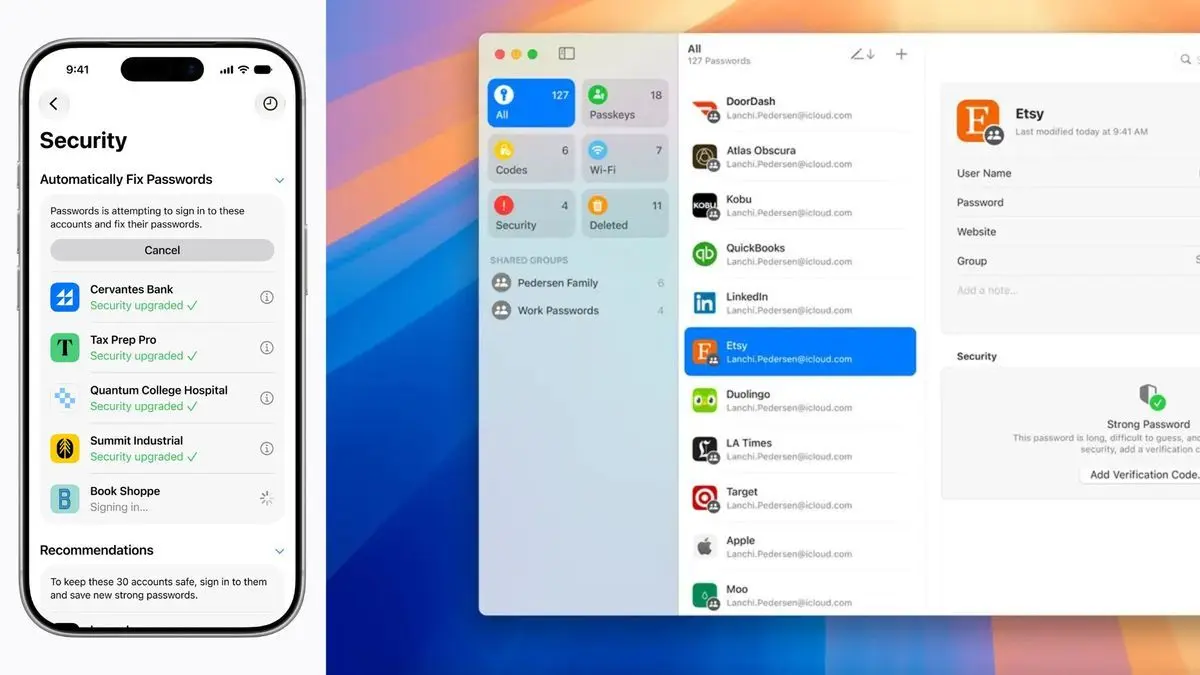
. The feature, arriving with iOS 27 later this year, represents a shift from merely alerting users about problematic credentials to taking action on their behalf. Instead of manually updating each account, users can now visit the Passwords app's Security tab and tap a Fix Passwords button to let agentic AI handle the entire process2
.
Source: TechRadar
The Apple Passwords app, first introduced with iOS 18 in 2024, already creates and stores passwords while flagging those that are weak, compromised, or reused across multiple accounts
1
. However, until now, users had to complete password changes themselves, navigating to each website individually. With iOS 27, Apple is using AI to automate this second part through what it calls AI-powered password management3
.How One-Tap Password Change Works
Based on the WWDC keynote demo, the one-tap password change feature proactively lists accounts with compromised passwords
1
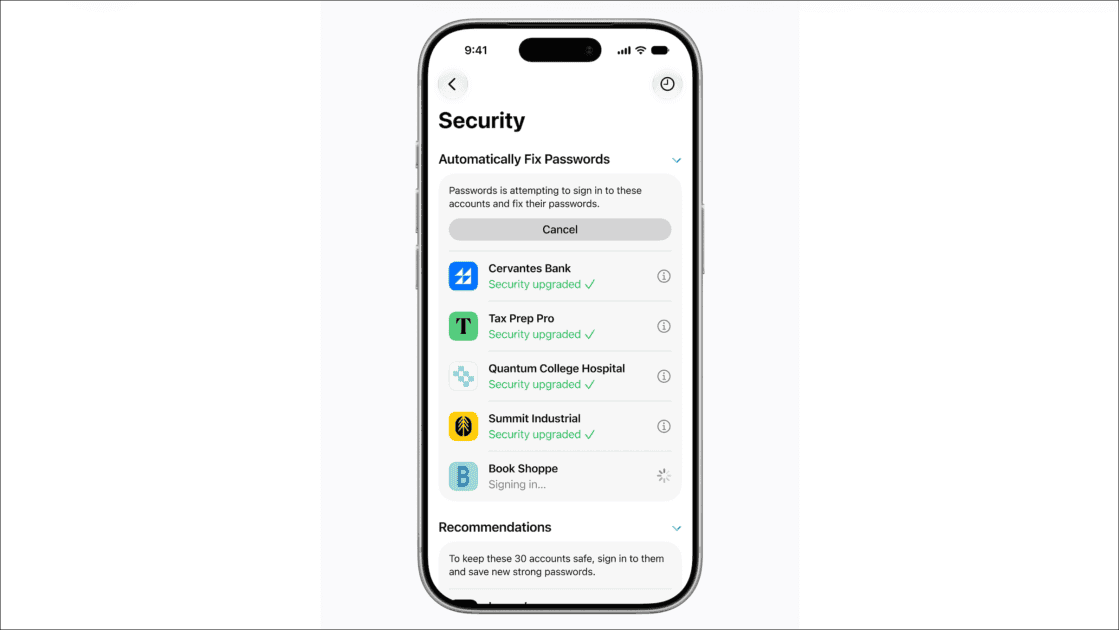
. After tapping the Fix Passwords button, the app uses Safari and Apple Intelligence to agentically sign in to those accounts and create stronger online credentials automatically. The entire action takes place in the background, with status updates changing from "Signing in" to "Saving strong password," and finally "Security upgraded"1
.
Source: PC Magazine
Users can stop the process midway by tapping Cancel, maintaining control over the automated workflow
1
. According to Apple, the feature "agentically take[s] action on a user's behalf" by securely navigating through websites to sign in and upgrade accounts to strong passwords2
. While the demo showed flawless execution, questions remain about how effective the agentic AI will be at navigating different websites' login processes, especially when multi-factor authentication is enabled2
.Privacy and Security with Apple Foundation Models
Apple emphasizes that the new capability is built privacy-first, using the next generation of Apple Foundation Models developed in collaboration with Google Gemini technology
3
. These models run on-device processing and on servers using Private Cloud Compute, ensuring user privacy remains protected3
. According to Apple, "when Private Cloud Compute is handling users' requests, their personal data is not stored nor made accessible to Apple or anyone else"3
.
Source: BleepingComputer
Unlike AI-generated passwords from chatbots that research has shown can be weaker than they appear and vulnerable to brute-force attacks, Apple's Passwords app generates solid passwords by default—strings that password checkers rate as "strong" and would take centuries to crack
2
. This addresses concerns about weak password security that plagued earlier AI password generation experiments.Related Stories

What This Means for Users and the Industry
The feature represents a practical application of agentic AI that addresses a real pain point in digital security. While Google offers Google Password Manager that can detect weak or compromised passwords, Gemini cannot currently automatically change passwords for you, making Apple's tool fairly novel
4
. IDC VP Francisco Jeronimo noted that "the winning AI experience for consumers will not be the loudest or most technically complex. It will be the one that understands context, respects privacy, works reliably across apps, and reduces friction"2
.The feature will be available on iPhone 16 models or later, iPhone 15 Pro, iPhone 15 Pro Max, iPad mini (A17 Pro), iPad models with M1 or later, MacBook Neo (A18 Pro), Mac models with M1 or later, and Apple Vision Pro
1
. Developers can access the iOS 27 beta now, with a public beta arriving next month and the stable version launching in September5
. This capability, combined with Siri AI enhancements announced at WWDC, signals Apple's commitment to making AI feel "native, useful, and invisible" across devices people use daily2
.References
Summarized by

Navi
[2]
[3]
Related Stories
Apple Intelligence brings AI tab organization and custom extensions to Safari
08 Jun 2026•Technology

Google Chrome to Introduce AI-Powered Automated Password Change Feature
11 Feb 2025•Technology

1Password for Agents Lets AI Assistants Securely Access Accounts Without Seeing Your Passwords
22 Oct 2026•Technology

Recent Highlights



Recent Highlights
Today's Top Stories






Don’t drown in AI news. We cut through the noise - filtering, ranking and summarizing the most important AI news, breakthroughs and research daily. Follow topics that matter to you and stay ahead.


