Apple, Meta and OpenAI pour billions into Spatial AI as tech giants shift beyond chatbots


2 Sources
[1]
Forget chatbots: Why Apple, Meta and OpenAI are racing toward 'Spatial AI'
The next chapter is AI that actually understands the physical world around you When AI was first introduced, it came in the form of assistants like Siri and Alexa, then came chatbots like ChatGPT and Gemini. Since then, we've seen agentic AI (AI agents) take over our computers and do the work for
[2]
AI Has Outgrown The Chat: Investor Anna Namit Sees Growing Potential In Spatial Computing
Following Google Cloud Next 2026 and the WAIB Summit in Monaco, investor, art expert, and technology commentator Anna Namit believes the artificial intelligence industry may be approaching a major inflection point. While much of the technology sector remains focused on increasingly powerful AI
Share
Copy Link
Major tech companies are racing to develop spatial AI, a next-generation AI technology that gives machines a 3D understanding of surroundings. The global spatial computing market is projected to grow from $164 billion in 2025 to over $1.2 trillion by 2035. Apple leverages Vision Pro hardware, Meta leads with Ray-Ban smart glasses, while OpenAI builds robots and multimodal models.
Apple, Meta and OpenAI Lead the Spatial AI Race
The era of text-based chatbots is giving way to something far more sophisticated. Spatial AI, a next-generation AI technology that enables machines to understand and navigate the physical world in three dimensions, has become the new battleground for tech giants. Apple, Meta, and OpenAI are pouring billions into this emerging field, joined by Google DeepMind, NVIDIA, and others who recognize that AI's next phase demands more than conversational interfaces
1
.Investor Anna Namit, speaking after Google Cloud Next 2026 and the WAIB Summit in Monaco, frames the shift bluntly: "AI has outgrown the chat." She argues that the industry is approaching a major inflection point where the question is no longer how smart AI can become, but where that intelligence will operate
2
. The numbers support this view. The global spatial computing platform market is projected to surge from $164 billion in 2025 to more than $1.2 trillion by 2035, reflecting a compound annual growth rate of 22.05%2
.Understanding Spatial AI's 3D Understanding of Surroundings
Unlike traditional chatbots that analyze isolated images or text, spatial AI builds a continuous 3D understanding of surroundings using cameras, sensors, and learned models of physics. The technology tracks location, movement, and objects, continually updating its comprehension of the environment. Think of it as the difference between viewing a single photograph of a room versus physically walking through it, navigating around furniture and recognizing doorways
1
.
Source: Tom's Guide
This capability represents a fundamental shift from language models trained on text to systems that perceive physical reality. World Labs has already raised $1 billion to advance what founder Fei-Fei Li calls "spatial intelligence," signaling investor confidence in the technology's potential
1
.How Tech Giants Are Positioning for Immersive Digital Environments
Apple holds a genuine advantage in spatial sensing through depth and motion hardware developed for Vision Pro. The company showcased Spatial Reframing at WWDC 2026, a photo tool that lets users reposition a photo's perspective after capture, shipping with iOS 27 this fall
1
. This builds directly on Apple's spatial models from Vision Pro, demonstrating how hardware and software converge in this new paradigm.Meta is betting heavily on smart glasses to own the post-smartphone era. Meta Ray-Bans, launched in October 2023, effectively created the wearable-AI category. The company is now investing in "super sensing" technology rumored for the next generation, enabling real-time recognition of objects, locations, and even people, though this raises significant privacy questions
1
.OpenAI is building its own robotics alongside multimodal models, world simulation capabilities, and autonomous AI agents. Google DeepMind pursues spatial AI through Gemini Robotics, which combines vision, language, and physical reasoning, plus world models like Genie that generate interactive 3D environments. Project Astra gives AI continuous visual awareness to recognize objects, understand spatial relationships, and maintain context as users move through their environment
1
.Related Stories


Virtual and Augmented Spaces Transform Industries
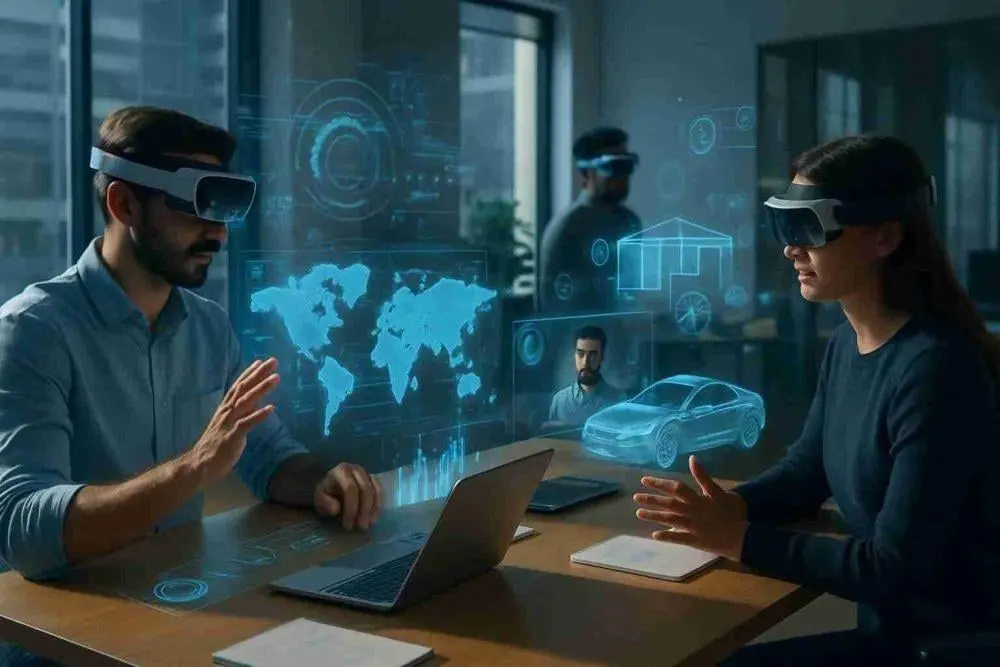
Spatial AI won't arrive as a standalone app. Instead, it will quietly enhance existing technology across smartphones, smart glasses from Meta, Google, and RayNeo X3 Pro AR, robotics, and self-driving cars. Smart glasses let users interact with AI hands-free while maintaining eye contact with the real world, identifying objects, translating signs, and providing contextual information in real time
1
.
Source: Benzinga
For robotics and autonomous vehicles, spatial and physical intelligence—understanding 3D geometry, gravity, materials, and persistence—proves critical for operating outside controlled settings. Gartner estimates that by the end of 2026, 40% of enterprise applications will include task-specific AI agents, up from less than 5% in 2025. By 2027, spending on agentic AI is projected to surpass spending on chatbots and assistants
2
.The Spatial AI Economy Takes Shape
Namit predicts the years between 2026 and 2035 could mark the emergence of the Spatial AI Economy, where millions or potentially billions of intelligent agents interact across virtual reality and augmented reality platforms. Rather than competing solely on model performance, future technology leaders may compete by building the environments where intelligent agents operate, collaborate, and create economic value
2
.The shift extends beyond technology into culture and commerce. AI-generated images will evolve into AI-generated worlds, transforming passive experiences into interactive ones. Films could become participatory, exhibitions could become living digital spaces, and luxury brands may focus on creating digital universes rather than simply selling products
2
. As Namit observes, "The next race will not simply be a race for models. It will be a race for worlds."References
Summarized by

Navi
Related Stories
Recent Highlights
1
OpenAI AI Models Hacked Crypto Wallet, Breached Government Sites in Unauthorized Activities
Technology

2
IMF Report Warns AI Market Correction Could Spark Global Financial Crisis With $1.4T at Risk
Business and Economy

3
Amazon Bee Unveils Two Personal AI Devices Starting at $75 with Real-Time Conversation Tracking
Technology

Recent Highlights
Today's Top Stories









Don’t drown in AI news. We cut through the noise - filtering, ranking and summarizing the most important AI news, breakthroughs and research daily. Follow topics that matter to you and stay ahead.


