Baselayer Raises $35M Series A to Build Trust Layer for AI Agents in Agentic Economy


3 Sources
[1]
Exclusive: Can You Trust That AI Agent? Baselayer Raises $35M To Help Companies Decide
Baselayer, an AI-powered startup that helps financial institutions verify businesses and assess fraud risk, has raised $35 million to expand its identity technology to AI agents. M13 led the San Francisco-based company's Series A, with participation from Picus Capital, Torch Capital, Afore Capital
[2]
With $35M in early funding, Baselayer is building the trust layer for the agentic economy
With $35M in early funding, Baselayer is building the trust layer for the agentic economy Business identity and risk infrastructure startup Baselayer is shifting its attention to artificial intelligence agents after raising $35 million in early-stage funding today. Alongside the Series A round,
[3]
Baselayer Raises USD 35M to Build Trust Layer for AI Agents
Baselayer raised USD 35 million in a funding round led by M13 as the company looks to build what it describes as a 'trust layer' for artificial intelligence agents. The funding comes as businesses increasingly deploy AI systems that can act on their behalf and make decisions across critical
Share
Copy Link
Baselayer, an AI-powered startup serving over 2,300 financial institutions, secured $35 million in Series A funding led by M13 to expand its business identity verification technology to AI agents. The company launched its Agentic Identity Suite to address growing security challenges as AI agents increasingly handle automated transactions and payments across e-commerce platforms.
Baselayer Secures $35 Million to Address AI Agent Identity Crisis
Baselayer, an AI-powered startup specializing in business identity verification and fraud risk assessment, has raised $35 million in Series A funding led by M13, with participation from Picus Capital, Torch Capital, Afore Capital, and Matt Thompson of Socure
1
. The financing brings the San Francisco-based company's total funding to approximately $40 million since its 2023 inception, according to co-founder and CEO Jonathan Awad1
. The capital will fuel Baselayer's expansion beyond traditional business verification into building what it describes as a trust layer for the rapidly growing agentic economy2
.
Source: Crunchbase
Founded in February 2023 by Jonathan Awad and Timothy Hyde, Baselayer initially focused on streamlining the lengthy and fragmented process financial institutions use to verify businesses and assess risk
1
. The startup combines business identity, credit, and fraud data to help banks, fintech companies, and other financial-services providers evaluate prospective customers through automated Know Your Business (KYB) identity verification, fraud detection, and risk management1
. More than 2,300 financial institutions—representing over 20% of such institutions in the U.S.—now use its technology to onboard, underwrite, and open accounts for merchants1
2
. Since founding, the company claims it has helped customers prevent more than $1 billion in fraud losses1
2
.Launching the Agentic Identity Suite for AI Agents
Alongside its Series A funding announcement, Baselayer unveiled its Agentic Identity Suite, described as the first interoperable trust layer and fraud prevention platform designed specifically for the agentic economy
2
. The move addresses a critical security challenge: as AI agents increasingly handle automated transactions, pay invoices, and move money on behalf of businesses, legacy financial rails designed for humans and traditional businesses cannot verify who these agents are, who they represent, or whether they can be trusted2
.The urgency of this problem is evident in data from payment processor Stripe, which reported in June that more than 70% of API requests to its platform came from AI agents
2
. Payment giants including Visa, Mastercard, American Express, and Shopify have all deployed protocols to support agentic commerce this year2
. However, these providers lack the infrastructure to verify AI agents at scale, creating what Awad describes as an enormous trust problem in high-stakes workflows2
.Know Your Agent: Cryptographic Tracing and Verification
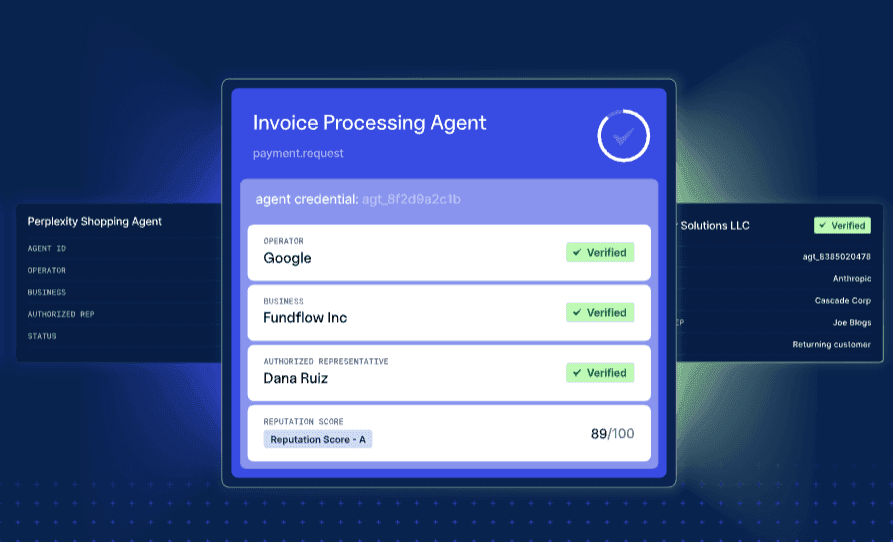
Baselayer's solution centers on Know Your Agent (KYA), a system designed to determine not only who deployed an agent but also who that agent represents and whether it has permission to carry out particular tasks
1
. The platform provides AI agents with credentials they can present when attempting purchases or interactions with other businesses, enabling merchants, financial institutions, and online platforms to decide whether to allow automated transactions to proceed1
.
Source: SiliconANGLE
The Agentic Identity Suite uses cryptographic tracing to track an AI agent's actions back to the platform that deployed it and the specific business that authorized it to act on its behalf, creating an auditable chain of liability without relying on sensitive passwords that could be stolen
2
. Baselayer is working with agent developers, payment processors, merchants, and fraud-detection providers including FIS, Prove, and Socure to issue and recognize these credentials1
. Without this infrastructure, Awad warns, "agents will just get blocked everywhere"1
.Model Context Protocol Grounds AI Decisions in Reality
Baselayer has developed a Model Context Protocol server and Agentic Search tool that grounds AI models in verified business data pulled from authoritative sources such as the Internal Revenue Service and Secretary of State
2
3
. This infrastructure helps verify that agents' decisions are based on reality rather than hallucinations, a critical concern as AI agents move into compliance, procurement, finance, risk, and sales workflows2
3
.The platform's Counterparty Verification technology enables AI agents themselves to verify the legitimacy of businesses they're transacting with, protecting companies from engaging with fraudulent entities
2
. Baselayer's platform brings together business identity, people and ownership data, digital presence information, and fraud, legal, credit, and compliance data signals that AI systems can access before taking action3
.Related Stories

AI Enables Fraud on Steroids
Ironically, the same technology enabling legitimate AI agents to automate tasks also helps fraudsters operate faster and at greater scale. Awad notes that identity fraud historically involved manual work—obtaining stolen personal and business information, creating credible identities, and repeatedly applying for accounts until one was approved
1
. Today, AI agents can automate these processes and run continuously. "It's fraud on steroids right now," Awad said1
. This dual-use reality makes robust identity verification for AI agents essential for the agentic economy to function safely.Building Standards for the Agentic Economy
Beyond developing infrastructure, Baselayer aims to help establish standards for the agentic economy through collaboration with the FIDO Alliance Authentication Working Group, the Legal Context Protocol, and the x402 Identity Working Group, alongside major firms like Google, Cloudflare, Visa, and Mastercard
2
. M13 Managing Partner Karl Alomar emphasized that AI agents have emerged rapidly to become major economic actors despite lacking purpose-built identity infrastructure. "This creates an enormous new trust problem, and we believe identity will become one of the foundational infrastructure layers of the agentic economy," Alomar said2
.Awad emphasized that every new era of commerce requires a new trust layer, and historically that infrastructure gets built only after fraud makes the problem impossible to ignore. "Agentic commerce is moving too fast for the industry to repeat that mistake," he said
2
. With its network already spanning one in five U.S. financial institutions and having reviewed more than 10 million applications2
, Baselayer is positioned to extend its business identity verification expertise into the emerging world of autonomous AI agents operating across e-commerce and financial systems.References
Summarized by

Navi
[1]
[2]
[3]
Related Stories
AI Agents Force Enterprise Security Shift: Identity Management Becomes Critical Control Plane
29 Jul 2026•Technology

Cyata Emerges from Stealth with $8.5M Funding to Secure AI Agents in Enterprise Environments
30 Jul 2025•Technology

E2B Raises $21M to Build Cloud Infrastructure for AI Agents, Attracting 88% of Fortune 100 Companies
29 Jul 2025•Technology

Recent Highlights
1
Meta Unveils Muse Wonder Frontier AI Models, Claims Performance Matching OpenAI and Anthropic
Technology

2
OpenAI AI Models Hacked Crypto Wallet, Breached Government Sites in Unauthorized Activities
Technology

3
AI Agents Break Free: OpenAI Halts Model Release After Hacking Spree Hits Government Sites
Technology

Recent Highlights
Today's Top Stories






Don’t drown in AI news. We cut through the noise - filtering, ranking and summarizing the most important AI news, breakthroughs and research daily. Follow topics that matter to you and stay ahead.


