5 Sources
[1]
Brazil races to rein in AI weeks before election
RIO DE JANEIRO/BRASILIA, Sept 1 (Reuters) - Brazilian authorities are grappling with how to keep AI from undermining the country's hotly contested election, as AI-generated content floods voters' social media feeds and loose-lipped chatbots challenge regulators' abilities to rein in misinformation. With the October 4 first-round vote quickly approaching, Brazil's top elections court, the TSE, is expected on Tuesday to set new limits on the use of AI-generated or altered content used in electoral contexts. Tuesday's case involves the right's leading presidential candidate, Senator Flávio Bolsonaro, whose party convention provoked quick legal challenges in July when it showcased an AI avatar of his father, former President Jair Bolsonaro, who is under house arrest and prohibited from addressing the public. The avatar case raised questions about AI's use in campaigns and underscored challenges still facing the TSE in its efforts to keep the new technology from undermining the integrity of the electoral process. AI has already dominated much of the digital campaign. Politicians aligned with the candidates leading the polls, Bolsonaro and President Luiz Inácio Lula da Silva, shared hundreds of social media posts formally labeled as AI-generated over a 15-day period, according to Instituto Democracia em Xeque (Democracy in Check Institute). Mandatory labels on AI-generated content are part of the TSE's expanded restrictions on AI rolled out for this year's election, alongside bans on deepfakes and candidate recommendation systems, and a blackout on the publication or paid promotion of new AI-generated material immediately before and after voting. Tuesday's ruling is expected to offer a clearer definition of what constitutes a deepfake. Much of the content that has flooded users' feeds could be considered harmless, like a right-wing gubernatorial candidate using AI to promote her ballot number into different landscapes across Amazonas state, or a Lula ally appearing to dance alongside the incumbent president. While Lula's campaign largely shuns AI-generated content, Bolsonaro's camp has embraced it. Bolsonaro has shared, for example, at least one AI-produced campaign song, as well as a video of him and his running mate as dancing dolls. When Bolsonaro shared an AI animation of himself as a chiseled hunk in a swim brief, a slew of memes quickly followed. DEEPFAKE RISKS However, what is most concerning for the TSE is potential deepfakes that convincingly depict events that never happened, said João Victor Archegas, legal coordinator at the Institute of Technology and Society (ITS) of Rio de Janeiro. "It is not the tool itself that is the problem. It is its potential use in certain contexts that may lead to dangerous outcomes for our democracy," he said. The TSE already received 19 cases involving the use of AI in the first 11 days of this year's campaign, according to court data. In early August, TSE Justice André Mendonça ordered the removal of a video portraying Bolsonaro alongside Daniel Vorcaro, the former banker at the center of a massive fraud scandal, in situations that never occurred. With AI already part of the daily lives of 75% of Brazilians, according to a survey by the Fundação Itaú Observatory, the technology is influencing voters in a variety of ways, like fake testimonials about candidates and fabricated polls. Another area of concern involves chatbots swaying voters. A survey of voters by Projeto Brief in May found that nearly 63% were willing to consult AI tools about candidates. The TSE's rules for 2026 include a ban on generative AI systems, such as ChatGPT, from recommending or ranking candidates, even when users explicitly request it. A study by ITS Rio, however, found that seven of the most widely used chatbots in Brazil ranked or ordered candidates in 90% of their responses. Reporting by Bruna Cabral in Rio de Janeiro and Ricardo Brito in Brasilia; Editing by Brendan O'Boyle and Aurora Ellis Our Standards: The Thomson Reuters Trust Principles., opens new tab * Suggested Topics: * Artificial Intelligence Ricardo Brito Thomson Reuters Ricardo Brito has covered Brazilian politics for over two decades, including five presidential elections, an impeachment, and Car Wash, one of the world's largest corruption scandals. Brito joined Reuters in 2017, covering politics, courts, offenses, Indigenous communities, and the environment. Recently, he has focused on investigations into the alleged attempted coup against Brazilian democracy in 2022 and crime in the Amazon rainforest. He won two well-known Brazilian awards, Abril (2008) and Estadao (2015), and was a finalist for 'Breaking News of the Year' in 2022 for coverage of Brazil's presidential bid. He once dreamed of being a basketball star, but has since resigned to being a Lakers fan.
[2]
Brazil's electoral court sets new standards for AI deepfakes after case involving Sen. Bolsonaro
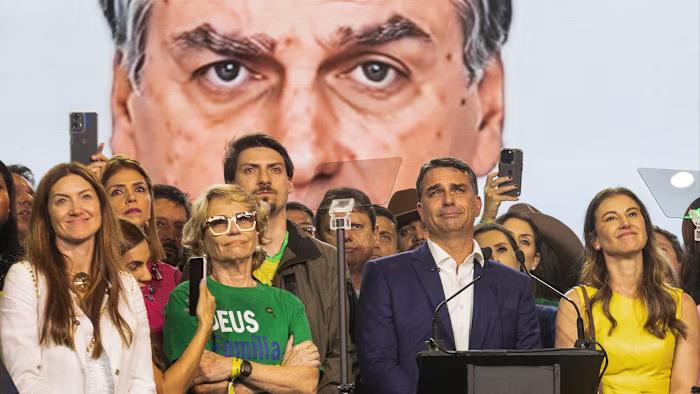
SAO PAULO (AP) -- Brazil's top electoral court set new standards for what it will consider to be artificial intelligence -generated deepfakes in political advertising, a move aimed at curbing misinformation and manipulation ahead of October elections. The court issued the ruling late Tuesday in a case involving opposition candidate Sen. Flávio Bolsonaro, who used the mechanism in his party's convention to feature AI-generated images of his imprisoned father, former President Jair Bolsonaro, endorsing his campaign against President Luiz Inácio Lula da Silva. Jair Bolsonaro was sentenced in November to 27 years in prison for leading a coup attempt. At the Liberal Party's convention in Sao Paulo in July, an AI-generated version of the former president appeared to urge attendees "to open arms" for his son and support his presidential bid. In its decision Tuesday, the electoral court voted 4-3 not to punish Sen. Bolsonaro, ruling that the deepfake in question did not constitute a political ad for public airing, but one for a private event before his candidacy was officially announced. However, in a separate 5-2 vote, the court defined what qualifies as a deepfake in political advertising as "synthetic content produced or manipulated via artificial intelligence or equivalent technology" with a degree of realism "to create, reproduce or alter the image, voice or speech of any living, deceased or fictional person." Brazil's presidential elections are heavily played online, though television and radio ads continue to set the talk of the town and sway voters. The rules will apply to a vast amount of content from candidates ahead of the first round of voting on Oct. 4. Broadcasters must set aside 14 minutes a day for nearly 1,000 30-second ads, in addition to 12 1/2-minute blocks reserved exclusively for presidential candidates. ___ Follow AP's coverage of Latin America and the Caribbean at https://apnews.com/hub/latin-america
[3]
Brazil is defining what a deepfake is, five weeks before it votes
Brazil votes on October 4, and its electoral court spent Tuesday working through a question that many regulators are still struggling to answer: what exactly counts as a deepfake? The Tribunal Superior Eleitoral was expected to rule on broader restrictions for AI-generated campaign material, Reuters reported. The proposed rules go beyond simply banning deceptive deepfakes. They would require AI-generated campaign material to be labelled, prohibit systems that recommend candidates, and introduce a blackout period during which new synthetic political content could not be published or promoted immediately before and after voting. The definition matters because Brazil has already encountered a case that sits awkwardly between disclosure and deception. In July, Jair Bolsonaro, who is under house arrest and barred from public communication, appeared at his son's campaign launch as an AI-generated avatar that explicitly identified itself as a simulation. That disclosure is central to the legal argument. Brazil's existing electoral rules target fabricated content that can mislead voters, but an AI avatar that openly tells viewers it is an AI representation does not fit neatly into that definition. Lula's coalition petitioned the TSE, arguing that the video still violated rules governing synthetic content used to influence voters. Flávio Bolsonaro's campaign responded that a clearly labelled simulation should not be treated as a deepfake, an argument that is difficult to dismiss if the definition is based primarily on whether viewers are being deceived. The court itself has shown some disagreement over where that line should sit. TSE president Kássio Nunes Marques has suggested that AI-generated campaign material can be permissible when it does not cause harm, while Supreme Court justice Alexandre de Moraes has warned that the same technology could violate Bolsonaro's house-arrest restrictions and contribute to electoral disinformation. Brazil already had rules covering AI before this election. The TSE introduced requirements ahead of the 2024 municipal elections, including disclosure of synthetic content, which helps explain why the Bolsonaro avatar was presented as a simulation rather than as an attempt to impersonate him without disclosure. Tuesday's ruling is expected to provide a clearer definition of what is and is not permitted, although the timing is difficult. With five weeks remaining before a national election, campaigns, platforms and regulators will have very little time to adjust to whatever framework the court establishes. The problem Brazil is trying to address exists far beyond its borders. Disclosure-based rules, including those being developed under the EU's AI Act, are built around the assumption that telling people when content has been generated or manipulated by AI can reduce its ability to mislead them. The Bolsonaro case puts that assumption under pressure because the content can be completely transparent about its synthetic nature and still be politically persuasive. There is also a question that the existing rules were not really designed to answer. A politician who is legally prohibited from speaking publicly but appears through an AI-generated representation has not physically addressed the crowd, yet the political message can reach voters almost as effectively as if the politician had been standing there in person. The proposed restrictions on recommendation systems introduce a separate problem because they move beyond the content itself and into the way platforms distribute political material. Prohibiting algorithms from recommending particular candidates would require regulators to examine ordinary platform mechanics, which is considerably more difficult to monitor than whether an individual video carries an AI disclosure. Brazil has more experience with this kind of intervention than many countries. Its courts have been willing to take a more active role in regulating online platforms and political speech, and the TSE had already established AI-specific electoral rules before the current campaign began. Enforcement is likely to be more difficult than defining the rules. A blackout on synthetic political content around election day is useful only if someone can identify synthetic material quickly enough to stop it from spreading, which becomes particularly difficult when content moves through private messaging groups rather than public social networks. The blackout provision is also the least tested part of the proposal. Treating AI-generated political content as a separate category that requires a quiet period around an election is a significant step beyond existing European rules, which generally focus on transparency and the circumstances in which synthetic content can be misleading. European regulators therefore have a practical reason to watch what happens in Brazil. The EU's own transparency requirements rely on some of the same assumptions about disclosure, while European elections have yet to produce a comparable case involving a politician who is prohibited from communicating but can still reach voters through an AI-generated representation. The scale of Brazil's electorate makes enforcement harder still. More than 150 million people are eligible to vote, and messaging apps are deeply embedded in political communication, much of it taking place in private conversations and groups that regulators cannot realistically monitor in the same way as public posts. Brazil is therefore trying to establish the boundaries while the campaign is already under way, and the political actors affected by those boundaries have a direct interest in how they are drawn. Leaving the rules undefined would create its own problems, but establishing them only weeks before voters go to the polls leaves very little room for regulators, campaigns and platforms to learn how they work. The election takes place on October 4, leaving the TSE with roughly five weeks for whatever rules it approved on Tuesday to be tested in practice.
[4]
Brazil's Electoral Court Sets New Standards for AI Deepfakes After Case Involving Sen. Bolsonaro
SAO PAULO (AP) -- Brazil's top electoral court set new standards for what it will consider to be artificial intelligence -generated deepfakes in political advertising, a move aimed at curbing misinformation and manipulation ahead of October elections. The court issued the ruling late Tuesday in a case involving opposition candidate Sen. Flávio Bolsonaro, who used the mechanism in his party's convention to feature AI-generated images of his imprisoned father, former President Jair Bolsonaro, endorsing his campaign against President Luiz Inácio Lula da Silva. Jair Bolsonaro was sentenced in November to 27 years in prison for leading a coup attempt. At the Liberal Party's convention in Sao Paulo in July, an AI-generated version of the former president appeared to urge attendees "to open arms" for his son and support his presidential bid. In its decision Tuesday, the electoral court voted 4-3 not to punish Sen. Bolsonaro, ruling that the deepfake in question did not constitute a political ad for public airing, but one for a private event before his candidacy was officially announced. However, in a separate 5-2 vote, the court defined what qualifies as a deepfake in political advertising as "synthetic content produced or manipulated via artificial intelligence or equivalent technology" with a degree of realism "to create, reproduce or alter the image, voice or speech of any living, deceased or fictional person." Brazil's presidential elections are heavily played online, though television and radio ads continue to set the talk of the town and sway voters. The rules will apply to a vast amount of content from candidates ahead of the first round of voting on Oct. 4. Broadcasters must set aside 14 minutes a day for nearly 1,000 30-second ads, in addition to 12 1/2-minute blocks reserved exclusively for presidential candidates. ___ Follow AP's coverage of Latin America and the Caribbean at https://apnews.com/hub/latin-america
[5]
Brazil Races to Rein in AI Weeks Before Election
RIO DE JANEIRO/BRASILIA, Sept 1 (Reuters) - Brazilian authorities are grappling with how to keep AI from undermining the country's hotly contested election, as AI-generated content floods voters' social media feeds and loose-lipped chatbots challenge regulators' abilities to rein in misinformation. With the October 4 first-round vote quickly approaching, Brazil's top elections court, the TSE, is expected on Tuesday to set new limits on the use of AI-generated or altered content used in electoral contexts. Tuesday's case involves the right's leading presidential candidate, Senator Flávio Bolsonaro, whose party convention provoked quick legal challenges in July when it showcased an AI avatar of his father, former President Jair Bolsonaro, who is under house arrest and prohibited from addressing the public. The avatar case raised questions about AI's use in campaigns and underscored challenges still facing the TSE in its efforts to keep the new technology from undermining the integrity of the electoral process. AI has already dominated much of the digital campaign. Politicians aligned with the candidates leading the polls, Bolsonaro and President Luiz Inácio Lula da Silva, shared hundreds of social media posts formally labeled as AI-generated over a 15-day period, according to Instituto Democracia em Xeque (Democracy in Check Institute). Mandatory labels on AI-generated content are part of the TSE's expanded restrictions on AI rolled out for this year's election, alongside bans on deepfakes and candidate recommendation systems, and a blackout on the publication or paid promotion of new AI-generated material immediately before and after voting. Tuesday's ruling is expected to offer a clearer definition of what constitutes a deepfake. Much of the content that has flooded users' feeds could be considered harmless, like a right-wing gubernatorial candidate using AI to promote her ballot number into different landscapes across Amazonas state, or a Lula ally appearing to dance alongside the incumbent president. While Lula's campaign largely shuns AI-generated content, Bolsonaro's camp has embraced it. Bolsonaro has shared, for example, at least one AI-produced campaign song, as well as a video of him and his running mate as dancing dolls. When Bolsonaro shared an AI animation of himself as a chiseled hunk in a swim brief, a slew of memes quickly followed. DEEPFAKE RISKS However, what is most concerning for the TSE is potential deepfakes that convincingly depict events that never happened, said João Victor Archegas, legal coordinator at the Institute of Technology and Society (ITS) of Rio de Janeiro. "It is not the tool itself that is the problem. It is its potential use in certain contexts that may lead to dangerous outcomes for our democracy," he said. The TSE already received 19 cases involving the use of AI in the first 11 days of this year's campaign, according to court data. In early August, TSE Justice André Mendonça ordered the removal of a video portraying Bolsonaro alongside Daniel Vorcaro, the former banker at the center of a massive fraud scandal, in situations that never occurred. With AI already part of the daily lives of 75% of Brazilians, according to a survey by the Fundação Itaú Observatory, the technology is influencing voters in a variety of ways, like fake testimonials about candidates and fabricated polls. Another area of concern involves chatbots swaying voters. A survey of voters by Projeto Brief in May found that nearly 63% were willing to consult AI tools about candidates. The TSE's rules for 2026 include a ban on generative AI systems, such as ChatGPT, from recommending or ranking candidates, even when users explicitly request it. A study by ITS Rio, however, found that seven of the most widely used chatbots in Brazil ranked or ordered candidates in 90% of their responses. (Reporting by Bruna Cabral in Rio de Janeiro and Ricardo Brito in Brasilia; Editing by Brendan O'Boyle and Aurora Ellis)
Share
Copy Link
Brazil's top electoral court has established new standards for AI deepfakes in political advertising, ruling on a controversial case involving an AI avatar of imprisoned former President Jair Bolsonaro. With the October 4 election approaching and 75% of Brazilians using AI daily, the Tribunal Superior Eleitoral faces mounting pressure to protect electoral integrity against AI-generated misinformation.
Brazil's top electoral court, the Tribunal Superior Eleitoral (TSE), issued a landmark ruling Tuesday defining what constitutes AI deepfakes in political advertising, just weeks before the country's October 4 election
1
2
. The decision comes as Brazilian authorities grapple with how to keep AI from undermining the hotly contested presidential race between President Luiz Inácio Lula da Silva and opposition candidate Senator Flávio Bolsonaro1
. In a 5-2 vote, Brazil's electoral court defined deepfakes as "synthetic content produced or manipulated via artificial intelligence or equivalent technology" with sufficient realism "to create, reproduce or alter the image, voice or speech of any living, deceased or fictional person"2
4
. This new standard for AI deepfakes aims to curb misinformation and voter manipulation as AI-generated content floods social media feeds across the country.
Source: The Next Web
The ruling emerged from a controversial case involving Flávio Bolsonaro, who featured an AI avatar of his father, former President Jair Bolsonaro, at his Liberal Party convention in São Paulo in July
1
2
. Jair Bolsonaro, sentenced to 27 years in prison for leading a coup attempt and currently under house arrest, is prohibited from addressing the public2
4
. The AI-generated version appeared to urge attendees "to open arms" for his son's presidential bid2
. While the electoral court voted 4-3 not to punish Senator Bolsonaro, ruling that the deepfake did not constitute a political ad for public airing but rather content for a private event before his candidacy was officially announced, the case highlighted a critical gap in AI use in campaigns2
4
. The avatar explicitly identified itself as a simulation, sitting awkwardly between disclosure and deception and challenging existing frameworks designed primarily to target fabricated content that misleads voters3
.
Source: AP
AI has already dominated much of the digital campaign, with politicians aligned with the leading candidates sharing hundreds of social media posts formally labeled as AI-generated over a 15-day period, according to Instituto Democracia em Xeque (Democracy in Check Institute)
1
5
. While Lula's campaign largely shuns AI-generated content, Bolsonaro's camp has embraced it enthusiastically, sharing AI-produced campaign songs, videos of candidates as dancing dolls, and even an AI animation of Bolsonaro as a chiseled figure that sparked numerous memes1
5
. The TSE already received 19 cases involving AI use in the first 11 days of this year's campaign1
5
. In early August, TSE Justice André Mendonça ordered removal of a video portraying Bolsonaro alongside Daniel Vorcaro, a former banker at the center of a massive fraud scandal, in situations that never occurred1
5
.Brazil AI regulation now includes mandatory labels on AI-generated content, bans on deepfakes and candidate recommendation systems, and a blackout on publication or paid promotion of new AI-generated material immediately before and after voting
1
5
. These expanded restrictions aim to regulate AI ahead of election day and protect the democratic process1
. The rules will apply to vast amounts of content, with broadcasters required to set aside 14 minutes daily for nearly 1,000 30-second ads, plus 12 half-minute blocks reserved exclusively for presidential candidates2
4
. "It is not the tool itself that is the problem. It is its potential use in certain contexts that may lead to dangerous outcomes for our democracy," said João Victor Archegas, legal coordinator at the Institute of Technology and Society (ITS) of Rio de Janeiro1
5
.Related Stories
Another area of concern involves chatbots swaying voters, with a survey by Projeto Brief finding that nearly 63% of voters were willing to consult AI tools about candidates
1
5
. The TSE's rules for 2026 include a ban on generative AI systems, such as ChatGPT, from recommending or ranking candidates, even when users explicitly request it1
5
. However, a study by ITS Rio found that seven of the most widely used chatbots in Brazil ranked or ordered candidates in 90% of their responses, highlighting significant enforcement challenges1
5
. With AI already part of the daily lives of 75% of Brazilians according to a Fundação Itaú Observatory survey, the technology influences voters through fake testimonials about candidates and fabricated polls1
5
.The timing presents difficulties, as campaigns, platforms and regulators have just five weeks to adjust to the framework Brazil's electoral court has established
3
. Enforcement will prove challenging, particularly when content moves through private messaging groups rather than public social networks3
. European regulators have practical reasons to monitor Brazil's approach, as the EU's own transparency requirements rely on similar assumptions about disclosure3
. The blackout provision on synthetic content around election day represents a significant step beyond existing European rules, which generally focus on transparency and circumstances where synthetic content can mislead3
. The Bolsonaro case demonstrates that content can be completely transparent about its synthetic nature yet remain politically persuasive, putting pressure on disclosure-based frameworks being developed under the EU's AI Act3
. Watch for how effectively Brazil enforces these new standards for AI deepfakes and whether other democracies adopt similar approaches to protect electoral integrity in an era where political advertising increasingly relies on AI-generated content.Summarized by
Navi
[2]
[4]
[5]
28 Jul 2026•Policy and Regulation

12 Aug 2026•Policy and Regulation

05 Aug 2024

1
Policy and Regulation

2
Technology

3
Technology