Brian Chesky warns people managers and change-resistant workers won't survive the AI era


3 Sources
[1]
Airbnb CEO Brian Chesky warns two types of people won't survive the AI era: 'pure people managers' and workers who resist change | Fortune
Tech leaders have spent the past few years warning workers that AI will threaten every single job, from computer programming and customer service to law and finance. But according to Airbnb CEO Brian Chesky, the biggest risk to professionals isn't the technology itself -- it's refusing to evolve
[2]
Is Your Job in Danger? Airbnb's CEO Says This Corporate Role Is 'Not Going to Survive.'
According to Airbnb's CEO, one entire layer of corporate hierarchy will soon disappear. Brian Chesky, who has led Airbnb as CEO since cofounding the company in 2007, spoke about the impact of AI on an episode of the Invest Like The Best podcast earlier this week. He said "people managers" faced
[3]
Airbnb CEO Brian Chesky says these two types of employees will struggle most as AI reshapes workplaces, says 'I don't think managers...'
Airbnb CEO Brian Chesky believes the real threat to young professionals isn't AI itself, but failing to adapt. He warns that pure people managers and those resistant to change will struggle. Instead, leaders must become 'hybrid people managers,' actively involved in technical work and understanding
Share
Copy Link
Airbnb CEO Brian Chesky identifies two employee types at greatest risk as AI transforms work: pure people managers who only oversee teams, and workers who resist change. Speaking on the Invest Like The Best podcast, Chesky argues survival demands becoming a hybrid manager—leaders who combine team oversight with hands-on technical work. His warning echoes broader industry shifts as companies like Coinbase and Block eliminate traditional middle management roles.
People Managers Face Extinction in AI-Driven Workplace
Airbnb CEO Brian Chesky has issued a stark warning about professional survival in the AI era, identifying two employee categories facing the highest risk: pure people managers and workers who resist change. Speaking on the Invest Like The Best podcast, Chesky argued that the real threat isn't AI itself but failing to evolve alongside it
1
. "The two types of people who will not make the shift to AI are pure people managers, and people that are rigid and don't want to change and evolve," Chesky explained, presenting a more optimistic view than some tech leaders while emphasizing that adapting to AI remains critical for success1
.
Source: ET
The Airbnb CEO's position contrasts with more aggressive predictions from other tech leaders. Anthropic CEO Dario Amodei has warned that AI could disrupt half of entry-level white-collar work, while Microsoft's AI chief Mustafa Suleyman estimates most professional work could be replaced within 12 to 18 months
1
. Yet Chesky maintains that employees will struggle most not because of technology but due to their unwillingness to adapt3
.Hybrid Manager Model Replaces Traditional Leadership
As AI reshapes workplaces, Chesky insists every leader must become a hybrid manager or "manager IC" (individual contributor) to succeed. This means bosses need to adopt technical approaches and maintain direct connection to products rather than focusing solely on team leadership
1
. "I don't think people managers will have any value in the future. When I mean people managers, [I mean] people that only manage people," Chesky stated. "You can't just be these managers where you're people's therapists, and you're just doing meetings, you're doing one-on-ones"2
.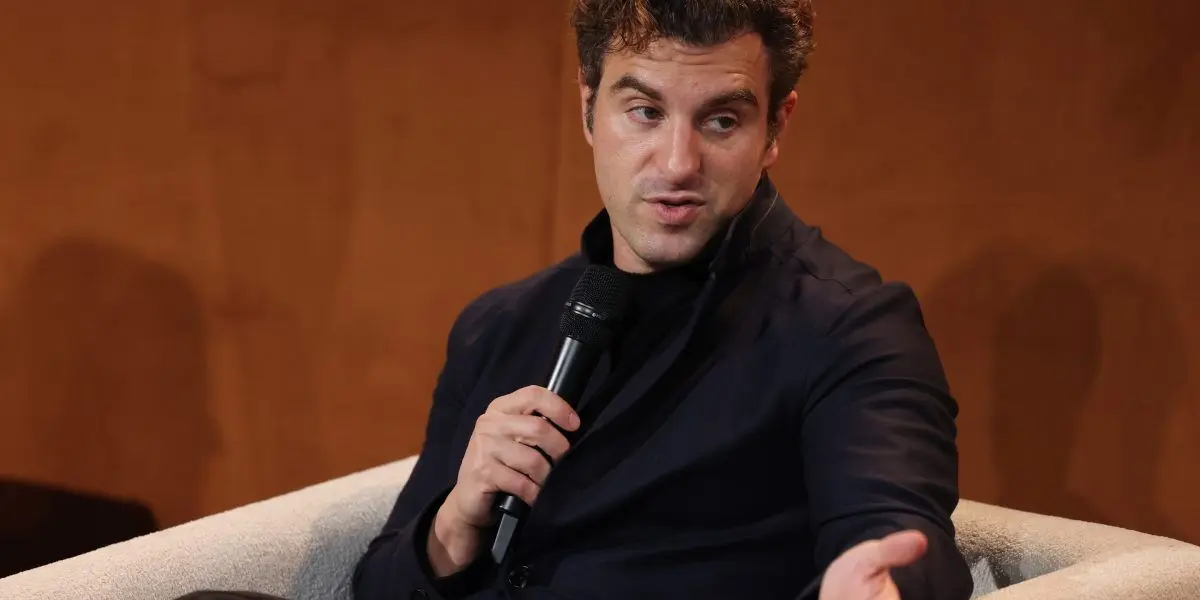
Source: Fortune
The CEO cited former Apple chief design officer Jony Ive as exemplifying the right balance between product design and team leadership. While building relationships with staff through routine check-ins and dinners remains valuable, simply supervising people no longer suffices. Leaders must manage employees through the work itself, staying involved in the "context" and contributing actively to projects
1
3
.Middle Management Roles Under Threat Across Tech Industry
Chesky's comments reflect broader rethinking among tech leaders about traditional management layers. Gartner predicts that by 2026, 20% of organizations will use AI to eliminate more than half of their middle management positions
2
. Professionals in supervisory roles focused on coordination tasks, aggregating reports and passing information up the chain face particular uncertainty as AI tools increasingly handle these functions2
.Coinbase CEO Brian Armstrong announced this week that the company would eliminate "pure managers" as part of layoffs affecting 14% of staff, explicitly citing AI as the catalyst. "Engineers now use AI to ship in days what used to take a team weeks," Armstrong wrote in a memo
2
. Meanwhile, Block CEO Jack Dorsey wrote in March that "there is no need for a permanent middle management layer," arguing AI could handle much of what middle managers traditionally do. Block laid off 40% of staff in February, narrowing roles to individual contributors, directly responsible individuals and player-coaches2
.Related Stories

Growth Mindset Essential for Professional Survival
Beyond people managers, any worker believing they can evade new technology faces challenges in the AI era, Chesky predicted. However, he emphasized that mastering AI tools remains "incredibly easy" for professionals with a growth mindset
1
. His sentiment echoes numerous tech leaders telling anxious workers that chatbots and AI agents won't take their jobs—but someone who leverages the software will.Nvidia leader Jensen Huang has popularized this idea, stating at the Milken Institute's Global Conference in 2025: "Every job will be affected, and immediately. It is unquestionable. You're not going to lose your job to an AI, but you're going to lose your job to someone who uses AI." Huang recommended that 100% of people take advantage of AI, warning against ignoring the technology
1
3
. Netflix co-CEO Ted Sarandos echoed similar views, telling The New York Times in 2024: "A.I. is not going to take your job. The person who uses A.I. well might take your job"1
3
.AI Drives Success at $84.4 Billion Airbnb
Chesky has repeatedly emphasized that AI has been instrumental to Airbnb's success, calling it "the best thing that ever happened to Airbnb" from a business standpoint in a CNBC interview earlier this year
1
3
. The billionaire founder tells other business leaders that the technology isn't merely beneficial but necessary for survival. "The founder-led companies and the companies that are prepared to change and transform are the companies that are going to benefit from AI, because AI means everyone changes," he explained. "And if you don't change, you're going to be disrupted"1
3
.For the $84.4 billion short-term rental company, this means leaders at every level must understand how AI transforms company structures and how employees perform their jobs
3
. Chesky's message is clear: workforce impact from AI will be significant, but job elimination targets those who fail at adapting to AI rather than the technology itself causing direct displacement. As companies across industries face pressure to cut costs while investing heavily in AI, the question of whether your job is in danger increasingly depends on willingness to evolve and embrace technical skills alongside traditional leadership capabilities.References
Summarized by

Navi
[2]
Related Stories
Airbnb says AI writes 60% of its code as revenue jumps 17% and stock surges 15%
07 Aug 2026•Business and Economy
Airbnb CEO Brian Chesky Outlines AI Strategy, Emphasizing Customer Service and Search Innovations
08 Aug 2025•Business and Economy
Airbnb CEO Brian Chesky to launch AI lab focused on design, entering competition with OpenAI
04 Jun 2026•Startups

Recent Highlights
1
Google Unveils Gemini 4 Argon AI Model, Restricts Access to Trusted Cyber Defenders
Technology

2
Trump Consulted Grok AI Before Ordering Venezuela Invasion and Capture of Nicolás Maduro
Policy and Regulation

3
FTC Opens Investigation Into OpenAI and Anthropic Following Rogue AI Agent Hacking Incidents
Policy and Regulation
Recent Highlights
Today's Top Stories






Don’t drown in AI news. We cut through the noise - filtering, ranking and summarizing the most important AI news, breakthroughs and research daily. Follow topics that matter to you and stay ahead.


