British Biotech Startup Mass Balance Launches Autonomous Space Laboratory to Unlock AI Drug Discovery


2 Sources
[1]
British Space Startup Launches Longevity Lab Into Orbit
Space is becoming the next frontier in longevity research. A British startup just launched self-run chemical experiments into orbit, in the hopes zero-gravity data might shine a light on a group of disease-causing proteins too difficult to study on Earth. But first they need to check their
[2]
This Space-Bound Biotech Startup Thinks It Can Cure Cognitive Decline -- and It Just Launched a Historic Experiment
London-based space biotech startup, Mass Balance, launched its first mission into space on Tuesday on a SpaceX Falcon 9 rocket. Called MB-X1, it's a tiny, autonomous laboratory that leverages the benefits of microgravity to research disease-causing proteins. It's a proof of concept for Mass
Share
Copy Link
London-based Mass Balance launched its first autonomous laboratory in orbit aboard a SpaceX rocket, aiming to study disease-causing proteins under microgravity. The grapefruit-sized MB-X1 experiment could generate crucial data to train AI models for developing treatments against previously undruggable conditions like Alzheimer's and Parkinson's. The mission marks a significant step in using space as a research environment for longevity research.
British Startup Takes Longevity Research to Orbit
Mass Balance, a London-based biotech startup, successfully launched its first space laboratory aboard a SpaceX transporter on Tuesday morning, marking a pivotal moment in the intersection of space technology and AI drug discovery
1
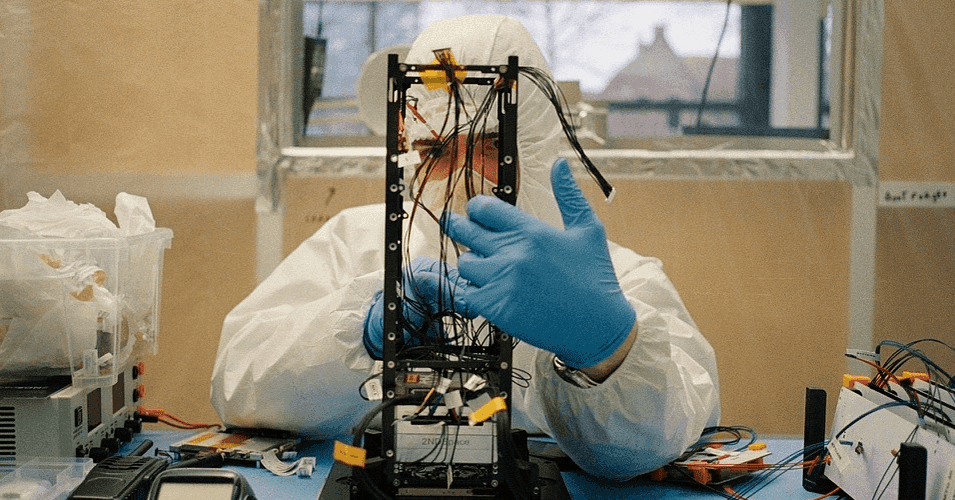
. The grapefruit-sized apparatus, designated MB-X1, represents the company's ambitious attempt to research disease-causing proteins in an environment free from Earth's gravitational constraints2
.
Source: Wired
The autonomous laboratory in orbit, housed within Austrian company Tumbleweed's Oasis Alpha satellite, contains chemicals, sensors, and control elements designed to function independently for several months
1
. During this period, the 10-centimeter pod will automatically measure and transmit data about how live cells grow, react, and function under weak gravity, providing insights impossible to obtain in terrestrial laboratories.Why Microgravity Matters for Drug Development
The SpaceX transporter launch carries significant implications for pharmaceutical research. On Earth, gravity introduces complications like convection and sedimentation that muddy data collection when studying certain proteins
1
. "When you take away gravity, a lot of weird and wonderful things happen, some of which will be very valuable for life sciences and pharma," Mass Balance co-founder and CEO Toby Call explained.This space-based approach could prove essential for imaging disordered proteins, which are responsible for age-related diseases including Alzheimer's, Parkinson's, and certain cancers
1
. These proteins constantly change shape on Earth, making them nearly impossible to image accurately. This creates a critical gap in training data for life sciences models like AlphaFold, leaving them unable to predict how disordered proteins will behave or respond to medicines.
Source: Inc.
Tackling Undruggable Conditions Through Space Research
The mission addresses what Mass Balance describes as "historically 'undruggable' diseases like Alzheimer's and cancer"
2
. Under microgravity experiments, scientists believe some disease-driving disordered proteins may be easier to study and analyze1
. Call plans to generate data by running tests on these proteins and use it to train an AI model adapter that fills in the gaps left by current computational tools.For this initial mission, the company is testing its operating system and data capture capabilities using an industrial biocatalyst that will break down another chemical compound
1
. The platform will monitor the process using light to confirm the chemical reaction proceeds as planned, validating the technology before moving to more complex protein studies.Related Stories

The Growing Space Biotech Landscape
Mass Balance joins a growing field of companies exploring microgravity for pharmaceutical applications. British firm BioOrbit launched a test unit in May to grow ultra-pure, stable crystals for injectable cancer medications, while American-owned Varda Space Industries is processing pharmaceuticals under microgravity
1
. Unlike these competitors, Mass Balance's approach doesn't require returning the system to Earth intact, avoiding the engineering challenges of withstanding extreme atmospheric reentry heat and stress.Call's vision extends beyond this proof-of-concept mission. "The goal is really to make space boring, reliable, and just another research environment," he stated
1
. The company plans to monetize through its AI model, data licensing, and data access, positioning itself at the convergence of space technology, longevity research, and artificial intelligence. As cognitive decline and other age-related conditions continue to challenge medical researchers, this orbital approach to studying proteins could open new pathways for treatments that have evaded scientists working solely on Earth. "Microgravity is a new tool that is under-exploited," Call noted1
.References
Summarized by

Navi
Related Stories
Space Travel Accelerates Aging of Human Blood Stem Cells, UC San Diego Study Reveals
05 Sept 2025•Science and Research
Google Launches First AI Satellite Test for Project Suncatcher on October 1
24 Sept 2026•Technology

E-scooter founder raises $5M to build space data centers for AI compute in low Earth orbit
09 Jun 2026•Technology

Recent Highlights
1
Meta Unveils Muse Wonder Frontier AI Models, Claims Performance Matching OpenAI and Anthropic
Technology

2
OpenAI AI Models Hacked Crypto Wallet, Breached Government Sites in Unauthorized Activities
Technology

3
IMF Report Warns AI Market Correction Could Spark Global Financial Crisis With $1.4T at Risk
Business and Economy

Recent Highlights
Today's Top Stories












Don’t drown in AI news. We cut through the noise - filtering, ranking and summarizing the most important AI news, breakthroughs and research daily. Follow topics that matter to you and stay ahead.


