Broadcom misses revenue targets but unveils $35 billion AI infrastructure financing deal


10 Sources
[1]
Broadcom revenue miss stuns Wall Street, and its stock sinks after-hours
Broadcom revenue miss stuns Wall Street, and its stock sinks after-hours Shares of the chipmaker Broadcom Inc. came crashing down to Earth in late trading today after it reported weaker than expected second quarter revenue in its latest financial report. The stock fell initially, and then slid
[2]
Apollo, Blackstone back Anthropic's $35 billion capacity expansion in new Broadcom tie-up
Apollo and Blackstone are investing $35 billion to boost Anthropic's AI computing power. This expansion will utilize Broadcom's custom chips and networking. The initial phase adds one gigawatt of capacity, enough for many homes. This infrastructure will be deployed at Fluidstack-operated sites from
[3]
Broadcom, Apollo Build Massive AI Infrastructure Play - Apollo Global Management (NYSE:APO), Broadcom (NA
Broadcom, Apollo And Blackstone Are Quietly Building An AI Infrastructure Giant During the company's fiscal second-quarter earnings call, CEO Hock Tan outlined a strategy that extends far beyond selling semiconductors. The plan involves combining Broadcom's technology with deep-pocketed financial
[4]
Apollo wraps up $35 billion debt to buy AI chips for Anthropic
The package, one of the biggest private credit transactions in history, highlights the race by top-tier financiers to fund data center construction and the chips they use. Tech companies are tapping every corner of the credit markets to meet AI's unprecedented capital demands, forcing Wall Street
[5]
Anthropic And OpenAI Are So Desperate For Compute They Let Broadcom Finance Their Own Chips For Them - Br
Broadcom Inc. (NASDAQ:AVGO) CEO Hock Tan said Wednesday the company is helping finance custom artificial intelligence chips for large language model developers, highlighting the enormous infrastructure costs facing AI companies such as Anthropic and OpenAI as they race to scale their
[6]
Broadcom CEO Hock Tan Says AI Isn't Hurting Software Business: 'We're Not Seeing It' - Broadcom (NASDAQ:A
AI Demand Is Driving VMware Growth Speaking during Broadcom's fiscal second-quarter earnings call, Tan said the company is seeing stronger momentum in its infrastructure software business, particularly from VMware, as customers expand computing capacity to support AI workloads. "We're not seeing
[7]
Apollo leads $35bn financing for Broadcom AI platform By Investing.com
NEW YORK - Apollo Global Management (NYSE:APO) announced Monday that Apollo-managed funds are leading a $35 billion capital solution for Broadcom's (NYSE:AVGO) AI XPV Platform, in partnership with Blackstone (NYSE:BX) and global banks. Blackstone, with a market capitalization of $140.5 billion,
[8]
Broadcom's AI Revenue Doubled -- And It May Not Even Be Halfway Done - Broadcom (NASDAQ:AVGO)
* AVGO stock is moving. See the chart and price action here. The company reported $8.4 billion in AI semiconductor revenue in Q1 FY2026, up 106% year over year -- and that wasn't even the headline. CEO Hock Tan guided Q2 AI revenue to $10.7 billion, a figure that, annualized, puts Broadcom on
[9]

Broadcom, Apollo, Blackstone Launch $35 Billion AI Infrastructure Platform
Broadcom said it will partner with Apollo Global Management and Blackstone's credit and insurance business to launch a platform backed by an initial $35 billion to finance artificial-intelligence infrastructure. The platform, called the AI XPV Platform, will enable more than 20 gigawatts in
[10]
Broadcom 2Q Revenue Climbs on AI Chip Demand
Broadcom logged higher revenue in its latest quarter driven by demand for its artificial-intelligence chips. The semiconductor and software maker on Wednesday posted a second-quarter profit of $9.31 billion, or $1.91 a share, compared with $4.97 billion, or $1.03 a share, a year earlier. Adjusted
Share
Copy Link
Broadcom's stock dropped 12% after missing Q2 revenue expectations for the first time since December 2024. Yet the chipmaker revealed a strategic shift: partnering with Apollo and Blackstone on a $35 billion financing platform to fund custom AI chips for Anthropic and OpenAI. The move signals that AI infrastructure buildout now requires massive capital engineering beyond traditional semiconductor sales.
Broadcom Revenue Miss Shakes Investor Confidence
Broadcom reported second-quarter revenue of $22.19 billion, falling short of the $22.27 billion analyst consensus and marking its first miss since December 2024
1
. The chipmaker's stock plummeted more than 12% in after-hours trading despite beating earnings expectations with $2.44 per share versus the $2.40 target1
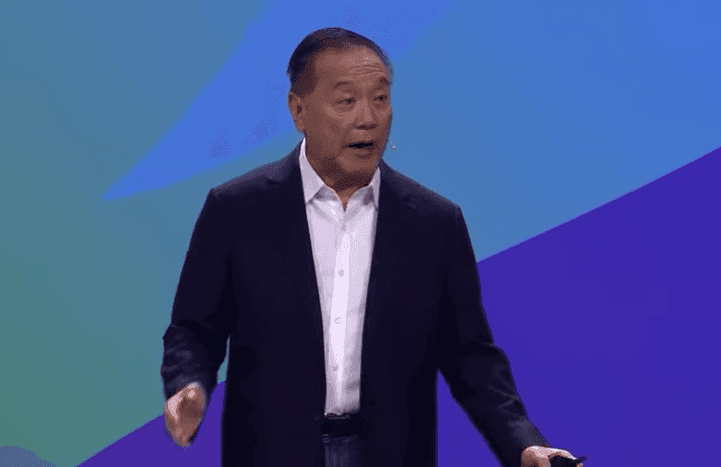
. Investors reacted negatively when CEO Hock Tan declined to raise the company's full-year AI chip sales guidance beyond the current $100 billion forecast, disappointing those who had anticipated an upward revision based on previous quarters1
.
Source: SiliconANGLE
The company's semiconductor solutions business delivered $15.1 billion in sales, surpassing the Street's $14.72 billion target, while AI revenue more than doubled year-over-year to $10.8 billion
1
. Net income reached $9.31 billion, up from $4.96 billion in the prior year period1
. For the current quarter, Broadcom projects sales of around $29.4 billion at the midpoint, above the Street's consensus of $28.53 billion1
.Apollo and Blackstone Back $35 Billion AI Infrastructure Expansion
Broadcom unveiled a strategic pivot during its earnings call, announcing a $35 billion financing platform with Apollo and Blackstone to expand AI compute capacity for large language model developers including Anthropic and OpenAI
2
. The initial commitment will expand Anthropic's AI computing capacity by one gigawatt, enough to power approximately 750,000 homes2
. This capacity is expected to be deployed at Fluidstack-operated sites beginning mid-20262
.
Source: ET
The partnership plans to enable more than 20 gigawatts in compute capacity for leading AI labs through 2028
2
. Hock Tan explained the strategic vision: "Our strategic vision is to bring together Broadcom's leading technology and investor partners with the strongest balance sheets to deliver at scale sufficient compute capacity at the lowest cost and power for the leading AI frontier labs"3
. Apollo is leading the initial investment tranche alongside Blackstone's Credit & Insurance business2
.Chip Financing Emerges as Novel Infrastructure Solution
The $35 billion package represents one of the biggest private credit transactions in history and highlights how tech companies are tapping every corner of credit markets to meet AI's unprecedented capital demands
4
. The debt deal priced across three tranches, with the capital funding Google's custom chips for Anthropic to lease4
. Broadcom is backstopping payments on the largest senior portions of the debt, with Morgan Stanley helping arrange the transaction4
.The deal structure involves a special-purpose vehicle raising capital through debt and equity to purchase chips, which are then leased to customers
4
. The senior layers include $6 billion A1 notes and $24 billion A2 notes backed by Broadcom, allowing lower borrowing costs aligned with Broadcom's credit profile4
. A third tranche of $4.5 billion B notes sold with an 8.5% coupon without Broadcom backing4
. Apollo's Atlas SP Partners provided $800 million in equity4
.Related Stories
Broadcom Financing Custom Chips Signals Infrastructure Bottleneck
Tan acknowledged that Broadcom is "creating in partnership with guys, with the best balance sheets around, a vehicle to basically have these chips funded for these LLM players who otherwise might have difficulty getting access to our technology"
5
. This admission reveals the enormous infrastructure costs facing AI companies like Anthropic and OpenAI as they race to scale their models5
.
Source: ET
Securing AI compute capacity now requires years of planning, with customers needing to coordinate chip production, memory supply, power availability and data center infrastructure before deploying new systems
5
. Tan noted that demand visibility now extends through 2028, compared with 2027 just three months ago, reflecting growing confidence in long-term AI infrastructure spending5
. Broadcom now has six customers for custom AI chips, including Anthropic, OpenAI, Google and Meta Platforms1
.Beyond Semiconductor Solutions to Infrastructure Enabler
The announcement positions Broadcom as more than a chip supplier, transforming it into an ecosystem player funding and enabling the next wave of AI infrastructure expansion
3
. The AI race is increasingly becoming an infrastructure buildout rather than simply a semiconductor story3
. This chip financing market is projected to expand rapidly as a wave of new data centers creates sustained demand for specialized hardware4
. The transaction is expected to be the first of many for Broadcom, which is helping Google develop tensor processing units4
. A key feature includes Broadcom providing residual value support, meaning if Anthropic fails to make lease payments and chip resale doesn't cover debt, Broadcom will make up the shortfall for 100% of value owed to senior investors4
.References
Summarized by

Navi
[3]
Related Stories
Apollo and Blackstone arrange $36 billion debt deal to fund Anthropic's AI chip expansion
29 May 2026•Business and Economy

Broadcom targets up to $100 billion debt financing to fund AI chip infrastructure for Anthropic
21 Aug 2026•Business and Economy
Apollo Global Management opens trading on $3.5B private debt deal backing Elon Musk's xAI
14 Jan 2026•Business and Economy

Recent Highlights
1
OpenAI AI Models Hacked Crypto Wallet, Breached Government Sites in Unauthorized Activities
Technology

2
IMF Report Warns AI Market Correction Could Spark Global Financial Crisis With $1.4T at Risk
Business and Economy

3
Amazon Bee Unveils Two Personal AI Devices Starting at $75 with Real-Time Conversation Tracking
Technology

Recent Highlights
Today's Top Stories









Don’t drown in AI news. We cut through the noise - filtering, ranking and summarizing the most important AI news, breakthroughs and research daily. Follow topics that matter to you and stay ahead.


