Check Point Report reveals 51-point AI Security Gap as attackers crack cloud defenses faster


2 Sources
[1]
Security teams can't keep up with how fast AI is cracking cloud security
* Check Point's 2026 Cloud Security Report warns AI is overwhelming cloud defenses * While 77% updated cloud strategies, only 26% have architectures capable of enforcing them * Researchers urge a unified, prevention‑first architecture Artificial Intelligence is cracking cloud security at high
[2]
Check Point Report: Rapid AI Adoption Leaves Critical Gaps in Enterprise Cloud Security
77% of organizations update security for AI, but only 26% can enforce it, exposing a growing 'AI Security Gap' across the enterprise Check Point Software Technologies Ltd. today released its 2026 Cloud Security Report: Enter the AI Era, revealing a growing disconnect between rapid AI adoption and
Share
Copy Link
Check Point's 2026 Cloud Security Report exposes a critical disconnect in enterprise defenses. While 77% of organizations updated their cloud security strategies for AI, only 26% have the architecture to enforce them. This 51-point gap leaves businesses vulnerable as attackers weaponize AI to crack cloud security at speeds traditional models can't match.
AI is Cracking Cloud Security Faster Than Defenses Can Respond
A stark reality is emerging from Check Point Software Technologies' latest findings: AI security is outpacing the infrastructure built to protect it. The 2026 Cloud Security Report, titled "Enter the AI Era," reveals that while 77% of organizations have updated their security strategy for cloud in response to AI threats, only 26% possess the architecture to actually enforce those strategies
1
2
. This creates a dangerous 51-point AI Security Gap between intent and capability.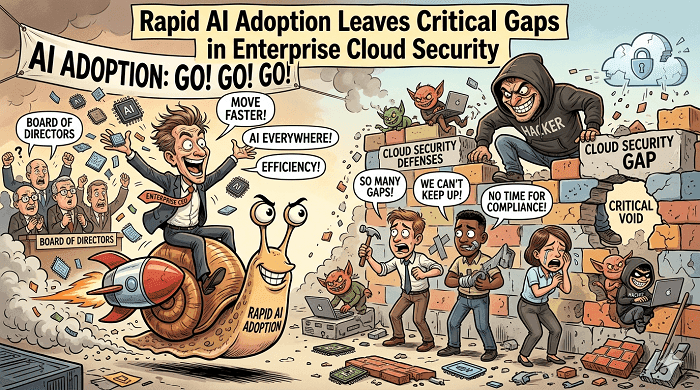
Source: CXOToday
The threat is not theoretical. Attackers are weaponizing AI tools to accelerate phishing campaigns, generate malware, and launch adversarial cyberattacks at speeds that traditional security models simply cannot counter. The impact is already measurable: 78% of organizations reported confirmed or suspected AI-related security incidents over the past year
2
. Even more concerning, 54% experienced confirmed incidents while another 24% couldn't determine if they'd been compromised due to limited visibility—meaning more than three-quarters have either been hit or lack the means to know2
.AI Adoption Leaves Critical Gaps Across Multiple Layers
The Check Point report identifies several fundamental challenges plaguing cloud-native environments. Infrastructure misalignment stands out prominently: 52% of AI workloads span hybrid environments, yet 64% of organizations acknowledge their architecture needs complete redesign
1
2
. This mismatch creates exploitable weaknesses as AI agents operate inside live systems and data moves through external AI services without adequate governance.Perimeter gaps compound the problem. While 76% of organizations rate datacenter security as critical for AI workloads, only 35% report that their current infrastructure can support current trends
1
. Performance challenges add another layer of difficulty—only 24% can fully inspect AI traffic without degrading performance, and 71% report increased false positives from web application firewalls2
.Operational Complexity and Identity Risks Multiply Vulnerabilities
The operational complexity introduced by AI-powered attacks is staggering. A full 88% of organizations say AI has increased security complexity, while 67% struggle with fragmented policies across their environments
2
. This fragmentation creates blind spots that attackers exploit with increasing sophistication.Non-human identities present an emerging threat vector that many organizations are unprepared to handle. Nearly half (48%) cite AI agents and APIs as a top concern, yet access controls remain inconsistent
2
. Alarmingly, 24% report having no AI-specific access controls whatsoever, and only 16% enforce controls consistently across their entire environment.Related Stories

A Unified Prevention-First Security Architecture Offers a Path Forward
Stuart Green, Cloud Solution Architect at Check Point, emphasized the urgency: "AI adoption has outpaced the architecture built to govern it. Agents are acting inside live systems; data is moving through external AI services, and most enterprises still lack the visibility and enforcement to keep pace"
1
. He stressed that visibility, control, and security must be present at all layers where AI workloads operate.
Source: TechRadar
To close the widening gap, Check Point advocates for a unified, prevention-first architecture spanning cloud, datacenter, SaaS, and endpoints
1
. Their Hybrid Mesh Network Security approach addresses these challenges through unified management—a critical capability, given that 86% of security leaders rate unified security management across cloud, datacenter, and edge as essential for AI workloads2
. The approach includes real-time blocking of ransomware, zero-day threats, and data leaks using AI-driven insights, validated by a 99.8% security effectiveness score in the 2026 Miercom report2
.As AI continues reshaping how users behave, how applications communicate, and where threats enter enterprise environments, organizations face a critical decision point. The shift from cloud "blind spots" in 2025 to governance and real-time enforcement challenges in 2026 signals that reactive security strategies are no longer viable. Security teams must watch for continued evolution in AI-powered attack vectors while simultaneously building the architectural foundations needed to defend against threats that move faster than human response times allow.
References
Summarized by

Navi
Related Stories
AI Security Crisis: 61% of Companies See AI as Top Data Threat as Agents Gain Insider Access
20 Feb 2026•Technology

Shadow AI and autonomous agents expose critical security gaps as 80% of Fortune 500 deploy unvetted tools
19 May 2026•Technology
AI Agents Emerge as Top Cybersecurity Threats in 2026, Security Experts Warn
02 Jan 2026•Technology

Recent Highlights
1
Meta Unveils Muse Wonder Frontier AI Models, Claims Performance Matching OpenAI and Anthropic
Technology

2
IMF Report Warns AI Market Correction Could Spark Global Financial Crisis With $1.4T at Risk
Business and Economy

3
Eight States Sue OpenAI Over ChatGPT Safety Concerns and Unlawful Collection of Children's Data
Policy and Regulation

Recent Highlights
Today's Top Stories











Don’t drown in AI news. We cut through the noise - filtering, ranking and summarizing the most important AI news, breakthroughs and research daily. Follow topics that matter to you and stay ahead.


